Retention reports and market data
Documents

UGC Impact Study 2025
The 2025 UGC Impact Study, conducted by GameDiscoverCo and commissioned by mod.io, analyzes the commercial and engagement benefits of integrating official user-generated content (UGC) support into video games.
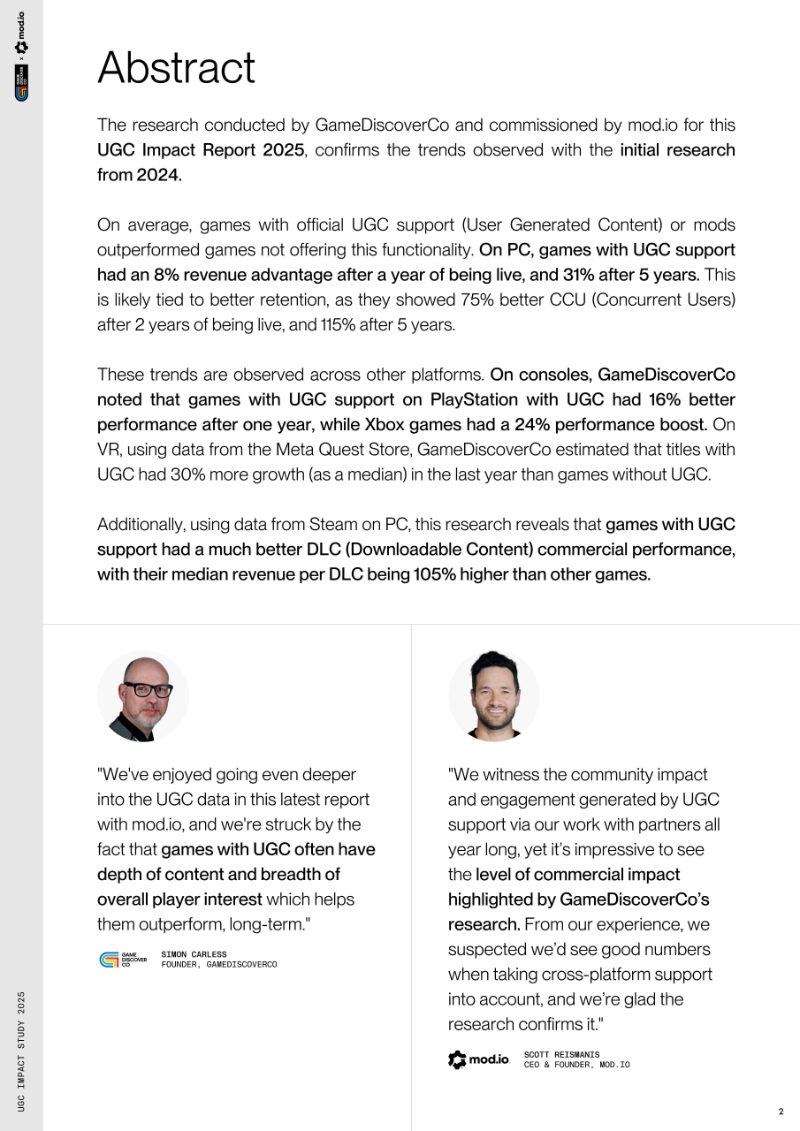
- Games with official UGC support see a 31% revenue advantage over non-UGC titles after five years, growing from an 8% advantage in the first year.
- UGC support drives long-term player retention, resulting in 75% higher concurrent user counts after two years and 115% higher after five years on PC.
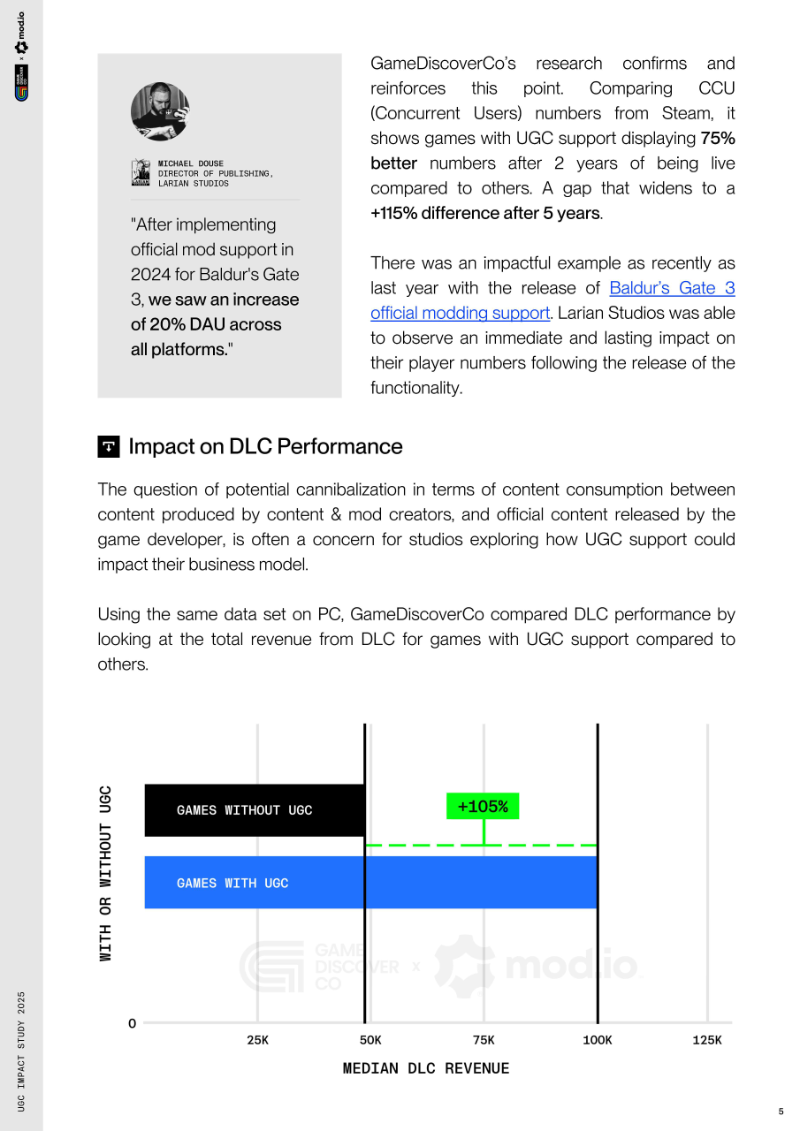
- Official UGC does not cannibalize sales; games with modding support see 105% higher median revenue per DLC, with SnowRunner players using mods being 2.4 times more likely to purchase official DLC.
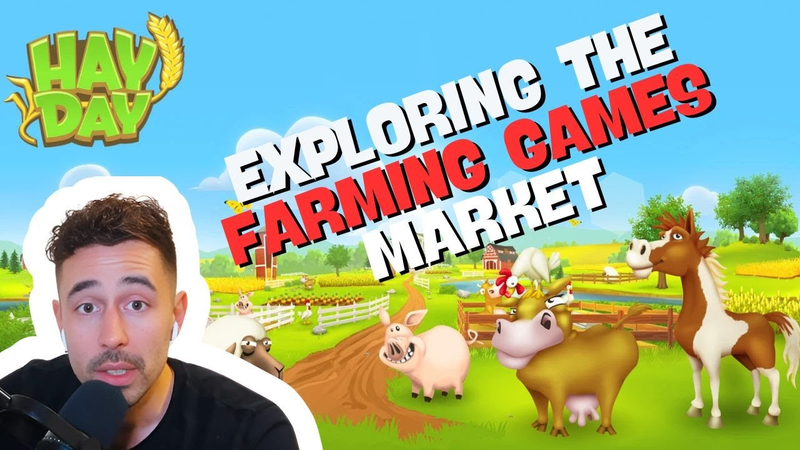
How to conquer the farming games market? Minigames FTW. Implement or die by Matej Lancaric!
The farming games market remains a highly lucrative and stable sector within the global gaming industry, characterized by long-term growth and dominance by established titles.
- Implementing mini-games that mirror successful UA creative assets is now mandatory for survival and engagement in the farming game genre.
- The farming game market is dominated by established titles like Township and Hay Day, with Township recently hitting a record $40 million in monthly revenue compared to Hay Day's $12 million.
- Revenue in the farming sub-genre is heavily concentrated in the US, which accounts for $150 million of the $300 million total revenue generated by top performers in recent quarters.
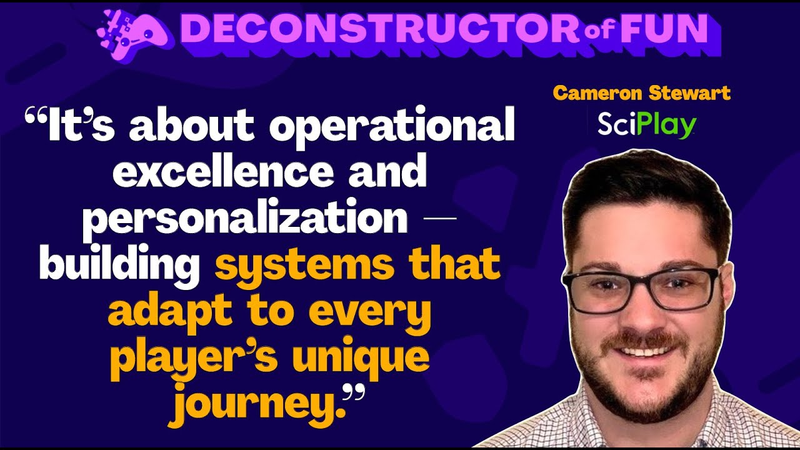
From Segmentation to Personalization: The SciPlay Approach to Success
The social casino market demands a strategic shift from broad player segmentation toward highly personalized experiences to ensure long-term retention and sustainable growth.
- Social casino developers must transition from broad player segmentation to highly personalized experiences to improve long-term retention and combat user rotation between competing applications.
- Operational success relies on separating long-term product vision from daily live operations to refine core game loops while simultaneously managing personalized user journeys.
- Firms should prioritize a unified, modular infrastructure and cross-platform content deployment using existing intellectual property rather than relying on standalone branded titles.

Running a Successful Live Service Game with Sergei Vasiuk
The gaming industry is undergoing a fundamental transition from traditional product-based models to games as platforms, where the developer’s primary role is to foster an ecosystem for social interaction, user-generated content, and community engagement.
- Transition from product-based models to games-as-platforms requires shifting organizational focus from launch-day revenue spikes to long-term player retention.
- Operational success depends on balancing quantitative analytics with qualitative community feedback and expert intuition to avoid analysis paralysis caused by over-reliance on A/B testing.
- Sustainable monetization should prioritize cosmetic items over pay-to-win mechanics to preserve a fair competitive environment and maintain long-term player trust.
Sticky, Loveable, and Loyal: How Developers Create Winning Games with Psychological Segmentation
Psychological segmentation serves as a transformative framework for modern game development, shifting the industry focus from superficial demographic targeting toward the underlying motivations and cognitive traits that drive genuine player engagement.
- Approximately 84% of games fail within their first three years, often due to a lack of market resonance and failure to achieve necessary scale.
- Psychological segmentation, which analyzes player motivations and personality traits, is a more effective strategy for driving installs and reducing churn than traditional demographic or behavioral targeting.
- Modern players increasingly prioritize 'long-term orientation,' seeking deep, enduring experiences where they can build worlds or characters over time rather than short-term entertainment.

Triple Match City: New Evolution of casual (Match 3D) games
Triple Match City represents a significant evolution in the casual gaming sector by successfully merging traditional match-3D mechanics with hidden-object gameplay.
- Triple Match City is scaling rapidly in revenue, reaching approximately $40,000 per day despite having a relatively small user base of roughly 21,000 daily active users (DAU).
- The game exhibits a significant disparity in monetization strategy between platforms, with iOS users experiencing no intrusive ads up to level 200, while Android versions utilize a more aggressive ad-heavy approach.
- Core gameplay mechanics focus on a 'hidden object' style 3D match experience that requires zooming and scrolling, designed to induce player error through cluttered inventory benches and stacked assets.
TikTok's LiveOps Enchantment
The mobile gaming industry is undergoing a fundamental shift, moving away from a reliance on new title launches toward the sustained monetization of established portfolios.
- Games older than five years now account for over 64% of total in-app purchase revenue, signaling a shift from new title launches to the monetization of established portfolios.
- LiveOps has become the primary mechanism for extending game lifecycles and maximizing long-term profitability in an increasingly saturated mobile market.
- The period between late December and mid-January, known as Q5, is a critical growth window characterized by heightened user engagement and reduced advertising costs.

LinkedIn's Gaming Strategy: Using Games to Foster Connection and Conversation
LinkedIn is strategically integrating a suite of thinking-oriented puzzles, including Queens, Pinpoint, Crossclimb, and Tango, to serve as catalysts for professional connection and conversation.
- LinkedIn is integrating daily, low-friction puzzles like Queens, Pinpoint, Crossclimb, and Tango to function as professional conversation starters rather than as a traditional gaming platform.
- The initiative has achieved an 80% day-over-day retention rate, demonstrating strong appeal among Gen Z users and in international markets including India, Brazil, and Turkey.
- To prevent distraction and maintain a focus on networking, LinkedIn enforces a strict limit of one game per day per user.

Age of Empires Mobile: Nostalgia Meets Modern Gaming (ehm, modern 4X strategy games)
Age of Empires Mobile serves as a strategic pivot for the classic real-time strategy franchise, transitioning the brand into the competitive landscape of modern 4X mobile gaming.
- Age of Empires Mobile launched globally on October 16, 2024, and quickly reached a daily revenue of approximately $500,000, though it has since experienced a slight downtrend.
- The game currently maintains a daily download rate of roughly 50,000, which significantly trails established 4X titles like Whiteout Survival and Last War, which continue to clock 200,000 to 250,000 daily downloads.
- The title functions primarily as a 4X strategy game that utilizes the Age of Empires brand as a skin, incorporating various mini-games—such as fishing and Vampire Survivors-style combat—to drive engagement.

Shooting for Success: Navigating the Ultra Competitive Shooter Genre
The competitive shooter market on PC and console is currently undergoing a period of significant contraction, characterized by a 40% decline in monthly active users for PvP first-person shooters between 2021 and 2024.
- The PvP first-person shooter market experienced a 40% decline in monthly active users between 2021 and 2024, with arcade shooters suffering a sharper 45% drop.
- Established 'black hole' titles like Fortnite, Call of Duty, and Counter-Strike continue to dominate the market, creating high barriers to entry due to player investment in social groups, ranks, and microtransactions.
- New shooter launches face rapid attrition, with daily active user counts typically falling below 20% of their peak within the first 90 days.
Brawl Stars': Learnings from the Removal of Loot Boxes
Brawl Stars underwent a significant strategic pivot between 2021 and 2024 to combat declining engagement and revenue, moving away from a reliance on loot boxes toward a more transparent, deterministic progression model.
- Removing loot boxes from Brawl Stars initially caused a decline in engagement, forcing the team to pivot toward a system that balanced player choice with long-term progression.
- The introduction of 'Stardrops' and a re-engagement program for returning players resulted in a 60% month-over-month increase in Daily Active Users (DAU).
- The team learned that shipping multiple major changes simultaneously creates 'noise' in data, making it difficult to isolate the impact of individual features on player behavior.
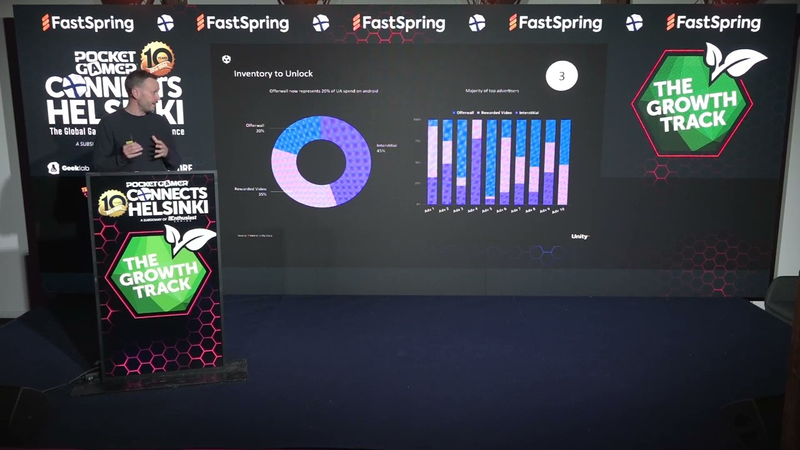
Session: Rewards Unlocked: Accelerating Game Growth with Rewarding User Experiences - Danny Cormack.
The rewarded user acquisition (UA) landscape is experiencing significant growth, driven by a shift toward privacy-centric environments and the performance limitations of traditional UA channels.
- Offer walls now account for 20% of total Android ad spend across all Unity channels, reflecting a significant shift in user acquisition strategies.
- Unity's 'Unity Rewards' web-based solution for iOS is currently in beta and showing strong performance, with 4x the ARPU and 3x the day-7 ROAS compared to Android campaigns.
- Internal Unity data indicates that offer wall users demonstrate superior retention from day 0 to 30 and higher LTV from day 0 to 60 compared to traditional video ad channels.