PC reports and market data
Documents
Main(s) and Alts: Multiple Character Management in World of Warcraft
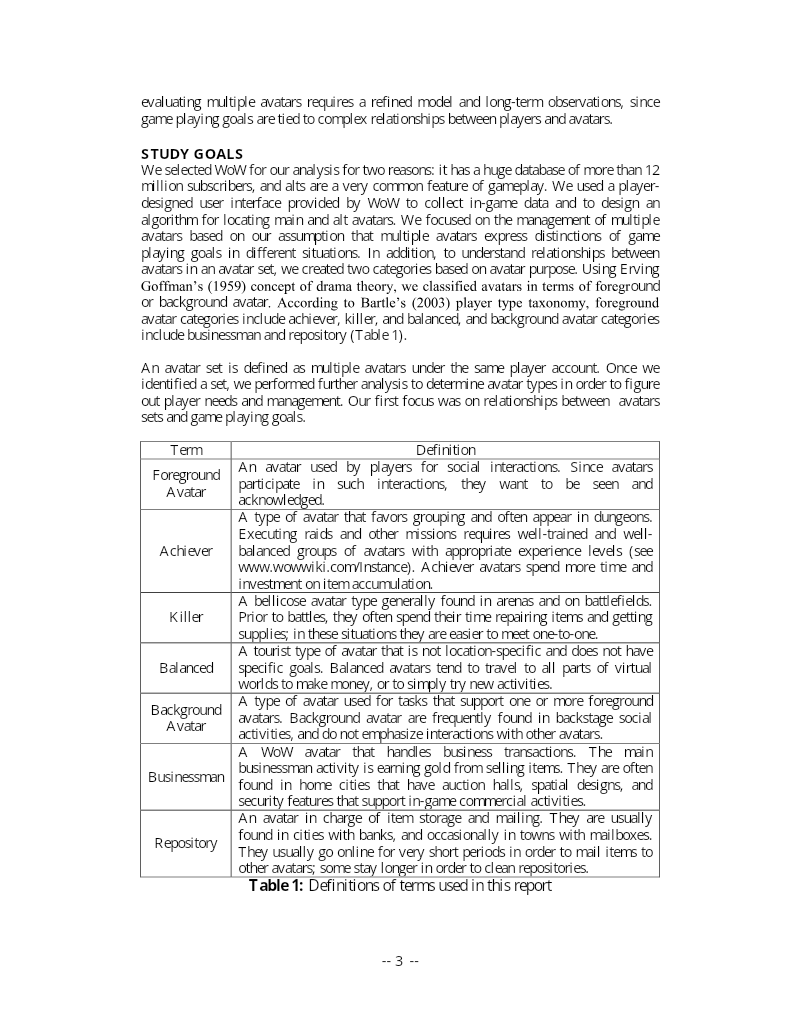
This study examines how players manage multiple characters, or "mains and alts," in World of Warcraft, focusing on how account owners group their avatars into sets and what those groupings reveal about player goals.
- The algorithm inferred avatar sets from publicly accessible online-status data, since account-to-avatar ownership is confidential, and was validated with a recall of 78.5% and precision of 97%.
- Data was collected continuously on two Taiwanese World of Warcraft servers (one PvE, one PvP) from November 2008 to June 2009, using a player-designed interface.
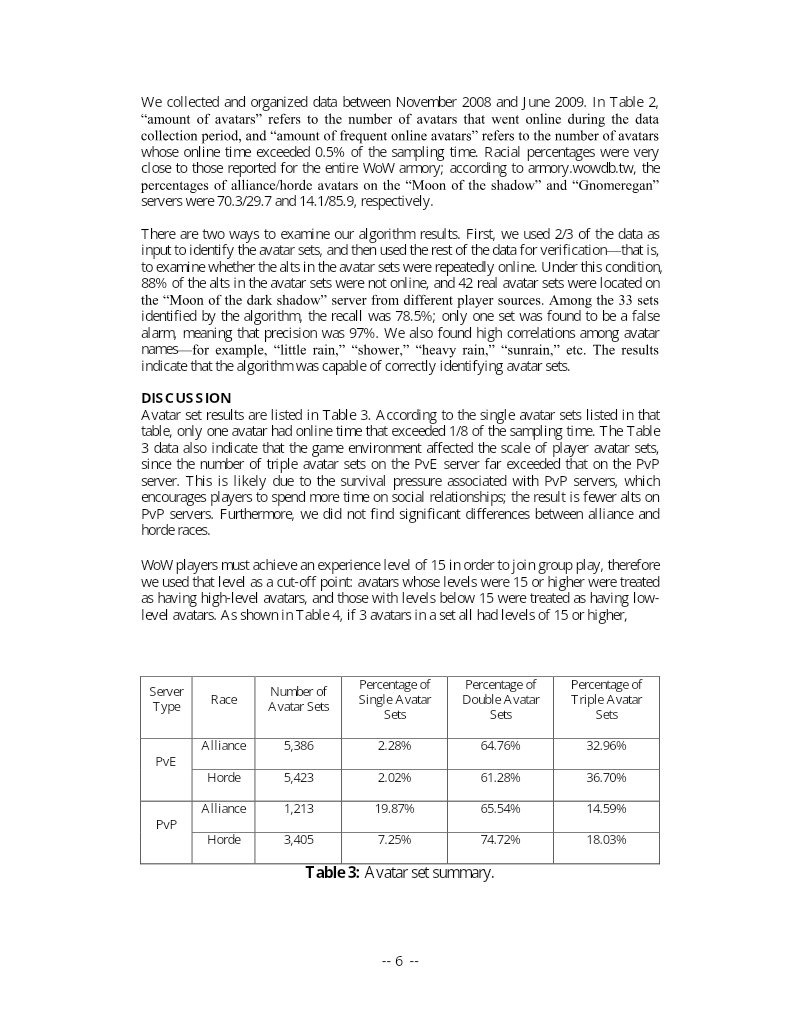
- Single-avatar sets were most common on PvP servers, while triple sets were more prevalent on PvE servers, which the authors attribute to survival pressures and social dynamics on PvP realms.
A Chinese Cyber Diaspora: Contact and Identity Negotiation on Taiwanese WoW Servers
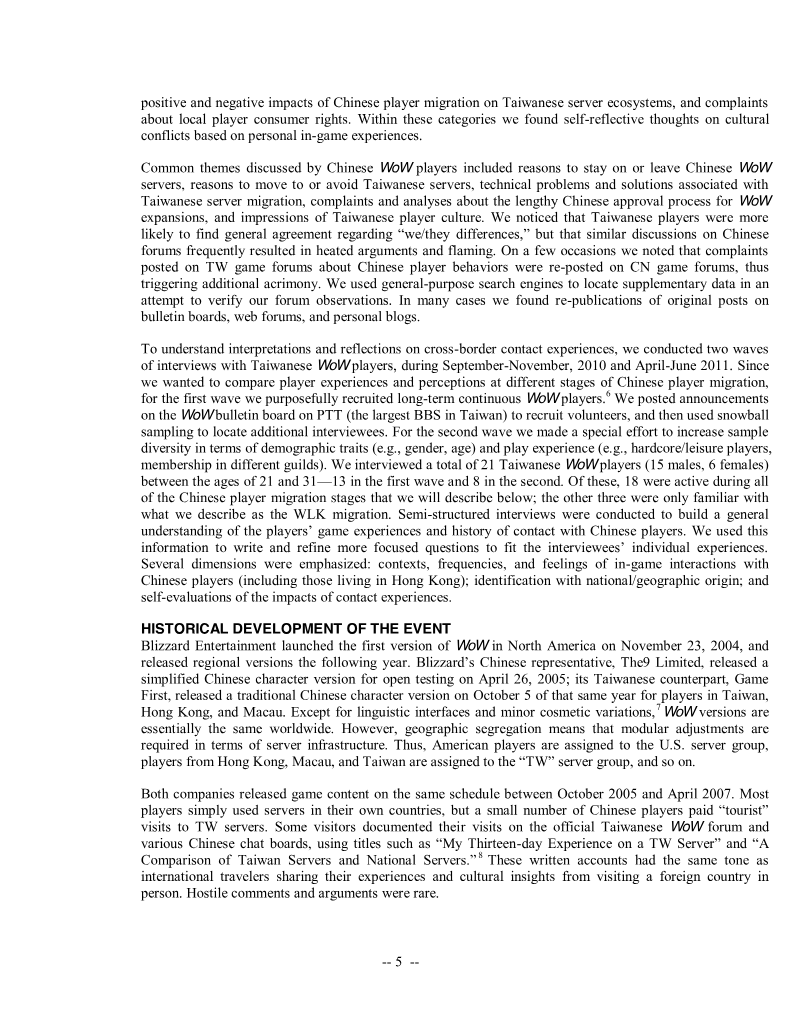
This study examines the 2008 "WoW rush," when many Chinese players moved their World of Warcraft accounts to Taiwanese servers following delays in China's release of expansion content.
- In 2008, many Chinese players moved their World of Warcraft accounts to Taiwanese servers ('the WoW rush') after delays in China's release of expansion content, a movement the authors call 'migration without physical presence.'
- Persistent online game worlds generated durable cross-Strait relationships and ongoing identity negotiation, differing from the brief, politically charged exchanges typical of open internet forums.
- Early friction over etiquette, language, and server overload often escalated into nationalist confrontations in public chat channels and forums; Game First's 2010 ban on political speech in public channels sharply reduced overt conflict but did not end cross-cultural tension.
Doing It Themselves! A Mixed-Method Study into the Motivations of Players to 'Create' in the Context of Gaming
This study investigates what motivates players to create content within digital games, focusing on two titles promoted as accessible creative experiences: Spore (PC and Mac) and LittleBigPlanet (PS3).
- Players who create content in games tend to be highly engaged: over 81% of survey respondents had used a level editor, and roughly one in five had contributed to game development in some form.
- Challenge was the highest-scoring motivation among respondents, followed by Arousal and a newly introduced Create construct, which correlated strongly with both Challenge and Arousal.
- Players are broadly omnivorous in genre preferences, with first-person shooters, action-adventures, and racing games ranking highest among respondents.
Kairotopos: A Reflection on Greek Space/Time Concepts as Design Implications in Minecraft
Kairotopos offers a conceptual lens for understanding how Minecraft's spaces and times become meaningful to players, drawing on ancient Greek distinctions between chronos and kairos for time and chora and topos for space.
- The report's central argument is that Minecraft's default landscape is largely undifferentiated 'chora', which players must transform through technical skill into meaningful 'topos'.
- This transformation makes possible 'kairos' moments in which judgment, or 'phronesis', governs action, with progression toward 'kairotopos' resembling the well-played game and the experience of flow.
- Minecraft's default structure chiefly supplies 'chronochora', leaving players to reach kairotopic experiences through their own judgment rather than through the game's design.
Game Developer Index 2010: Sweden
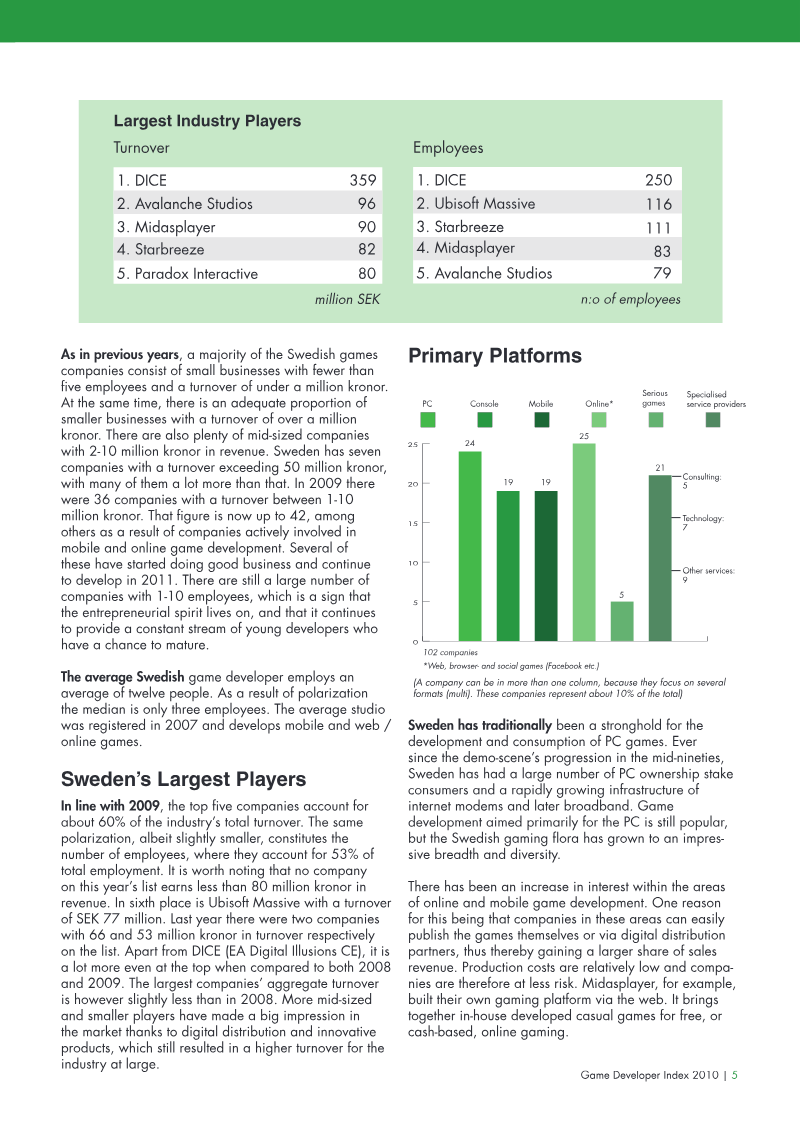
The Swedish game industry entered a period of significant expansion in 2010, characterized by a record turnover of 1.181 billion SEK and a 9.2 percent increase in total employment.
- The Swedish game industry reached a record turnover of 1.181 billion SEK in 2010, supported by a 9.2 percent increase in total employment.
- Market concentration remains high, with the five largest companies accounting for 60 percent of the industry's total revenue.
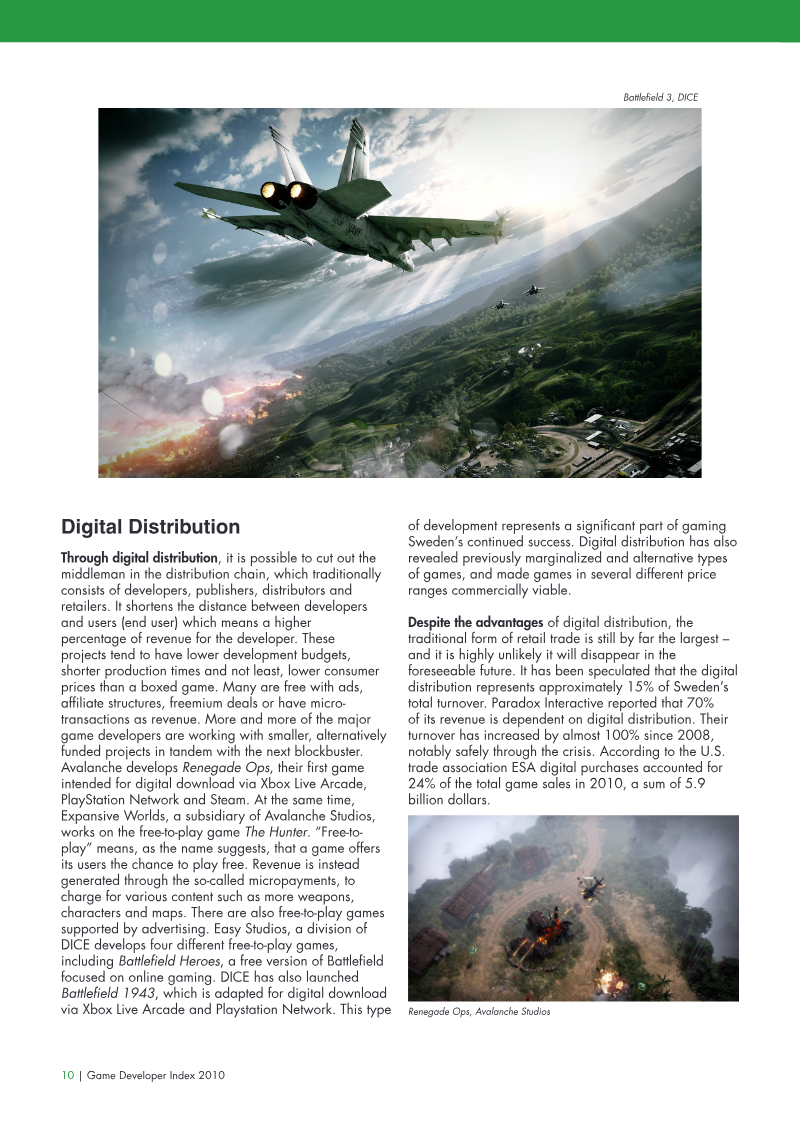
- The sector is successfully pivoting toward digital distribution and mobile platforms, utilizing diverse monetization strategies like free-to-play, freemium, and ad-funded models.
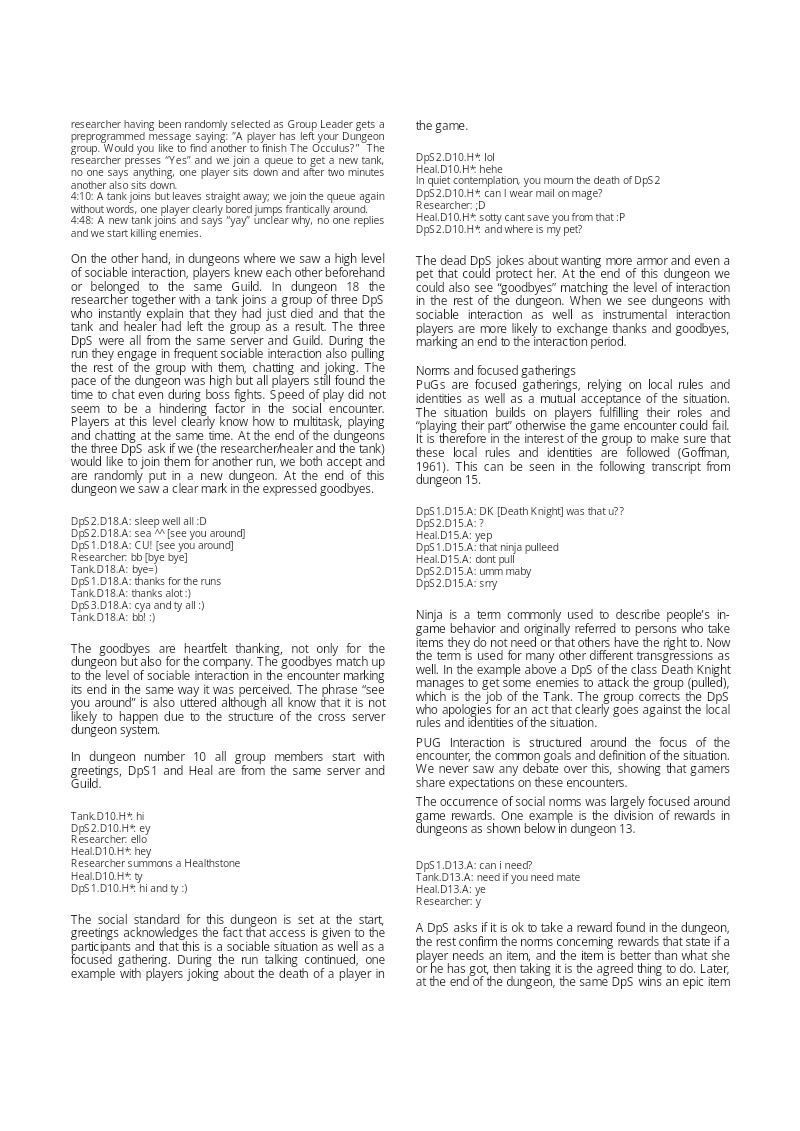
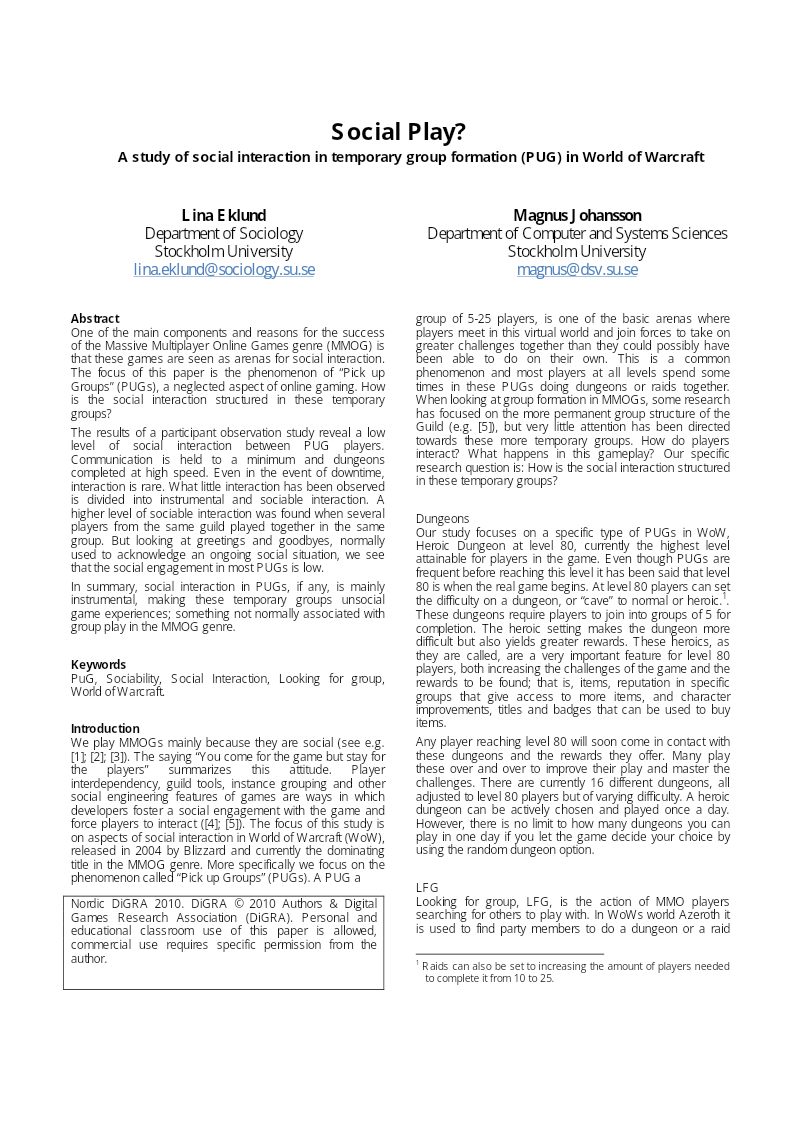
Social Play? A Study of Social Interaction in Temporary Group Formation (PUG) in World of Warcraft
Drawing on 24 recorded random dungeon runs in World of Warcraft, this study examines social interaction in pick-up groups (PUGs), the temporary teams players form to complete dungeons with strangers.
- Pick-up group interaction in World of Warcraft dungeons is predominantly instrumental, focused on tactics, rewards, and task completion, with greetings, farewells, and rapport-building rare.
- The study, based on 24 recorded random dungeon runs, characterizes PUGs as largely "unsocial" when measured against the social expectations commonly associated with massively multiplayer online games.
- Sociable exchanges occur mainly when group members already share a guild or prior acquaintance, indicating that social engagement depends on existing ties rather than arising spontaneously in temporary groups.
Försäljning av dataspel: Sverige 2009
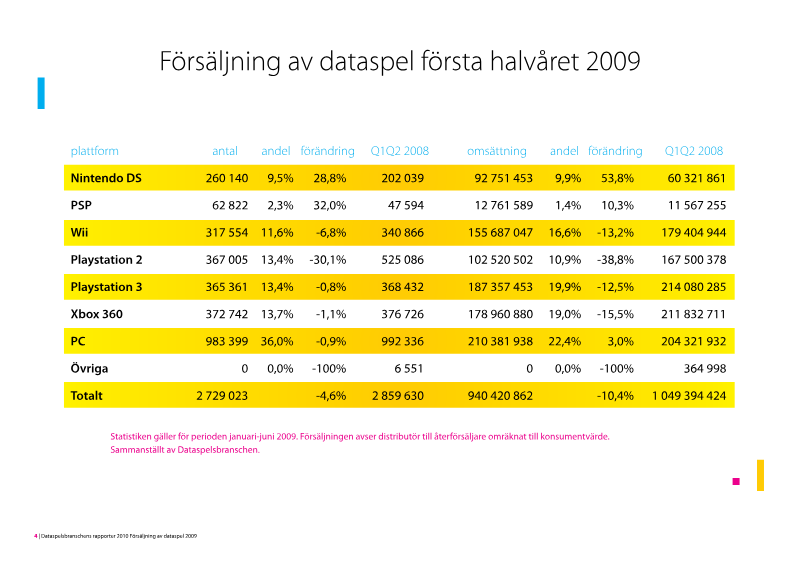
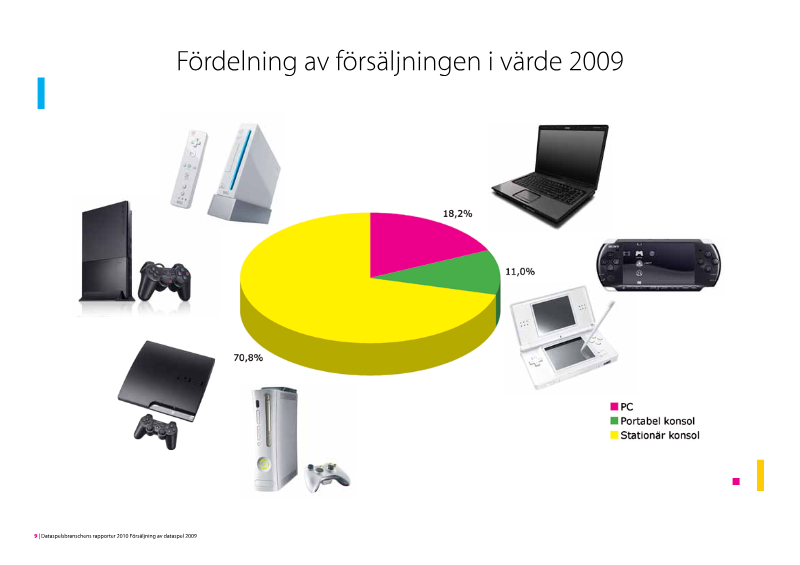
The Swedish video game market experienced a slight contraction in 2009, following a record-breaking performance in 2008. Total sales volume decreased by 3 percent, while total market value fell by 6 percent.
- The Swedish video game market contracted in 2009, with total sales volume falling 3 percent and total market value decreasing 6 percent compared to 2008.
- Despite the annual decline, total revenue in 2009 remained 25 percent higher than 2007 levels, with a market recovery occurring in the second half of the year.
- The PlayStation 2 saw a 57 percent drop in value, marking a significant generational shift toward newer platforms like PlayStation 3, Wii, Xbox 360, and Nintendo DS.
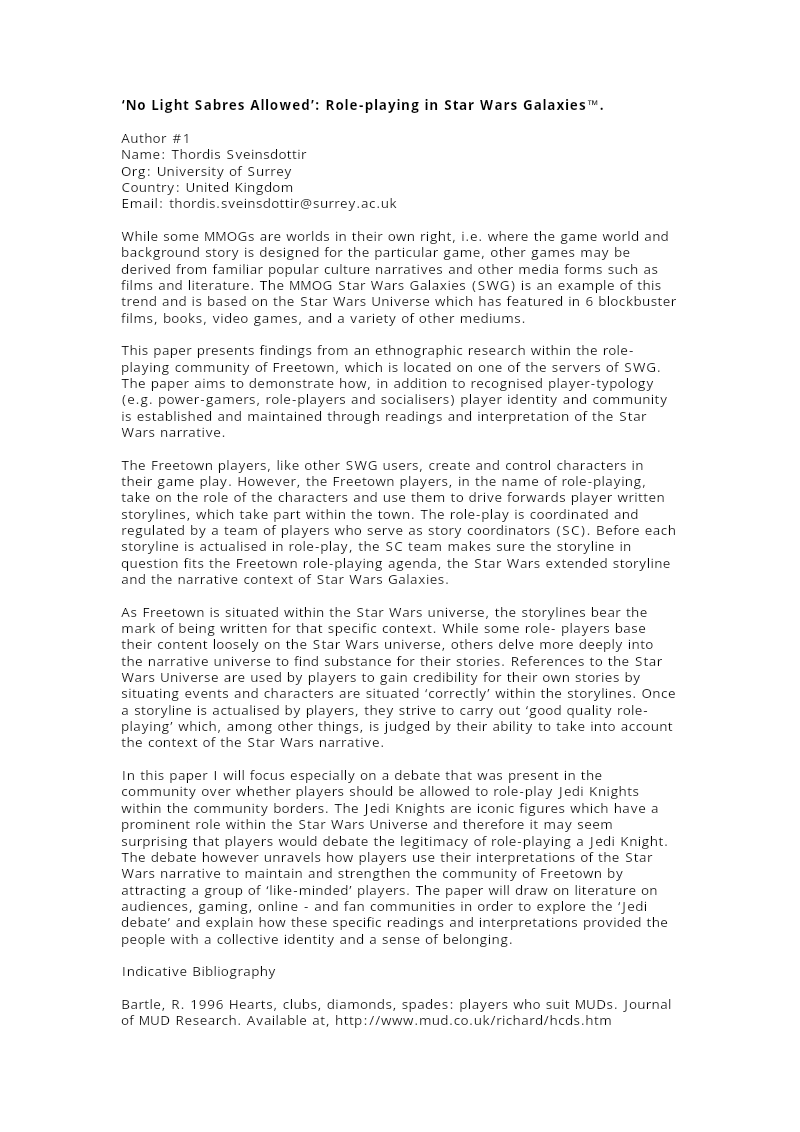
No Light Sabres Allowed: Role-playing in Star Wars Galaxies
This paper examines role-playing within Freetown, a community on a Star Wars Galaxies (SWG) server, using ethnographic research to show how player identity and community are built through interpretation of the Star Wars narrative.
- Freetown, a community on a Star Wars Galaxies server, builds player identity and belonging through close interpretation of the Star Wars extended narrative rather than relying only on the typical player types of power-gamers, role-players, and socialisers.
- A team of story coordinators reviews each player-written storyline before it is enacted, checking it against the community's role-playing agenda, the Star Wars extended narrative, and the context of Star Wars Galaxies itself.
- Within Freetown, "good quality roleplaying" is judged largely by how well it respects the Star Wars narrative context, and players who draw more deeply on the franchise gain credibility by placing events and characters correctly within its canon.
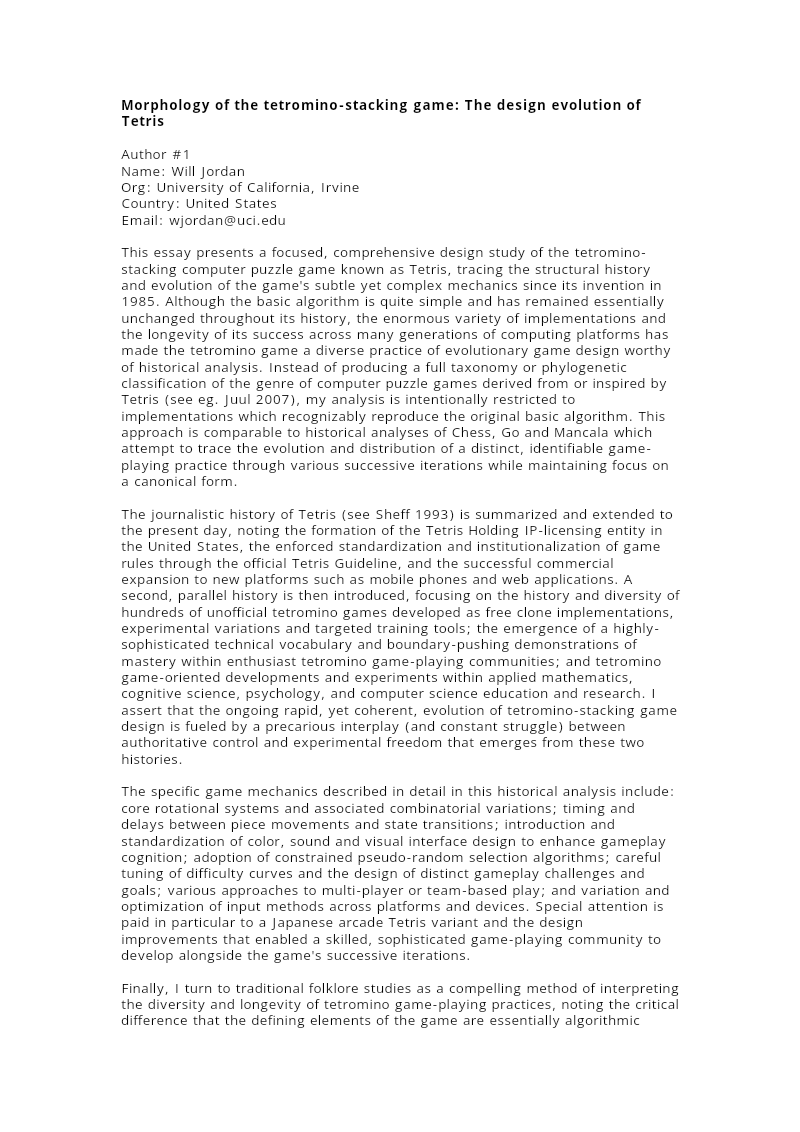
Morphology of the Tetromino-Stacking Game: The Design Evolution of Tetris
This essay offers a design-historical study of Tetris, the tetromino-stacking puzzle game invented in 1985, tracing how its mechanics have evolved while its core algorithm has remained essentially constant.
- The essay argues Tetris's ongoing coherent evolution comes from a tension between authoritative control (institutional standardization of rules) and experimental freedom (an extensive unofficial lineage of clones, variants, and training tools).
- The study restricts its analysis to implementations that faithfully reproduce the original algorithm, treating Tetris as a canonical form comparable to chess, Go, and mancala, even though its core algorithm has remained essentially constant since its 1985 invention.
- Two parallel histories are traced: the official trajectory, including the formation of the Tetris Holding IP licensing entity, adoption of the official Tetris Guideline, and expansion onto mobile and web platforms, and an unofficial history of hundreds of free clones and variants.
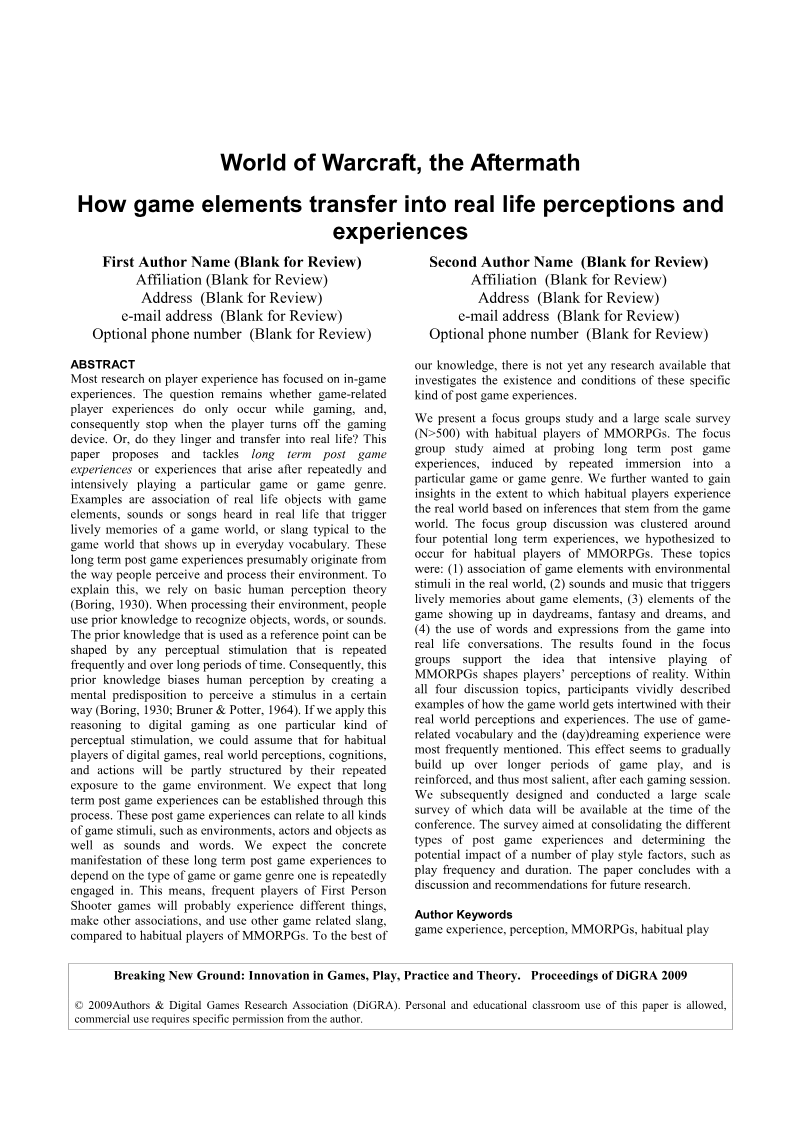
World of Warcraft, the Aftermath: How Game Elements Transfer into Real Life Perceptions and Experiences
This paper investigates whether the experiences of habitual players of massively multiplayer online role-playing games (MMORPGs) persist beyond the act of play and shape how players perceive their everyday environment.
- The paper proposes that intensive, repeated immersion in MMORPGs can produce lasting "post game experiences" that persist beyond play, such as associating real-world objects with game elements, game imagery surfacing in daydreams and dreams, and using game slang in everyday conversation.
- The authors ground this in basic perception theory: frequently repeated stimuli build prior knowledge that biases how people recognize and interpret later stimuli.
- A two-stage design was used: focus groups first explored four hypothesized categories of post game experience, then a survey of more than 500 habitual MMORPG players aimed to consolidate these categories and test how play frequency and session duration relate to their occurrence.
Gold Farming in the MMORPG World of Warcraft: An Ethical Perspective on a Controversial Growth Market
This paper examines gold farming in World of Warcraft, the practice of systematically generating in-game currency and items under the game's economic system and selling them for real money to players who prefer not to invest the time themselves.
- The paper frames gold farming in World of Warcraft as a fundamentally normative question requiring ethical rather than purely functional analysis, using it as a test case for broader issues in virtual economies and the commodification of online life.
- The central ethical debate pits critics, who argue gold farming is unfair to other players and fosters exploitation, against proponents, who cite employment created in developing economies, particularly the largely Chinese farming operations supplying the market.
- The author argues game developers have an ethical obligation to design economic systems that either accommodate or prevent real-money trade, treating this as a matter of corporate ethics as well as player conduct.
MMOGs and the Ecology of Fiction: Understanding LOTRO as Transmedial World
This paper by Lisbeth Klastrup and Susana Tosca examines Lord of the Rings Online (LOTRO) as a gameworld instantiation of a transmedial world, a concept they previously defined as an abstract content system from which fictional stories and characters can be actualized across multiple media forms.
- LOTRO is analysed as a gameworld instantiation of a transmedial world: an abstract content system from which stories and characters can be actualized across multiple media, which the authors Lisbeth Klastrup and Susana Tosca previously defined.
- The framework centres on three core features of the source world, its mythos, topos, and ethos, and examines how players respond when the game departs from these canonical elements.
- Key analytical concepts are credibility, immersion, interpretation, and realignment, partly drawn from Wolfgang Iser's theory of repertoire and gaps as adapted to games by Tosca.