Monetization reports and market data
Documents

Softlaunch Sonar #8 - Exploring the Latest Game Releases & Innovations
The mobile gaming industry is currently defined by a strategic shift toward aggressive iteration on proven mechanics and the widespread adoption of hybrid genre models.
- The mobile market is shifting toward hybrid genre models that blend successful core loops, such as combining arcade idle progression with base-building or integrating board-game mechanics into puzzle frameworks.
- Developers are aggressively iterating on proven 4X strategy mechanics popularized by high-performing titles like Last War and Whiteout Survival to mitigate risks in a saturated market.
- Rising user acquisition costs and market saturation have made IAP-driven monetization models essential for sustaining growth in new mobile releases.

Personalization in Gaming: The Holy Grail of User Experience (and
Personalization represents the next frontier in gaming user experience, moving beyond static, rule-based segmentation toward dynamic, AI-driven environments.
- Gaming is shifting from static, rule-based segmentation to dynamic, AI-driven environments using contextual multi-armed bandit algorithms to automate difficulty, pricing, and ad frequency in real time.
- Machine learning replaces manual A/B testing, allowing studios to simultaneously optimize for conflicting goals like player retention and monetization without repetitive manual configuration.
- The mobile casual puzzle sector is currently the primary adopter, using these tools to refine rewarded video placements and prevent revenue cannibalization.

This Region Is A Hidden Goldmine for Game Developers
The Middle East and North Africa (MENA) region is emerging as a strategic growth market for mobile game developers, offering a combination of lower cost-per-install (CPI) rates and a rapidly expanding, mobile-first user base.
- The MENA region offers a strategic growth opportunity for mobile developers due to lower cost-per-install (CPI) rates and a mobile-first user base that can reach 60% of the performance metrics of tier-one markets.
- Mobile casual gaming, specifically board, puzzle, and card genres, dominates the regional market and accounts for over 70% of total gaming activity.
- Regional investment strategies have shifted from localized publishing of foreign titles toward the development and acquisition of original intellectual property and proprietary technology, led by Saudi Arabia, the UAE, and Qatar.

Exploring Match Villains: A New Contender for THE Casual Throne
Match Villains, developed by the Turkish studio Good Job Games, represents a strategic attempt to capture market share within the highly competitive mobile match-three puzzle genre.
- Good Job Games' 'Match Villains' is attempting to disrupt the saturated U.S. match-three market by replicating the core mechanics and monetization models of industry leaders like Royal Match.
- Since its April launch, the title has scaled to approximately 50,000 daily installs but currently generates only $50,000 in daily revenue.
- Analysts project the game's long-term daily revenue potential is capped at $150,000 due to the difficulty of competing against entrenched market incumbents.



State of Mobile Gaming 2025
The global mobile gaming market entered a period of mature recovery in 2024, characterized by a strategic pivot toward live services and high-value player retention.
- Global mobile gaming revenue grew 4% to $82 billion in 2024 despite a 6.6% decline in total downloads, signaling a shift toward high-value player retention.
- The industry has entered a 'live operations' era, with 84% of total revenue now generated by games utilizing continuous updates and seasonal events.
- Publishers have reduced new game releases by 50% since 2020, focusing resources on high-quality core titles rather than volume.

The Art of Scaling Games: When to scale your game?
Successful game scaling functions as an asset-acquisition strategy, transforming individual titles into predictable, long-term revenue annuities.
- A game is ready for scaling only after demonstrating consistent, predictable cohort performance over a period of nine to twelve months.
- Profitability calculations must be granular, accounting for platform fees, creative production costs, and internal team overhead to determine an accurate net return on ad spend.
- Studios should mitigate performance volatility by maintaining a robust pipeline of creative concepts, as scaling initiatives often extend payback periods and tie up significant capital.

A Beginners Guide to Ad Monetization: The Fundamentals by Felix Braberg
Mobile ad monetization relies on the interplay between effective cost per mille (eCPM) and fill rates to drive sustainable revenue.
- Ad Revenue per Daily Active User (Ad ARPDAU) is the primary metric for evaluating monetization performance, providing a stable baseline independent of user acquisition fluctuations.
- A healthy monetization ecosystem requires a balanced demand distribution where no single ad network accounts for more than 40 percent of total earnings.
- During the soft launch phase, developers should prioritize maximizing ad viewer rates and impressions per DAU rather than focusing exclusively on eCPM.
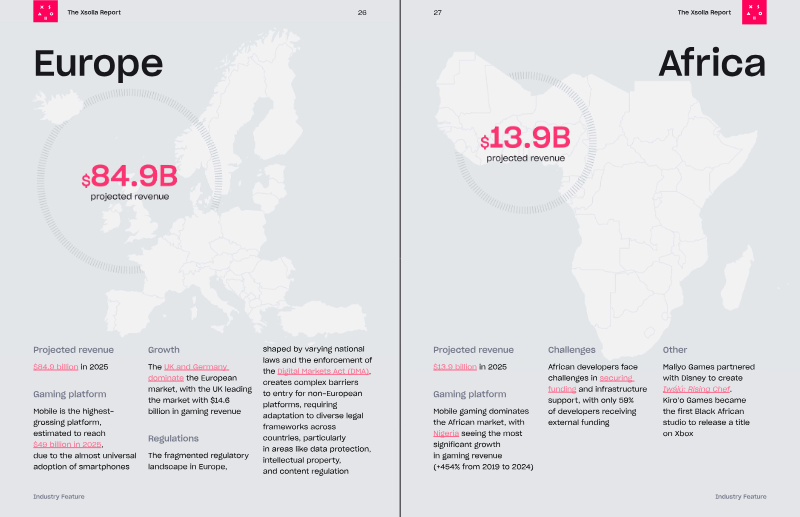


The Xsolla Report: State of Play – Q1 2025
The global gaming industry is entering a period of sustained expansion, with total revenue projected to reach $522 billion by 2025 and a forecasted annual growth rate of 7.25% through 2029.
- The global gaming industry is projected to reach $522 billion in revenue by 2025, with a forecasted annual growth rate of 7.25% through 2029.
- Developers are increasingly adopting direct-to-consumer strategies and web-based storefronts to bypass traditional platform fees and improve profit margins.
- The industry is shifting from passive consumption to active participation, driven by Gen Z and Gen Alpha’s preference for user-generated content and in-game development tools.

Who is Tripledot & what do they do? The History, games portfolio & estimated profits
Tripledot Studios, a UK-based developer founded in 2017, has established itself as a dominant force in the casual gaming sector by prioritizing high-volume, ad-monetized titles.
- Tripledot Studios generates an estimated $320 to $380 million in annual revenue with profit margins of approximately 40%, resulting in $150 to $200 million in yearly profit.
- The company maintains a dominant position in the casual gaming market with 10 million monthly downloads and 8.3 million daily active users.
- Tripledot’s core business model relies on high-volume, ad-monetized evergreen puzzle games like Woodoku, Triple Tile, and Math Crossword, which bypass the 30% platform tax associated with in-app purchases.

TWIG #321 AppLovin’s SHOCK Acquirer, Monster’s Gone WILD, and Guitar Hero’s $1B CORPSE
The global gaming industry is currently navigating a period of intense structural realignment, characterized by strategic consolidation and a pivot toward high-stakes intellectual property.
- Savvy Games Group’s $3.5 billion acquisition of Scopely signals a shift toward long-term institutional investment from Saudi Arabia, prioritizing permanent industry influence over short-term vanity projects.
- Tripledot acquired AppLovin’s game division for $900 million, reflecting a broader trend of unexpected market consolidation as companies seek to scale operations.
- Supercell is shuttering Space Ape to centralize operations in London, signaling a strategic pivot away from niche puzzle games toward ambitious, real-time action titles.

Love & Deepspace: The success of Otome Games. A very heavy RPG with dating mechanics & ASMR systems
Love and Deepspace represents a significant evolution in the otome genre, successfully transitioning from traditional 2D formats to a high-fidelity 3D experience.
- Love and Deepspace generates approximately $40 million in monthly revenue, with 60% of its earnings originating from China and 12% from the United States.
- The game successfully targets a young female demographic, with 86% of its user base being female and 50% of total players under the age of 25.
- The title represents a significant evolution in the otome genre by transitioning from traditional 2D visuals to high-fidelity 3D graphics comparable to Final Fantasy cinematics.

GTA VI Online is the Next Big Metaverse Platform
The Epic Games Store (EGS) continues to function primarily as a proprietary launcher for Fortnite rather than a direct competitor to Steam.
- Take-Two Interactive management is tempering investor expectations regarding a UGC-driven metaverse model for GTA VI, framing it as a potential long-term evolution rather than an immediate feature.
- Rockstar Games has reportedly engaged with prominent Roblox and Fortnite creators to explore custom virtual experiences, though significant technical and operational hurdles remain for such a transition.
- The Epic Games Store generated approximately $1.1 billion in 2024, but this revenue is driven almost exclusively by first-party engagement rather than third-party sales.