Monetization reports and market data
Documents

💰 Ad Monetization Trends - Prison games take over by Felix Braberg
The mobile gaming market is currently experiencing a significant shift in simulation and idle arcade genres, characterized by a widespread transition toward prison-themed titles.
- The mobile simulation and idle arcade genres are shifting toward prison-themed titles, replacing the previous market dominance of supermarket-themed simulators.
- Supercent's 'Prison Life' generates an estimated $38 million annual run rate by combining high-frequency rewarded ads with interstitials and a free-to-premium speed-up onboarding funnel.
- Developers are successfully reskinning existing supermarket simulator mechanics to fit prison settings, as seen in titles like 'Prison Escape Journey' and 'Prison Escape Simulator'.
The TikTok of Games
The instant gaming market is undergoing a fundamental transformation, shifting toward low-friction, snackable experiences that prioritize rapid iteration over the high-cost, formulaic models of traditional AAA studios.
- Remix.gg functions as a platform for instant, zero-install games that leverage AI to democratize game creation, allowing users to build and launch titles in 5 to 10 minutes.
- The platform targets Gen Z and Millennial audiences by focusing on snackable, culturally relevant content that mirrors viral trends, such as TikTok memes or real-world events.
- Creators on the platform have already earned tens of thousands of dollars through game jams, with plans to integrate tokenization to further scale monetization and reward systems.
Masters of Publishing 5: Scaling Isn’t a Milestone, It’s a Grind (Samantha Benjamin, Growth)
Scaling hybrid-casual games demands a sophisticated, long-term operational strategy that prioritizes sustainable profitability over the rapid, short-term break-even cycles typical of the hyper-casual market.
- Hybrid-casual scaling requires a long-term financial strategy that accounts for 90 to 120-day break-even windows, moving away from the rapid recovery cycles of hyper-casual games.
- Growth managers must utilize predictive lifetime value (LTV) modeling and continuous product optimization rather than relying on simplistic, plug-and-play user acquisition tactics.
- High install volume is an unreliable metric that can mask poor long-term return on investment; sustainable growth depends on rigorous post-install data analysis.

Masters of Publishing 3: Ads Don’t Kill Retention, Bad Ads Do (Maayan Aharonovitch, Monetization)
Hybrid casual gaming represents a distinct industry segment that requires a sophisticated, integrated approach to monetization.
- Hybrid casual games must integrate monetization into the core gameplay loop during the initial design phase rather than treating it as an afterthought.
- Successful monetization relies on dynamic, automated player segmentation that identifies friction points and offers rewarded video ads as value-driven solutions.
- There is a strong synergy between ad-watching and paying behaviors, as high-value users often engage with both rewarded videos and in-app purchases simultaneously.

Masters of Publishing 1: Secrets to Getting Signed by a Publisher
The mobile gaming industry has undergone a fundamental transition from the high-volume hypercasual model toward a hybrid-casual framework that prioritizes long-term engagement and quality.
- The mobile gaming market has shifted from hypercasual models to hybrid-casual frameworks that prioritize long-term player engagement and sophisticated progression systems.
- Successful hybrid-casual titles require a dual monetization strategy and robust live operations, as these elements are now essential for scaling in the current market.
- Publishers now act as full-stack partners, providing expertise in game economy design and user acquisition to fill capability gaps within development studios.

🚂 Full Steam Ahead: Steam Games That Could Be Mobile Hits (Q2 2025)
The transition of successful Steam titles to the mobile market represents a significant growth opportunity for developers capable of adapting core gameplay loops to touch-based interfaces.
- Successful Steam-to-mobile migration relies on adapting core gameplay loops like 'unfolding' mechanics, idle simulations, and roguelites for touch-based interfaces.
- Long-term mobile retention for these titles requires the integration of robust economy engines and consumable-based monetization strategies.
- High-potential titles for mobile adaptation include Peak (co-op climbing), The Alters (sci-fi survival), Nine Kings (deck-building), and Rematch (sports simulation).

Week in Mobile Games E66 - UGC platform revenue share and app store competition
The mobile gaming landscape is currently defined by shifting revenue models and the persistent resilience of developers operating under extreme geopolitical instability.
- Epic Games has launched a creator payout model for Fortnite UGC that offers a 74 percent revenue share, with a planned reduction to 37 percent by 2027.
- The 37 percent long-term revenue share for Fortnite creators raises questions about Epic Games' ongoing legal and public advocacy against the standard 30 percent platform fees charged by Apple and Google.
- Mobile platform holders are updating their storefronts to enhance game discovery and social integration in response to rising regulatory pressure and the growth of alternative distribution marketplaces.

Are video game companies getting their release dates wrong?
The video game industry is currently undergoing a fundamental transformation in its release strategies and monetization models, moving away from rigid, retail-driven calendars toward a more fragmented, year-round approach.
- The gaming industry is shifting from rigid, retail-driven calendars to a fragmented, year-round release model as physical retail declines and the 'patient gamer' segment grows.
- Despite the shift toward flexibility, 70 percent of AAA titles remain clustered within five months of the year, specifically February, March, and the late-summer to mid-autumn window.
- Publishers strategically target late February and March to boost end-of-fiscal-year financial performance, while actively avoiding April due to a post-fiscal-year lull.
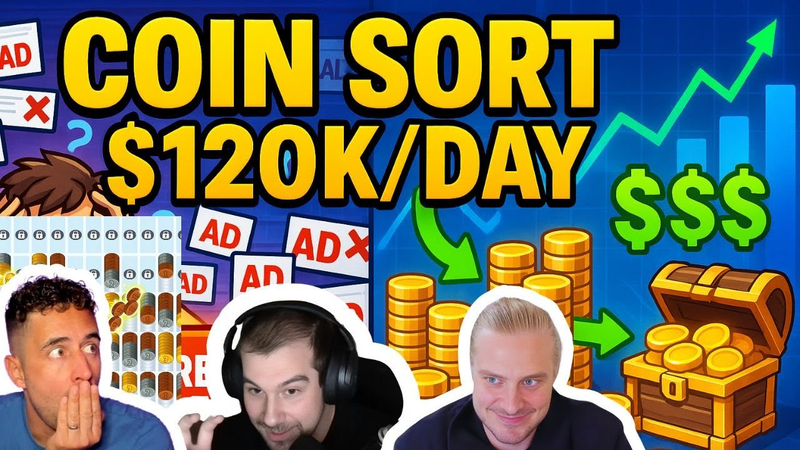
Coin Sort Review: The Hybrid Puzzler smarter than HexaSort
Coin Sort represents a significant evolution in the hybrid-casual puzzle genre, demonstrating that high-agency mechanics can successfully drive substantial revenue through a balanced monetization strategy.
- Coin Sort generates approximately $120,000 in daily revenue, with 65% of earnings derived from in-app purchases rather than ad impressions.
- The game prioritizes monetization efficiency over user volume, contrasting with competitors like HexaSort, which maintains a larger active user base of 1.7 million players.
- The core gameplay loop focuses on high-agency, intuitive coin-sorting and merge mechanics rather than complex meta-progression systems.

Market Update: UEFN Monetization, Meta’s Vision, and the Future of Consoles
The gaming industry is currently navigating a period of structural transition, characterized by a shift toward platform-driven economies, hardware innovation, and evolving financial models.
- Epic Games is expanding UEFN monetization to empower creators, though the long-term impact remains uncertain regarding whether this revenue is truly additive or if it cannibalizes existing Fortnite store spending.
- Meta is prioritizing an entertainment-focused strategy for its hardware, exemplified by the $799 price point for its latest AR glasses, which aims to attract early adopters to build an app ecosystem despite current limitations in user comfort and content depth.
- The gaming investment landscape is shifting toward specialized financing models, such as UA (user acquisition) financing, which allows companies to raise capital specifically for scaling growth rather than relying solely on traditional equity rounds.
Supercell’s First Flop? Squad Busters Still Busting
Supercell is currently facing a critical juncture as its recent performance, particularly regarding the mobile title Squad Busters, suggests a shift from its historical culture of innovation toward a more stagnant, corporate structure.
- Supercell is struggling to maintain its historical culture of agility as the underperformance of Squad Busters, two years post-launch, signals a shift toward a stagnant, corporate structure.
- The company has not produced a major successful game launch since 2018, putting significant pressure on its current portfolio and growth strategy.
- Internal pressures related to a potential IPO have created a reluctance to sunset underperforming titles, contradicting the studio's long-standing philosophy of killing unsuccessful projects.

Jagex prepared to take financial hit to save RuneScape
Jagex is currently undergoing a strategic pivot to prioritize the long-term health and integrity of the RuneScape franchise over short-term revenue gains.
- Jagex is prioritizing the long-term sustainability of the RuneScape franchise over short-term revenue by re-evaluating and potentially reducing microtransactions in RuneScape 3.
- The company has abandoned third-party publishing and large-scale acquisitions to focus exclusively on its core MMO portfolio: RuneScape, Old School RuneScape, and RuneScape: Dragonwilds.
- Old School RuneScape maintains its market position through a democratic development model that requires a 70% player approval rating for all content updates.