VideoThe Game Business
Jagex prepared to take financial hit to save RuneScape
23 Sept 202516 min video
Transcript
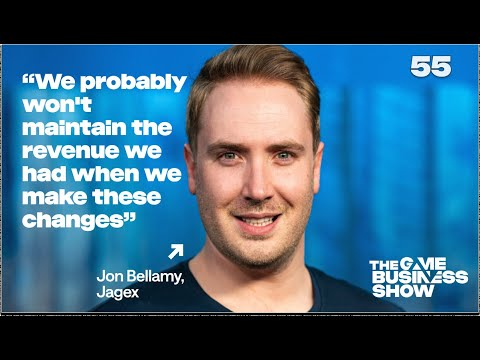
I'm a big believer in strengthening your strengths rather than sort of strengthening what you might feel to be weaknesses. I think people do, you know, the French make wine and the Germans make cars and Drax makes Runescape. We probably won't maintain the revenue that we currently are when we make these changes. That's the truth. But equally, if we're taking a 10 or 15 or 25 year view, you know, some short-term pain is probably worth the restoration of the game if we can get to that point. Hello and welcome to the game business show with me Christopher Dr. Today we are interviewing the new CEO of Jagex John Bellamy. John took over from former CEO Phil Manel back in March. Phil vacated the role after nearly eight years leading the Runescape company. Now Bellamy is relatively new to the video games industry at least compared to most CEOs but he is a veteran Runescape player and he's already experienced an incredibly busy and sometimes challenging start to life as Jagex CEO. The firm launched a new Runescape game back in April called Runescape Dragons, which was a surprise shadow drop, but it
then followed that by further layoffs in June and is currently trying to react to fan negativity about how Runescape has been monetized. During Gamescom, I got the chance to catch up with John and ask him a few questions on how things are going and what he's learned so far. And here is that interview. So, enjoy. Hello, John. Welcome to the show.
Hello. Hello. Thank you for having me. I love the fact that we've we've come to Cologne to do this meeting, seeing as Jagex is based in Cambridge, which is my hometown as well. So, we've come all the way to uh Germany to to to meet up. It's typical really.
I know it's not at all convenient, but I'm glad we're doing it anyway.
Yeah. You've had quite a turbulent, quite a baptism of fire since taking the CEO role at Jagex. How have you uh how have you found it?
Yeah, it's been amazing. It still feels like a real privilege. Obviously, I've I've played these games for 20 years and I worked here previously about a decade ago and so it still feels sort of like coming home. And there's a lot of old faces that I recognize. The game's in really good shape. So, um, yeah, it feels good. No regrets. Very happy.
One of the big stories has been the, uh, scaling back of monetization or at least
rethinking of monetization. That's been that's been grabbing the headlines. Talk me through the journey. How did you get here?
Oh, criy, that's a long one. Um, it's it's a 25 year story to be totally honest that that sort of peaks in 2013 where a few changes were made to the game. there's new monetization model that got rolled out, the one we're all familiar with today.
Um, the sort of visual identity of that game had been changing. We're talking, of course, about Runescape 3 here, been changing for a little while. Um, and I think many of our players started to feel like they were missing the game of old and so old school Runescape was the direct antidote to that.
Yeah.
Um, I think some of the challenges that that led to the creation of our lovely Old School Runescape product um, still exist in one form or another inside of Runescape 3. M
um and so at least myself and and the wider team but mostly the team have been looking at the way the product currently is um the happiness of of players or where they're finding frustration in deciding well if we believe this game has another 25 years what do we need to
change and monetization is near the top of that list.
You did some surveys and the fan there's a possibility of getting fans back if you could make those changes.
Yeah. Well that that's it. So we saw we saw in those surveys there was a lot of hope that we could sort of wind back some of the microtransaction approach that we're doing or augment it to make it a little bit more sustainable and healthy. And there was many people who were quick to say look I'd be interested in coming back to Runescape 3. It's a game I view very fondly and I have a lot of nostalgia for but that really pushed me away. And so that's one of two or three things that are commonly cited. And so we saw the responses and we saw the numbers and we've been running experiments for the last few weeks.
Yeah. uh that started with the removal of um our kind of treasure hunter is our microtransaction layer. We were the total removal of that temporarily that hasn't been done since it was implemented in 2012 or something like this.
And so I think we we started as we intended to go along and really decided to not just ask players but also make changes in game to see what the results
of that are and the team have been learning for the last three or four weeks so that we can put some substance behind our own assumptions. Has anything surprised you so far?
Yeah, a few things. Um, I think I think it can be a tendency sometimes to think um, you know, microtransaction is bad. Nobody likes it. These are universally unappealing. And we've learned that that's just not the case. Actually, that surprised me a little bit. There are many of the players who quite like elements of what we do and would be sad to see them go. Uh, more than I originally assumed. However, the the vocal responses that we've got have largely been very positive. There's been a lot of hope, a lot of sort of encouragement for this direction of travel and I know people are really looking forward to hearing what we come away with just in the same way that you've just asked.
How confident are you can maintain the revenue that you need whilst also making the changes to support players? This feels like a very difficult objective you've set yourself.
It is hard. It it is we probably won't maintain the revenue that we currently are when we make these changes. That's the truth. But equally, if we're if
we're taking a 10 or 15 or 25 year view, you know, some short-term pain is probably worth the restoration of the game if we can get to that point.
And that's that's the experiment that we're running and that's the bet that we're hoping to take.
You've launched a new Runescape game this year in uh I'm going to it's Dragon Wild. Has I got the name right? Yes. Good. Um I saw it at GDC. It's a it's I've not I've not played it, but since then, but it was you shadow dropped it in April. That's quite a We had a uh panel last night here in Gamescom in Cologne where we talked about Shadow Drops and everyone said that's a very high-risisk strategy. Um so tell me why why did you I mean I guess you at the time you weren't necessarily involved in it but what was what was the thinking?
Yeah. No, I'd been involved from behind the scenes. I was on the board for for about a year, right? So I' definitely been following along. But credit to Phil who who really drove a lot of that and Jesse and the team in Dragon Wild. Um why did we do that? There's there's a handful of reasons. I think I think we knew that this was going to be a game first and foremost for Runescape players past and present. And those are players much like myself that have learned to
expect very frequent updates all of the time in a persistent world that will continue to grow and improve and get better over time. With Dragon Worlds, what we were launching was an early access product. We' done a ton of work over multiple years. Um, but the game wasn't finished. So what I didn't want to do is and we collectively didn't want to do is create a bunch of hype and fanfare, set expectations really high for a team of people, a group of people that are already a very high expectation coming from Runescape and Old School Runescape and then let people down. So we wanted to make sure we were sensible and humble in the way that we launched it. It's done tremendously well nonetheless, but when we do full content launch next year, you'll see a lot more fanfare
and sort of excitement because we've got a fuller product that we can ship and start committing to frequent updates on. I was going to ask how is it going and you're you're happy with it so far? Is it doing what you what you're looking for it to do at this stage?
It's done really well. Really really well, Chris. Much better, I think, than we anticipated. Um, we hoped for we had some sort of very high-end goals and it surpassed those at early access.
Okay.
And so, um, you know, the team's in a
really good place. Um, I've played a ton of the game. Lots of our players have. And you can see now there's a bunch of Runescape players saying, "I would love to see more and more and more and more in the product." And so, we're furiously developing. We're actively hiring into that team.
Trying to build out the sort of um pipeline of content,
but the the first priority is committing to delivering everything we've already promised in our pipeline. And that should come late next year.
Interestingly, I still think of old school Runescape as a new concept, but it's been going what 12 years now. It's
exactly
old school is actually old school now.
Did I say it did like 200,000 players or something the other weekend? It was a phenomenal um number.
Yeah. I guess I mean this this is quite a soft question, but what's made this game so enduring?
That is a soft question because
um honestly I think it's it's quite a simple formula that's not very easy to do. I think if you can create a game that is is um really diplomatically developed, meaning we don't release anything into the game that doesn't achieve a 70% popularity poll rating in
game from our players. And so it's it's very democratic the way that we run the game.
Sounds like a good model for Brexit. that with
no comment. Um, but but that's worked really well and it's it's helped us stay on the the straight and narrow because who knows better what should be in the game than the people who are playing it all day every day. Um, and that's that's proven to be a really great model. Um, on top of that, we charge one subscription price and you get access to all of the game if you pay it, which is really simple and I think increasingly fresh in in today's market, which is quite nice to be able to be in that position. And then finally, I think we have some really clear lines in the sand that we would never transgress with old school Runescape. No microtransactions ever and a whole host of other sort of clear rules that I think our players will all be very familiar with. And just sticking to those, even when it's tough sometimes to accept that content we really want to make isn't the stuff that's desired, it's proven to be quite successful in the long run.
Is there anything about it? I mean, there's a very unique specific nostalgia element to that game as well. Is there
anything about it that you can apply to Inscape 3 or any of your other titles?
Yeah. Um, I think I think Old School is a game that is swimming in integrity and I think integrity is um is really desirable especially today. At least that's my view.
Um, and I think RS3 is um what we're looking at for RS3 is also much about integrity. So visual integrity, monetization integrity, and integrity of gameplay. Mhm.
And I think if we put that right at the core of what we're doing, much as we have for Old School Runescape, it will manifest in a different way for RS3, but I think it will still prove to be successful.
I played another game at GDC. I didn't even realize that you published Scum the um the which is an astonishing game really. I I well above my skill level and patience
and mine.
But I almost didn't notice that this was still going on in the background at Jagex. These sort of projects, are they are they remotely a priority? I mean, I'm not talking about Scum in particular, but are you looking at those sort of other projects still?
Um, no, we're not actively looking at third party publishing. That's something we've done previously.
I think for for Jagex, um, the priority is and will be for the foreseeable future Runescape in its various incarnations. I'm a big believer in in strengthening your strengths rather than sort of strengthening what you might feel to be weaknesses. I think people do, you know, the French make wine and the Germans make cars and Drax makes Runescape and that's exactly where I would like us to be for the next five or so years. Scum's a great game being built by a team um in a company called Game Pires and they have a ton of autonomy because the kind of game that you'll have experienced is very different to the kind of games that Jagex is known for typically and so the worst thing I think we could do is go and impress upon that team that we know how best to make a hardcore shooter.
Um you know we back that team because they know best how to make a hardcore shooter.
Now you've joined Jagex at a very and I know I know you've been in the background before this but you've enjoyed Jagex at a very tricky time for the industry. I know you've had to make some cuts and changes as well as as every single person in the industry has.
Yeah.
How are things with the team now? Are they um can you are you confident you can still deliver your goals and what you're setting out to do with with with with the with the people that you have?
Yeah. Yeah, definitely. Um it is a tough time and I think everyone's feeling it. Nobody's particularly happy with the state of where we are.
And I've been here just as you have for the last couple of days. And whether it's a banker, an investor, an executive or a developer, pretty much everybody's feeling that it's it's, you know, it's not the golden days that it was a few years ago.
I've never felt anything like this.
Nor me. Nor me. I think a lot of us in this industry are going through our first like downturn in a cycle.
Yeah.
You know, there'll be more in the future every 10, 15 years or something, but for many of us, this is the first. And so, we're kind of learning as we go. I think that's why we've seen as much shock as we have versus other industries that are a bit more used to being in this.
I've seen moments in the industry where you know platforms have shifted and shift and and things have changed which causes sections of the industry to go through declines or projects to be cancelled but you always felt there was some other area that was growing and there was some other area for people to go to to look to. There were more publishers back then. There wasn't quite so much of the consolidation that we've seen um across the industry. So I look at it now and I I think you part of the
shock is it's everywhere and there's almost nowhere there's no people are looking for green shoots and things and it and there might be some in certain corners but and we're starting to see more this year than we certainly had last year but it's um
it's there there's not many
there's not many. I think one of the um one of the saving graces that we have had and I'm sure you've you've seen and talked about this at length
is the rise of the kind of double A champion, right? I mean, that's
that's kind of the defining tune whenever I'm walking through a Gamescom or or talking with with folks in the industry is that, you know, you you can take a $400 million budget and there's not many of them left, but you can still take a swing with that kind of thing, but you can also take a swing with a tenth of that
and deliver not so different results if if you get it right. And we've seen that from
um Obscure and a bunch of others recently, right? And I think that that is a guiding light for many who might have been a bit disheartened coming out of a big studio. I like the fact you said double A budgets. I don't really see like CL obscure as a double A get. You know what it does is AAA quality. What Space Marine 2 is AAA quality.
These are all these are all delivering the experiences you demand of them but they're doing it either with much smaller teams or in lot faster. Um and we're even seeing I I've started to see I've spoken to two companies here who are made trying to make games in like 18 months. Obviously much smaller games often like rogike or 2D titles. These are big companies doing that and I and I find that interesting as well to follow. Um, we might um, but I always I still think there's room for AAA. Um,
for sure, for sure. But I mean, if it can be done in a new, scrappier way, I think that's probably good for all of us.
I'm going ask one more question and it's one I tend to end my interviews on, which is like what what's your goal? What's your target? How do you see Jagex in 5 years? Where do you want it? Where do you want to where do you want to take it? There's a very clinical answer to that, but the honest answer is I would like um I would like Old School Runescape, Runescape 3, and Dragon Wilds as a collective Runescape franchise to be if not the biggest, but then clearly the second biggest MMO franchise in the Western world. Um we're already very close to that position to be.
Yeah, we are. It's it's one of those things that surprises people quite frequently, but um there's a fantastic
tool online that I won't plug the name of, but it it sort of demonstrates mind share across YouTube and a bunch of other platforms, Google searches. how much is a game talked about and I checked recently an old school Runescape is has the greatest mind share of any MMO in the west which I found surprising and I think many others would as well and I think if we can stay in that position then the size of the game in terms of the player base and and the team those things will follow and so we I think we've established where we want to be we're already pushing towards it and the growth at least for old school Runescape over the last few months has been amazing so I think if we can continue that as we are we don't plan on doing big acquisitions necessarily or um spinning up large scale new projects. Really the focus is on doing what we already do quite well um but making 1 2 3% improvements across a 100 different places every year for the next 5 years.
Yeah, that's that seems to be a bit of the strategy. Focus is a word.
Focus is the word.
That was much more succinct than mine. But yes, focus is the plan.
Yeah. Great. Well, thank you John. I'll let you get back to your meetings and um
I hope you have a successful Gamescom.
Perfect. Thanks for having me.
That's it for today's episode of the Game Business Show. It was a little shorter this week and I know that some of you like things to be a little shorter. In fact, a more concise version of the game business show will be available to paying subscribers in addition to exclusive content which we'll be releasing on a monthly basis. We really would love your support so we can keep doing these videos. So, if you are able to help us, please do. More details can be found at thegamebusiness.com. We will be back with more news, analysis, and interviews in the days to come. Until then, thank you for tuning in.
Auto-generated captions from YouTube — names and numbers may be misheard.

















Comments