VideoTwo & a Half Gamers
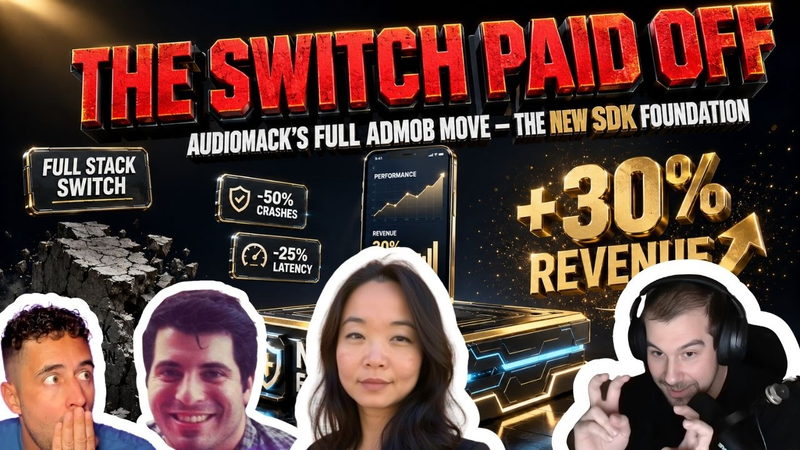
How Audiomack Boosted Revenue by 30% with Google’s New Next-Gen SDK
24 Jun 202614 min video
Relevant. Relevant was the third word.
If publisher could flip any feature that would kind of help them see immediate uplift in terms of the revenue, what would what would it be be?
We have a lot of features, but I would say the one that comes to mind right now is 4AP. We're seeing a lot of immediate
[music] [music] [music] [music] [music] [music]
Hello everybody. We're here at MAU Vegas where everybody's talking about new Google product launches for growth, supporting publishers, and finding the right way to grow as well. And yes, you have heard it right. We're here for the inside the scoop with Sarah and Matt. Can you introduce yourself?
Of course. Thank you. Sarah here. I lead the AdMob partnerships a team for apps and gaming developers in North America. Good to be here.
And I'm Matt. I'm the VP of revenue for AudioMack. We're a music streaming platform with a global footprint.
And my name is Matej Lancaric.
I'm Jakub Remiar.
And we are your hosts. Publishers and developers are hitting the performance plateau. To break through the wall, we need a rock-solid foundations. Now, the new GMA thanks gen SDK is officially version 1.00, right?
So, what are the top reasons for publishers to actually switch?
Right.
So, as you mentioned, I think the foundation is really critical for that next wave of growth. Um when we think about actually building a house, you need a foundation. So, for us, it's the same thing when we think about our app developers. And the next gen SDK that we have, we need to probably have a better name. The GMA next gen SDK is kind of a mouthful, but um it is something that we've done in terms of we've done a kind of a huge overhaul uh from the ground up and really rewrote the code from um from the bottom up because we realized that to sustain a complex ad serving tech uh that has to build on top of it, you can't use what we used to do for banners and other other simple ad serving bases. So, for us, this is really a faster, lighter, and even more stable SDK. So, we really hope that we have an exciting rollout and really hope our uh developers really adopt it fast.
Oh, I got it. Talking about the stability, like I guess nothing kills the song vibe than a mid-song crash.
Exactly. Yeah.
Um Matt, can you share like how how does it feel for you switching to this?
Yeah, uh I think I can kind of summarize it with just like four data points. Um since launching on GMA, I think we saw a 25% reduction in ad load latency in emerging markets. Uh 16% increase in intel across the board, and then uh 20% reduction in ANRs, and a 30% reduction in crashes uh since launching.
Nice.
So, you carved out pretty good niche, right? So, championing the the artists, the mixtape cultures, and giving creators the kind of massive platform. Looking ahead, like what's your big plan for for the app?
Yeah, Audiomack's in a a really exciting time right now. You know, we're transitioning from this boutique music platform to a major streamer. Our users are growing, our music catalog is growing. We're now we have licensing agreements with all the major music labels and users are really turned on to
us because we have a really we're really affordable streamer. We have a very robust free tier where they can stream as much music as they want without really any limitations. But looking ahead, you know, as we're you know, we we want to ride that momentum and as we're experiencing this like accelerated growth that comes with higher expectations and especially on the ad front. You know, when new users come to our platform, they're not comparing the ad experience to like a mobile game or like a utility app. They're comparing it to, you know, the Spotifys of the world and CTV apps and all the other streamers that they're used to. So, yeah, and we're a small independent like company, you know, with a small team. So, we're being held at a standard of companies that are 50x our size and we've been really excited to partner with Google because in a lot of ways they help level the playing field for us where we could do a lot It means we could do a lot more with less and just here at MAU they're
announcing a lot of like product launches. They're super exciting. Um, they kind of find that balance between user experience and monetization. So, for us as a music streamer, LTV is so pivotal. Um, you know, we're not as ephemeral as a lot of music apps or as a lot of apps in general rather where like our lifespan is like 28 or 60 days. Like we have users in the platform for years. So, for us, um, you know, we really like that Google's trying to bridge that gap. You know, for us we're glad to sacrifice a dollar or two today if it means that user's going to stick around for like five years.
Yeah. Going to get that dollar back in five years.
Exactly.
Way more way more than that. Yeah, way more than that. Uh, I guess a lot of devs are kind of terrified a little bit from I guess switching and having their match rate drop. Uh, Can we talk a little bit about that? Like why do you think that holds them back?
Yeah, there you know as a pub there's a ton of data at your fingertips and it's easy to get lost in the minutia
of it but really at the end of the day the most important chart is revenue. You know I recently did some AB tests with price floors where I saw the match rate drop but the CPM and the revenue went up. And you know when I kind of and like latency is the same way with that where these are basically health charts for your app. And you know if you push some experiments it might skew that data a little bit and then you might get the impression that your app is unhealthy but really it's all about context. You know like if you go to the doctor's office and you're sitting in the office and he's taking your heart rate and it's 160 BPM like he's probably alarmed but if you're in his office and you're running on a treadmill and he takes your heart rate as 160 like that's considered healthy for the exercise that you're doing. So kind of the same way for all of you.
Which KPI to look at.
Exactly.
Or I would actually just say not just looking at one KPI but looking at the combined stored as telling right. I think to Matt's point the context piece is really important. So to the back to the match rate piece I think for you when we look at the match rate is
important to look at the match rate but also at the total request and then when you look at that also how does that play out for your app pool as well right? So if your match rate drops a little bit but your total request goes up your impressions goes up then your app pool goes up. So I think understanding kind of how that all plays out um is is probably really important and I really have important to have that context.
Just cuz the usual advice like match match rate doesn't pay bills and all that kind of stuff.
Yeah.
Exactly.
Then Matt you made a huge move like to entire stack to ad player. How did you come up with that decision? That's like huge question.
Yeah, I mean there is a clear revenue opportunity with Google. You know they'd always been a strong partner for us through partner bidding and especially in emerging markets. And you know, but I think what really sold us on it was, you know, might sound cheesy, but the Google team. Um, you know, working with their But now the but but honestly like like all pubs like we rely so much on Google
products to operate various aspects of our app. And you know, working with the Google team we're able to kind of tap into a level of expertise where we're not just learning about how to make AdMob perform better, we're learning how to leverage all these footprints in our app to make AdMob better.
Can I ask one interesting question? How did you measure measure the potential impact of the ad revenue that you can get from
Before the switch you were
Yeah, before the switch. Uh, we had been using and then since switching I think we saw we've seen a 30% revenue increase so it's been pretty substantial there, but I think the biggest surprise that we didn't take into account before uh, switching was just what kind of a benefit we saw from being on Google infrastructure in emerging markets. I think we like overnight saw a 20% reduction in ANRs and a 50% reduction in crashes.
Yeah, that's the crash rate big again.
Yeah, yeah, exactly. Yeah, it's huge for us.
Yeah, of course, of course.
And especially if you think about like Audiomack and then really thinking about the emerging market which Audiomack
plays a really big role in for independent artists like this is one area that we knew that was a really critical part for the company as a whole and where we were really really confident in what we can bring in terms of value add.
Should we do a little bit of questions and fast answers?
Yeah, rapid fire stuff. Of course, you need to answer in under 10 seconds.
Do we have to hit a buzzer?
Uh, yeah, can you hear the buzzer?
It's the most nervous I'm getting right now.
If the new GMA would be like the SDK in Las Vegas like a Las Vegas headliner, what would it be for you?
Circus Soleil. Um, light, fantastic and also
Okay.
The Blue Man Group.
Oh, okay.
Yeah.
So, Matt, like what feel like feeling perfectly describes the untangling the like legacy SDKs and the code.
What uh what
song
Yeah, what song? Yes, what song?
What song kind of captures that had that feeling? Yeah, yeah. I have to go disco classic, Don't Leave Me This Way by
Thelma Houston. You know that one? Don't leave baby
[laughter]
My heart is for loving and is all for you. Yeah.
No, no, no, no.
I don't think so.
I don't think so.
Let me take the next one. Describe exactly in three words the perfect ad experience.
Can I do four words?
Right ad perfect time.
Ah, okay.
Predictable, respectful,
relevant
Relevant was the third word.
If a publisher could flip any feature that would kind of help them see immediate uplift in terms of revenue, what would what would it be?
We have a lot of features, but I would say the one that comes to mind right now is 4 IP. We're seeing a lot of immediate uplift right away across not just Google, but also across third-party networks.
Yep.
Okay. This goes for you, I guess, Matt. What was the one feature that you can't live without after this switch?
I think like the data I don't know Clearly, clearly the AdMob suite. Um, but but honestly, genuine, that's that's a good answer. I would also say if we're looking at just the product, um the full suite of reporting is super useful and just really can get in-depth. And then in particular, ad load latency is a data point that they've released in the last year. And you know, for us it's
It's huge.
You're looking back at those important context page files.
Exactly. Yeah, yeah.
Let's say. Take the last one, I think.
Yeah, so currently, you said like you're unlocking massive scale in like emerging markets in like in Africa as well. Like what's the actual secret?
I mean, come on.
Yeah.
I think it's just building an authentic connection in the markets that you're trying to, you know, to grow in. And not just grow in, but like really kind of create a foothold in, you know. We, you know, got as big as we did by focusing on localization, by you know, having taste makers in market and kind of understanding the culture of the market
that we're in and like what's coming next from the music perspective. And, you know, leaning in with the right artist. We leaned in with like Shay Vibes and Burna Boy when, you know, they didn't really have a platform anywhere else. And that brought users to us, you know, they're very loyal users and kind of, you know, saw us as someone that understood their region and their market.
Also be assured like when you decrease the ARPU and crash rates in these countries that help you organically as well. That is just a double whammy.
Make us less of an annoying service to use, right?
Apple.
Yeah, no. I think one of the things that when we were I still remember the conversation we had with um mediation platform testing with Dave, the CEO. We're sitting in the New York room in the office and one of the things we talked about is that we really want to partner with Audiomack because we believe in their mission. And I think that's something that's really critical to us in terms of like community building. And if you think about it in gaming as well, um building a right community who is loyal to you is going to pay you huge dividends way beyond what you can do in
a quick turn out in terms of a cash flow first focus. So, really believe in the mission and really excited to work with your team, too. So,
It's been great.
Thanks for for listening. The hard work is actually done in your studio. Go and get Go get to to work and then grow the app. See you next time.
Auto-generated captions from YouTube — names and numbers may be misheard.
The migration of the music streaming platform Audiomack to Google’s Next-Gen GMA SDK 1.00 resulted in significant technical and financial improvements. By overhauling their ad-serving infrastructure, the company achieved a 30% increase in total revenue and a 16% rise in overall ad performance. These gains were accompanied by substantial technical optimizations, including a 25% reduction in ad load latency and a 50% decrease in app crash rates, particularly within emerging markets.
The transition highlights the importance of prioritizing long-term user lifetime value (LTV) over short-term metrics. While publishers often fear that switching SDKs or implementing price floors might negatively impact match rates, the analysis suggests that match rate should be viewed in the broader context of total ad requests and impressions. When evaluated holistically, these adjustments often lead to higher overall revenue and a more stable user experience. The stability provided by the new SDK is particularly critical for streaming services, where technical interruptions like app crashes can significantly degrade user retention.
The success of this migration was driven by a focus on infrastructure stability and localized growth strategies. By leveraging Google’s updated SDK, Audiomack was able to maintain a high-quality, ad-supported free tier that competes with larger global streaming platforms. The findings emphasize that for developers, the ideal ad experience is defined by being predictable, respectful, and relevant. Ultimately, the partnership demonstrates that investing in a robust technical foundation allows smaller, independent companies to scale effectively while balancing monetization with the need to foster long-term user loyalty.

Two & a Half Gamers · 2026

Two & a Half Gamers · 2026

Two & a Half Gamers · 2026

Two & a Half Gamers · 2026

Two & a Half Gamers · 2026

Two & a Half Gamers · 2026

Two & a Half Gamers · 2026

Two & a Half Gamers · 2026

Two & a Half Gamers · 2026

Two & a Half Gamers · 2026

Two & a Half Gamers · 2026

Two & a Half Gamers · 2026

Two & a Half Gamers · 2026

Deconstructor of Fun · 2026

Deconstructor of Fun · 2026
Two & a Half Gamers · 2026

Two & a Half Gamers · 2026

Deconstructor of Fun · 2026

Two & a Half Gamers · 2026
Two & a Half Gamers · 2026

Two & a Half Gamers · 2026

Deconstructor of Fun · 2026

Two & a Half Gamers · 2026

Two & a Half Gamers · 2026
Comments