Mergers & Acquisitions reports and market data
Documents
Embracer Group Divests Gearbox Entertainment: Investor Presentation
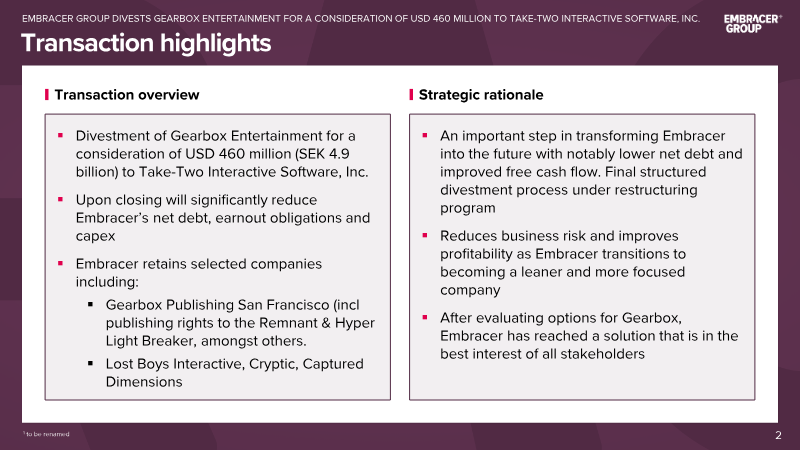
Embracer Group has finalized the divestment of Gearbox Entertainment to Take-Two Interactive Software, Inc. for a total consideration of USD 460 million.
- Embracer Group is selling Gearbox Entertainment to Take-Two Interactive for USD 460 million to reduce net debt and improve free cash flow.
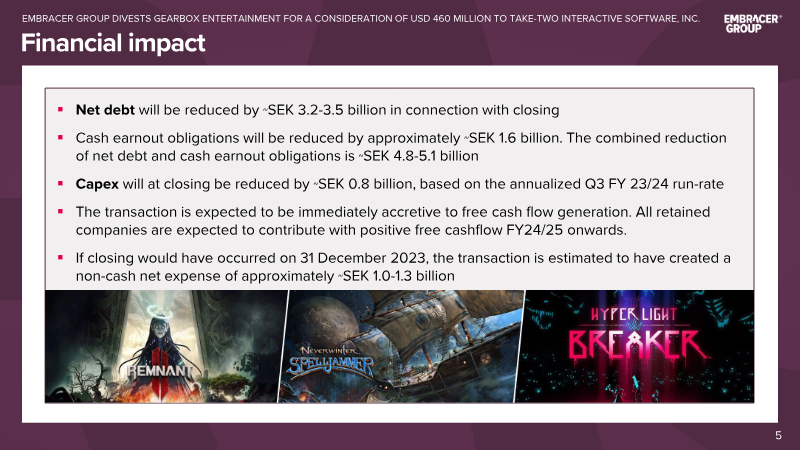
- The transaction is expected to generate net cash proceeds of SEK 3.2 billion to 3.5 billion after Embracer liquidates the newly issued Take-Two shares received as payment.
- The deal eliminates approximately SEK 1.6 billion in cash earnout obligations and reduces annual capital expenditure by roughly SEK 0.8 billion.

Embracer Group Ceases Operations in Russia: Divestment of Selected Saber Interactive Assets
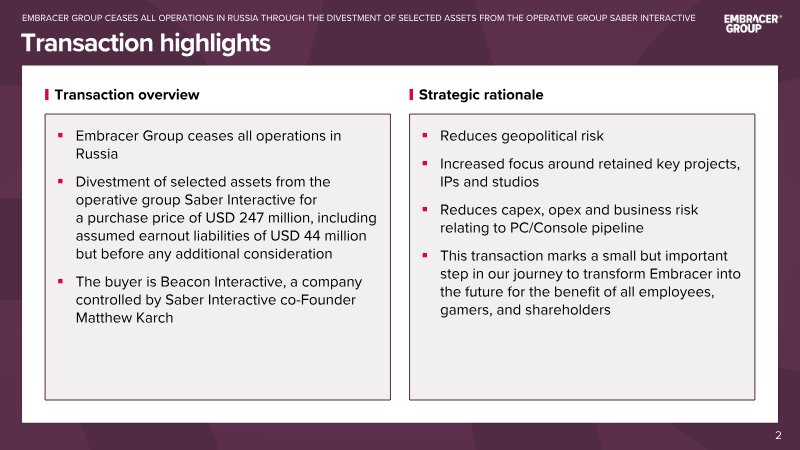
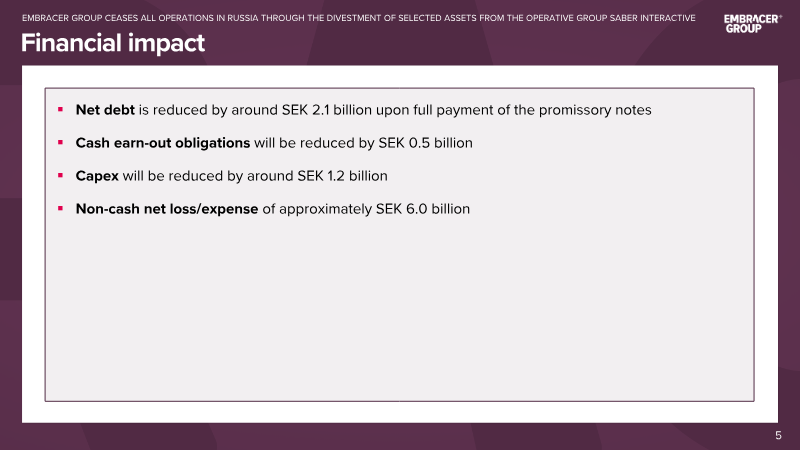
Embracer Group has finalized the complete cessation of its operations within Russia through the divestment of selected assets from its Saber Interactive operative group.
- Embracer Group has exited Russia by divesting selected Saber Interactive assets to Beacon Interactive, a company controlled by Saber co-founder Matthew Karch, for a total transaction value of USD 247 million.
- The deal includes an option for the buyer to acquire 4A Games and Zen Studios, and it is expected to reduce Embracer’s net debt by approximately SEK 2.1 billion and annual capital expenditure by SEK 1.2 billion.
- Embracer anticipates a non-cash net loss of approximately SEK 6.0 billion as a result of the divestment, which is part of a broader corporate transformation strategy to reduce operational risk and expenditure.
Emulator Armageddon / Netflix Ports / Private Equity / Early 2024 Winners
The gaming industry is currently navigating a significant structural correction, moving away from an era of unsustainable growth and hyper-realistic, high-budget development toward a model that prioritizes operational efficiency and core gameplay.
- The gaming industry is shifting from high-budget, hyper-realistic development toward operational efficiency, as evidenced by the commercial success of mid-tier, community-focused titles like Helldivers 2 and Palworld.
- Private equity firms are increasingly acquiring established studios, such as Jagex and Saber Interactive, signaling a strategic pivot toward stable cash flows and lean operations over debt-fueled expansion.
- Nintendo’s successful legal action against the Yuzu emulator highlights a hardening stance on intellectual property protection, while the Epic Games versus Apple antitrust battle continues to create volatility in mobile distribution.
Why Video Game Layoffs Aren't Done Yet I Extra Credits Gaming
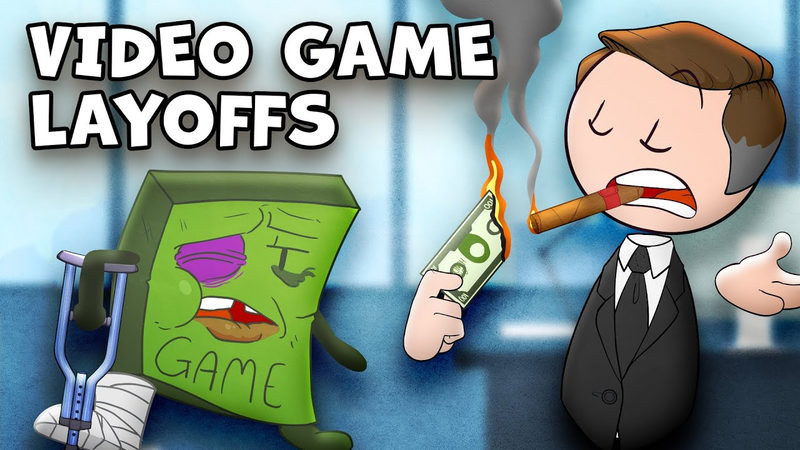
The current wave of layoffs in the video game industry, which has resulted in approximately 9,000 to 12,000 job losses over the past year, is not indicative of a systemic industry collapse.
- The current wave of industry layoffs, totaling approximately 9,000 to 12,000 job losses over the past year, is a structural correction rather than a systemic collapse.
- Mass workforce reductions are a direct result of companies over-hiring and over-leveraging during a period of historically low interest rates that prioritized growth over profitability.
- Tech-driven game development relies heavily on human capital, allowing corporations like Amazon, Unity, Embracer, and Epic Games to scale headcount up during cheap credit cycles and cut it rapidly when economic conditions tighten.



Keywords Studios FY 2023 Results
Keywords Studios achieved a resilient financial performance in 2023, reporting €780 million in revenue and a total growth rate of 13%.
- Keywords Studios reported €780 million in revenue for 2023, representing 13% total growth and 9% organic growth despite currency headwinds and U.S. labor strikes.
- The company achieved an adjusted operating margin of 15.6% and an EBITDA of €158.3 million, supported by a strong cash conversion rate of 82.3%.
- Management is pursuing a revenue target exceeding €1 billion, supported by a €225 million investment in five acquisitions during 2023 and a $400 million revolving credit facility.

Learnings from Building & Exiting Three Companies with Paul Gouge, Founder of Fourth Star
The pursuit of excellence in the mobile gaming industry requires a departure from the common "family" corporate culture in favor of a high-performance "sports team" model.
- Adopt a 'sports team' organizational model that prioritizes elite talent and radical transparency over a 'family' culture to maintain high performance in saturated markets.
- Implement the AIM framework—Audience, Ingredients, and Mix—to filter out low-quality game concepts early and prevent the waste of development resources.
- Replace the 'fail fast' mentality with a disciplined, high-quality development process that emphasizes rigorous prototyping and granular, measurable roadmaps.
Midnight, the AA Web 3 Games Consolidator
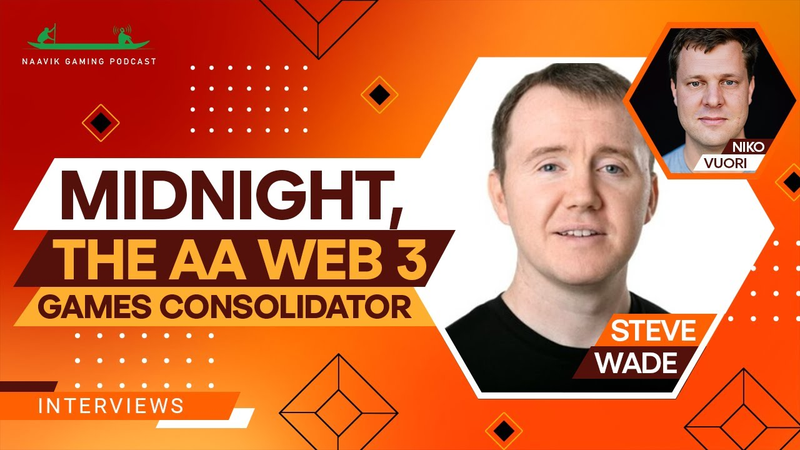
Midnight operates as a strategic consolidator within the Web3 gaming sector, focusing on the acquisition and development of AA-tier PC and console titles.
- Midnight is a strategic consolidator acquiring and developing AA-tier PC and console titles, specifically targeting studios with proven engagement metrics that have struggled with traditional funding.
- The company aims to release approximately 13 titles annually with individual budgets ranging from $500,000 to $5 million to ensure a broad, niche-focused ecosystem.
- The operational core is 'Evergreen,' a deconstructed MMO companion app that functions as a social hub for cross-game item trading and crafting while abstracting blockchain complexity for Web2 users.

TWIG BREAKING NEWS: The Xbox Business Update 2.15.2024 Watch Party
Xbox is navigating a pivotal strategic transition, aiming to expand its reach by porting four established first-party titles to competing platforms like PlayStation and Nintendo Switch.
- Xbox is porting four established first-party titles to competing platforms, including PlayStation and Nintendo Switch, while maintaining day-one Game Pass availability for all new first-party releases.
- Microsoft is integrating Activision Blizzard titles into its ecosystem, starting with the addition of Diablo IV to Game Pass in March 2024.
- The company reports double-digit growth in PC and cloud gaming, though critics argue the overall subscription-focused model has failed to drive meaningful user base expansion over the last decade.
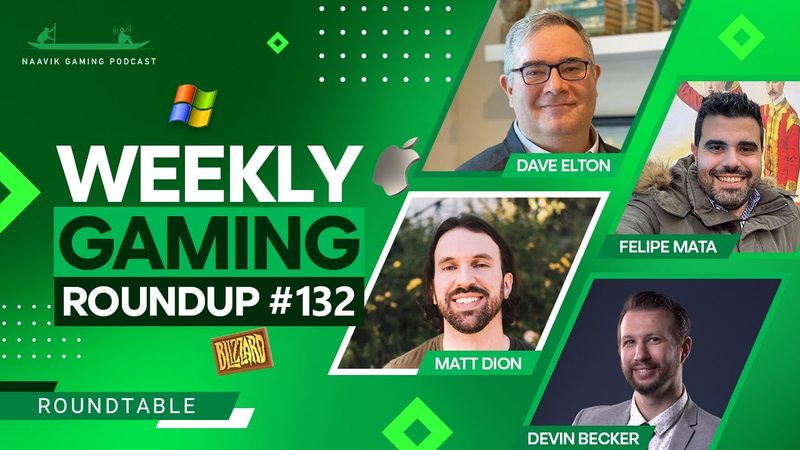
China's Regulations / Microsoft & EA Earnings / Apple’s Legal Challenges
The global gaming industry is currently navigating a period of significant structural transition, defined by shifting regulatory landscapes, evolving platform power dynamics, and changing consumer entry points.
- The Chinese government has retracted restrictive monetization regulations following market volatility, though major firms like Tencent continue to face stagnant growth and are pivoting toward AI to drive performance.
- Microsoft’s acquisition of Activision Blizzard reflects a broader industry shift toward operational efficiency and a strategic focus on high-revenue, service-based business models.
- Mobile devices have become the primary gaming gateway for younger generations, with nearly all children engaging with games by age ten.
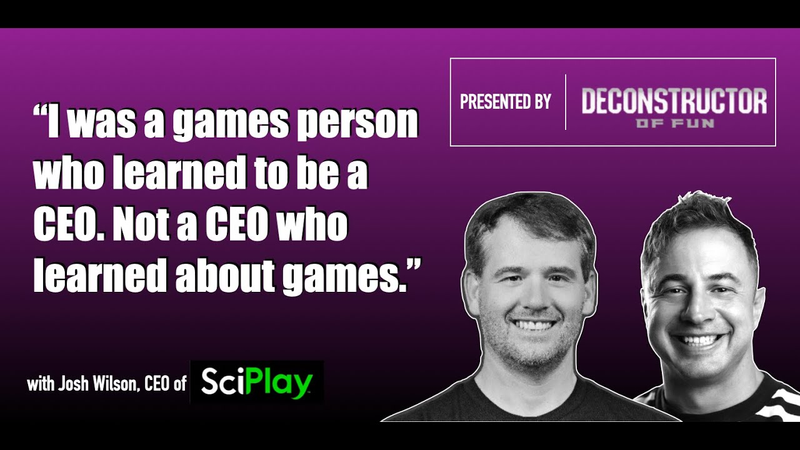
6 x Operative Changes That Kept SciPlay Growing with Josh Wilson, CEO of SciPlay
SciPlay has sustained seven consecutive quarters of growth by pivoting from aggressive user acquisition toward a model centered on profitability, retention, and technical infrastructure.
- SciPlay achieved seven consecutive quarters of growth by shifting from aggressive user acquisition to a model focused on profitability, retention, and technical infrastructure following the 2021 Apple IDFA changes.
- The company is reducing reliance on third-party app stores and paid marketing by building a proprietary direct-to-consumer platform and internal adtech.
- Operational efficiency is driven by standardizing auxiliary features, such as leaderboards and daily bonuses, across the entire game portfolio.

Valve's Daily Deals / Activision Blizzard & NetEase Reconcile / Apple's 27% Fee
The gaming industry is currently undergoing a significant shift toward cross-platform accessibility and increased operational transparency.
- Valve is transitioning Steam’s daily deal curation from opaque, relationship-based models to a data-driven system prioritized by revenue and concurrent player counts.
- Activision Blizzard and NetEase have reconciled, facilitating the return of major franchises to the Chinese market, though the partnership remains exposed to volatile government monetization policies.
- Despite antitrust rulings, Apple continues to enforce a 27% fee on external payments, with high operational friction effectively preventing developers from bypassing established platform ecosystems.
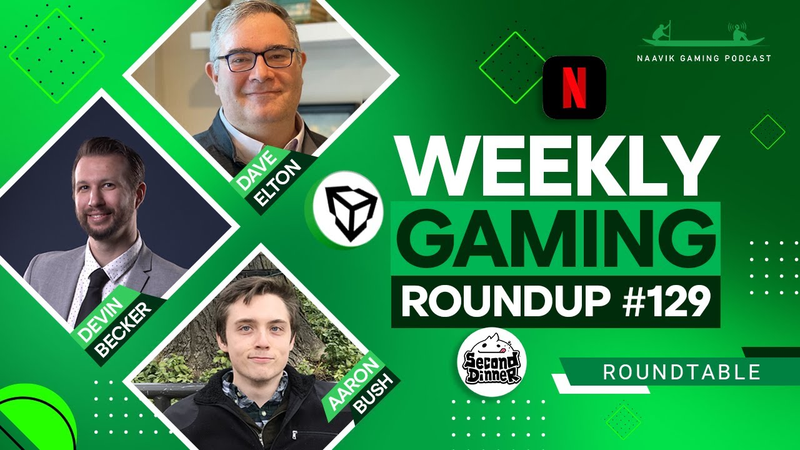
CES Takeaways / Subscription Strategy Changes / Second Dinner's $100M Raise
The gaming industry is currently navigating a period of significant structural transition, characterized by a shift away from aggressive subscriber growth toward diversified revenue models and operational efficiency.
- The gaming industry is shifting from aggressive subscriber growth to diversified revenue models, with companies like Xbox adopting platform-agnostic distribution and windowing strategies to maximize reach beyond proprietary hardware.
- Following a period of rapid expansion, the industry underwent a significant correction in 2023, resulting in over 10,000 job cuts and an 80% decline in venture capital funding.
- Second Dinner’s $100 million Series B raise signals that capital remains accessible for high-performing studios capable of maintaining long-term, high-engagement titles despite a cautious investment climate.