Marketing reports and market data
Documents

How D2C can build personal relationships | Liam Wiltshire from Tebex #PGConnects
Direct-to-consumer (D2C) strategies in the gaming industry are evolving beyond simple fee avoidance, shifting toward building deeper, more sustainable relationships between developers and players.
- Direct-to-consumer (D2C) strategies are shifting from simple fee avoidance to building sustainable, long-term relationships through web-based shops and community portals.
- Developers are increasingly utilizing D2C platforms to bypass in-app purchase limitations, enabling personalized engagement tools like tailored offers and direct communication channels.
- Subscription-based monetization models are replacing one-off microtransactions to provide predictable revenue and support the long-term maintenance of live-service games and modding ecosystems.

From Drumming to Downloads: Why ASO Is All About Discipline
Sustainable organic growth in the mobile gaming industry depends on treating app store presence as a dynamic, live channel rather than a static asset.
- Sustainable organic growth requires an 'always-on' discipline rather than sporadic efforts, treating the app store as a live, evolving channel that demands consistent maintenance.
- Teams should move away from manual, repetitive tasks by leveraging AI and automation tools, which can reduce manual workflow time by up to 40%.
- To prove the value of organic growth to stakeholders, teams must measure incrementality by establishing clean baselines and cross-referencing console data with Mobile Measurement Partner (MMP) metrics.

🚨📢 BREAKING NEWS: Mobile Stagnates, Monopoly GO Hits $6B, Liftoff Files for IPO
The mobile gaming industry experienced a period of divergence in 2025, characterized by a slight rise in global revenue to $81.8 billion while traditional app store metrics suggested stagnation.
- Scopely’s Monopoly Go became the fastest mobile game in history to reach $6 billion in lifetime revenue, achieving the milestone in 1,275 days and currently generating approximately $200 million per month.
- Global mobile gaming revenue reached $81.8 billion in 2025, though traditional app store metrics show stagnation due to a massive shift toward web stores that bypass platform fees.
- Industry observers estimate that 40% to 50% of revenue from large-scale developers is now excluded from standard iOS and Google Play tracking, meaning official reports likely underrepresent actual market performance.

Live Q&A With Chris Zukowski about Steam Next Fest
Steam Next Fest serves as a critical promotional milestone for indie developers, but its efficacy is fundamentally tethered to the volume of wishlists a game accumulates prior to the event.
- Launch your demo well before Steam Next Fest to build wishlists, as the event itself is highly competitive and favors games that already have significant traction.
- Use median playtime on your demo as the primary metric to evaluate game quality, as it is a more reliable indicator of player engagement than average playtime or subjective feedback from friends.
- If your game consistently ranks in the bronze or silver tiers on Steam benchmarks, it is likely that the core concept is not resonating with the market, and you should consider shipping the project to move on to a new game.

🎯 Hunting Sniper Review: Old game, new UA = SERIOUS Money!
The mobile game Hunting Sniper has emerged as a significant financial success within the realistic sports genre, generating approximately $200,000 in daily revenue.
- Hunting Sniper generates approximately $200,000 in daily revenue, outperforming established genre competitors like Hunting Clash by nearly tenfold.
- The game’s rapid scaling since its August 2024 launch is driven primarily by an aggressive user acquisition strategy rather than innovative game design.
- Developers maintain a high-volume creative output, releasing hundreds of new marketing assets monthly across Facebook, Google, and TikTok.

🎯 Mobile Ad Monetization Checklist: From Soft Launch to Scale by Felix Braberg
This guide provides a strategic framework for mobile game developers to implement and scale ad monetization, covering the transition from soft launch to full-scale operations.
- Prioritize user retention by enforcing strict ad creative standards, as networks often default to intrusive, long-form end cards that degrade the user experience.
- During soft launch, target a 45% viewer rate for rewarded video ads and a 70% viewer rate for interstitials to balance monetization with retention.
- Maintain an updated app-ads.txt file to ensure full access to reseller demand and maximize potential ad revenue.
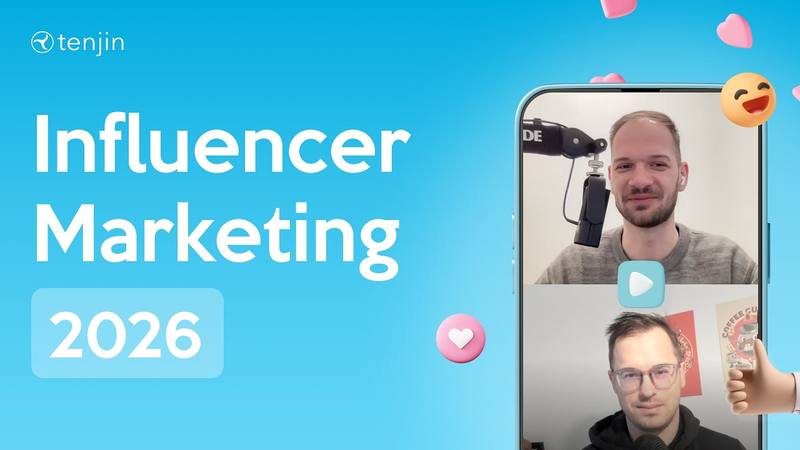
Influencer Marketing for Mobile Apps 101: 2026 Edition
Mobile app developers are increasingly pivoting away from traditional paid user acquisition toward micro-creator marketing to combat the unsustainable surge in advertising costs.
- Paid user acquisition costs have surged significantly, with CPMs increasing 10x over the last two years, making micro-creator marketing a necessary alternative for scaling apps.
- High-performing influencer campaigns can achieve CPMs as low as $0.60 to $0.70 in the U.S. market, compared to the standard industry range of $3 to $5.
- Effective creator compensation should prioritize performance-based bonuses over fixed fees, using the creator's median view count from the previous three months as the benchmark for success.

The AI Disruption Index: How AI Is Reshaping Consumer Discovery
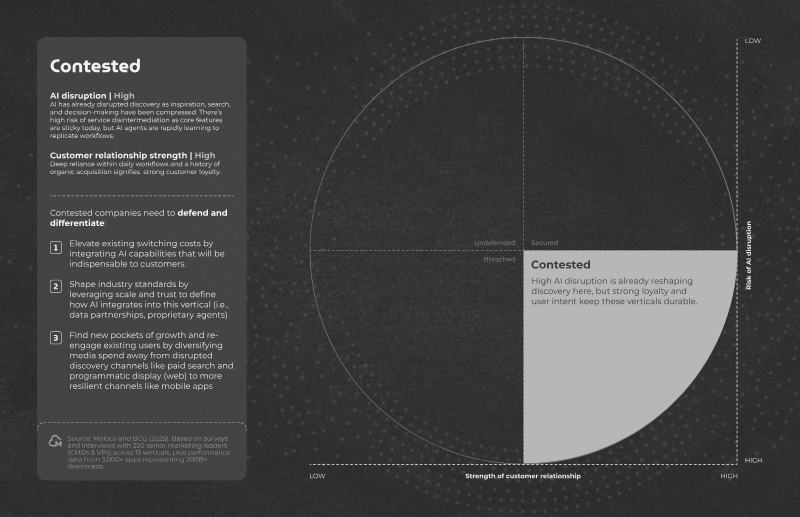
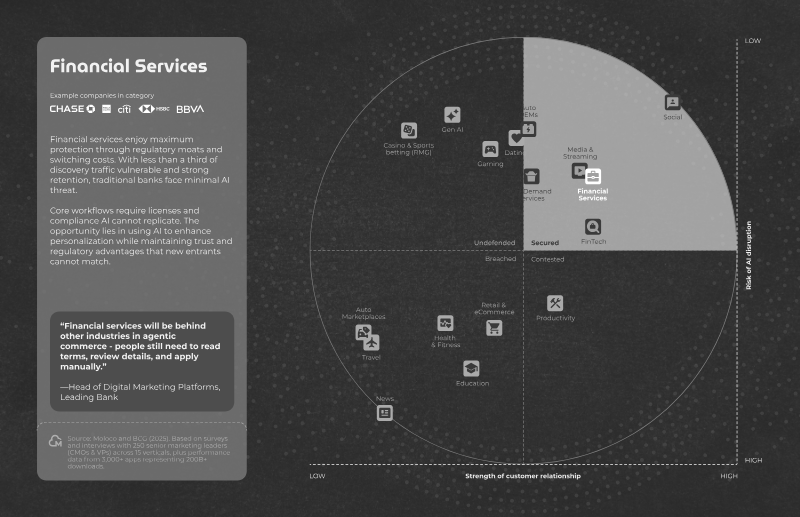
The AI Disruption Index demonstrates that artificial intelligence is fundamentally altering how U.S. consumers discover and purchase brands, with one-third of adults now using personal AI agents to find products and nearly half employing AI for purchase research.
- One-third of U.S. adults now use personal AI agents for product discovery, while nearly 50% utilize AI for purchase research.
- AI-driven 'zero-click' discovery is actively eroding traditional paid search and organic search channels, threatening sectors like retail, education, and health & fitness.
- Sectors with strong regulatory or content moats, specifically financial services, media rights holders, and auto OEMs, currently maintain a defensive advantage against AI disintermediation.

☠️ The end of original creatives: Creative Trends just got darker
The mobile gaming industry is currently undergoing a fundamental shift toward a copy-first development strategy, prioritizing high-volume, replicable creative assets over original intellectual property.
- The mobile gaming industry is shifting toward a copy-first strategy that prioritizes high-volume, replicable creative assets over original intellectual property to maximize conversion metrics.
- Artificial intelligence is being leveraged to mass-produce deceptive creative content, significantly lowering production costs while enabling the rapid deployment of fabricated, high-drama scenarios.
- Publishers are increasingly utilizing 'fake ads' that feature unauthorized use of major global brands and misleading gameplay representations to drive user acquisition.
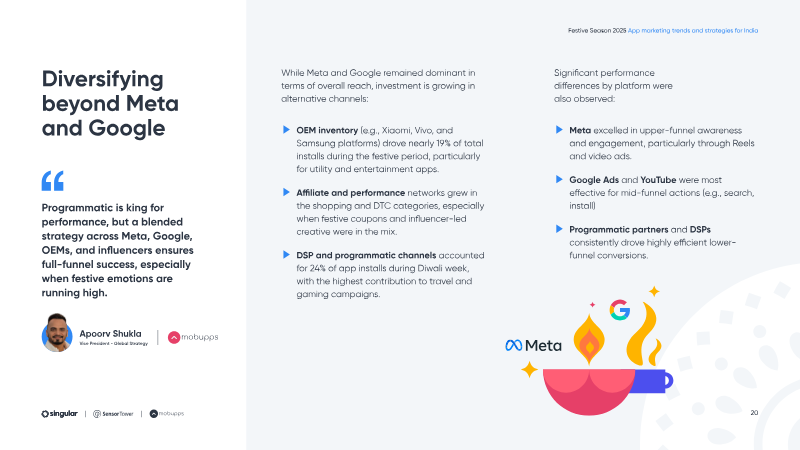
Festive Season 2025: App Marketing Trends and Strategies for India
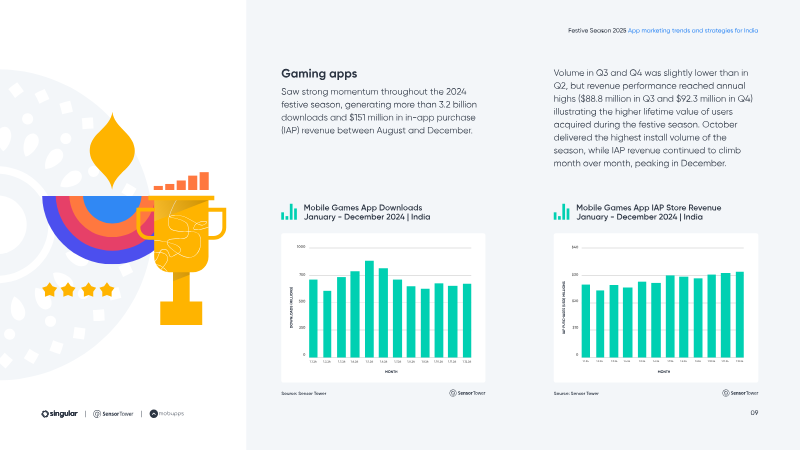
India’s festive season—from Onam in August through Diwali and Christmas in December—drives more than 30% of the country’s annual digital advertising spend, making it a pivotal period for app marketers.
- India's festive season (August–December) accounts for over 30% of annual digital ad spend, driving a 36% increase in installs and a 69% surge in re-engagements during the peak window.
- Mobile gaming remains a primary growth driver, recording 3.2 billion downloads and $151 million in-app purchase revenue in 2024.
- Ad spend efficiency improved during the festive period, with a 53% increase in mobile ad investment accompanied by a 12% reduction in cost-per-install (CPI).

Mobile Gaming Measurement in 2026: What's Actually Working?
The mobile gaming industry is undergoing a significant transition in measurement strategy as privacy regulations and the decline of traditional identifiers render last-click attribution insufficient.
- Ubisoft is shifting from last-click attribution to a holistic measurement framework for 2026 mobile launches, such as Rainbow Six Mobile and The Division Resurgence, to account for brand impact, content creators, and CTV.
- Effective growth measurement now requires integrating performance data with incrementality testing, organic lift, and K-factor analysis to capture the total value of multi-channel campaigns.
- Media Mix Modeling (MMM) is becoming a critical component of the modern growth stack, with AI being deployed specifically to analyze complex datasets and fill gaps in attribution data.

🚨📢 BREAKING NEWS: 2026 State of Gaming Marketing, Turkish studio raises big, Meta shuts studios
The 2026 gaming landscape is defined by rapid consolidation, a surge in creative output, and a strategic shift toward monetization efficiency.
- Global user acquisition spending reached $25 billion in 2026, with Turkey and India now capturing one-third of all UA expenditure outside of China.
- Top advertisers increased creative volume by 30% year-over-year, producing 2,400 to 2,600 variations per quarter to combat a market where ad impressions grew twice as fast as paid installs.
- Meta has shuttered three VR studios—Saru Games, Twisted Pixel Games, and Armatur Studio—as the company pivots its strategic focus from the metaverse toward wearable technology.