Updated Jun 1, 2026 by InvestGame
Report · January 20, 2026
Published by InvestGame
Festive Season 2025 App marketing trends and strategies for India 01 Market 4 The festive season app economy 02 Performance 15 Cost, performance, and return on ad spend 03 Media mix and channel insights 18 04 Creative strategy 21 05 Remarketing, retargeting, and retention 25 06 Conclusion 30 Festive Season2025App marketing trends...
in partnership with Festive Season 2025 App marketing trends and strategies for India ESSENTIAL GUIDE 2025
Festive Season 2025 App marketing trends and strategies for India Content 01 Market 4 The festive season app economy 02 Performance 15 Cost, performance, and return on ad spend 03 Media mix and channel insights 18 04 Creative strategy 21 05 Remarketing, retargeting, and retention 25 06 Conclusion 30
Festive Season2025App marketing trends and strategies for India Introduction India’s festive season, which spans a full quarter-year, from Onam in August through Diwali and Christmas in December, is atimeof cultural and religious celebration. It’s also a critical period for app marketers todrive scale, optimize media investments, and engage high-value audiences. In 2025, festive campaigns areexpected to account for morethan 30% of total annual digital ad spend, with mobile continuing to dominate both attention and transaction The festive season in India is not just about momentary spikes– it's a strategic window where data-driven storytelling and timely userengagement make all the At the scaleweoperate, This report, composed in collaboration leveraging real-time insights allows us to with Sensor Tower andMobupps, move beyond just installs and focus on synthesizes key market data, campaign long-term impact. Reports like these benchmarks, and creative strategies to help decode shifting consumer behavior help brands succeed during during high-intent periodslikeDiwali, the busiest shopping and engagement enabling marketers to optimize both window of the year.From CPI and ROAS performance and brand outcomes. trends to media mix modeling and creative fatigue mitigation, theinsights By Singular, in partnership with Sensor Tower and Mobupps presented here the latest across thousands of campaigns and Nikhil billions of Head - Growth & Partnerships
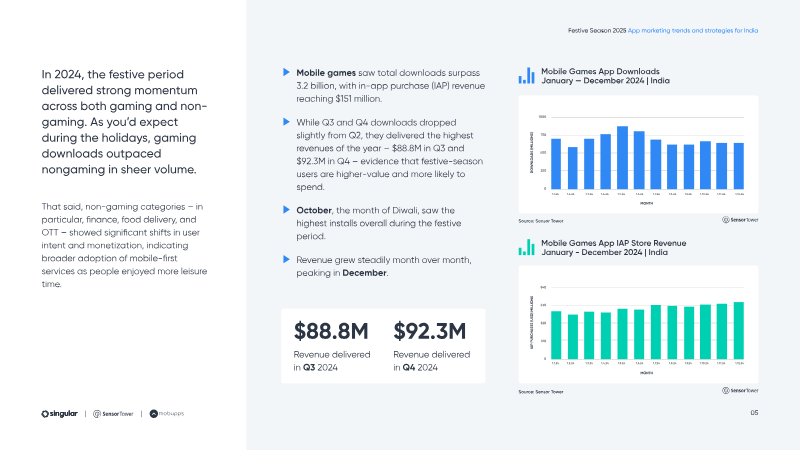
Festive Season2025App marketing trends and strategies for India In 2024, the festive period Mobile games saw total downloads surpass Mobile Games App delivered strong momentum 3.2 billion, with in-app purchase (IAP) revenue January — December 2024 | India across both gaming and reaching $151 million. gaming. As you’d expect W hileQ3 and Q4 downloads dropped during the holidays, gaming slightly fromQ2, they delivered thehighest DOWNLOADS (MILLIONS) downloads outpaced revenues of the year – 88.8M in Q3 and nongaming in sheer volume. 92 .3M in Q4 –evidence that festive-season users are higher-value and more likely to spend. 0 1.1.24 1.2.24 1.3.24 1.4.24 1.5.24 1.6.24 1.7.24 1.8.24 1.9.24 1.10.24 1.11.24 1.12.24 That said, non-gaming categories –in October , the month of Diwali, sawthe MONTH particular, food delivery, and highest installs overall during the festive Source: Sensor Tower OTT – showed shifts in user period. Mobile Games App IAP Store intent and monetization, indicating January - December 2024 | India broader adoption of Revenue grew steadily month over month, services as people enjoyed moreleisure peak ing in December. time. IAP Purchases (USD) Millions 88.8M 92.3M Revenue delivered Revenue delivered 0 in Q3 2024 in Q4 2024 1.1.24 1.2.24 1.3.24 1.4.24 1.5.24 1.6.24 1.7.24 1.8.24 1.9.24 1.10.24 1.11.24 1.12.24 Month Source: Sensor Tower
Festive Season 2025 App marketing trends and strategies for India Non-gaming apps also surged during the Mobile App (Non Games) Downloads festive quarter, particularly in shopping, January - December 2024 | India food delivery, and OTT, where seasonal behavior shaped both install and revenue trends. Downloads (Millions) In non-gaming, there was a strong correlation between festive milestones and transactional behavior. This suggests that during the holidays, users prefer the 0 1.1.24 1.2.24 1.3.24 1.4.24 1.5.24 1.6.24 1.7.24 1.8.24 1.9.24 1.10.24 1.11.24 1.12.24 convenience of mobile to manage shopping, MONTH meals, payments, and entertainment. Source: Sensor Tower Mobile App (Non Games) App IAP Store January - December 2024 | India IAP Purchases (USD) Millions 0 1.1.24 1.2.24 1.3.24 1.4.24 1.5.24 1.6.24 1.7.24 1.8.24 1.9.24 1.10.24 1.11.24 1.12.24 Month Source: Sensor Tower
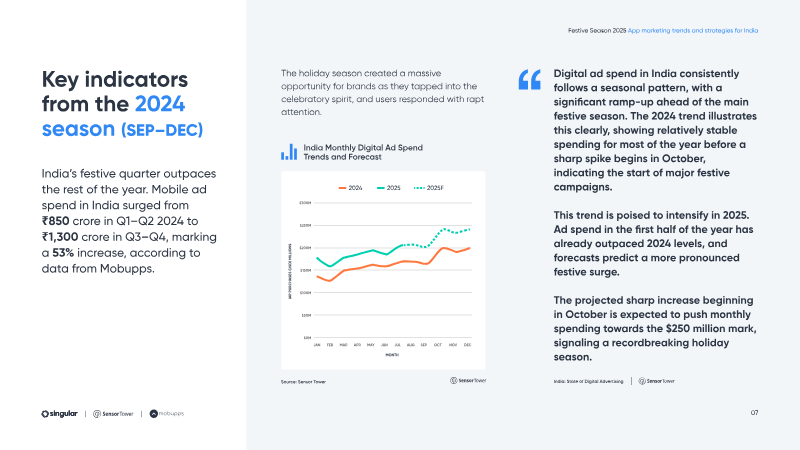
Festive Season 2025 App marketing trends and strategies for India Key indicators The holiday season created a massive from the 2024 opportunity for brands as they tapped into the celebratory spirit, and usersresponded with rapt season (SEP–DEC) attention. India Monthly Digital Ad Spend Trends and Forecast India’s festive quarter outpaces the rest of the year. Mobile ad 2024 2025 2025F spend in India surged from $300M ₹850 crore in Q1–Q2 2024 to $250M ₹1,300 crore in Q3–Q 4, marking IAP Purchases (USD) Millions a 53% increase, according to 200M data from Mobupps. 150M $100M Digital ad spend in India consistently follows a seasonal pattern, with a ramp-up ahead of the main festive season. The2024 trend illustrates this clearly, showing relatively stable spending for most of the yearbefore a sharp spike begins in October, indicating the start of major festive This trend is poised to intensify in 2025. Ad spend inthe half of the year has already outpaced 2024 levels, and forecasts predict a more pronounced festive The projected sharp increase beginning 50M in October is expected to push monthly spending towards the 250 million mark, $0M JAN FEB MAR APR MAY JUN JUL AUG SEP OCT NOV DEC signaling a recordbreaking holiday Month Source: Sensor Tower India: State of Digital Advertising
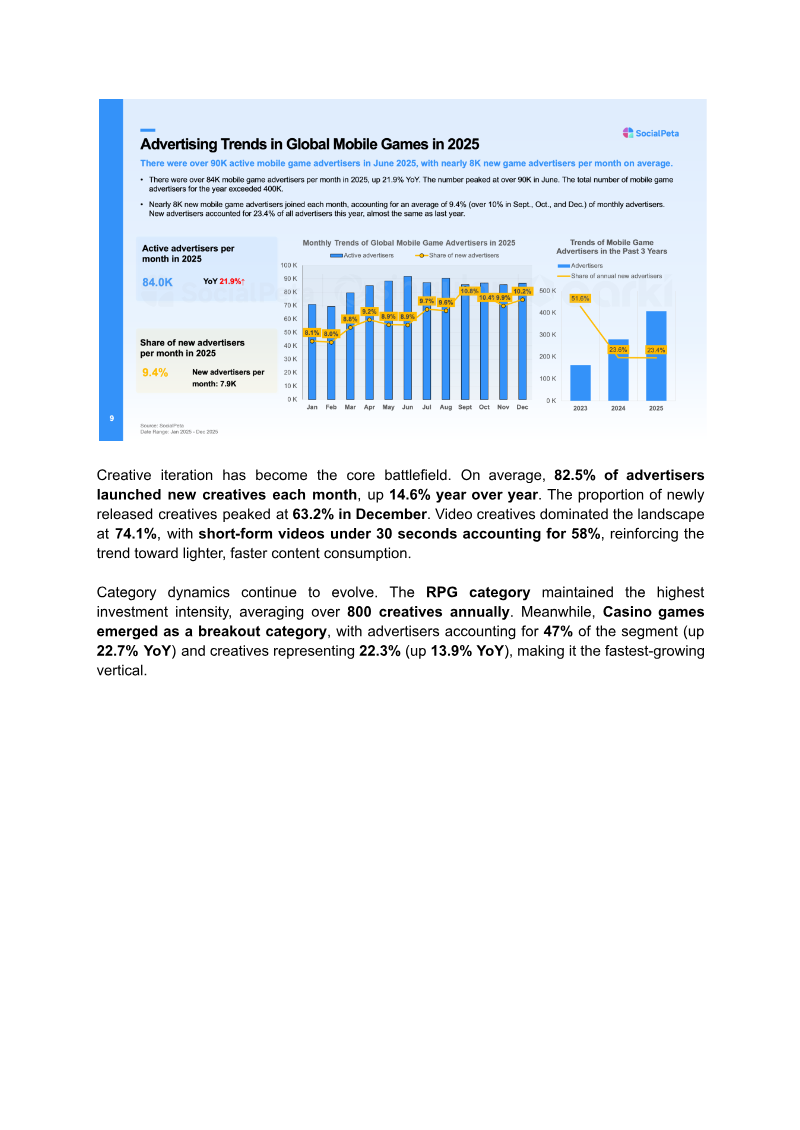
With Over 400,000 Advertisers Analyzed, the 2026 Global Mobile Gaming Marketing T hite Paper Decodes How Growth Is Being As the global mobile gaming market shifts from rapid expansion driven by new user acquisition to an increasingly competitive battle for existing users, 2025 marks a decisive turning point for marketers worldwide.
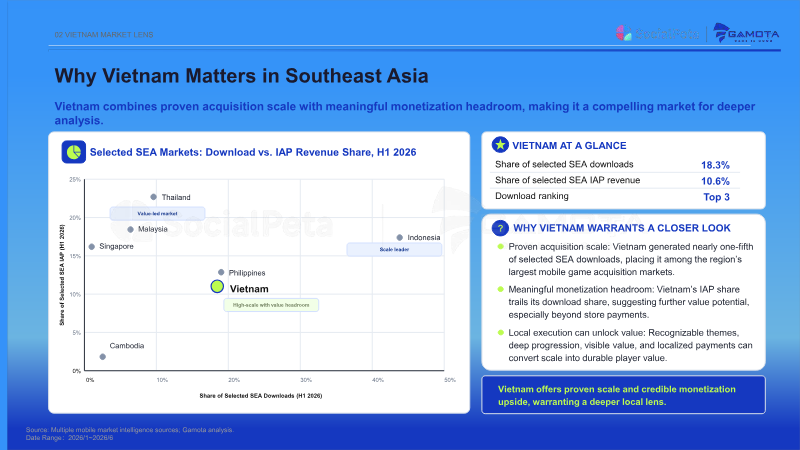
Southeast Asia solidified its position as the world’s second-largest mobile gaming market by downloads in early 2025, reaching 1.93 billion installs. While the region currently ranks seventh globally in revenue at $625 million, it demonstrates significant monetization potential fueled by expanding digital payment infrastructure and rising smartphone penetration. Indonesia serves as the primary volume driver with 870 million installs, while Thailand leads the region in consumer spending, generating $162 million. This growth is increasingly supported by publishers based in Singapore and Vietnam, who have emerged as a dominant global force, contributing over 5.8 billion installs to the international market through a mix of hypercasual hits and competitive titles. Market dynamics reveal a shift toward high-engagement genres and localized content strategies. Although casual arcade and simulation games drive the highest download volumes, monetization is concentrated in Strategy, MOBA, and RPG segments. Mobile Legends: Bang Bang remains the regional revenue leader, sustained by hyper-local live operations and community engagement. Simultaneously, the 4X Strategy genre is experiencing rapid expansion, highlighted by a 77.7% revenue surge for titles like Last War: Survival. Conversely, traditional MMORPGs have seen a decline of nearly 20%, making way for Open World Adventure RPGs and sophisticated strategy games that leverage deep social and competitive mechanics. The regional landscape is characterized by distinct national preferences and the global expansion of local firms. Vietnam has become a powerhouse for survival-themed hypercasual games, while Thailand shows a unique affinity for realistic sports simulations. Established titles like Garena Free Fire continue to dominate global charts by blending cultural relevance with nostalgic collaborations. Ultimately, the region’s trajectory is defined by a transition from high-volume downloads to sophisticated monetization, driven by a combination of community-led activations and the strategic global influence of Southeast Asian publishers.
The mobile gaming landscape experienced a notable shift in monetization and user acquisition patterns between 2022 and the first half of 2023. In-app purchase (IAP) activity demonstrated robust growth across both major mobile operating systems, with Android and Apple platforms recording increases of 23% and 24%, respectively. This upward trend in monetization suggests a resilient consumer base despite broader economic fluctuations within the mobile app ecosystem. Geographic distribution of installs remained relatively stable on Android, with India, Brazil, and the United States maintaining their positions as the top three markets. Conversely, the iOS landscape underwent more significant regional changes, as the United Kingdom, Canada, and Germany gained prominence, displacing China and Saudi Arabia from the top five rankings. These shifts highlight the evolving importance of Western markets for iOS-based mobile game developers. Ad network performance also saw a realignment in competitive dominance. On Android, Google Ads ascended to the top position for total installs in the first half of 2023, while Meta entered the top five. On iOS, AppLovin reclaimed the leading position, and Meta secured a top-five spot, reflecting a dynamic advertising environment where major platforms continue to vie for market share. This analysis relies on anonymized data aggregated by Tenjin from January 1, 2022, through June 30, 2023. The findings are restricted to ad networks and countries that achieved a minimum threshold of 25 million installs, ensuring that the reported trends represent significant market activity. By tracking these metrics, the data provides a clear view of the shifting priorities and regional focus areas for mobile publishers navigating the transition toward hybrid monetization models.
The hyper-casual mobile gaming sector experienced a notable escalation in acquisition costs during the latter half of 2022, characterized by rising median cost-per-install (CPI) rates across both Android and iOS platforms. By the fourth quarter of 2022, median CPI reached all-time highs of $0.20 on Android and $0.42 on iOS. This upward trend in acquisition spending was global, as no major market tracked by ad spend experienced a decrease in median CPI on Android, while iOS markets saw varied fluctuations, including a significant decrease in the United States and notable increases in France and Germany. Retention metrics reveal a consistent performance advantage for iOS over Android across all tiers of game quality. For the top 2% of hyper-casual titles, iOS achieved a 45% Day 1 retention rate compared to 38% on Android, with Day 7 retention figures similarly favoring iOS at 19% versus 14%. This performance gap persists among the top 25% of games and the median cohort, where iOS maintains a higher percentage of returning players. These findings underscore a widening disparity between high-performing titles and average games, emphasizing the critical importance of engagement optimization in a landscape of increasing user acquisition costs. The analysis draws upon data from over 100,000 games and one-third of the global mobile player base to establish these benchmarks. By segmenting performance by platform and geographic region, the data highlights the shifting economic landscape for developers and publishers. The findings suggest that while market saturation and rising costs present significant challenges, the ability to maintain player retention remains the primary differentiator between top-tier hyper-casual games and the broader market.