Market Forecast reports and market data
Documents

The Shifting Landscape of the Gaming Industry in 2024 with Newzoo's Ben Porter
The global gaming industry is currently navigating a period of structural right-sizing, transitioning from the aggressive, investment-fueled expansion of the post-COVID era toward a model defined by profitability and operational efficiency.
- The gaming market is experiencing a structural right-sizing where 90% of new revenue is concentrated in only 43 titles, creating extreme barriers to entry for new releases.
- Total player engagement has dropped significantly, with playtime declining by 26% since 2021 as new games struggle to compete with established live-service ecosystems.
- Industry growth figures are currently inflated by currency volatility and rising costs, leading to a disconnect between reported revenue and widespread workforce reductions.

TWIG #280 Game Industry Reports Galore
The modern gaming landscape is defined by a strategic push toward transmedia expansion and the integration of complex monetization models.
- The anticipated launch of a Nintendo Switch successor, featuring hardware upgrades and backward compatibility, is expected to serve as a critical catalyst for the stagnant console market.
- Transmedia adaptations like the Fallout series effectively increase brand awareness, but the incremental revenue generated often fails to offset the high production costs and logistical complexities involved.
- Mobile developers are increasingly shifting toward midcore monetization strategies, such as external web stores and dynamic bundle offers triggered by player failure states, to maximize revenue.
Nvidia (NVDA) to the moon! | Pixels & Profits #9
Nvidia has successfully pivoted from its origins as a gaming hardware manufacturer to become the primary architect of the global artificial intelligence infrastructure.
- Nvidia's revenue structure has shifted heavily toward data centers, which generated $18 billion in the quarter ending January 2024, accounting for over 80% of total revenue.
- Nvidia maintains a significant competitive moat due to the immense capital and hardware-focused infrastructure required for chip production, which is far more difficult to replicate than software-based competition.
- The company is successfully expanding its ecosystem beyond hardware through software SDKs and platforms like Maxine, Riva, NeMo, and Omniverse, which facilitate generative AI development and 3D world simulation.
The Road Ahead: Gaming Market Outlook Google's Alpagut Çilingir
The mobile gaming industry is currently navigating a period of significant contraction, characterized by declining market growth, rising user acquisition costs, and a shift toward a winner-takes-all dynamic where top-tier titles increasingly dominate market share.
- The mobile gaming market is shifting toward a winner-takes-all dynamic, characterized by declining overall growth and rising user acquisition costs.
- Studios must transition from hyper-casual models to hybrid-casual mechanics to improve long-term retention and monetization efficacy.
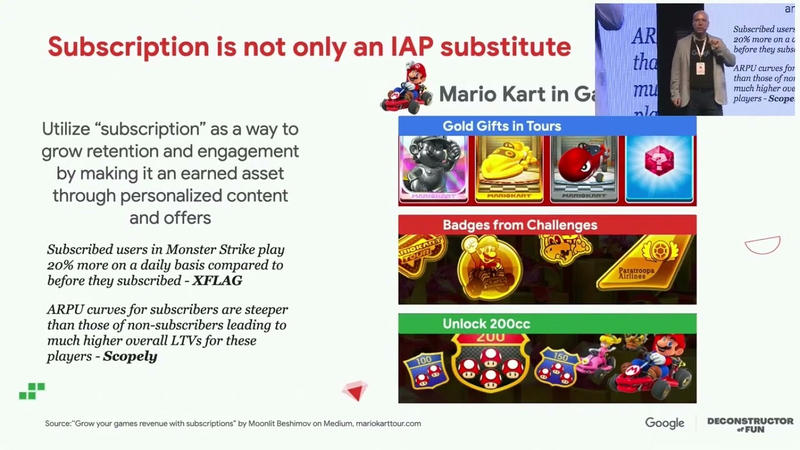
- Subscription models are becoming essential engagement tools, particularly when integrated with gamification features like badges and challenges.
Unfiltered Market Talk with Michail Katkoff & Eric Kress
The global gaming industry is currently navigating a period of structural stagnation, driven by a post-pandemic market correction, the lingering effects of privacy-centric user acquisition shifts, and a restrictive macroeconomic environment.
- The gaming industry has shifted from rapid expansion to a mature phase characterized by structural stagnation, driven by post-pandemic corrections, privacy-centric user acquisition challenges, and high interest rates.
- High capital costs are forcing studios to prioritize immediate operational efficiency and profitability over speculative growth, effectively stifling large-scale mergers and acquisitions.
- The mobile gaming market is evolving into a winner-take-all environment where established titles dominate revenue share, leading to a decline in core gaming segments despite the resilience of casual genres.

Reinvent India's Media & Entertainment Sector Is Innovating for the Future
The Indian media and entertainment sector reached a valuation of INR2.32 trillion in 2023, marking an 8.1% growth rate driven primarily by digital media and online gaming.
- The Indian media and entertainment sector reached a valuation of INR2.32 trillion in 2023 and is projected to exceed INR3 trillion by 2026, growing at a 10% CAGR.
- Digital media is expected to overtake television as the dominant industry segment by 2024, supported by a projected expansion to nearly one billion active screens by 2030.
- Online gaming has become the fourth-largest segment, surpassing filmed entertainment despite the implementation of a 28% GST mandate.



Manifesto 2024-2029: Più di un (video)gioco
The manifesto articulates a strategic vision for positioning Europe as a leading global hub for video-game development, emphasizing the sector’s unique blend of technology and creativity.
- The manifesto advocates for EU-wide policy alignment to establish Europe as a global video-game development hub by 2029, prioritizing the protection of an open, competitive market against new taxes or distribution constraints.
- Industry stakeholders are lobbying for the adaptation of the Creative Europe programme and the extension of the General Exemption Regulation to better align public funding mechanisms with the specific economic realities of game development.
- The proposal calls for the revision of NACE codes to accurately measure and report the sector's economic contribution to the European Union.

Karl Knights and Lirui Ding On The Data And Trends Defining Mobile Gaming In 2024
Global mobile gaming revenue is demonstrating resilience, characterized by a 4% increase in consumer spending throughout 2023 when excluding the Chinese market.
- Global mobile gaming revenue (excluding China) grew by 4% in 2023, signaling a stabilization of the market despite plateauing user time.
- Studios are increasingly utilizing predictive analytics and performance scoring to forecast app success and optimize development cycles.
- Industry monetization is shifting toward hybrid models that combine traditional in-app purchases with advertising strategies.

State of Mobile Gaming 2024 - Karl Knights, Data.ai
The 2024 State of Mobile Gaming analysis provides a comprehensive overview of the global mobile app ecosystem, focusing on market performance, genre trends, and consumer behavior throughout 2023.
- Global mobile gaming consumer spend in 2023 increased by 4% year-over-year when excluding the China market, despite a 2% decline in total app downloads to 88 billion.
- Mobile ad spend remains a growth engine, reaching $362 billion in 2023 with a projected compound annual growth rate of 16.2% to exceed $400 billion in 2024.
- The 'Billion Dollar Club'—apps generating over $1 billion in annual consumer spend—added 13 new members in 2023, including Royal Match and Gardenscapes.

PC and Console Gaming Predictions with Newzoo's Tom Wijman
The global gaming market is currently navigating a period of stagnation, with growth projected at a modest 1.3% through 2026.
- The global gaming market is experiencing a period of stagnation with growth projected at only 1.3% through 2026, refuting the industry's historical reputation as recession-proof.
- The industry is shifting away from live-service saturation and passive subscription models toward premium, high-quality experiences as consumer preferences evolve.
- Studios are prioritizing operational sustainability through widespread layoffs, reduced development budgets, and a strategic aversion to investing in new intellectual property.

Palworld Explodes / Riot Scales Back / Newzoo’s 2024 Report / Bullish Trends
The global gaming industry is currently navigating a period of intense operational recalibration, characterized by both the explosive success of independent hybrid titles and widespread corporate restructuring.
- The gaming industry is undergoing a period of significant downsizing, with approximately 4,000 layoffs recorded in early 2024 as companies correct pandemic-era hiring excesses.
- Riot Games has initiated a major restructuring, laying off 11% of its workforce and closing its Riot Forge label to shift toward a more focused, project-centric model.
- Newzoo’s 2024 forecast projects conservative industry growth of only 1%, reflecting market contraction, persistent inflation, and a move away from overly optimistic financial projections.

Games Marketing Predictions for 2024 with Eric Seufert
Microsoft is poised to challenge the mobile gaming duopoly in 2024 by leveraging the European Union’s Digital Markets Act to launch a proprietary mobile app store.
- Microsoft is positioned to challenge the Apple and Google mobile duopoly in 2024 by launching a proprietary app store, potentially utilizing Activision and King’s user bases to support a new advertising product.
- Official app stores will retain market dominance despite the Digital Markets Act, as high processing costs and platform-imposed friction limit the adoption of alternative in-app payment systems.
- Mobile game developers are increasingly shifting revenue to direct-to-consumer web stores to bypass platform commissions, which creates a discrepancy between public revenue data and actual industry performance.