Market Analysis
Documents
Power of Play: Informe Global de Videojuegos 2025
The research surveyed more than 24,000 active gamers from 21 nations on six continents, representing a broad cross‑section of the global gaming population (average age 41, 48 % female). Its central thesis is that video games function as a powerful catalyst for cognitive, social, educational, and mental‑health benefits, extending far beyond entertainment. Across all regions, a majority of players report gaming primarily for fun (56 %), stress relief (55 %) and mental stimulation (46 %). Mobile devices dominate usage (55 % of respondents), followed by PCs/laptops and consoles, while 73 % say gaming reduces feelings of isolation and 81 % view it as mentally stimulating.
Perceived skill development is strong: 77 % associate gaming with enhanced creativity, 74 % with problem‑solving, and substantial portions note improvements in teamwork, resilience and social interaction. The survey highlights a professional impact, with 43 % globally—reaching 76 % in Nigeria and 70 % in India—believing gaming positively shaped their education or career. Mental‑health outcomes are equally pronounced; 70‑90 % report reduced stress, increased happiness and a healthier outlet for daily challenges, with the highest well‑being scores in India, Nigeria and Mexico. Online multiplayer is identified as the primary social connector, cited by up to 96 % of respondents.
Complementary academic research corroborates these findings, showing that digital games boost learning engagement, reading skills and decision‑making, while immersive technologies such as AR/VR enhance performance in high‑stress professional settings, including medical surgery and aerospace training. Collectively, the evidence positions video games as a validated tool for skill development, education, and mental‑health recovery across diverse global markets.
- Gaming is primarily used for stress relief (55%) and mental stimulation (46%), with 73% of the 24,000 surveyed players reporting that it reduces feelings of isolation.
- Skill development is a major outcome, as 77% of players associate gaming with enhanced creativity and 74% with improved problem-solving abilities.
- Mobile devices are the leading platform for 55% of global gamers, followed by PCs/laptops and consoles.
- 43% of global respondents believe gaming has positively influenced their education or career, with that figure rising to 76% in Nigeria and 70% in India.
- Online multiplayer serves as the primary social connector for up to 96% of respondents.

El Seguro en el Ámbito de los Videojuegos
This industry guide, developed by the Spanish Video Game Association (AEVI) in collaboration with legal experts from Pérez-Llorca, serves as a strategic framework for managing risk within the video game development and publishing sectors. The primary thesis emphasizes that insurance is an essential mechanism for ensuring the financial viability of projects, acting as an indirect prevention tool against the inherent complexities of game production, such as tight delivery schedules, technical bugs, and intellectual property disputes.
The analysis identifies several critical risk categories specific to the gaming industry, including breach of delivery deadlines, transmission of computer viruses, and unauthorized data intrusions. Key findings highlight that Professional Civil Liability (RCP) and Errors and Omissions (E&O) insurance are the most vital protections for developers, covering involuntary contractual breaches and negligence. Furthermore, the guide underscores the rising importance of cybersecurity insurance to mitigate operational costs and reputational damage resulting from hacking, ransomware, and data leaks, which can trigger significant sanctions from regulatory bodies like the Spanish Data Protection Agency.
The scope of the guidance focuses on the Spanish market, referencing local legal standards and regulatory bodies, while covering the entire industry lifecycle from independent developers and freelancers to large publishers. It details specific coverage areas such as intellectual property infringement—protecting against claims regarding music, characters, and concept art—and liability for defamation or the unauthorized use of public images. Methodologically, the guide provides a practical checklist for insurance procurement, advising firms to utilize insurance brokerages for periodic contract reviews and to ensure all operational risks are disclosed to maintain policy validity.
- Professional Civil Liability (RCP) and Errors and Omissions (E&O) insurance are the primary mechanisms for protecting developers against involuntary contractual breaches and professional negligence.
- Cybersecurity insurance is essential for mitigating the operational costs and reputational damage associated with ransomware, data leaks, and hacking incidents.
- Insurance policies must specifically cover intellectual property infringement, including claims related to unauthorized use of music, character designs, and concept art.
- The Spanish Video Game Association (AEVI) and Pérez-Llorca identify breach of delivery deadlines, computer virus transmission, and unauthorized data intrusions as the most critical operational risks for game studios.
- Regulatory compliance, particularly regarding data protection standards enforced by the Spanish Data Protection Agency, is a major driver for adopting comprehensive insurance coverage.

Videojuegos en el Aula: ¿Qué se está haciendo en España? Manual para docentes 2025
Video games have become a central cultural and educational tool in Spain, where more than 22 million people—over half of them women—play an average of 8.2 hours each week. This widespread engagement is leveraged to motivate learning, prompting the development of a coordinated ecosystem that supplies teachers with curated resources, professional training, and ready‑to‑use platforms such as Dok Student, Cokitos, Mundo Primaria, Eutopía and Escapeweb. Publicly funded titles like ABC Dinos, BookyPets and Quijote: Quest for Glory employ RPG, tower‑defense and card mechanics to reinforce early literacy, while historically grounded games such as Dîrok, Plus Ultra Legado and El Enigma de Toledo integrate rigorous research into curricula, supporting both STEM competencies and language development.
A parallel surge in health‑oriented games addresses the mental‑health concerns of Spanish adolescents, with 41 % reporting problems and one‑third never having discussed them. These applications aim to provide preventive support and therapeutic engagement within school settings. Meanwhile, esports and gamified learning are gaining institutional traction; a national competition rewards winning schools with €20 000 in technology, and industry partnerships like GGTech’s site visits illustrate viable career pathways. Complementary initiatives, such as Cruz Roja’s 150‑hour Unity programming course for unemployed youth and the Andalusian “Desafía & Aprende” program, further embed game design skills into broader employment strategies.
Overall, the Spanish educational landscape demonstrates a rapid, multi‑sectoral integration of video games that spans literacy, history, health, and vocational training, reflecting a strategic response to the medium’s pervasive cultural presence and its potential to enhance learning outcomes across the country.
- Spain’s gaming ecosystem is supported by over 22 million players, with women accounting for more than half of the user base and an average weekly playtime of 8.2 hours.
- Educational integration is facilitated by a standardized infrastructure of platforms including Dok Student, Cokitos, Mundo Primaria, Eutopía, and Escapeweb.
- Publicly funded titles like ABC Dinos, BookyPets, and Quijote: Quest for Glory utilize RPG and tower-defense mechanics to improve early literacy, while games like Dîrok and El Enigma de Toledo support STEM and history curricula.
- To address the 41% of Spanish adolescents reporting mental health concerns, schools are increasingly adopting therapeutic and preventive video game applications.
- Institutional support for esports and gamification includes a national competition offering €20,000 in technology prizes and industry-led career exposure through partners like GGTech.
Global Business Strategies for K-Fashion: A Focus on K-Content
The analysis demonstrates that the future competitiveness of Korean fashion hinges on integrating cultural content with advanced technology and participatory fan ecosystems. Influencer campaigns have evolved from reliance on celebrity notoriety to collaborations built on shared values and fan‑aligned storytelling, positioning fan‑generated media as an active co‑marketing partner rather than a peripheral buzz generator. This shift amplifies brand authenticity and deepens consumer loyalty across global markets.
Artificial intelligence is identified as the primary catalyst reshaping product development, marketing, and sustainability. On‑demand production models, exemplified by Desigual’s AI‑driven forecasting, have markedly reduced inventory waste, while hyper‑personalized styling tools and virtual‑try‑on platforms are delivering measurable financial gains. Gentle Monster’s AI‑based recommendation engine lifted revenue by 25 %, and H&M’s deployment of digital twins curtailed refund rates, underscoring the profitability of AI integration. The emergence of agentic commerce, projected to mature by 2026, promises further automation of the purchase journey and deeper data‑driven consumer insights.
Geographically, the findings span a global perspective, encompassing major fashion hubs in North America, Europe, and Asia, and cover the period from the early 2020s through the anticipated developments of 2026. The scope encompasses the apparel, accessories, and eyewear segments, with particular emphasis on digital fashion, AI‑enabled supply chains, and the symbiotic relationship between K‑content and international consumer culture. Collectively, these insights outline a strategic roadmap for Korean fashion brands seeking to leverage cultural capital and technological innovation to secure sustainable growth worldwide.
- AI integration is a primary driver of profitability, evidenced by Gentle Monster’s 25% revenue increase through recommendation engines and H&M’s reduction in refund rates via digital twins.
- Korean fashion brands are shifting influencer strategies from celebrity-based notoriety to value-aligned storytelling, treating fan-generated media as a core co-marketing partner to boost authenticity.
- On-demand production models, such as those utilized by Desigual, are effectively leveraging AI-driven forecasting to minimize inventory waste and improve supply chain sustainability.
- Agentic commerce is projected to mature by 2026, a development expected to further automate the consumer purchase journey and provide deeper data-driven insights.
- Future competitiveness for Korean fashion relies on the strategic integration of cultural content, advanced technology, and participatory fan ecosystems across global markets.
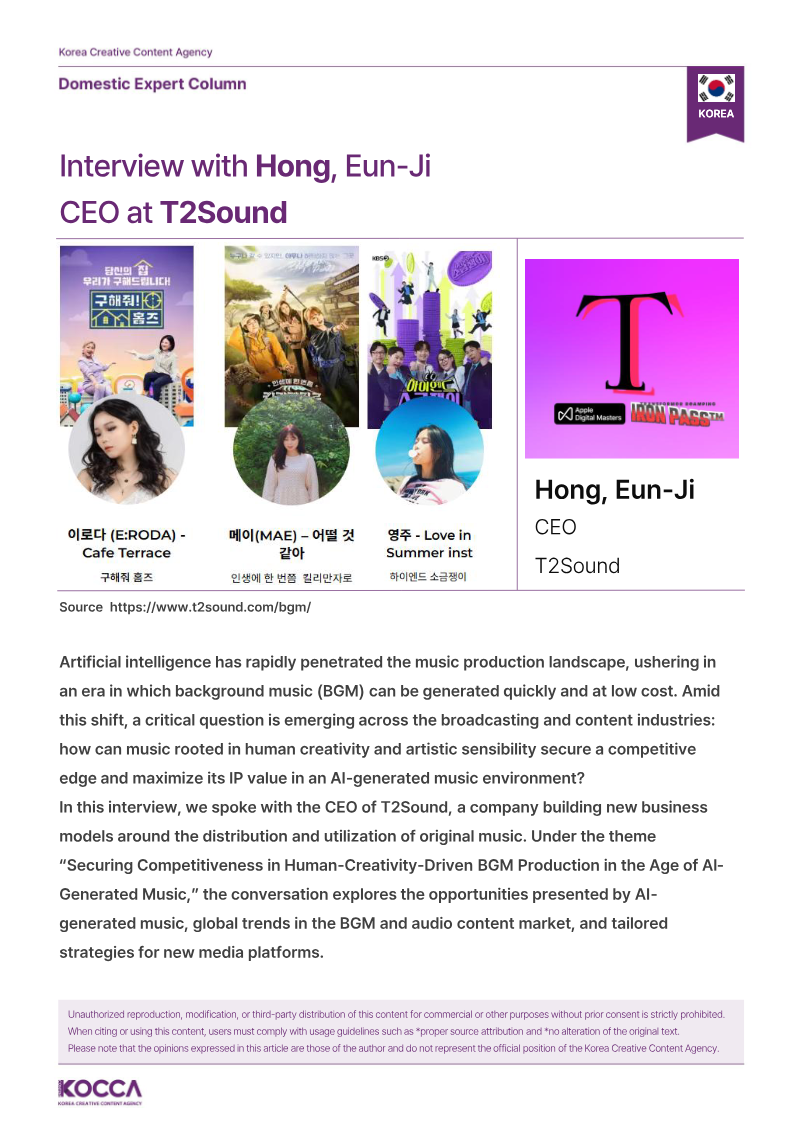
Securing Competitiveness in Human-Creativity-Driven BGM Production in the Age of AI-Generated Music: South Korea
The interview with Hong Eun‑Ji, CEO of T2Sound, examines how background‑music (BGM) producers in South Korea can preserve competitive advantage as AI‑generated music becomes increasingly affordable and rapid. The central thesis is that human creativity—particularly the ability to convey authentic emotion and intent—remains the decisive factor that AI cannot replicate, and that leveraging AI as a collaborative tool rather than a threat can enhance, not replace, the artistic value of BGM.
Key insights emphasize that quality and emotional resonance, achieved through meticulous mixing and mastering, are the core values guiding T2Sound’s work. The company prioritises collaboration with external creators, believing that collective expertise yields richer nuance than isolated in‑house production. Market trends reveal a shift among overseas buyers toward tracks with distinctive sonic signatures rather than generic pleasantness, and Korean BGM’s success abroad is linked to its unique emotional line and texture. In short‑form media, the interview highlights the necessity of an immediate, memorable hook within the first few seconds to secure brand recognition and audience immersion.
Looking ahead to 2026, the conversation predicts a consolidation around financially proven genres such as hip‑hop and trot in Korea, reflecting an industry increasingly driven by economic sustainability. The interview’s qualitative methodology—direct dialogue with a leading BGM provider—offers a focused perspective on the evolving interplay between AI tools, human artistry, and global market demands within the South Korean audio‑content sector.
- Human creativity remains the primary competitive advantage for BGM producers, as the ability to convey authentic emotion and intent cannot be replicated by AI.
- T2Sound maintains market competitiveness by prioritizing meticulous mixing and mastering to ensure high-quality emotional resonance, rather than competing solely on speed or cost.
- Global demand is shifting away from generic background music toward tracks with distinctive sonic signatures, with Korean BGM gaining traction due to its unique emotional texture.
- Short-form media content requires an immediate, memorable hook within the first few seconds to successfully secure brand recognition and audience immersion.
- T2Sound leverages a collaborative model with external creators to achieve richer artistic nuance than what is typically produced through isolated in-house workflows.
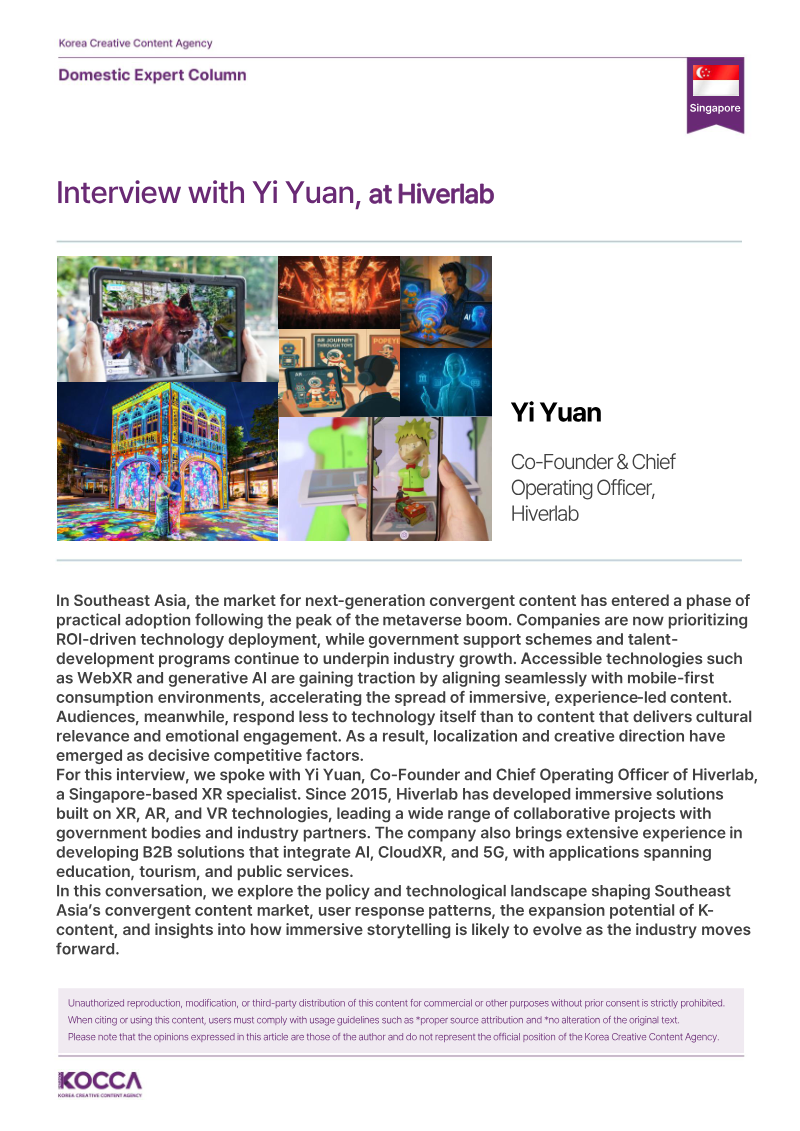
Interview with Yi Yuan, at Hiverlab: Southeast Asia
The interview underscores a shift in Southeast Asia’s convergent‑content market from speculative metaverse enthusiasm to a pragmatic, ROI‑driven landscape where augmented reality has become the primary vehicle for marketing and tourism initiatives. Growth is anchored in measurable outcomes such as cost‑reduction ratios and increased foot‑traffic, supported by government funding and a mobile‑first infrastructure that leverages WebXR and expanding 5G networks. Large‑scale AR deployments at heritage and tourist sites illustrate the sector’s scalability, emphasizing the necessity of culturally resonant storytelling, clear narrative structures, and quantitative metrics like dwell time and interaction density to assess engagement.
Effective experiences consistently incorporate gamified micro‑games and selfie‑style interactions that encourage user participation and social sharing. These design elements amplify interaction density and foster virality, reinforcing the importance of narrative quality over pure technological novelty. The chief operating officer highlights that AI‑generated, personalized storytelling—through digital humans and generative‑AI scripts—remains the chief catalyst for sustained user interest, with success measured by dwell time, interaction density and social‑virality indicators.
A principal commercial obstacle is the high bandwidth demand of simultaneous, large‑scale XR experiences. The rollout of 5G and cloud‑native architectures such as CloudXR has already mitigated latency and loading challenges, as demonstrated by the AR broadcast of Singapore’s Chingay festival in 2020. Continued expansion across the region will depend on further high‑bandwidth network deployment, sustained government infrastructure investment, and deeper integration of AI technologies to produce adaptive, immersive content.
- Southeast Asia’s convergent-content market has shifted from speculative metaverse projects to a pragmatic, ROI-driven focus on augmented reality for marketing and tourism.
- Success in the region is measured by quantitative metrics including dwell time, interaction density, and social-virality indicators rather than technological novelty.
- Large-scale AR deployments are currently anchored by government funding and mobile-first infrastructure, utilizing WebXR and 5G networks to ensure scalability.
- AI-generated personalized storytelling, including digital humans and generative-AI scripts, is identified as the primary catalyst for sustaining long-term user interest.
- High-bandwidth demands for simultaneous XR experiences are being addressed through cloud-native architectures like CloudXR, as evidenced by the 2020 AR broadcast of Singapore’s Chingay festival.
Growth of the Korean Emoticon Market: A New Distribution and Expansion Method for the K-Character Industry
The Korean emoticon market has evolved from a peripheral messaging feature into a multi‑billion‑won character‑IP industry, now valued at roughly KRW 1.5 trillion (≈US$1.2 trillion). This transformation is anchored by KakaoTalk, whose emoticon platform expanded from an initial KRW 100 billion base in the early 2010s to a dominant revenue stream that underpins a broader ecosystem of licensed characters and digital content. Over the past fourteen years, more than 850 000 distinct emoticons have been released, generating in excess of 300 billion individual sends, illustrating both high user engagement and the low‑sensitivity nature of the market’s cash flow.
The core of this growth lies in the development of unique intellectual‑property (IP) assets such as KakaoFriends and LINE Friends. These brands have transcended simple sticker usage to become central brand assets that are licensed across a spectrum of media, including merchandise, mobile games, animation, and information‑communication‑technology services. By converting emoticons into high‑value IP, companies have created diversified revenue channels that extend well beyond the messaging platform itself.
Export potential is accelerating, driven by corporate collaborations and strategic international expansion. Partnerships with established IP owners enable Korean firms to tap into global distribution networks, while the modular nature of emoticon‑based branding facilitates rapid adaptation to foreign markets. The overall trajectory suggests that the emoticon sector will continue to serve as a catalyst for the broader K‑character industry, reinforcing Korea’s position as a leading exporter of digital cultural content.
- The Korean emoticon market has grown into a KRW 1.5 trillion (≈US$1.2 trillion) industry, anchored by the KakaoTalk platform.
- Over the last 14 years, the market has seen the release of more than 850,000 distinct emoticons, resulting in over 300 billion individual sends.
- Emoticons have evolved from simple messaging features into high-value intellectual property (IP) assets, such as KakaoFriends and LINE Friends, that drive revenue across merchandise, mobile games, and animation.
- The industry has expanded significantly from its initial KRW 100 billion base in the early 2010s to become a primary revenue stream for digital content ecosystems.
- The sector’s growth is characterized by low-sensitivity cash flow and high user engagement, providing a stable foundation for broader K-character industry development.
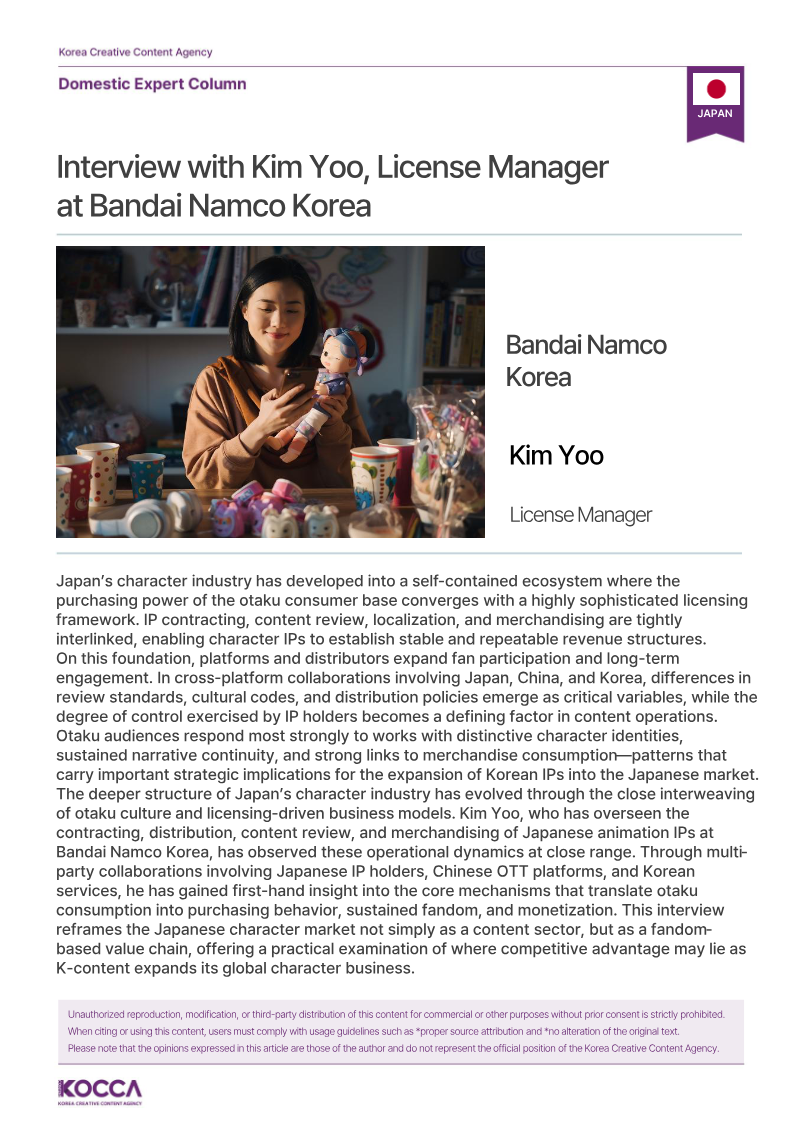
Interview with Kim Yoo, License Manager at Bandai Namco Korea
The Japanese character market has evolved from a niche subculture into a mainstream value chain driven by a diverse demographic of high-spending fans. While male consumers maintain a strong presence in the traditional collectible figure segment, women in their 20s and 30s have emerged as a dominant force, shifting market demand toward lifestyle goods, customizable plush toys, and shareable social media content. This transformation is fueled by the global reach of streaming platforms, the normalization of fandom culture through K-pop, and an increasing consumer preference for immersive offline experiences such as pop-up stores and collaboration cafés.
Strategic success in this landscape requires a dual-track approach that balances mass-market accessibility with premium, limited-edition offerings. Current growth is heavily concentrated in cross-category collaborations where character intellectual properties intersect with fashion, digital goods, and the music industry. Navigating this market necessitates a deep understanding of multi-tiered licensing structures and a commitment to protecting the narrative integrity, or worldview, of each IP. Establishing long-term credibility through disciplined execution remains a prerequisite for international partners seeking to enter this competitive ecosystem.
Looking toward 2026, the industry is moving toward a hybrid model that prioritizes experiential content and convergence-driven trends. To remain competitive, businesses must develop the agility to identify these shifts early and execute initiatives swiftly. The integration of character IPs into broader cultural sectors like exhibitions and music suggests that the future of the market lies in creating holistic brand experiences rather than simple product manufacturing. This evolution underscores the necessity for strategic flexibility and rapid response to the changing tastes of a globalized fandom.
- The Japanese character market has shifted from a niche segment to a mainstream industry driven by high-spending female consumers in their 20s and 30s.
- Market demand is moving away from traditional collectible figures toward lifestyle goods, customizable plush toys, and content optimized for social media sharing.
- Strategic success requires a dual-track model that balances mass-market accessibility with premium, limited-edition product offerings.
- Growth is increasingly concentrated in cross-category collaborations that integrate character intellectual property with fashion, digital goods, and the music industry.
- The industry is transitioning toward a hybrid model by 2026 that prioritizes experiential, holistic brand experiences like pop-up stores and collaboration cafés over simple product manufacturing.
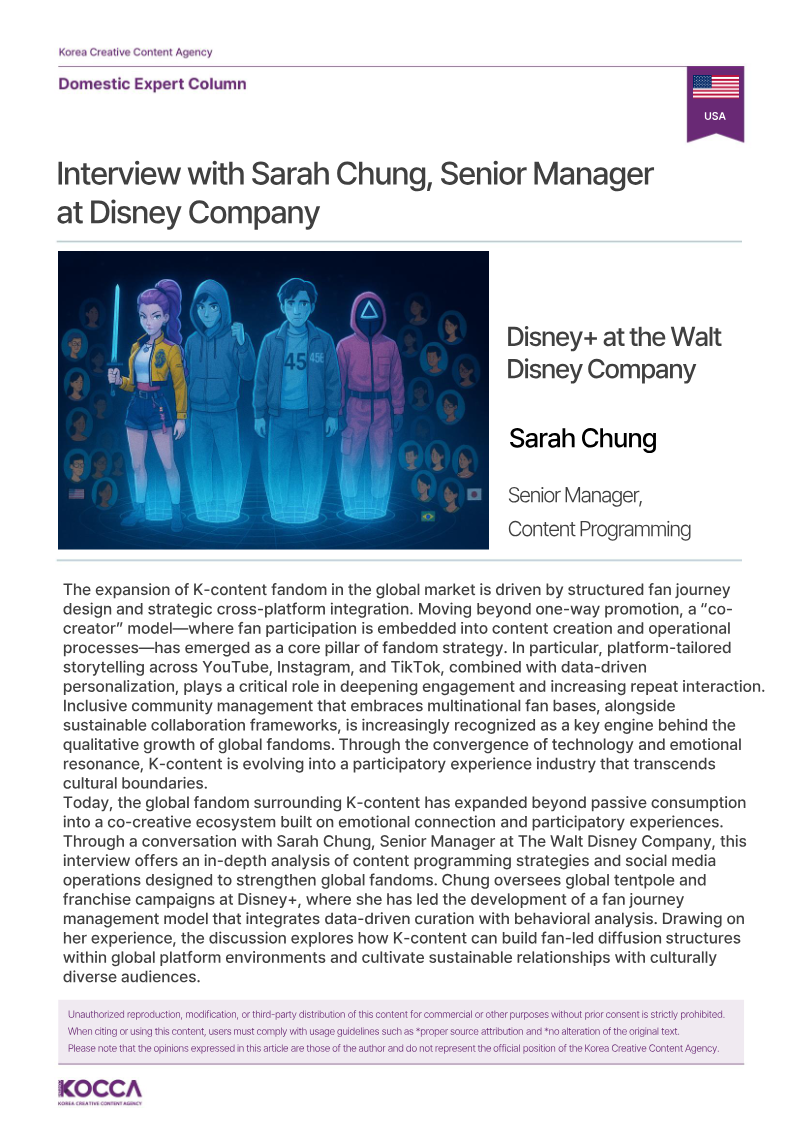
Interview with Sarah Chung, Senior Manager at Disney Company
The interview underscores that the worldwide surge of Korean content is rooted in a “cocreator” fandom model, where streaming services offering seamless subtitle and dubbing options enable audiences to engage directly with material and co‑produce cultural moments. This participatory dynamic is amplified by nostalgia‑driven “comfort viewing” and the rapid diffusion of fan‑made short‑form clips on TikTok, which together reshape attention spans and create a feedback loop that fuels further consumption.
A key finding is that Korean productions are breaking out of traditional genre boundaries, as illustrated by titles such as The Glory, D.P., Sweet Home and Gyeongseong Creature. These series now contend not only with other OTT platforms but also with short‑form ecosystems like TikTok and YouTube, as well as user‑generated content. To secure global reach, Korean studios must prioritize distribution channels that combine extensive international footprints with aggressive off‑platform promotion, while exploiting AI‑driven recommendation engines to surface relevant titles amid an oversupply of options.
Looking ahead to 2026, success will depend on a balanced strategy that merges technological adaptability, clear conceptual storytelling, and format experimentation. Integrating nostalgia‑centric comfort viewing with cross‑platform interactive campaigns will allow Korean creators to navigate a fragmented global content landscape and maintain competitive relevance across both long‑form and short‑form media environments.
- The global success of Korean content is driven by a 'cocreator' fandom model, where streaming platforms leverage seamless localization tools to allow audiences to actively participate in cultural moments.
- Korean productions must now compete for attention against both traditional OTT platforms and short-form ecosystems like TikTok and YouTube, necessitating a shift in how content is marketed and consumed.
- To maintain global reach, studios must adopt a dual strategy of utilizing platforms with extensive international footprints while executing aggressive off-platform promotional campaigns.
- Success in a saturated market requires the integration of AI-driven recommendation engines to ensure content visibility amid an oversupply of available media options.
- Future competitive relevance through 2026 depends on blending nostalgia-driven 'comfort viewing' with cross-platform interactive campaigns that bridge long-form and short-form media.
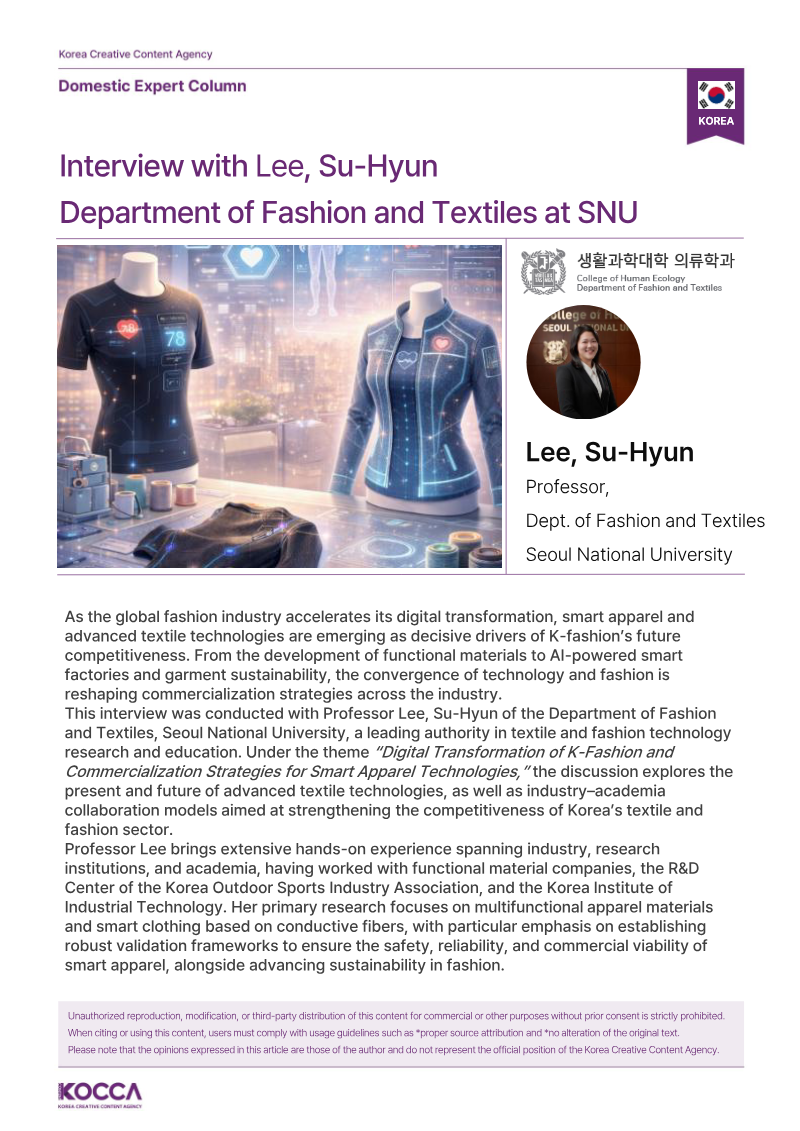
Interview with Lee, Su-Hyun: South Korea
The interview with Professor Lee Su‑Hyun of Seoul National University articulates digital transformation (DX) as a comprehensive restructuring of the Korean fashion value chain, extending beyond e‑commerce to encompass AI‑driven design, smart‑factory automation, and data‑centric marketing. By leveraging generative AI for 3‑D virtual prototyping, automated sewing, digital twins, and metaverse‑enabled retail experiences, the industry can cut sample costs, shorten lead times, and enhance personalized consumer interactions while supporting carbon‑neutral objectives such as on‑demand production and circular‑economy tracking.
Professor Lee emphasizes that smart apparel remains in early commercial stages, with functional niches in sports, healthcare, and disaster safety already demonstrating pilot deployments. Critical technical barriers include washability and durability of conductive fibers, sensor performance after repeated laundering, and the need for flexible, miniaturized battery solutions. Rapid advances in printed textile batteries and energy‑harvesting technologies are narrowing these gaps, yet mass‑production capacity and system integration lag behind leading markets in the United States and Germany.
Strategic recommendations focus on three business models: subscription‑based health and fitness services, interoperable platform modules detachable across garments, and specialized ceremonial wear where visible technology adds value. Successful scaling will require coordinated industry‑academia curricula, a robust talent pipeline, national standardization participation (e.g., IEC TC124), shared testing facilities, and proactive IP support to translate Korea’s strong patent portfolio into globally competitive products.
Looking ahead to 2026, AI and sustainability are projected to dominate the fashion sector. AI will become an essential capability across design, inventory, and personalization, while sustainability will drive digital traceability, carbon‑neutral manufacturing, and circular‑economy initiatives, together reshaping competitiveness criteria for the Korean fashion industry.
- South Korea’s fashion industry is undergoing a comprehensive digital transformation (DX) that integrates generative AI for 3-D virtual prototyping, smart-factory automation, and data-centric marketing to reduce sample costs and lead times.
- The adoption of on-demand production and digital traceability is being prioritized to meet carbon-neutral objectives and support circular-economy initiatives within the fashion value chain.
- Smart apparel development is currently limited to functional niches in sports, healthcare, and disaster safety, with technical progress hindered by the durability of conductive fibers and the need for miniaturized, flexible battery solutions.
- To achieve global competitiveness by 2026, the industry must overcome current lags in mass-production capacity and system integration compared to the United States and Germany.
- Strategic business models for smart apparel include subscription-based health services, modular, detachable technology components, and high-value ceremonial wear.
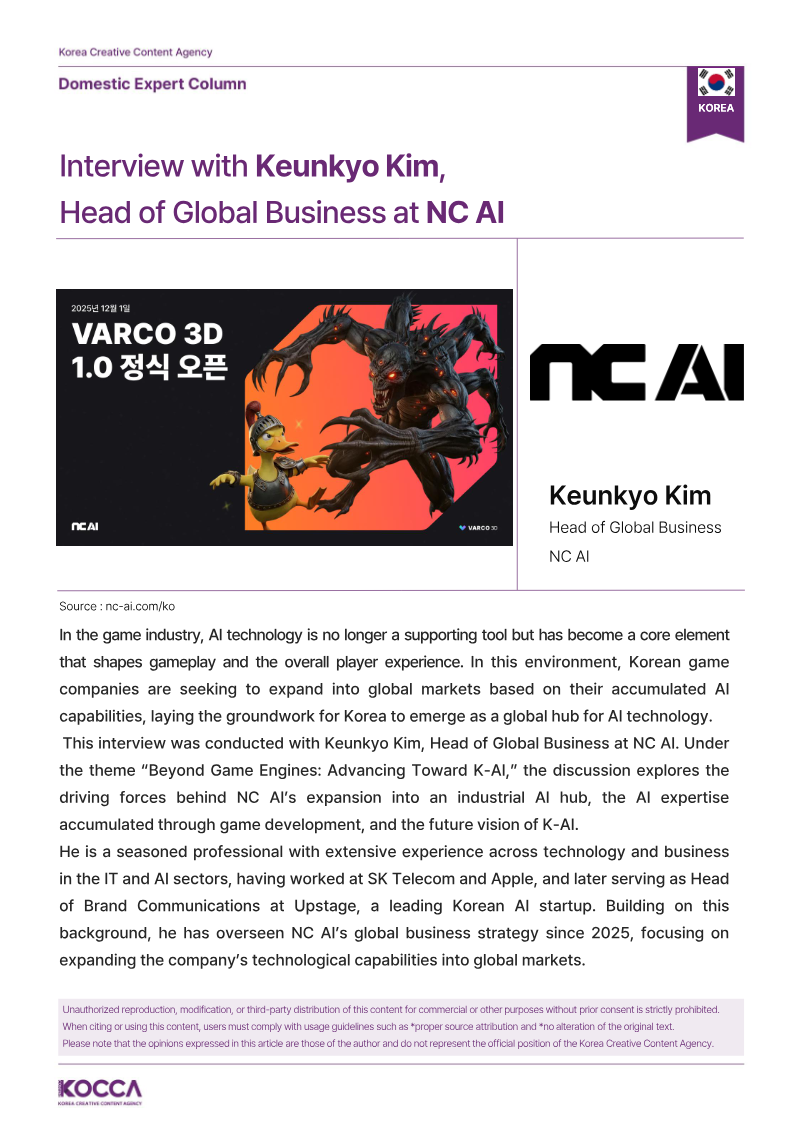
Interview with Keunkyo Kim, Head of Global Business at NC AI
The interview articulates NC AI’s transformation from a game‑focused research lab into a national industrial‑AI hub, positioning Korea as a global center for “K‑AI.” It outlines the company’s ambition to leverage fourteen years of game‑AI expertise to drive cross‑industry innovation, emphasizing that AI has moved from a supporting role to a core driver of gameplay, content creation, and broader economic competitiveness.
NC AI, a subsidiary of NCSoft, has built a proprietary large‑language model called VARCO and the VARCO 3D engine, which can generate near‑realistic, physics‑based 3D environments from text or images. The firm was selected as one of five leaders in Korea’s Independent Foundation Model project and became the first Korean entity to deploy its LLM on AWS. An open‑source release of VARCO Vision 2.0 attracted over 10 000 downloads within ten days, reflecting a strategic push for global adoption and a vibrant developer ecosystem.
The company’s real‑time processing and reinforcement‑learning capabilities, honed in massive MMORPG settings, are now applied to digital twins for manufacturing, robotics, smart‑city, and defense sectors. NC AI pursues a dual‑track model—developing a 200‑billion‑parameter LLM while simultaneously creating lightweight, edge‑optimized multimodal diffusion models—to balance scale with field efficiency. Its proprietary safety filter, Safeguard, has been integrated into NCSoft’s NCER chatbot, underscoring a commitment to AI trustworthiness and standards collaboration.
Looking ahead, NC AI leads a consortium of 54 organizations to produce industry‑specific AI that validates in real‑world environments, aiming for Korean AI sovereignty and global leadership. By enabling user‑generated content through VARCO 3D, Voice, and animation tools, the firm promotes a “everyone can be a creator” ethos, encouraging young talent to contribute to a vertically integrated AI ecosystem that links industry, government, and academia and positions Korea as a powerhouse in the international AI landscape.
- NC AI is leveraging 14 years of MMORPG-based reinforcement learning and real-time processing expertise to expand from gaming into industrial sectors, including manufacturing, robotics, smart cities, and defense.
- The company is developing a dual-track AI strategy that balances a 200-billion-parameter large language model with lightweight, edge-optimized multimodal diffusion models for field efficiency.
- NC AI’s proprietary VARCO 3D engine enables the generation of physics-based 3D environments from text or images, while the open-source VARCO Vision 2.0 achieved over 10,000 downloads within ten days of release.
- As a leader in Korea’s Independent Foundation Model project, NC AI is the first Korean entity to deploy its proprietary LLM on AWS and currently heads a 54-organization consortium to drive industry-specific AI adoption.
- The firm is prioritizing AI safety and trustworthiness through its proprietary 'Safeguard' filter, which is already integrated into the NCER chatbot.

PowerUP: Spelbranschen – en svensk basnäring
Sweden’s video‑game sector is positioned as a culturally driven, “born‑global” industry that, despite generating more than SEK 3.5 billion in revenue and employing over 15 000 staff abroad, remains fragmented and under‑supported at the national level. The analysis maps the ecosystem of roughly 1 000 firms—87 % micro‑enterprises, 42 % with no employees, and only 1 % large companies—highlighting that 97 % of studios rely on regional clusters such as Skövde, Malmö and the northern hub, which suffer from chronic under‑financing and a lack of long‑term planning. The sector’s growth is constrained by low legitimacy, inadequate national financing mechanisms, and regulatory barriers that impede talent recruitment, especially for start‑ups and regional firms.
Key findings show a mismatch between the sector’s cultural impact—average player age 32, documented benefits for creativity, problem‑solving, STEM interest and mental health—and the absence of coordinated public‑private structures to translate these gains into economic value. Comparative data reveal Sweden’s early‑stage funding to be far below peer EU nations, while the talent pipeline is strained, with a projected need for 25 000 developers over the next decade and 40 % of the current workforce being foreign‑born. The report recommends establishing a comprehensive national game strategy, a dedicated investment fund modeled on Industrifonden, long‑term financing for regional clusters, and a Swedish games institute to de‑risk commercial projects and retain IP ownership.
To secure sustainable growth, the analysis calls for reform of innovation metrics, inclusion of game‑specific occupations in labour policy, expanded vocational and research education, and the separation of cultural and commercial funding streams. By implementing these measures, Sweden could elevate its position from the EU’s fourth‑largest producer to a leading contender alongside France and Germany by 2025.
- Sweden's video-game sector requires a national strategy and a dedicated investment fund to support an ecosystem of 1,000 firms, 87% of which are micro-enterprises.
- The industry faces a critical talent shortage with a projected need for 25,000 new developers over the next decade, while 40% of the current workforce is already foreign-born.
- Despite generating over SEK 3.5 billion in revenue and employing 15,000 staff abroad, the sector is hindered by inadequate national financing and regulatory barriers that impede start-up growth.
- 97% of studios are concentrated in regional clusters like Skövde, Malmö, and northern hubs, which currently suffer from chronic under-financing and a lack of long-term planning.
- The sector remains highly fragmented, with 42% of firms having no employees and only 1% classified as large companies.