Market Analysis
Documents

Uppdaterad Statistik för de Kulturella och Kreativa Branscherna: Sverige
Sweden’s cultural and creative economy is quantified through an extensive 2023 update that records more than 140 000 firms employing roughly 250 000 people and generating over SEK 650 billion in turnover. Limited companies account for the bulk of activity (SEK 607 billion from 48 000 entities), while sole traders and other legal forms contribute SEK 16 billion and SEK 30 billion respectively. Revenue per employee averages SEK 2.6 million and intangible assets are valued at SEK 20 billion, underscoring the sector’s high productivity and knowledge intensity.
The core thesis asserts that existing SNI‑code classifications markedly under‑represent large and fast‑growing components such as digital platforms, video‑games, furniture design, and numerous craft activities, leading to distorted employment, value‑added and regional statistics. By revising the SNI list, eliminating irrelevant codes, and cross‑checking company accounts, a more accurate database—derived from roughly 73 000 active limited companies and refined to about 40 000 distinct firms—has been assembled. The transition to the 2025 SNI framework introduces five‑digit codes that improve granularity for design, illustration and literary arts, though short‑term classification gaps persist.
Turnover concentration is evident in a few dominant markets: music (SEK 11.4 billion, 12 % nominal growth), cultural events (SEK 42.3 billion), design (SEK 78.5 billion) and video‑games (SEK 34.6 billion). Data collection relied on commercial databases because Bolagsverket’s APIs cannot filter by SNI, highlighting a systemic data‑access limitation. The report recommends appointing a lead agency—suggested as Tillväxtverket—to oversee an annual analytical publication and maintain a comprehensive KKB database that integrates cultural VAT, service exports, firm size, region and activity type, ensuring reliable, comparable statistics across Sweden’s cultural and creative sectors.
- Sweden’s cultural and creative economy comprises over 140,000 firms and 250,000 employees, generating a total annual turnover exceeding SEK 650 billion.
- Limited companies drive the vast majority of sector revenue, contributing SEK 607 billion of the total turnover compared to SEK 46 billion from other legal entities.
- The sector demonstrates high productivity and knowledge intensity, with an average revenue per employee of SEK 2.6 million and intangible assets valued at SEK 20 billion.
- Key industry segments include design (SEK 78.5 billion), cultural events (SEK 42.3 billion), video games (SEK 34.6 billion), and music (SEK 11.4 billion, reflecting 12% nominal growth).
- Current SNI-code classifications significantly under-represent high-growth areas like digital platforms and video games, necessitating a transition to a more granular 2025 five-digit SNI framework.
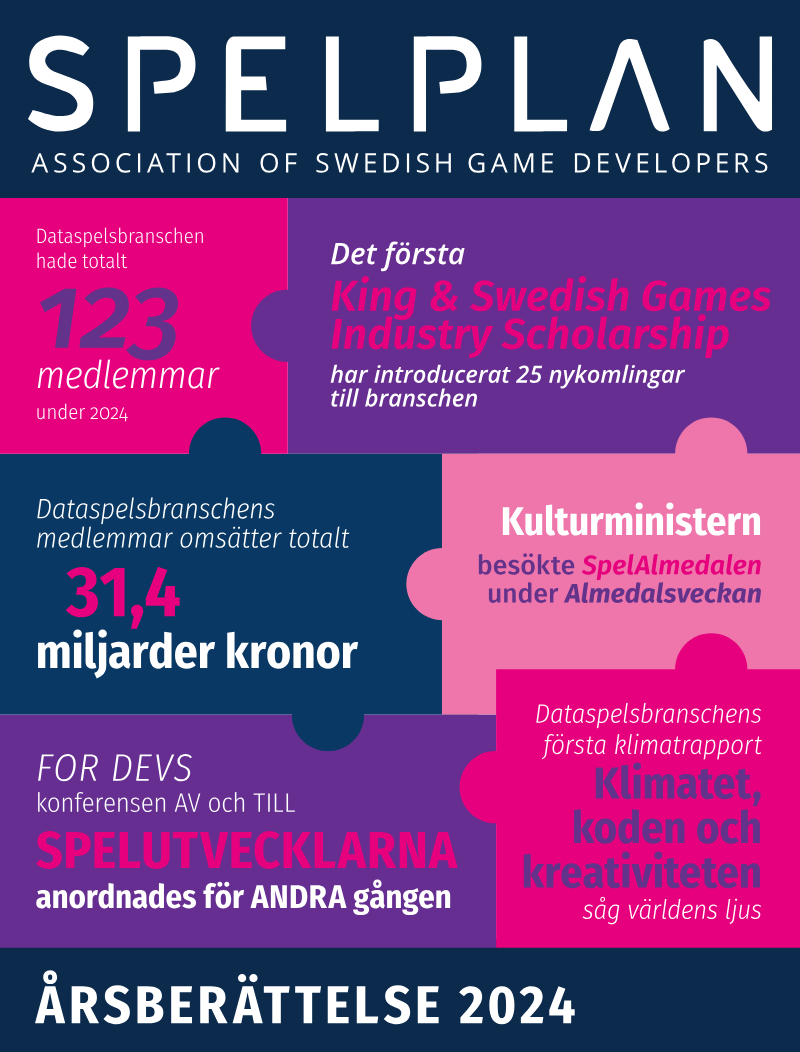
Association of Swedish Game Developers: 2024 Report
The 2024 overview of Sweden’s games industry presents a comprehensive assessment of the sector’s performance, challenges, and forward‑looking dynamics within the Swedish market. It argues that, despite a noticeable wave of studio closures, the industry remains resilient and is entering a phase of regeneration driven by regional clusters, targeted investment schemes, and internationally successful titles.
Analysis of the year shows that development activity is increasingly concentrated in hubs such as Skövde, where new studios have emerged and produced world‑hit games like Satisfactory, a title that secured both D.I.C.E. and Golden Joystick awards. This creative output underscores Sweden’s capacity to generate globally competitive products even as legacy firms exit the market. Growth is attributed largely to coordinated programmes—including Redeye Gaming Day, Invest in Games, and the EU‑funded CDG‑Booster mentoring cohort—that channel capital, mentorship, and market access to emerging developers.
The findings highlight a sector that, while contending with consolidation pressures, is expanding its export footprint and sustaining employment through the formation of new companies and the scaling of award‑winning projects. Investment in talent development and cluster formation emerges as a decisive factor in maintaining Sweden’s reputation as a leading European game‑development hub.
Overall, the 2024 snapshot confirms that Sweden’s games industry, spanning development, publishing, and ancillary services, continues to generate significant economic value and cultural impact, positioning itself for sustained growth in the coming years.
- Sweden’s games industry is undergoing a structural shift characterized by legacy studio closures offset by the emergence of new, high-performing development hubs.
- Regional clusters like Skövde have become primary drivers of industry output, exemplified by the commercial and critical success of the title Satisfactory.
- Industry resilience is supported by targeted support initiatives, including Redeye Gaming Day, Invest in Games, and the EU-funded CDG-Booster mentoring program.
- The sector is maintaining its international export footprint and employment levels by successfully scaling new companies and award-winning projects.
- Strategic investment in talent development and cluster-based infrastructure is identified as the core factor sustaining Sweden’s position as a leading European game-development hub.

Spelutvecklarindex: Sweden 2025
The analysis maps Sweden’s game‑development landscape, arguing that the sector’s rapid expansion has positioned the country as a leading European hub while simultaneously exposing new regulatory and societal challenges. Over the past twenty years the industry has multiplied from 71 firms with SEK 0.5 billion in revenue to more than 1 100 companies generating roughly SEK 37 billion—an increase of about 7 500 %—and employing 9 130 staff domestically, complemented by an additional 11 000 workers abroad. This growth underscores the sector’s escalating economic weight and its contribution to national employment.
Geographically, the ecosystem spans all Swedish counties, comprising over 300 development studios. The highest concentrations are found in Stockholm and its surrounding regions, notably Uppsala, Värmland and Örebro, where studio density exceeds twelve entries per county. Domestically, Swedish‑produced titles commanded the majority share of the Steam market in 2024, reflecting strong consumer preference for locally created content and reinforcing the sector’s market relevance.
Artificial intelligence has become a dual‑purpose tool within the industry: it is employed to generate novel game assets and to identify players exhibiting signs of radicalisation or harassment. The analysis stresses that radicalisation often migrates from in‑game interactions to external, unmoderated forums, distinguishing it from broader online hate. Consequently, it calls for coordinated, cross‑border interventions that involve regulators, academic researchers and game companies to mitigate these risks while preserving the sector’s innovative momentum.
- Sweden’s game industry has grown to over 1,100 companies generating SEK 37 billion in annual revenue, a 7,500% increase from the SEK 0.5 billion recorded twenty years ago.
- The sector currently employs 9,130 staff domestically and an additional 11,000 workers abroad.
- Swedish-produced titles held the majority market share on Steam in 2024, demonstrating strong consumer demand for local content.
- The industry ecosystem is comprised of over 300 development studios distributed across all Swedish counties, with the highest density concentrated in Stockholm, Uppsala, Värmland, and Örebro.
- Artificial intelligence is being utilized as a dual-purpose tool for both generating game assets and monitoring player behavior for signs of radicalization and harassment.

State of AI Apps Report 2025
The analysis quantifies the rapid expansion of generative‑AI applications in the first half of 2025, documenting 1.6 billion downloads and $1.2 billion in in‑app‑purchase revenue. This represents a 67 percent increase in downloads and a 200 percent jump in revenue compared with the second half of 2024, indicating a pronounced acceleration in user adoption and monetisation. Engagement metrics rose in tandem, underscoring the sector’s heightened activity during this period.
User demographics reveal a pronounced male and youth bias: roughly 60 percent of users are male and nearly 70 percent are under 35. While flagship services such as ChatGPT and Google Gemini attract comparatively balanced audiences and exhibit strong cross‑app overlap, niche offerings—including Grok and DeepSeek—tend to cluster with privacy‑focused, crypto‑trading, and gaming user personas. This segmentation highlights divergent appeal across the generative‑AI landscape.
Advertising investment intensified, with OpenAI’s major campaign propelling it into the top‑ten spenders in key markets such as the United States, India and South Korea. AI‑driven ad creatives increasingly employ light‑hearted, animal‑centric visuals while emphasizing concrete everyday utilities, exemplified by Google Gemini’s car‑warning guidance and Microsoft Copilot’s quiz‑making and recipe‑generation tools. Spend estimates, tracked across U.S. platforms including Reddit, LinkedIn, TikTok and YouTube, illustrate the breadth of digital‑advertising channels leveraged.
Overall, the findings portray a sector experiencing explosive growth, a skewed yet evolving user base, and a surge in AI‑powered marketing activity across major global markets during H1 2025.
- Generative AI applications experienced explosive growth in H1 2025, reaching 1.6 billion downloads and $1.2 billion in in-app purchase revenue.
- Revenue growth significantly outpaced adoption, with a 200 percent increase in in-app purchase revenue and a 67 percent rise in downloads compared to H2 2024.
- The user base is heavily skewed toward younger males, with approximately 60 percent of users being male and nearly 70 percent under the age of 35.
- While flagship services like ChatGPT and Google Gemini maintain broad appeal, niche AI apps such as Grok and DeepSeek are increasingly associated with privacy-focused, crypto-trading, and gaming demographics.
- OpenAI has become a top-ten advertising spender in major markets including the United States, India, and South Korea.

Gaming App Insights Report: 2025 Edition
The analysis tracks the state of the global mobile‑gaming market through 2024 and projects its trajectory toward 2025, emphasizing how emerging AI‑driven personalization will shape growth. It establishes that the sector is recovering from the volatility of 2023, with worldwide app installs climbing 4 % year‑over‑year in 2024, even as average session length contracted. Core user engagement metrics, however, show modest decline: day‑1 retention fell from 28 % to 27 % and median revenue per active user dropped from $0.31 to $0.28, indicating pressure on traditional monetization models. In contrast, advertising efficiency improved, reflected in higher installs per mille (IPM) and stronger ad‑performance indicators across major markets.
The report’s geographic scope is global, encompassing all major mobile‑gaming regions, and its temporal frame spans the 2023‑2025 period. It integrates data from app stores, ad networks, and cross‑platform measurement tools to deliver a comprehensive view of user acquisition, retention, and revenue trends. The central thesis posits that the next wave of growth will be powered by AI‑enabled, culturally tailored experiences that adapt difficulty, blend monetization formats, and deploy live events to boost lifetime value. Developers and marketers who adopt a metrics‑focused, AI‑augmented approach—identifying pivotal in‑game moments and steering users toward optimal pathways—are projected to achieve the most scalable expansion. Cross‑platform analytics suites are highlighted as essential for delivering the visibility required to implement these strategies effectively.
- Global mobile-gaming app installs grew by 4% year-over-year in 2024, signaling a recovery from 2023 market volatility.
- Monetization is under pressure as median revenue per active user declined from $0.31 to $0.28.
- User retention metrics weakened in 2024, with day-1 retention falling to 27% from the previous year's 28%.
- Advertising efficiency has improved, evidenced by higher installs per mille (IPM) and stronger performance indicators across major global markets.
- Average session lengths contracted in 2024, contributing to a modest overall decline in core user engagement metrics.
Japan Market Report 2025
The Japanese games market represents a unique and highly lucrative landscape, accounting for 9.1% of global games revenue despite containing only 2.2% of the global player base. Average revenue per user is significantly higher in Japan than in Western markets, with Japanese players spending approximately $223 compared to $145 in the United Kingdom. While the market is characterized by a strong preference for domestic franchises and Nintendo’s 70% dominance of console hardware, a substantial $2.5 to $3.0 billion opportunity exists for international stakeholders when excluding mobile and Nintendo platforms.
Demographic and behavioral data indicates that Japan’s PC and console player base is generally older than its Western counterparts. Player motivations also diverge sharply from global trends; Japanese gamers prioritize narrative depth, character design, and solo play, whereas Western players favor open worlds, high-end graphics, and competitive multiplayer. Genre preferences further illustrate this divide, with Japanese console players gravitating toward single-player RPGs and fantasy themes, while PC players increasingly embrace shooters and lower-priced co-op experiences.
The market has seen rapid PC revenue growth over the last seven years, though this trajectory is expected to stabilize through 2027. Conversely, the console segment has faced recent declines attributed to the Nintendo Switch lifecycle and a weaker slate of premium releases. International publishers face specific macroeconomic challenges, notably the weakening Japanese Yen against the U.S. Dollar. Despite these headwinds, titles such as Apex Legends and Genshin Impact have maintained massive free-to-play success, signaling continued potential for well-positioned global titles. This analysis utilizes data from the Newzoo Global Gamer Study, incorporating surveys from over 73,000 gamers across 37 markets to provide a comprehensive view of the 2025 landscape.
- Japan generates 9.1% of global games revenue from only 2.2% of the global player base, with an average revenue per user of $223 compared to $145 in the UK.
- International stakeholders have a $2.5 to $3.0 billion market opportunity when excluding mobile and Nintendo platforms, which currently command 70% of console hardware dominance.
- Japanese gamers prioritize narrative depth, character design, and solo play, contrasting with Western preferences for open worlds, high-end graphics, and competitive multiplayer.
- While PC revenue has experienced rapid growth over the last seven years, this trajectory is projected to stabilize through 2027.
- The console segment is currently facing declines due to the Nintendo Switch lifecycle and a weaker slate of premium releases.

Shooter Games on Live Streaming Mini-Report
This analysis explores the landscape of shooter games on live streaming platforms from 2019 through 2025, tracking viewership trends, subgenre shifts, and the impact of esports. While shooters remain a cornerstone of the industry—consistently accounting for at least 20% of all gaming viewership—the genre has seen a 6% decline in market share since 2022. By 2024, shooters represented approximately one-in-five gaming hours watched, totaling 6.1 billion hours.
The data reveals a significant transition in subgenre dominance. Tactical shooters overtook battle royale games in 2023 to become the most-watched subgenre. This shift is largely driven by the sustained popularity of Valorant and Counter-Strike, which together claim 90% of tactical shooter viewership. Conversely, the battle royale subgenre has seen its viewership halve since its 2020 peak, despite the continued popularity of Fortnite. Other segments, such as extraction and arena shooters, have maintained stable but smaller market shares, with Escape From Tarkov accounting for nearly two-thirds of all extraction shooter hours.
Esports serves as a primary engine for the genre's visibility. By late 2025, nearly half of all Counter-Strike viewership was generated by esports events. Valorant maintains a balanced global presence, holding significant viewership shares across North America, Europe, Asia, and the Southern Hemisphere. In contrast, Counter-Strike remains heavily reliant on the European market, while PUBG Mobile dominates the mobile-centric Asian market.
The analysis also highlights the influence of individual creators and variety streamers. In 2024, Gaules emerged as the leading shooter streamer with 79.2 million hours watched. While Twitch remains the dominant platform for top creators, accounting for 73% of the top ten's viewership, the data shows high viewer overlap between franchises. For example, over 40% of Valorant viewers also engage with other tactical shooters, suggesting strong community fluidity across the genre. Methodology for these findings includes data aggregation from all major streaming platforms, excluding TikTok Live, with specific sentiment analysis conducted on Twitch chat data.
- Shooter games remain a pillar of live streaming, accounting for 6.1 billion hours watched in 2024, though their total market share has declined by 6% since 2022.
- Tactical shooters became the most-watched subgenre in 2023, with Valorant and Counter-Strike capturing 90% of that segment's viewership.
- Battle royale viewership has halved since its 2020 peak, despite the sustained popularity of Fortnite.
- Esports is a critical driver of engagement, accounting for nearly 50% of all Counter-Strike viewership by late 2025.
- Viewer demographics are geographically segmented, with Counter-Strike concentrated in Europe, PUBG Mobile dominating the Asian market, and Valorant maintaining a balanced global presence.
Yearly Live Streaming Trends Report 2024
The live streaming industry experienced a period of stabilization and strategic maturation throughout 2024, characterized by a modest 3% year-over-year increase in total hours watched across major platforms. This growth brought the global annual viewership to approximately 35 billion hours, signaling a shift from the volatile surges of previous years toward a more sustainable, long-term trajectory. While Twitch maintained its position as the market leader in terms of total hours watched, its market share faced increasing pressure from YouTube Gaming and Kick, the latter of which saw a 45% increase in viewership as it successfully attracted high-profile creators through non-exclusive contracts and aggressive revenue-sharing models.
Geographically, the Asia-Pacific region remains the primary engine for mobile streaming growth, while North American and European markets show a deepening preference for high-production "eventized" content. Non-gaming content, specifically the Just Chatting category, continues to dominate the landscape, accounting for nearly 15% of all platform activity. However, the competitive gaming sector saw a resurgence driven by the massive success of tactical shooters and the expansion of co-streaming rights for major esports tournaments. These community-driven broadcasts often outperformed official channels, representing a fundamental shift in how audiences consume professional competitive play.
The integration of artificial intelligence and enhanced monetization tools defined the technological landscape of the year. Creators increasingly utilized AI-driven moderation and clip-generation tools to maximize reach across short-form video platforms like TikTok and Instagram Reels, which now serve as the primary discovery funnel for live broadcasts. Brands have responded by shifting budgets toward long-term creator partnerships rather than one-off sponsorships, seeking to capitalize on the high engagement rates of mid-tier streamers who boast more dedicated, niche communities. As the industry moves into 2025, the convergence of live commerce and interactive broadcasting is expected to become the next major frontier for platform revenue.
- The live streaming industry reached 35 billion hours watched in 2024, reflecting a stable 3% year-over-year growth rate as the market shifts toward long-term sustainability.
- Kick grew its viewership by 45% in 2024 by leveraging aggressive revenue-sharing models and non-exclusive contracts to challenge Twitch’s market leadership.
- The 'Just Chatting' category remains the dominant content type, accounting for nearly 15% of all platform activity across the industry.
- Co-streaming rights for major esports tournaments have fundamentally changed consumption habits, with community-driven broadcasts frequently outperforming official tournament channels.
- Short-form video platforms like TikTok and Instagram Reels have become the primary discovery funnels for live streaming, driven by the adoption of AI-powered clip-generation tools.

Global Sports Tech Market Report H1 2025
In the first half of 2025 the global sports‑technology sector recorded approximately $52 billion in announced or closed transactions, underscoring a rapid acceleration of both merger‑and‑acquisition activity and capital raising. Roughly $32 billion stemmed from 233 M&A deals, while a record‑high $6.6 billion was secured through 239 private‑placement rounds, more than 80 % of which involved early‑stage companies. The capital influx was driven by a mix of strategic consolidations—most notably TSG Consumer’s $1.5 billion acquisition of EOS Fitness and RTL’s $613 million purchase of Sky Deutschland—alongside a wave of targeted investments such as Valeas’s $110 million majority stake in Ticketmanager, Genstar’s acquisition of Playmetrics for integration with Stack Sports, and IMG’s takeover of SportsRecruits. Deal multiples varied across subsectors, reflecting divergent growth trajectories within wearables, fan‑engagement platforms, and performance‑analytics solutions.
Geographically, the activity spanned North America, Europe and emerging markets, with transaction processing centralized through Drake Star Securities LLC in the United States and its UK affiliate, Drake Star UK Limited, both operating under FINRA regulation and SIPC membership. This infrastructure ensures compliance and investor protection for institutional participants. The concentration of early‑stage financing and the prevalence of large‑scale consolidations together signal a market transitioning from fragmented innovation toward integrated platforms capable of delivering end‑to‑end sports experiences. The data suggest that investors and strategic acquirers view the sector as a high‑growth arena, positioning it for continued expansion and deeper consolidation throughout the remainder of 2025.
- The global sports tech market reached a total deal value of $51.9 billion in H1 2025 across 503 announced or closed transactions.
- M&A activity dominated the sector with $32.2 billion in disclosed deal value across 233 deals, led by TSG Consumer’s $1.5 billion acquisition of EōS Fitness.
- Private placements hit a record $6.6 billion across 239 deals, highlighted by Infinite Reality raising $3 billion and DAZN securing $1.8 billion.
- Investor appetite for new sports-focused capital remains high with over $3.5 billion in new funds announced, including the $1.2 billion Checketts Sports fund.
- Disney acquired a 70% stake in FuboTV for $220 million in cash and a $145 million loan, creating a provider with 6.2 million subscribers.

Global Gaming Report 2025
The analysis focuses on the accelerating consolidation of the worldwide gaming ecosystem, emphasizing the unprecedented scale of mergers and acquisitions (M&A) and private‑placement financing observed in the final quarter of 2025 and projecting a further surge into 2026. In Q4 2025, a record‑high 43 announced transactions totaled $83 billion, highlighted by Netflix’s $82.7 billion purchase of Warner Bros.’ avatar‑technology portfolio and Kakao Games’ $78 million strategic stake aimed at expanding its PC and console footprint. Private‑placement activity complemented the M&A wave, with 137 deals raising $1.5 billion, underscoring heightened investor appetite for growth‑stage gaming ventures.
The data reveal a clear shift toward acquisition of immersive‑technology assets, particularly avatar and metaverse‑related capabilities, as major platform operators seek to deepen engagement across streaming and interactive media. Geographic distribution remains truly global, with North American and Asian firms leading both deal origination and capital provision, while sovereign wealth entities such as the Public Investment Fund (PIF) emerge as influential buyers. The breadth of activity spans traditional console and PC publishers, mobile‑first developers, and emerging gaming‑tech startups, indicating a convergence of content, distribution, and underlying technology.
Looking ahead to 2026, the outlook anticipates a sharp acceleration in gaming‑tech M&A, driven by a roster of “buyers to watch” that includes PIF‑backed Scopely, Netflix, Paramount, Tencent, Krafton and NCSoft. The forecast suggests that strategic imperatives—namely, securing avatar‑tech, expanding cross‑platform ecosystems, and leveraging data‑driven monetisation—will fuel continued dealmaking at volumes exceeding the historic Q4 2025 peak. Overall, the findings point to an industry in the midst of rapid structural realignment, with capital flowing toward assets that enable deeper, more immersive player experiences and broader monetisation opportunities.
- The gaming M&A market reached a landmark $161 billion in total disclosed value across 759 announced deals in 2025.
- Netflix announced a major $82.7 billion acquisition of Warner Bros. and its gaming division, which triggered a hostile $108.4 billion bid for Warner Bros. Discovery by Paramount–Skydance.
- A consortium led by PIF completed a $55 billion leveraged buyout of Electronic Arts (EA) in September 2025.
- Private company financings totaled $6.2 billion across 509 deals, led by Luma AI’s $900 million Series C and a $2.5 billion investment in Dream Games by CVC and Blackstone.
- The Drake Star Gaming Index rose 12% in 2025, significantly bolstered by Unity's 92% stock price increase and NEXON's 63% growth.

Sports Tech Market 2025
The 2025 sports‑technology market experienced an unprecedented surge of private capital, with roughly 500 announced transactions totaling $14.3 billion. Early‑stage investments alone contributed about $8.8 billion, underscoring a robust pipeline of emerging innovators and a strong appetite among venture investors for nascent solutions across performance analytics, fan engagement, and digital infrastructure. This influx of funding reflects a broader confidence in the sector’s growth trajectory and its expanding role within the global sports ecosystem.
Concurrently, the year was marked by a wave of mega‑valuations and record‑size mergers and acquisitions, most prominently the $10 billion acquisition of the Los Angeles Lakers and the $6.1 billion purchase of the Boston Celtics. These franchise deals, together with a $76 billion NBA media‑rights package, illustrate the escalating financial stakes attached to elite sports properties and the premium placed on content distribution platforms. Valuation metrics for traditional sports‑tech firms stabilized around an average EV/EBITDA multiple of 4.2× and a revenue multiple near 13×, indicating a mature market where profitability and top‑line growth are increasingly scrutinized by investors.
Overall, the analysis captures a market that is both capital‑intensive and consolidation‑driven, with the United States serving as the focal point for high‑profile transactions while broader global trends echo similar patterns of investment and valuation. The data suggest that continued inflows of private capital, coupled with strategic M&A activity, will shape the competitive landscape and set valuation benchmarks for the next phase of sports‑technology development.
- The sports tech market reached a record $200 billion in total deal value across 1,026 announced transactions in 2025.
- M&A activity was dominated by two mega-deals: Netflix's $82.7 billion proposed acquisition of Warner Bros Discovery and Saudi PIF/Silver Lake's $55 billion acquisition of EA.
- Private placements hit a record $14.3 billion in 2025, a 1.5x growth in value since 2023, despite the total number of financing deals declining to 500.
- New capital for sports tech-focused funds exceeded $12 billion in 2025, highlighted by Apollo Global Management launching a $5 billion strategic sports investment vehicle.
- The Fantasy, Esports & Betting segment led capital raised in private placements, featuring landmark rounds for Polymarket ($2.2 billion) and Kalshi ($1.5 billion).
Game Developer Employment: Career Formation of Student Game Creators 2019 Survey 2025
The 2025 Japanese survey of students’ career aspirations investigates how the role of “game creator” is perceived across gender, age, and educational level, aiming to gauge the pipeline of future talent for the domestic game development sector. It encompasses elementary, middle, high‑school, technical‑college and university respondents nationwide, providing a comprehensive snapshot of attitudes toward a profession that remains peripheral in the broader labor market.
Findings reveal a stark gender divide. Among male pupils in elementary and middle school, the game‑creator career ranks first overall and consistently appears within the top two choices for grades three through nine, indicating strong early enthusiasm. In contrast, female students place the same role far lower, with the position falling to nineteenth overall for females and remaining near the bottom of their preference lists at every age level. When respondents reach higher‑education stages, roughly eighty percent of those who still consider the occupation view it primarily as a professional pathway rather than a hobby or ancillary activity.
The data suggest that while the game‑creator profession enjoys robust appeal among young males, it fails to attract comparable interest from females, potentially limiting diversity in the future workforce. The pronounced early‑stage gender gap underscores the need for targeted outreach, curriculum development, and mentorship programs that can broaden awareness and appeal among female students, thereby strengthening the talent base for Japan’s evolving game industry.
- A significant gender divide exists in career aspirations, with game creator ranking as the top choice for male elementary and middle school students while placing nineteenth for females.
- The appeal of a game development career for males remains consistently high, appearing in the top two career choices for students from grade three through nine.
- Approximately 80% of higher-education students interested in game creation view the role as a professional career path rather than a hobby or secondary activity.
- The persistent lack of interest among female students across all age levels suggests a potential long-term bottleneck for diversity in the Japanese game industry workforce.
- The 2025 survey data indicates that the game creator profession remains a peripheral career choice within the broader Japanese labor market despite strong early enthusiasm from young males.