Market Analysis
Documents

The Future Of NPCs: What Gamers Demand From Next-Gen Characters
The evolution of non-playable characters (NPCs) has failed to keep pace with the rapid advancements in game graphics and narrative complexity, leading to a significant gap in player immersion. While modern titles feature sophisticated world-building, NPC technology remains largely stagnant, relying on repetitive dialogue trees and rigid scripts. Research conducted among 1,002 U.S.-based gamers aged 16 to 50 reveals that while 84% of players consider NPCs vital to the gaming experience, over half are frustrated by repetitive dialogue and an inability for characters to adapt to in-game changes.
The transition toward advanced AI NPCs—characters powered by machine learning, natural language processing, and emotional perception—represents a transformative shift for the industry. Survey data indicates an overwhelming appetite for this technology: 99% of gamers believe advanced NPCs would positively impact gameplay, and 88% believe they would significantly improve immersion. Players specifically desire NPCs with situational awareness, the ability to remember previous interactions, and the capacity for free-flowing conversation. This demand is highest among fans of RPG and sandbox genres, where interaction with the world is a core mechanic.
Beyond enhancing the player experience, the integration of advanced AI presents a substantial commercial opportunity for developers. The findings show that 81% of gamers are willing to pay more for titles featuring intelligent NPCs, and 79% are more likely to purchase a game if it includes this technology. Furthermore, 78% of respondents indicated they would spend more time playing games with advanced NPCs, suggesting a direct correlation between AI sophistication and player retention.
The methodology utilized a 20-minute online survey where participants interacted with demos of advanced AI technology. The sample included a diverse range of players across PC, console, mobile, and VR platforms, spending an average of five to eight hours per week gaming. Ultimately, the data suggests that moving away from scripted dialogue toward dynamic, autonomous characters is essential for studios looking to remain competitive and meet the rising expectations of modern audiences.
- 99% of gamers believe that integrating advanced AI into NPCs would positively impact gameplay, while 88% expect it to significantly improve overall immersion.
- 81% of players are willing to pay a premium for games featuring intelligent NPCs, and 79% report a higher likelihood of purchasing titles that utilize this technology.
- 78% of gamers indicate they would increase their playtime in titles featuring advanced, autonomous NPCs, suggesting a direct link between AI sophistication and player retention.
- While 84% of the 1,002 surveyed gamers consider NPCs vital to the gaming experience, over 50% express frustration with current limitations like repetitive dialogue and rigid, non-adaptive scripts.
- Players specifically demand NPCs capable of situational awareness, memory of past interactions, and free-flowing, natural language conversation, with the highest demand coming from RPG and sandbox genre fans.

Trends Report 2025
Intrinsic in-game advertising functions as a resilient, year-round engagement channel that maintains steady session volumes even during seasonal lulls in traditional media. While PC and console platforms offer superior immersion and average session lengths of 107 minutes, mobile gaming provides twenty-five times the impression scale and greater gender diversity. Market data reveals a significant strategic opportunity in the first quarter, particularly in North America, where advertising costs drop by over 25% despite high player activity. This period offers a cost-effective window for wellness and travel brands to reach an attentive audience at a lower entry point than the highly competitive fourth quarter.
The effectiveness of this medium is driven by high viewability rates reaching nearly 100% and attention metrics that consistently outperform traditional digital formats. Although the sports genre commands the highest playtime and premium pricing, racing and simulation categories represent efficient alternatives where high engagement intersects with lower costs. Regional performance varies significantly, with European markets offering peak value in the first and third quarters, while the Asia-Pacific region follows a distinct cycle driven by second-quarter demand and localized cultural events.
Beyond visibility, these advertisements generate substantial brand lift, including a 20-point increase in recall and a 6% conversion rate for physical foot traffic. While male players currently report higher brand favorability, female audiences demonstrate stronger purchase intent, suggesting a need for more nuanced targeting strategies. Overall campaign performance remains highly efficient, with conversion costs averaging 21% below established goals. To maximize these returns, advertisers must integrate gaming into their permanent media mix, while developers should align in-game events with high-demand periods and real-world sporting calendars to optimize revenue.
- In-game advertising delivers high efficiency, with conversion costs averaging 21% below established goals and brand recall increasing by 20 points.
- North American advertising costs drop by over 25% in the first quarter, providing a cost-effective window for brands to reach highly active players.
- Mobile gaming offers twenty-five times the impression scale of PC and console platforms, while PC and console environments provide deeper immersion with average session lengths of 107 minutes.
- Racing and simulation game categories serve as cost-efficient alternatives to the premium-priced sports genre while maintaining high engagement levels.
- In-game ads achieve nearly 100% viewability, consistently outperforming traditional digital media formats in attention metrics.

InvestGame Q4'24 Report (Unknown Time)
The gaming industry experienced a strategic shift in 2024, moving away from short-term financial arbitrage toward long-term, objective-driven transactions. While the broader market faced a stricter environment characterized by layoffs and the offloading of non-core assets, total deal-making activity remained above pre-pandemic levels. A significant trend emerged in the work-for-hire sector, highlighted by the $2.8 billion Keywords buyout. Additionally, venture capital interest notably pivoted from game development studios toward platform and technology startups, leaving corporate venture arms to fill the gap in studio financing.
The analysis identifies a stabilization phase following the post-pandemic "hangover." Private investments saw a 22% year-over-year increase in funding during Q4 2024, while the M&A market recorded one of its strongest quarters in two years. Although the public market remained volatile, a three-quarter recovery trend in public offerings suggests a gradual reopening of the IPO window. Geographically, North America and Europe led early-stage studio fundraising, accounting for the vast majority of capital raised, while Asian developers dominated new top-tier mobile releases.
The outlook for 2025 anticipates sustained M&A momentum driven by lower interest rates, significant cash reserves among public strategics, and increased private equity involvement. Investment in AI-driven solutions and web3 is expected to rise, fueled by renewed crypto enthusiasm. While high-profile gaming teams will continue to command strong valuations, such deals may become less frequent as investors prioritize "picks and shovels" technology over pure content.
This report covers global gaming industry segments including PC, console, mobile, and hardware, with a specific focus on M&A, private equity, and public offerings. Data is derived from public media, business partners, and market insights, tracking closed transactions while excluding pure gambling and non-gaming blockchain ventures.
- The gaming industry is shifting toward long-term, objective-driven transactions, evidenced by a strong Q4 2024 M&A market and a 22% year-over-year increase in private investment funding.
- Venture capital is pivoting away from game development studios in favor of platform and technology startups, forcing corporate venture arms to become the primary source of studio financing.
- The work-for-hire sector is seeing major consolidation, underscored by the $2.8 billion buyout of Keywords.
- Public markets are showing signs of a gradual recovery, with a three-quarter trend suggesting the IPO window is beginning to reopen despite ongoing volatility.
- Investment strategies for 2025 are expected to prioritize 'picks and shovels' technology—specifically AI and web3 solutions—over pure content development.

Access for All: Expanding Opportunities for Players and Publishers Worldwide
This analysis explores the strategic shift toward out-of-app monetization in the global gaming industry, with a specific focus on Southeast Asia and China. The primary thesis posits that while Apple and Google have historically dominated distribution, publishers are increasingly adopting alternative channels—including third-party web stores, first-party direct-to-consumer platforms, and alternative app stores—to bypass high "take rates" and better serve unbanked populations in emerging markets.
Key findings indicate that out-of-app monetization is already a mature practice in Asia. In Southeast Asia, these channels account for 21% of mobile game revenue, while in China, they represent 53% of the market. Data from 2023 highlights that in the "SEA-6" countries (Indonesia, Malaysia, Philippines, Singapore, Thailand, and Vietnam), 40-50% of the adult population remains unbanked, making the credit card-centric models of primary app stores ineffective. Consequently, gamers in these regions prefer e-wallets, carrier billing, and physical vouchers. A case study of Mobile Legends: Bang Bang in the Philippines demonstrated that a localized promotion using an e-wallet partner led to a 133% increase in daily purchase volume and a 167% rise in transactions.
The scope of the research covers the evolution of digital distribution over the last 15 years, with a forward-looking projection through 2027. It emphasizes the impact of regulatory momentum in the EU, UK, South Korea, and Japan, where new legislation is forcing primary stores to allow alternative payment systems. Methodology relies on Niko Partners’ 2023 market model, gamer surveys, and proprietary data from Coda Payments. The findings conclude that publishers who fail to localize their monetization and discovery strategies risk losing significant market share to regional competitors who offer more flexible, lower-cost payment solutions.
- Out-of-app monetization is a dominant force in Asia, accounting for 53% of the mobile gaming market in China and 21% in Southeast Asia.
- In the SEA-6 region, 40-50% of the adult population is unbanked, rendering traditional credit card-centric app store models ineffective for a large segment of potential players.
- Publishers are increasingly bypassing primary app stores to avoid high take rates and to implement localized payment methods like e-wallets, carrier billing, and physical vouchers.
- Localized payment strategies drive significant growth; a case study of Mobile Legends: Bang Bang in the Philippines showed a 133% increase in daily purchase volume and a 167% rise in transactions via e-wallet partnerships.
- Global regulatory pressure in the EU, UK, South Korea, and Japan is mandating that primary app stores allow alternative payment systems, accelerating the shift toward decentralized distribution.

Tower Defense Games - Industry Snapshot
Tower Defense games represent a high-performing sub-genre within the casual arcade category, characterized by exceptional monetization and engagement depth. Analysis of 2020 industry data reveals that the top 5% of Tower Defense titles significantly outperform related sub-genres like Idlers, Platformers, and Board Games in financial efficiency. Specifically, these top-tier games achieve a conversion rate of 3.83%, more than double that of their closest competitors, and maintain an Average Revenue Per Daily Active User (ARPDAU) of $1.66. This financial strength is further evidenced by an Average Revenue Per Paying User (ARPPU) of $83, suggesting a highly committed and spending-prone player base.
Engagement metrics for the genre are equally robust, with top-performing titles commanding an average daily playtime of 130 minutes. While Day 1 retention sits at 40%, slightly lower than some competing sub-genres, Day 7 retention remains competitive at 15%. Geographic performance varies by metric; Italy leads in Day 7 retention at 39%, while France sees the highest daily playtime at 210 minutes. China stands out as the most lucrative market for conversion, reaching a rate of 8.7%.
The success of the genre is attributed to its accessible core mechanics, high replayability, and the ease with which developers can integrate meta-features such as PvP modes, daily challenges, and RPG elements. These features allow for significant meta-game shifts with minimal content overhead. Notable titles entering the market in 2020, such as Rush Royale and Towerlands, exemplify the trend of blending traditional defense mechanics with strategy and role-playing elements to drive long-term player investment. This data is derived from a network of over 134,000 integrated games and 1.8 billion monthly cross-title players.
- Top-tier Tower Defense games achieve a 3.83% conversion rate and an ARPDAU of $1.66, significantly outperforming Idlers, Platformers, and Board Games.
- The genre sustains a highly committed player base with an Average Revenue Per Paying User (ARPPU) of $83 and an average daily playtime of 130 minutes.
- China is the most lucrative market for the genre, reaching a conversion rate of 8.7%, while France leads in engagement with 210 minutes of daily playtime.
- Retention metrics for top titles show a 40% Day 1 rate and a 15% Day 7 rate, with Italy notably achieving a 39% Day 7 retention rate.
- Successful 2020 titles like Rush Royale and Towerlands demonstrate that blending traditional defense mechanics with RPG elements and PvP modes drives long-term player investment.

Newzoo Puzzle Games Report: Mobile Game Genre Insights
Produced through a partnership between Newzoo and Pangle, this analysis examines the global mobile puzzle game market with a specific focus on the divergent trends between Western and Eastern territories. The study covers major markets including the United States, China, Japan, and South Korea, utilizing 2020 revenue data and 2021 consumer insights. By comparing market dynamics, monetization strategies, and player demographics, the research aims to provide actionable intelligence for developers seeking global expansion.
Findings indicate that the United States is the world’s largest mobile puzzle market, followed by Japan and China. While classic match-3 mechanics remain dominant globally, the genre is evolving through "meta" elements like narrative and decoration. A significant regional distinction exists in monetization: Western titles rely heavily on in-app advertising (IAA) and simple economies, whereas Eastern titles—particularly in Japan—integrate deep character collection, progression, and gacha mechanics, leading to higher in-app purchase (IAP) revenue. Data shows that while Western players demonstrate a higher tolerance for frequent ad breaks, Japanese players prefer longer sessions with fewer interruptions but show a greater willingness to pay for additional functions and aesthetic enhancements.
Demographically, puzzle gamers across all regions skew female and are typically full-time employees with mid-to-high income. However, Eastern players tend to be younger and more highly educated than their Western counterparts. The methodology relies on Newzoo’s proprietary Global Games Market Report and Consumer Insights, supplemented by a case study from Japanese developer Translimit. The analysis concludes that success in the puzzle genre requires localized user acquisition strategies, such as performance-based A/B testing and region-specific ad creative optimization, to navigate the distinct cultural expectations of the global mobile audience.
- The United States is the world's largest mobile puzzle market, followed by Japan and China.
- Western puzzle games rely heavily on in-app advertising (IAA) and simple economies, while Eastern titles—especially in Japan—prioritize deep character collection and gacha mechanics to drive higher in-app purchase (IAP) revenue.
- Western players demonstrate a higher tolerance for frequent ad breaks, whereas Japanese players prefer longer, uninterrupted sessions and show a greater willingness to pay for aesthetic enhancements and additional functions.
- The global puzzle genre is shifting from classic match-3 mechanics toward the integration of 'meta' elements, such as narrative-driven gameplay and decoration features.
- While puzzle gamers globally skew female and are typically full-time employees with mid-to-high income, Eastern players are generally younger and more highly educated than their Western counterparts.

Essential Facts: About the U.S. Video Game Industry 2025
The 2025 Essential Facts report by the Entertainment Software Association provides a comprehensive analysis of the video game industry's footprint in the United States. Based on a February 2025 survey of 5,000 respondents conducted by YouGov, the data reveals that 205.1 million Americans—approximately 64% of the population—play video games for at least one hour per week. The study spans a broad demographic range from ages 5 to 90, highlighting that gaming has become a lifelong pastime; notably, 49% of Boomers and 36% of the Silent Generation engage in weekly play.
The findings emphasize the social and developmental role of gaming within American households. Approximately 82% of gaming parents play with their children, and 67% believe video games offer more potential benefits than social media. Beyond entertainment, 87% of players who engage with sports titles report that these games improve their real-life athletic performance. The industry also serves as a significant cultural discovery engine, with younger generations using games to find new music, movies, and television shows. Accessibility remains a priority, as 21% of adult players report having a disability, and nearly half of that group considers in-game accessibility features to be extremely important.
Economically, the industry continues to show robust growth, with total consumer spending reaching $59.3 billion in 2024. This figure represents a 32% increase since 2019, with the majority of revenue ($51.3 billion) derived from software content. Mobile remains the most popular platform, used by 72% of gaming households, followed by PCs and consoles. The report concludes that video games have transcended their status as a hobby to become a primary driver of the U.S. economy and a central pillar of modern social connection and skill development.
- The U.S. video game industry generated $59.3 billion in consumer spending in 2024, marking a 32% increase since 2019.
- Approximately 205.1 million Americans, or 64% of the population, play video games for at least one hour per week.
- Software content is the primary revenue driver, accounting for $51.3 billion of the total $59.3 billion industry spend in 2024.
- Mobile gaming is the dominant platform, utilized by 72% of gaming households, followed by PC and console platforms.
- Gaming has broad demographic appeal, with 49% of Boomers and 36% of the Silent Generation engaging in weekly play.

Newzoo Hypercasual Mobile Game Genre Report: Eastern vs Western Markets
Hypercasual mobile games represent a significant and evolving segment of the global gaming industry, accounting for 36 of the top 100 downloaded mobile games in 2021. While the genre is characterized by simple mechanics and high accessibility, it has faced increasing competition, leading to a shift toward hybrid-casual models. These newer titles incorporate meta-features and live operations to improve player retention, which typically falls below 10% by the seventh day for standard hypercasual titles.
The market demonstrates distinct regional variations, with hypercasual games enjoying significantly higher popularity in Western markets like the United States and United Kingdom compared to Japan and South Korea. In 2021, runner and racing subgenres overtook simulation and puzzle titles as the most downloaded categories. Demographically, hypercasual players across key markets skew male, are often full-time employees with mid-to-high incomes, and are younger than the average mobile gamer.
Monetization remains primarily driven by in-game advertising, with interstitial video identified as the most adopted format, followed by rewarded videos and banner ads. However, hybrid monetization is rising, with developers increasingly offering in-app purchases for ad removal or exclusive content. Data from 2021 indicates that the hypercasual sector is highly dynamic; only eight of the top 36 hypercasual titles from 2020 remained in the top rankings the following year. To maintain growth, publishers are leveraging broad targeting strategies that are less affected by privacy changes like IDFA and are utilizing sophisticated retention optimization tools to acquire loyal users.
- Hypercasual games accounted for 36 of the top 100 most downloaded mobile games in 2021, though the sector is highly volatile with only eight of the top 36 titles from 2020 remaining in the top rankings the following year.
- Standard hypercasual titles struggle with retention, typically seeing less than 10% of players return by the seventh day, which is driving a strategic shift toward hybrid-casual models that incorporate meta-features and live operations.
- Runner and racing games became the most downloaded subgenres in 2021, surpassing the previously dominant simulation and puzzle categories.
- Hypercasual games are significantly more popular in Western markets like the U.S. and U.K. compared to the Japanese and South Korean markets.
- Monetization is shifting from a reliance on interstitial, rewarded, and banner ads toward hybrid models that integrate in-app purchases for content or ad removal.
Diversity and Inclusion in Gaming: Newzoo & Intel Report
This research, conducted by Newzoo in collaboration with Intel, examines the state of diversity and inclusion within the United States gaming market. The study challenges the misconception that the gaming population is primarily composed of young, white males, noting that there are approximately 2.7 billion gamers globally. By analyzing a representative sample of 1,824 gamers aged 10–65 via Computer Assisted Web Interviewing in early 2020, the findings identify significant gaps in representation, accessibility, and affordability that impact marginalized communities.
The data reveals that gamers of color, particularly Black and Hispanic/Latinx players, tend to be younger and more engaged than their white counterparts. For instance, roughly 75% of Black PC players are under the age of 35, compared to 50% of white players. Furthermore, Black and Asian PC gaming populations skew more female than other groups. Despite this high engagement, 47% of all U.S. gamers report avoiding titles they feel are not made for them, and over half emphasize the importance of diverse character representation—a sentiment strongest among LGBTQIA+ players and those with disabilities.
Economic factors play a critical role in gaming habits and hardware preferences. Due to historical economic disparities and younger average ages, Black and Hispanic/Latinx gamers are more likely to use laptops rather than expensive high-end desktops and show a higher affinity for game library subscriptions like Xbox Game Pass. These services provide a lower barrier to entry for high-quality content. Additionally, the study finds that players of color are more likely to be "Ultimate Gamers" or "Subscribers" compared to white gamers, who have a higher share of "Lapsed Gamers."
The analysis concludes that the industry must move beyond "sitting on the fence" regarding societal issues. Nearly half of U.S. gamers are more likely to support publishers that take active stances on social justice. By prioritizing affordability, accessibility, and authentic representation, hardware and software providers can better serve an evolving, diverse audience and unlock significant untapped revenue and engagement opportunities.
- Nearly 50% of U.S. gamers are more likely to support publishers that take active stances on social justice issues, signaling a shift in consumer expectations toward corporate responsibility.
- 47% of U.S. gamers actively avoid titles they perceive as not being designed for them, highlighting a significant barrier to market penetration for non-inclusive content.
- Black and Hispanic/Latinx gamers are younger and more engaged than white counterparts, with 75% of Black PC players under the age of 35 compared to 50% of white players.
- Economic disparities drive hardware preferences, as Black and Hispanic/Latinx gamers favor laptops over high-end desktops and show a higher affinity for subscription services like Xbox Game Pass to lower barriers to entry.
- Over half of the U.S. gaming population prioritizes diverse character representation, a sentiment that is most pronounced among LGBTQIA+ players and those with disabilities.

Power of Play: 2025 Global Video Games Report
Across more than twenty national markets, the majority of gamers report that playing video games reduces stress and enhances happiness, with 70‑90 % indicating lower stress levels and 57‑91 % feeling happier. Respondents also cite diminished anxiety and isolation, while parents observe a positive shift in relationships with their children, ranging from roughly one‑third in Sweden to nearly four‑fifths in Nigeria. Mobile devices dominate the landscape, accounting for 60‑96 % of play sessions, and online multiplayer emerges as the most prevalent social mode.
In the United Arab Emirates, United Kingdom and United States, surveys of roughly three thousand gamers reveal consistent benefits: about 70‑80 % experience reduced stress and increased well‑being, and roughly two‑thirds of parents note improved parent‑child interaction. Genre preferences diverge, with UAE players favoring teamwork, collaboration and creativity, whereas UK and US gamers gravitate toward problem‑solving, critical‑thinking and cognitive‑skill development. Approximately half to sixty percent of participants perceive gaming as supportive of career‑related or hobby pursuits, and a similar share report enhancements in professional competencies.
Research spanning multiple sectors demonstrates that video‑game‑based training yields measurable gains in cognition, decision‑making speed and technical performance. Gamers outperform non‑gamers in robotic‑surgery simulations, emergency‑response drills and retail‑seasonal‑sales scenarios, with meta‑analyses confirming statistically significant improvements in perception, attentional control and procedural accuracy. These outcomes translate into higher job performance, reduced error rates and stronger return on investment, prompting organizations such as NASA, the U.S. Air Force and elite sports teams to integrate game‑based platforms into their training pipelines.
- Video games provide measurable professional benefits, with gamers outperforming non-gamers in robotic surgery, emergency response, and retail simulations due to improved cognition, decision-making speed, and attentional control.
- Organizations including NASA, the U.S. Air Force, and elite sports teams have integrated game-based platforms into their training pipelines to reduce error rates and improve return on investment.
- Mobile devices are the primary gaming platform globally, accounting for 60–96% of all play sessions.
- A majority of gamers across more than twenty national markets report significant mental health benefits, with 70–90% experiencing reduced stress and 57–91% reporting increased happiness.
- Approximately 50–60% of gamers report that gaming supports their career or hobby pursuits and enhances professional competencies.

New Zealand Plays
Video gaming has become a mainstream activity across New Zealand households, with the majority of homes now possessing multiple gaming devices. Seventy‑three percent of residences own two or more consoles or similar hardware, and eighty‑one percent of the population engages in gaming, most of them adults; the average player is 36 years old and eighty percent are aged 18 or older. Parental motivations for allowing children to play centre on enjoyment, educational value and problem‑solving, while a strong majority of parents enforce rules around gameplay. Over three‑quarters of parents set limits, and nearly four‑tenths consider those limits “very much” enforced, with a similar proportion applying them “to some degree.” Adult respondents display solid awareness of New Zealand’s game‑classification system, though familiarity drops for the R13‑R16 categories.
The findings derive from a nationally representative sample of 820 households surveyed in May 2025, encompassing 1,309 individual gamers—including 282 parents—and demographic data on 1,731 persons across the sampled homes. The study achieved a 3.5 percent margin of error and collected detailed information on device ownership, playtime, attitudes and knowledge of classification standards. Results highlight the entrenched role of gaming in everyday life, the prevalence of parental regulation, and a generally high level of consumer understanding of content ratings, albeit with gaps for mid‑range age classifications.
Overall, the research underscores the maturity of the New Zealand gaming market, the integration of gaming into family routines, and the need for clearer communication around specific rating bands to support informed parental decision‑making.
- Gaming is a mainstream activity in New Zealand, with 81% of the population playing and 73% of households owning two or more gaming devices.
- The average New Zealand gamer is 36 years old, with 80% of the gaming population aged 18 or older.
- Over 75% of parents implement gameplay limits for their children, with nearly 40% describing these rules as strictly enforced.
- Parental support for gaming is primarily driven by the perceived benefits of enjoyment, educational value, and problem-solving skills.
- While awareness of the New Zealand game-classification system is generally solid among adults, there is a notable decline in familiarity regarding R13–R16 rating categories.
The Romanian Video Games Development Industry
The analysis presents a comprehensive overview of Romania’s video‑game development sector, focusing on revenue performance, geographic concentration, and workforce trends over the past decade. Its central thesis is that the industry has experienced rapid expansion, with total turnover rising from roughly €119 million in 2015 to more than €340 million in 2024, while the number of active studios grew by 70 % within the same period.
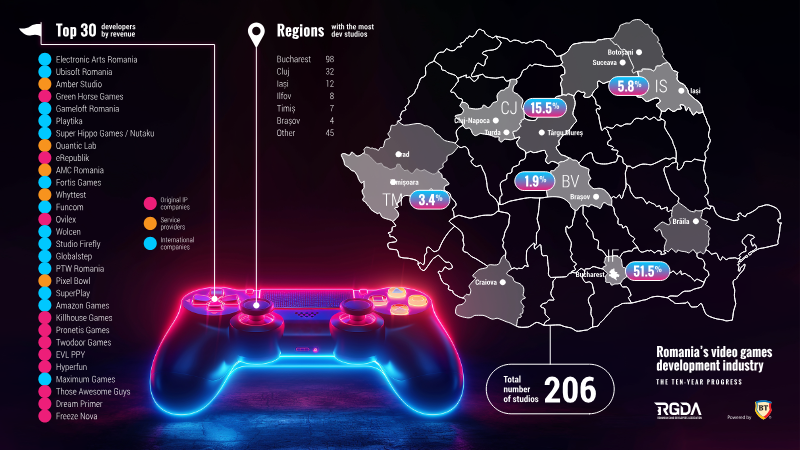
Revenue concentration is illustrated by a ranking of the top thirty developers, highlighting that multinational publishers such as Electronic Arts Romania (Bucharest) and Ubisoft Romania (Cluj‑Napoca) dominate the market, together accounting for a substantial share of the €340 million total. Mid‑size studios—including Amber Studio (Iași), Green Horse Games (Ilfov), and Playtika (Brașov)—contribute notable percentages, ranging from 5 % to 15 % of overall earnings. The data also maps studio locations, revealing a strong clustering in Bucharest, Cluj‑Napoca, Iași, and Brașov, with emerging hubs in Timișoara, Turda, and Arad.
Workforce figures show headcount increasing from 279,986 employees in 2015 to a projected 343,160 in 2024, reflecting a 12 % annual growth rate in personnel. Productivity, measured as turnover per employee, rose by 7.4 % over the ten‑year span, indicating that revenue gains are not solely driven by hiring but also by higher efficiency. Service‑oriented companies and international providers together represent 51.5 % of the sector, underscoring the importance of outsourcing and cross‑border collaborations.
The scope encompasses the entire Romanian market, covering all development, publishing, and service activities from 2015 through 2024. Figures appear to be compiled from company‑reported revenues, employee registers, and regional studio counts, suggesting a mixed methodology of financial reporting and industry surveys. Overall, the evidence points to a robust, diversifying ecosystem that is increasingly integrated with the global video‑game supply chain.
- The Romanian video game industry has nearly tripled its turnover in the last decade, growing from approximately €119 million in 2015 to over €340 million in 2024.
- The sector’s workforce has expanded at an annual rate of 12%, with total headcount projected to reach 343,160 employees by 2024.
- Market dominance is held by major multinational publishers like Electronic Arts in Bucharest and Ubisoft in Cluj-Napoca, while mid-size studios such as Amber, Green Horse Games, and Playtika contribute between 5% and 15% of total earnings.
- Industry efficiency has improved alongside growth, with productivity—measured as turnover per employee—increasing by 7.4% over the ten-year period.
- The number of active development studios in Romania has increased by 70% since 2015, with operations clustering in major hubs like Bucharest, Cluj-Napoca, Iași, and Brașov.