Market Analysis
Documents

Mobile App User Trends: MENA Ramadan 2026
The analysis focuses on mobile application usage patterns observed during the Ramadan period of 2026 across the Middle East and North Africa (MENA) region. The primary objective is to quantify shifts in user engagement, subscription behavior, and platform preference relative to the preceding year and a broader baseline average. Key metrics examined include overall app usage, subscription growth, in‑app purchases, and social media interaction.
Findings indicate a pronounced rise in overall app engagement during Ramadan 2026, with total usage increasing by approximately 111 % compared to the same period in 2025. Subscription activity shows a 42 % uptick, while in‑app purchase volume climbs by 91 %. Social media engagement metrics—measured through likes, shares, and comments—exhibit a 63 % increase. When benchmarked against the average growth rate for the same timeframe (2025‑2026), these figures represent a significant acceleration, suggesting heightened consumer activity during the holy month.
The data set covers all MENA markets and aggregates daily usage logs from a representative sample of mobile devices. The methodology involved longitudinal tracking of app sessions, transaction records, and social media interactions over the 30‑day Ramadan period. Comparative analysis was performed against both the previous year’s Ramadan metrics and a rolling 12‑month average to isolate seasonal effects.
In conclusion, the Ramadan period of 2026 drove substantial growth across multiple facets of mobile app consumption in MENA, with overall usage and monetization metrics surpassing historical trends. These insights underscore the strategic importance of tailoring app offerings, promotional campaigns, and user experience enhancements to align with cultural and religious calendars in the region.
- Overall mobile app engagement in the MENA region during Ramadan 2026 increased by 111% compared to the same period in 2025.
- In-app purchase volume saw a significant surge, rising by 91% during the 30-day Ramadan period.
- Social media interaction, measured by likes, shares, and comments, grew by 63% compared to the previous year.
- Subscription activity experienced a 42% uptick during the 2026 Ramadan period.
- Growth metrics across usage and monetization significantly outperformed both the previous year's Ramadan data and the rolling 12-month baseline average.

The AI Disruption Index: How AI Is Reshaping Consumer Discovery
The AI Disruption Index demonstrates that artificial intelligence is fundamentally altering how U.S. consumers discover and purchase brands, with one‑third of adults now using personal AI agents to find products and nearly half employing AI for purchase research. A survey of 283 marketing leaders across fifteen verticals, coupled with analysis of more than 3,000 apps that collectively amassed over 200 billion downloads, confirms that AI has already eroded traditional discovery channels and is poised to disintermediate services that depend heavily on paid search and weak customer relationships.
Generative‑AI agents pose the greatest threat to news, education, health & fitness, retail, and on‑demand services, where AI can replace conventional search and recommendation workflows. Only sectors with strong regulatory or content moats—such as financial services, media rights holders, and auto OEMs—retain a defensive advantage. The study underscores that brands must embed AI‑driven personalization and deepen direct customer relationships to counter the risk of zero‑click discovery.
Mobile applications emerge as the primary competitive advantage for brands able to own the customer journey. They provide first‑party data, closed‑loop measurement, and personalized experiences that are difficult for AI agents to replicate. The report recommends three strategic priorities: investing in superior mobile app experiences, unifying and activating customer signals through comprehensive data profiles, and rethinking channel mixes to favor resilient, direct‑engagement platforms over fragmented paid or organic search. These actions will enable brands to mitigate AI‑driven disruption and secure long‑term customer loyalty across the United States.
- One-third of U.S. adults now use personal AI agents for product discovery, while nearly 50% utilize AI for purchase research.
- AI-driven 'zero-click' discovery is actively eroding traditional paid search and organic search channels, threatening sectors like retail, education, and health & fitness.
- Sectors with strong regulatory or content moats, specifically financial services, media rights holders, and auto OEMs, currently maintain a defensive advantage against AI disintermediation.
- Mobile applications serve as the primary defense against AI disruption by enabling first-party data collection, closed-loop measurement, and personalized experiences that AI agents cannot easily replicate.
- Brands must shift strategic focus away from fragmented search channels toward direct-engagement platforms to secure long-term customer loyalty.
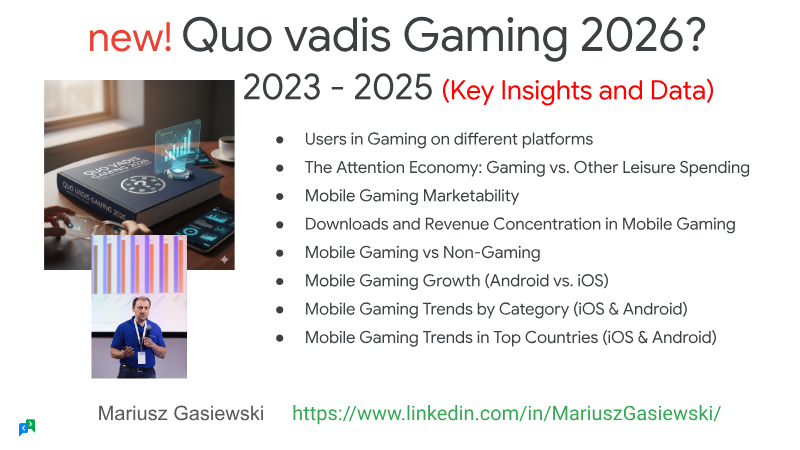
Key Insights and Data: 2023–2025
Mobile gaming drives the global industry’s growth through 2025, accounting for more than half of worldwide revenue and over eighty percent of players. Global gaming income is projected to reach $197 billion in 2025, a 7.5 % year‑over‑year rise largely powered by mobile and PC segments, while console expansion remains modest. The sector’s resilience is most pronounced in emerging markets where Android and iOS user volumes surge, yet revenue concentration persists in Western regions—particularly the United States and the United Kingdom—where iOS dominates acquisition spend.
Competitive dynamics sharpen as the top ten to fifty titles on Google Play and Apple’s App Store capture an increasing share of revenue, creating a winner‑take‑all environment. Hyper‑casual and match‑3 games concentrate U.S. spend, whereas Android strategy titles spread more evenly across Japan, Korea, and Taiwan. Sub‑genres such as chess, ludo, hidden object RPGs, and slots thrive in China, India, Brazil, and Southeast Asia, collectively commanding 15–20 % of global spend. Across most categories, day‑one retention has slipped from roughly 80 % to about 60 %, underscoring a broader challenge of sustaining early engagement.
Download patterns reveal Android’s volume advantage—about 70 % of global downloads—with the United States, India, Brazil, and Indonesia leading. iOS, though smaller in volume (30 %), delivers higher per‑download revenue, especially in China and the U.S. iOS penetration is rising in emerging markets such as Brazil and Vietnam, while Android’s share in India climbs from 18.8 % to 21.3 %. Genre‑level analysis shows modest growth (10–30 %) across most mobile categories, with occasional outliers and declines in specific niches. Overall, the landscape is characterized by rapid mobile expansion, concentrated monetization power, and shifting geographic priorities that shape strategic opportunities for developers and marketers.
- Global gaming revenue is projected to reach $197 billion in 2025, representing a 7.5% year-over-year increase driven primarily by mobile and PC segments.
- Mobile gaming remains the dominant force in the industry, accounting for over 50% of global revenue and more than 80% of the total player base.
- The mobile market is increasingly a winner-take-all environment, with the top 10 to 50 titles on Google Play and the Apple App Store capturing a growing share of total revenue.
- Android maintains a 70% share of global downloads, while iOS accounts for 30% but continues to generate significantly higher revenue per download in key markets like the U.S. and China.
- Sustaining early player engagement is becoming more difficult, as day-one retention rates have declined from approximately 80% to 60% across most categories.

Major Organizational, Operational and Portfolio Reset to Reclaim Creative Leadership and Restore Sustainable Growth
Ubisoft has initiated a major organizational and operational reset designed to reclaim creative leadership and restore sustainable growth in an increasingly selective AAA market. This strategic pivot addresses rising development costs and the competitive challenges of establishing new intellectual properties. The transformation is built upon three primary pillars: the implementation of a new operating model, a refocused game portfolio with a revised three-year roadmap, and a significant rightsizing of the global organization to improve agility and reduce fixed costs.
The new operating model decentralizes production into five distinct Creative Houses supported by a centralized Creative Network and Core Services. These houses are specialized by genre and business model, focusing on billionaire brands like Assassin’s Creed and Far Cry, competitive shooters such as Rainbow Six and Ghost Recon, live-service experiences, immersive narrative universes, and casual family-friendly titles. To support this focus, Ubisoft has discontinued six games—including the Prince of Persia: The Sands of Time remake and four unannounced titles—while allocating additional development time to seven other projects to ensure higher quality standards.
Financial restructuring is a critical component of this reset, with the company targeting a total reduction in fixed costs of approximately €500 million by March 2028 compared to FY23 levels. This includes the closure of studios in Halifax and Stockholm, alongside restructurings in Abu Dhabi, RedLynx, and Massive. For FY26, the group anticipates net bookings of approximately €1.5 billion and a non-IFRS EBIT loss of around €1 billion, largely due to a €650 million one-off accelerated depreciation from canceled and delayed titles. Moving forward, the group aims to reach a run-rate fixed cost base of €1.25 billion by 2028, prioritizing robust cash generation and a more disciplined approach to capital allocation.
- Ubisoft is targeting a €500 million reduction in fixed costs by March 2028 compared to FY23 levels to restore sustainable growth.
- The company is restructuring into five specialized Creative Houses to focus on core franchises like Assassin’s Creed, Far Cry, and Rainbow Six while improving operational agility.
- Ubisoft has canceled six projects, including the Prince of Persia: The Sands of Time remake and four unannounced titles, while extending development timelines for seven others to prioritize quality.
- The company projects an FY26 non-IFRS EBIT loss of approximately €1 billion, driven by €650 million in one-off depreciation charges from canceled and delayed games.
- To achieve a target run-rate fixed cost base of €1.25 billion by 2028, Ubisoft is closing studios in Halifax and Stockholm and restructuring operations in Abu Dhabi, RedLynx, and Massive.
Festive Season 2025: App Marketing Trends and Strategies for India
India’s festive season—from Onam in August through Diwali and Christmas in December—drives more than 30 % of the country’s annual digital advertising spend, making it a pivotal period for app marketers. In 2024, mobile games alone attracted over 3.2 billion downloads and generated $151 million in‑app purchase revenue, while non‑gaming verticals such as shopping, food delivery and OTT experienced sharp install spikes during key festivals. The data reveal a 53 % rise in mobile ad spend from Q1‑Q2 to Q3‑Q4, with installs up 36 % and re‑engagements soaring 69 % during the peak festive window, underscoring the season’s high‑value user acquisition and monetisation potential.
User‑acquisition efficiency improved markedly, with CPI falling by approximately 12 % while CPA remained stable. Video and playable ads delivered the highest ROAS—up to 4.2× in fintech and 3.8× in e‑commerce—and programmatic/OEM placements on Xiaomi and Samsung yielded significant conversion lifts, particularly in Tier‑2 and Tier‑3 cities. Creatives that refreshed weekly, incorporated localized language, and employed urgency cues such as countdowns outperformed static ads, highlighting the need for agile, culturally relevant creative and a diversified media mix that extends beyond Meta and Google into programmatic and OEM channels.
Marketers are increasingly leveraging data‑driven platforms—Singular, MobuppsX, Sensor Tower, Pathmatics and others—to optimise acquisition, retention and media spend. By integrating MAFO, iRTB, advanced fraud prevention and audience‑retention analytics, brands can reduce wasted spend, improve advertising ROI and accelerate growth across web, social and mobile channels. A unified data‑house approach enables faster campaign optimisation, measurable engagement gains and stronger competitive positioning during India’s lucrative festive period.
- India's festive season (August–December) accounts for over 30% of annual digital ad spend, driving a 36% increase in installs and a 69% surge in re-engagements during the peak window.
- Mobile gaming remains a primary growth driver, recording 3.2 billion downloads and $151 million in-app purchase revenue in 2024.
- Ad spend efficiency improved during the festive period, with a 53% increase in mobile ad investment accompanied by a 12% reduction in cost-per-install (CPI).
- Video and playable ads are the most effective formats, delivering up to 4.2× ROAS in fintech and 3.8× in e-commerce.
- Programmatic and OEM placements on devices like Xiaomi and Samsung are essential for capturing growth in Tier-2 and Tier-3 cities.
2026 US Venture Capital Outlook
The 2026 US venture capital outlook projects a cautiously optimistic landscape, driven largely by an explosive surge in early‑stage activity and the continued dominance of artificial intelligence (AI) startups. AI firms now command 65 % of venture capital, fueling near‑record first‑financing counts and setting a high bar for late‑stage valuations. While liquidity remains the primary constraint—exit values are projected below $300 billion and limited LP enthusiasm persists—the emergence of improved secondary markets and a potential rebound in initial public offerings are expected to alleviate pressure. Multistage firms that focus on seed rounds are poised to sustain growth across both early and later stages, yet emerging managers may face fundraising challenges that could curtail diversification.
A widening gap between AI‑focused, high‑growth startups and their slower‑moving peers is evident. In Q3 2025 the United States hosted 830 active unicorns with a record $3.9 trillion post‑money valuation, yet many of these firms are liquidity‑constrained and struggle to secure follow‑on funding. AI companies dominate late‑stage deals, with median Series C and D+ valuations reaching $838 million; AI rounds exceed non‑AI deals by roughly 26 % at Series D+, underscoring investor confidence in the AI boom while highlighting potential risks if public AI valuations contract.
Fundraising is projected to rebound to $100‑$130 billion in 2026, largely driven by recycled distributions that are expected to account for roughly 70 % of new commitments. Strong exit activity through 2025 and renewed interest in AI‑focused funds—such as a $10 billion Andreessen Horowitz vehicle—underpin this outlook. However, risks remain: a potential liquidity reversal or recession‑induced sentiment decline could keep commitments below $100 billion, tempering the projected recovery.
- AI startups currently command 65% of all venture capital, driving record-high median valuations of $838 million for Series C and D+ rounds.
- The US venture capital market is projected to see a fundraising rebound to $100–$130 billion in 2026, with approximately 70% of new commitments expected to come from recycled distributions.
- As of Q3 2025, the US hosted 830 active unicorns with a combined post-money valuation of $3.9 trillion, though many face significant liquidity constraints and difficulties securing follow-on funding.
- AI-focused late-stage deals currently command a 26% valuation premium over non-AI counterparts, creating a widening performance gap between high-growth AI firms and slower-moving peers.
- Liquidity remains a primary market constraint, with total exit values for 2026 projected to remain below $300 billion despite anticipated improvements in secondary markets and IPO activity.
Flemish Games Sector: 2025 Industry Report
The Flemish games sector demonstrates consistent growth and structural stability as of 2025. The industry, encompassing game development, publishing, support services, and incubators, has expanded its corporate footprint significantly, rising from 60 active entities in 2020 to 128 in 2025. This growth trajectory reflects a robust ecosystem that has more than doubled its number of participants over a five-year period. Geographically, the industry remains concentrated in East Flanders, which hosts 42 companies, followed by Antwerp with 33, West Flanders with 24, Flemish Brabant with 19, and Limburg with 10.
The sector is characterized by a predominantly micro-enterprise structure, with 112 companies employing between one and ten staff members. Small businesses account for 15 entities, while only one mid-sized firm exists, and no large-scale organizations with over 250 employees are currently present. Despite this small-scale composition, the workforce has seen a steady upward trend, reaching 728 full-time equivalents in 2025. This represents a recovery and expansion from the 627 full-time equivalents recorded in 2020, highlighting the sector's increasing capacity to sustain professional employment.
Financial performance mirrors this operational expansion, with total annual turnover reaching 76.5 million euros in 2025. This figure marks a steady climb from 58.7 million euros in 2020, indicating a resilient market that has successfully navigated economic fluctuations. By maintaining a steady increase in both company count and revenue, the Flemish games industry continues to solidify its position as a growing contributor to the regional economy, supported by a dense network of small, specialized development and service-oriented studios.
- The Flemish games sector has more than doubled its corporate footprint since 2020, growing from 60 to 128 active entities by 2025.
- Annual industry turnover reached 76.5 million euros in 2025, reflecting a steady increase from 58.7 million euros in 2020.
- The sector is composed almost entirely of micro-enterprises, with 112 of the 128 companies employing between one and ten staff members.
- Total professional employment in the sector has grown to 728 full-time equivalents in 2025, up from 627 in 2020.
- Industry activity is geographically concentrated, with East Flanders hosting the largest share of companies (42), followed by Antwerp (33) and West Flanders (24).

India Player Behavior & Market Insights: August 2026
The Indian gaming landscape is undergoing a significant demographic and structural transformation as of August 2026. Female participation has reached near parity, climbing to 49% of the total player base, up from 43% in 2023. This shift is accompanied by a diversification in revenue streams, as non-battle royale mobile titles have successfully expanded their market share from 53.2% to 62.8% over the past three years. Younger demographics are increasingly gravitating toward user-generated content platforms like Roblox and Minecraft, driven by a preference for integrated social interaction and viral, minigame-based gameplay loops.
Payment behaviors in the region remain heavily localized, with the Unified Payments Interface serving as the primary transaction method for 84.6% of players. This reliance on digital infrastructure far outpaces traditional credit card usage, which sits at 31.5%. Furthermore, a notable segment of the market, totaling 31.5%, actively bypasses standard app stores in favor of web stores, third-party platforms, and top-up cards to acquire in-game content. These trends suggest a maturing ecosystem where players prioritize convenience and alternative payment channels over legacy distribution models.
Sentiment regarding generative artificial intelligence has shifted toward increased caution among both players and developers. This cooling of enthusiasm is largely attributed to economic anxieties surrounding the potential displacement of jobs within the industry. As the market continues to evolve, stakeholders must navigate these changing consumer attitudes toward technology while adapting to a gaming population that is increasingly diverse, socially connected, and technologically savvy. These insights reflect a broader trend of market stabilization and professionalization within the Indian digital entertainment sector.
- Female participation in the Indian gaming market has reached near parity, rising to 49% of the total player base as of August 2026, up from 43% in 2023.
- Non-battle royale mobile titles have successfully expanded their market share from 53.2% to 62.8% over the past three years.
- The Unified Payments Interface (UPI) is the dominant transaction method, utilized by 84.6% of players, significantly outpacing credit card usage at 31.5%.
- Approximately 31.5% of the market now bypasses standard app stores, opting instead for web stores, third-party platforms, and top-up cards.
- Younger demographics are increasingly shifting toward user-generated content platforms like Roblox and Minecraft, favoring integrated social interaction and minigame-based loops.
Reconnecting with Gen Z Mobile Gamers: UK
Mobile gamers aged 18 to 24 represent a critical demographic for the UK gaming industry, characterized by high engagement levels but increasing volatility. While 79% of this cohort plays mobile games at least several times a week, their overall time investment is declining, dropping to an average of 4.4 hours per week. This shift is driven by intense competition from other digital entertainment channels, with 57% of Gen Z players reporting that social media, streaming, and short-form video content are actively displacing their mobile gaming time.
The research, based on an online survey of 1,605 UK residents, reveals that Gen Z exhibits significantly lower title loyalty than the general population. Approximately 57% of these players frequently rotate between games, constantly seeking new experiences. This churn is exacerbated by dissatisfaction with current industry practices; 71% of Gen Z players cite intrusive monetization and advertising as primary deterrents, while 62% feel there is a lack of fresh, appealing content in the current market.
To recapture this audience, developers must pivot toward discovery strategies rooted in social proof and authentic gameplay. Gen Z discovery is increasingly spontaneous, relying on creator content and peer recommendations rather than traditional marketing assets. Successful engagement strategies require front-loading immediate rewards, designing for shareable social moments, and implementing fair, non-intrusive monetization models. By prioritizing short-form satisfaction and consistent content updates, developers can better align with the fragmented attention spans and high expectations of this demographic, ultimately fostering more sustainable long-term retention.
- 71% of UK Gen Z mobile gamers cite intrusive monetization and advertising as the primary reason for abandoning games.
- Gen Z mobile gaming time is declining to an average of 4.4 hours per week as 57% of players shift their attention to social media, streaming, and short-form video.
- Title loyalty is low among this demographic, with 57% of players frequently rotating between games in search of new experiences.
- 62% of Gen Z players report a lack of fresh, appealing content in the current mobile gaming market.
- While 79% of 18- to 24-year-olds play mobile games at least several times a week, engagement is increasingly volatile and reliant on spontaneous discovery through creator content and peer recommendations.

Beyond the App Store: A Guide to Direct Linkouts and Out-of-App Monetization
The mobile gaming industry is undergoing a structural shift as regulatory changes and legal precedents in the United States, Europe, Asia, and Latin America dismantle long-standing app store monopolies. This transition allows publishers to bypass traditional platform commissions of 15% to 30% by steering users toward direct, out-of-app payment channels. The primary thesis is that recovered margins should not be viewed merely as profit, but as a strategic reinvestment budget to enhance player value, improve live operations, and drive long-term audience growth.
Successful implementation requires a disciplined approach to user segmentation, value proposition, and interface design. Rather than inviting all players to use external payment methods, publishers should target high-propensity users—such as frequent spenders or those at higher game levels—to minimize friction for casual players. Because out-of-app flows inherently introduce more steps than native in-app purchases, publishers must provide a tangible incentive, such as bonus currency, exclusive items, or lower effective pricing, to ensure the external path remains attractive.
Operationalizing this strategy requires robust infrastructure to manage global payment routing, tax compliance, fraud protection, and reconciliation. Attempting to build these capabilities in-house often results in excessive overhead that negates the margin benefits. Data from large-scale deployments indicates that well-executed linkout programs can drive significant incremental growth, with some publishers seeing a 17% increase in webstore revenue and a 78% rise in first-time purchase rates. Ultimately, the transition to out-of-app monetization represents a move toward a more sustainable, publisher-controlled economic model that prioritizes lifetime value over single-transaction margins.
- Global regulatory shifts are dismantling app store monopolies, enabling publishers to bypass 15% to 30% platform commissions by utilizing direct, out-of-app payment channels.
- Well-executed webstore programs have demonstrated a 17% increase in total revenue and a 78% rise in first-time purchase rates for mobile game publishers.
- Publishers should treat recovered margins as strategic reinvestment capital for live operations and audience growth rather than immediate profit.
- To maintain conversion rates, publishers must offer tangible incentives such as bonus currency, exclusive items, or lower pricing to offset the increased friction of external payment flows.
- Targeting high-propensity users, such as frequent spenders or high-level players, is more effective than broad-based rollouts that risk alienating casual users.

Gaming Deep Dive: Ad Monetization 2026
Mobile gaming has structurally reorganized to treat advertising as a foundational revenue model, generating $12 billion annually across 19 global markets. As of 2026, ad-supported titles account for 84% of all game downloads, underscoring the ubiquity of this monetization strategy. The landscape is characterized by significant market consolidation, with AppLovin and AdMob controlling 65% of total ad revenue. Within this ecosystem, the puzzle genre remains the primary driver of financial performance, capturing over half of all ad earnings.
The competitive environment has evolved to include a substantial presence from non-gaming sectors, as social platforms and e-commerce entities now account for 31% to 49% of ad impressions across major genres. While advertising provides a reliable revenue floor, data confirms that pure ad-only models are increasingly insufficient for maximizing profitability. Instead, top-tier publishers are shifting toward hybrid strategies that integrate in-app purchases with ad monetization. This approach allows developers to capture value from non-spending users while simultaneously protecting the experience of high-value segments.
Success in the current market requires navigating stark geographic disparities and the rise of emerging platforms like Roblox. Hybridcasual titles have emerged as a critical growth segment, leveraging deep engagement and precise audience segmentation to outperform traditional models. Ultimately, the industry is moving toward a sophisticated equilibrium where advertising serves as a strategic tool for user retention and monetization, rather than a standalone revenue stream. Publishers that fail to adopt these nuanced, hybrid monetization frameworks risk losing ground in an increasingly consolidated and competitive global landscape.
- Ad-supported titles now represent 84% of all mobile game downloads, establishing advertising as a foundational revenue model generating $12 billion annually across 19 global markets.
- The ad monetization market is highly consolidated, with AppLovin and AdMob controlling 65% of total industry ad revenue.
- Pure ad-only monetization models are increasingly insufficient, forcing top-tier publishers to shift toward hybrid strategies that integrate in-app purchases to maximize profitability.
- The puzzle genre is the primary financial driver of the sector, accounting for more than 50% of all ad earnings.
- Non-gaming sectors, specifically social platforms and e-commerce entities, now account for 31% to 49% of ad impressions across major game genres.
China WeChat Mini Games Industry Report 2026
The WeChat Mini Games industry in China has emerged as a dominant, high-growth sector within the broader digital ecosystem. As of 2026, the market is characterized by a rapid shift from simple casual titles toward mid-to-hardcore genres, including strategy, RPG, and tower defense games. This evolution is underscored by a significant increase in paid user acquisition, with over 51,000 games actively running advertisements in 2025, a figure that substantially outpaces traditional mobile game growth.
Market data indicates that the Mini Games sector generated RMB 53.535 billion (approximately $7.65 billion) in 2025, representing a 34.39% year-over-year increase, with projections exceeding RMB 70 billion for 2026. Revenue is primarily driven by in-app purchases, which account for 68.11% of total earnings, while advertising monetization contributes the remaining 31.89%. WeChat maintains a leadership position among competing platforms, boasting a 51.5% penetration rate and an industry-wide monthly active user base of 571 million as of August 2025.
User engagement remains high, with the average daily playtime exceeding 60 minutes and a daily session frequency of approximately 5.1 times. The core demographic is aged 24–40, with a majority residing in tier-3 cities or below. Successful titles increasingly utilize hybrid gameplay mechanics, such as combining MMORPG elements with idle or strategy features, to maintain player retention.
For international developers, the market presents significant opportunities but requires navigating complex regulatory and technical barriers. Successful entry necessitates partnering with local Chinese publishers to manage ISBN licensing, payment integration, and platform-specific performance optimizations. Technical requirements are stringent, as games must typically load in under 10 seconds and adhere to strict package size limits, often requiring the use of specialized engines like Cocos or Laya to ensure compatibility within the WeChat environment.
- The WeChat Mini Games market reached RMB 53.535 billion in 2025, a 34.39% year-over-year increase, with projections exceeding RMB 70 billion for 2026.
- WeChat dominates the sector with a 51.5% platform penetration rate and 571 million monthly active users as of August 2025.
- Revenue is primarily driven by in-app purchases (68.11%), supplemented by advertising monetization (31.89%).
- The industry is shifting toward mid-to-hardcore genres like RPG and strategy, supported by over 51,000 games actively running paid advertisements in 2025.
- Core user engagement is high, averaging over 60 minutes of daily playtime across 5.1 daily sessions, primarily among users aged 24–40 in tier-3 cities or below.