1 free read left. Create a free account for unlimited reading + AI research.
Create free accountReport Sensor Tower
1 free read left. Create a free account for unlimited reading + AI research.
Create free accountReportSensor Tower
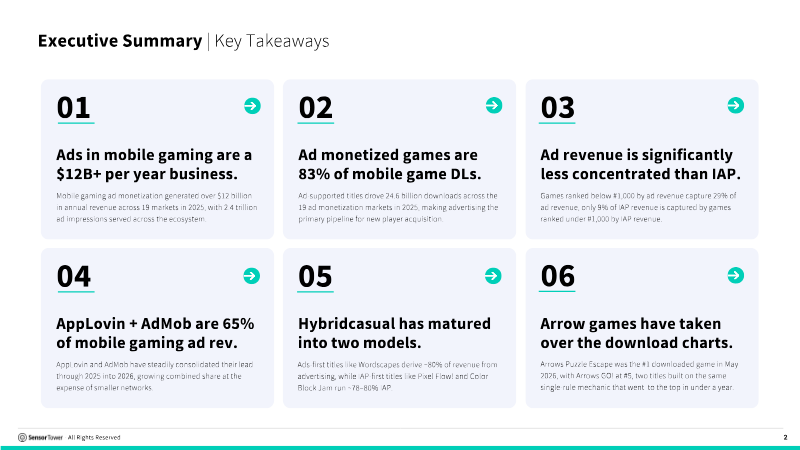
Advertising has become a foundational revenue model for mobile gaming. It generates $12 billion annually across 19 global markets.
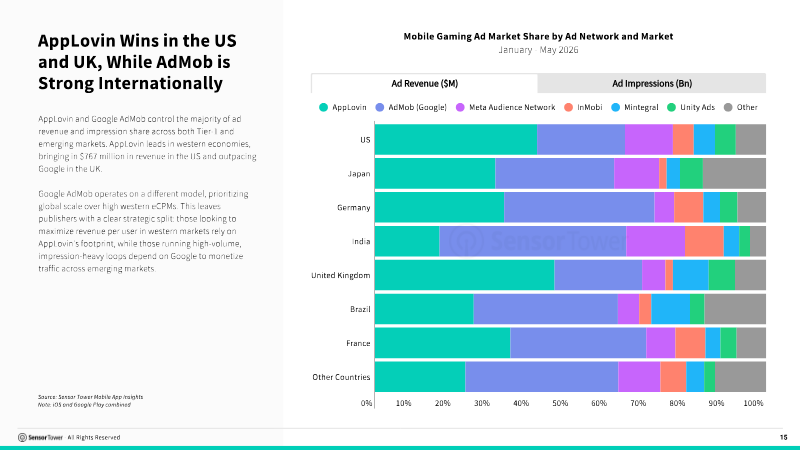
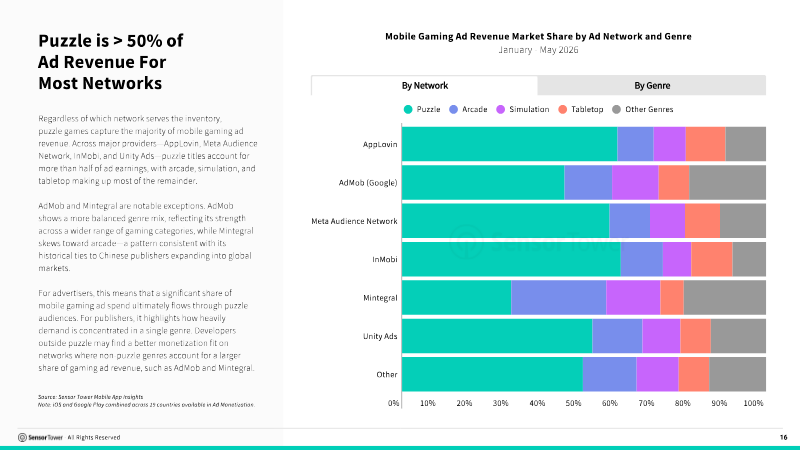
Mobile gaming has structurally reorganized to treat advertising as a foundational revenue model, generating $12 billion annually across 19 global markets. As of 2026, ad-supported titles account for 84% of all game downloads, underscoring the ubiquity of this monetization strategy. The landscape is characterized by significant market consolidation, with AppLovin and AdMob controlling 65% of total ad revenue. Within this ecosystem, the puzzle genre remains the primary driver of financial performance, capturing over half of all ad earnings.
The competitive environment has evolved to include a substantial presence from non-gaming sectors, as social platforms and e-commerce entities now account for 31% to 49% of ad impressions across major genres. While advertising provides a reliable revenue floor, data confirms that pure ad-only models are increasingly insufficient for maximizing profitability. Instead, top-tier publishers are shifting toward hybrid strategies that integrate in-app purchases with ad monetization. This approach allows developers to capture value from non-spending users while simultaneously protecting the experience of high-value segments.
Success in the current market requires navigating stark geographic disparities and the rise of emerging platforms like Roblox. Hybridcasual titles have emerged as a critical growth segment, leveraging deep engagement and precise audience segmentation to outperform traditional models. Ultimately, the industry is moving toward a sophisticated equilibrium where advertising serves as a strategic tool for user retention and monetization, rather than a standalone revenue stream. Publishers that fail to adopt these nuanced, hybrid monetization frameworks risk losing ground in an increasingly consolidated and competitive global landscape.
Sensor Tower · 2026
Sensor Tower · 2026
Sensor Tower · 2026
Sensor Tower · 2026
Sensor Tower · 2026
Sensor Tower · 2026
Sensor Tower · 2026
Sensor Tower · 2026
Sensor Tower · 2026
Sensor Tower · 2026
Sensor Tower · 2026
Sensor Tower · 2026
Mobilegamer.biz · 2026