Investment reports and market data
Documents

Sensor Tower's AppMagic acquisition and Sega's brutal Rovio comments | Week in Mobile Games podcast
The mobile gaming intelligence sector is undergoing significant consolidation following Sensor Tower’s acquisition of its rival, AppMagic.
- Sensor Tower has acquired its rival AppMagic, positioning itself as the dominant player in the mobile market data industry following its previous acquisition of Data.ai.
- eBay has officially rejected a $5.5 billion acquisition proposal from GameStop, which had been criticized for lacking clear financial details regarding how the deal would be funded.
- Sega is moving forward with a transmedia strategy for the Rovio-owned Angry Birds IP, including the release of Angry Birds 2 in mainland China and a third film scheduled for December.
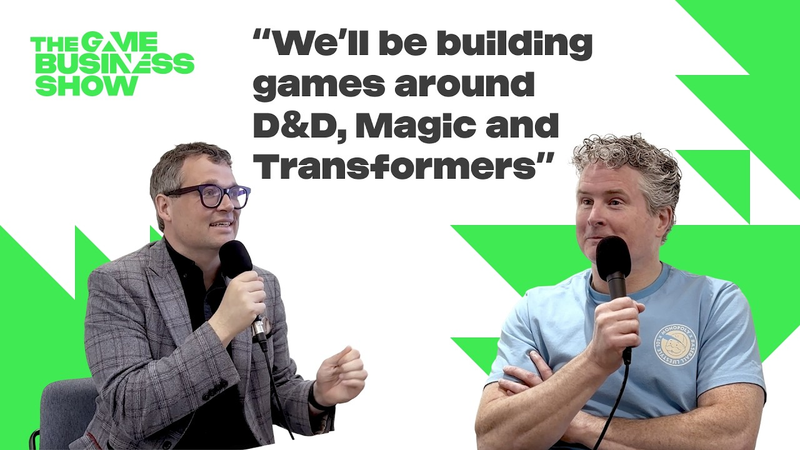
The D&D company is spending $1bn making video games, and none of them are games-as-a-service
Hasbro is currently executing a decade-long, $1 billion investment strategy to expand its footprint in the video game industry.
- Hasbro is executing a $1 billion, decade-long investment strategy to expand its video game footprint, explicitly rejecting the games-as-a-service (GaaS) model in favor of premium, single-player experiences.
- The company is prioritizing high-quality, 40-to-50-hour traditional PC and console titles to avoid the high volatility and low success rates associated with GaaS.
- Hasbro’s portfolio strategy divides development between internal studios for core brands like Dungeons & Dragons and Magic: The Gathering, and external partnerships for casual or mobile properties like Monopoly Go.

Corporate Shenanigans | Design Club
The gaming industry is currently navigating a period of significant volatility characterized by aggressive pricing strategies, corporate malfeasance, and shifting platform dynamics.
- GameStop's attempt to acquire eBay for $55.5 billion was met with skepticism due to the CEO's inability to explain the financing structure, which relied on a mix of cash and common stock.
- Unknown Worlds successfully released a new Subnautica title to critical acclaim, achieving an 85% positive rating on Steam and 443,993 concurrent players despite ongoing legal disputes with Krafton regarding contract payments.
- Financial analysts, including those at Bank of America, have publicly suggested that premium titles like Grand Theft Auto 6 could be priced at $80, a significant increase from the $60 industry standard that has persisted for nearly 20 years.

Long development cycles are putting off video game investors
The video game industry is currently undergoing a painful financial correction following a period of post-pandemic over-investment that fostered unsustainable budgets and unrealistic growth expectations.
- The gaming industry is facing a financial correction due to a misalignment between traditional venture capital models and long, multi-year production cycles that lack early-stage performance indicators.
- Investors are increasingly deterred by the industry's reliance on legacy titles, as 92 percent of current sector revenue is generated by games older than six years.
- To mitigate high-risk, massive-budget development, major publishers are adopting agile strategies and leveraging artificial intelligence to optimize workflows and reduce prototyping costs.
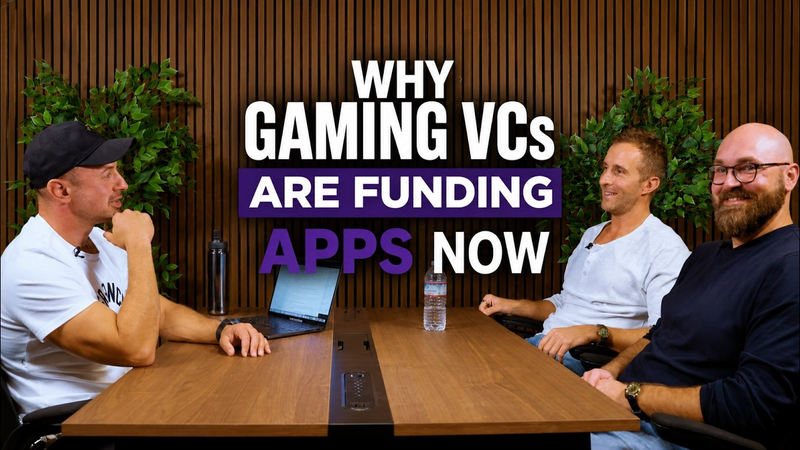
From Mobile Games to Apps: Inside Play Ventures' $500M Fund
Play Ventures has evolved its investment strategy from a mobile gaming focus to a broader mandate encompassing consumer applications.
- Play Ventures has expanded its $500M fund mandate from a mobile gaming-only focus to include broader consumer applications, leveraging shared expertise in user acquisition and subscription monetization.
- The firm mandates two-year vesting cliffs and utilizes behavioral assessments during due diligence to mitigate the risk of co-founder conflict, which they identify as a primary determinant of early-stage failure.
- Investment decisions are made through a non-hierarchical structure where any team member can challenge a deal and only a minority of partnership votes are required to proceed.

TWIG #382: Merge Mansion Falls, Xbox Fires the Wrong People, and the Math That Killed Gaming VC
The gaming industry is undergoing a fundamental structural transition, moving away from the high-growth, venture-backed models of the past decade toward a landscape defined by operational efficiency, asset-focused management, and lean production cycles.
- The gaming industry is shifting from high-growth, venture-backed models to a focus on operational efficiency, fiscal discipline, and long-term cash flow optimization.
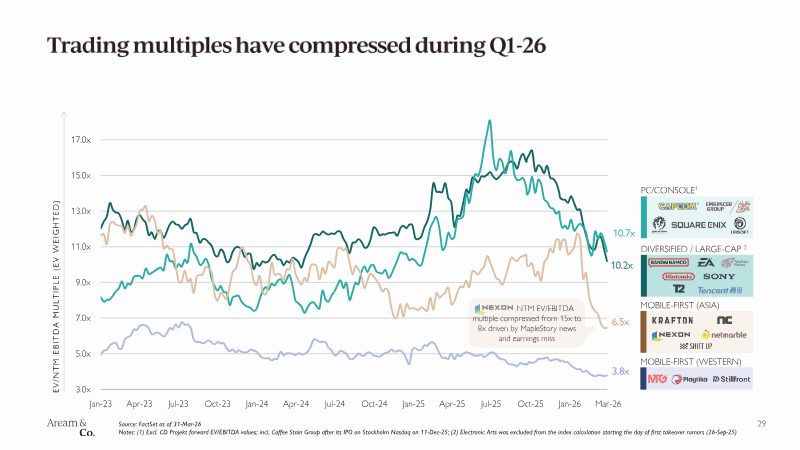
- Venture capital investment in gaming has plummeted due to compressed valuation multiples and a shrinking pool of potential acquirers, signaling the end of the mobile free-to-play era's explosive growth.
- Studios are increasingly adopting a 'band model' that utilizes small core teams supplemented by freelancers, outsourcing, and AI to mitigate the rising costs of traditional development.



The Essential UA Financing Guide: 2026
The guide outlines a non-dilutive financing model designed to fund mobile studios’ user acquisition (UA) campaigns by leveraging cohort performance data.
- Global mobile user acquisition (UA) spend reached $78 billion in 2025, representing a 13% year-on-year increase.
- Studios can access non-dilutive financing to cover up to 80% of monthly UA spend per cohort, avoiding equity dilution while scaling growth.
- Repayment is tied directly to cohort performance, with the schedule beginning only once the return on ad spend (ROAS) reaches the 100% breakeven point.

The state of the UK games industry with UKIE CEO Nick Poole
The United Kingdom games industry stands as a global creative powerhouse, yet its long-term stability is currently hindered by a lack of coordinated political advocacy and structural support comparable to the film and television sectors.
- The UK games industry contributes approximately £6 billion in Gross Value Added (GVA) to the economy and generates an additional £1.3 billion for other sectors through game technology.
- UK tax relief for games is currently 5 percentage points lower than the rates provided to the film and TV industries, creating a competitive disadvantage for domestic studios.
- The UK risks becoming an 'incubator economy' where talent and innovation are developed but not retained, necessitating a shift toward building sustainable, long-term companies rather than just individual games.

Left VC to Become a Founder Again. Here's What They Don't Tell You About Running a Fund
The venture capital landscape has undergone a significant shift, rendering the fundraising environment for micro-funds increasingly difficult in a post-pandemic economy.
- The current fundraising environment for micro-funds is increasingly difficult, forcing managers to spend over 50% of their time on capital acquisition rather than portfolio support.
- Industry clout and operational experience are insufficient substitutes for direct, high-level institutional relationships when attempting to secure fund backing.
- The micro-VC model is currently a low-margin, grueling endeavor that often requires independent wealth or a long-term bootstrapping mindset to remain sustainable.
Global Gaming Report Q1 2026
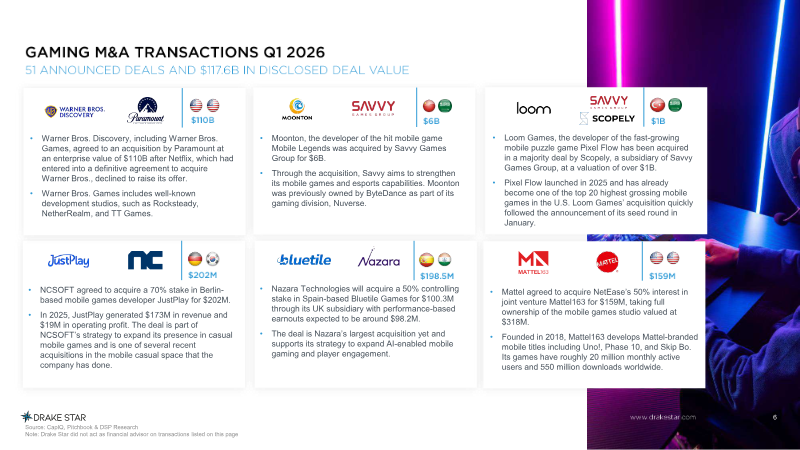
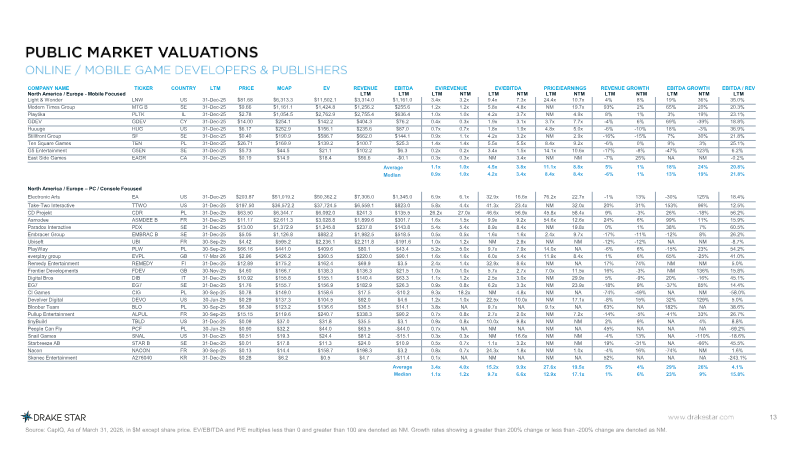
The global gaming industry experienced a period of significant structural realignment during the first quarter of 2026, characterized by a surge in high-value consolidation alongside a cooling of public market sentiment.
- Q1 2026 saw 106 private placement deals totaling $785 million, a significant decrease from Q1 2025's $5.0 billion across 149 deals, indicating a cooling investment landscape.
- Project financing is now the primary funding path for studios due to headwinds in studio equity, with dedicated User Acquisition (UA) funds emerging as a new lifeline for mid-stage mobile studios.
- Key strategics to watch include PIF/Scopely, KRAFTON, NCSoft, Tencent, MTG, Take-Two, Netflix, everplay, and Keywords Studios, while Private Equity is expected to drive take-private transactions of publicly listed gaming firms.

Video Game Market Update: Q1 2026
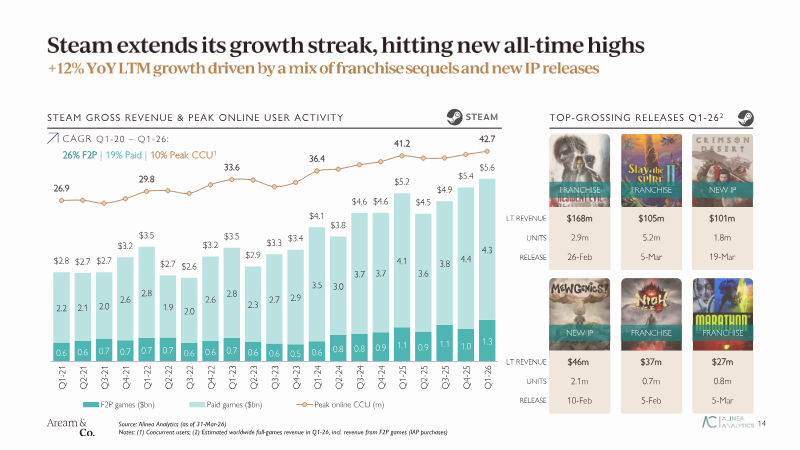
The global video game industry experienced a period of significant divergence during the first quarter of 2026, characterized by record-breaking consumer engagement alongside a tightening capital environment.
- The console market reached a record $21.7 billion in Q1 2026, primarily driven by the Nintendo Switch 2's first holiday season, while Sony and Microsoft experienced year-over-year revenue declines.
- Mobile gaming's in-app purchase (IAP) revenue has plateaued, with Q1 2026 gross IAP revenue at $20.6 billion, while install volumes hit multi-year lows, indicating a shift towards monetization efficiency.
- Mergers and Acquisitions (M&A) activity in Q1 2026 saw a high quarterly deal value of $7.7 billion across 52 deals, with mobile studios accounting for the majority of headline acquisitions.

The Blood of the Dawnwalker developer: Everyone we spoke to wanted to invest
Rebel Wolves operates on the principle that high-quality, AAA dark fantasy role-playing games are best produced within smaller, boutique environments that prioritize team culture and creative ownership.
- Rebel Wolves maintains a boutique studio model of approximately 160 employees to minimize bureaucratic inefficiency and ensure leadership remains directly involved in creative production.
- The studio secured major financial and operational backing through partnerships with NetEase for funding and Bandai Namco for global publishing.
- Development of the upcoming title, The Blood of the Dawnwalker, utilizes AI-generated voice placeholders to iterate on complex narrative branches before committing to final production costs.