Updated Jun 1, 2026 by InvestGame
Report · April 24, 2026
Published by InvestGame
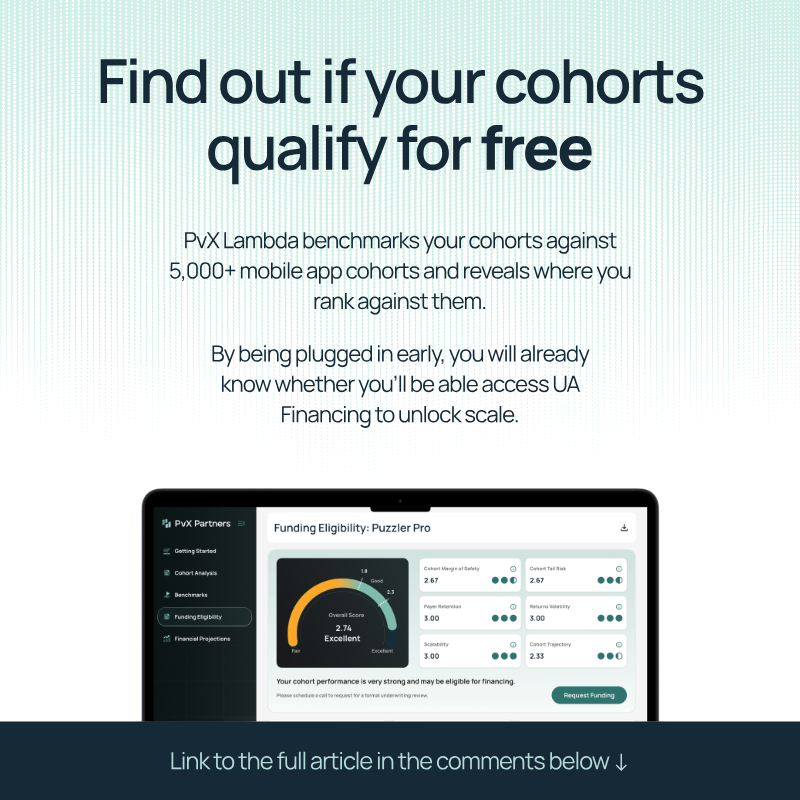
Most mobile studios spend 50–70% ofrevenue expensive capital available: equity. GlobalUA spend hit$78B in2025, User Acquisition Financing is non-dilutive growth capitalthat funds your marketing Repayment in lock-step with userrevenues Your cash balance growswhile UA scales Downside is shared if cohorts underperform 1 Share your cohort data (Appsflyer, Adjust, GCP, <u>2</u> Cohorts areunderwritten and a facility issized 3 Draw down up to 80% of your UAspends for each <u>4</u> R...
The UA Guide for 2026 Most mobile studios spend 50–70% ofrevenue on paidUA and fundit with the expensive capital available: equity. See howUA financing is changing that and how you might qualify ⇢ ---
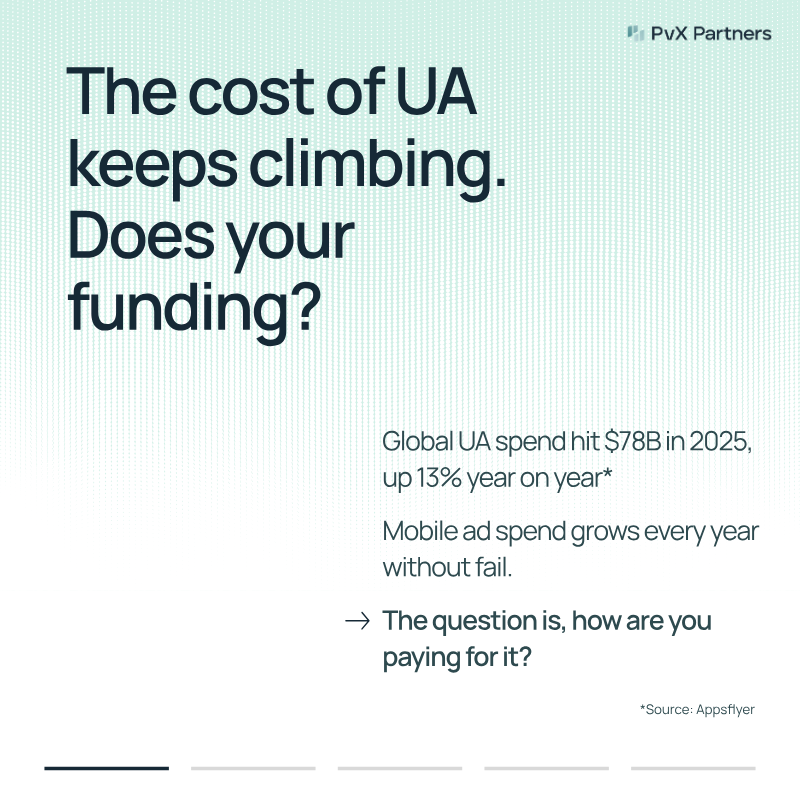
The cost of UA keepsclimbing. Doesyour funding? GlobalUA spend hit$78B in2025, up 13% yearonyear* Mobile adspendgrowsevery year withoutfail. Thequestion is, howareyou paying for it? *Source: Appsflyer
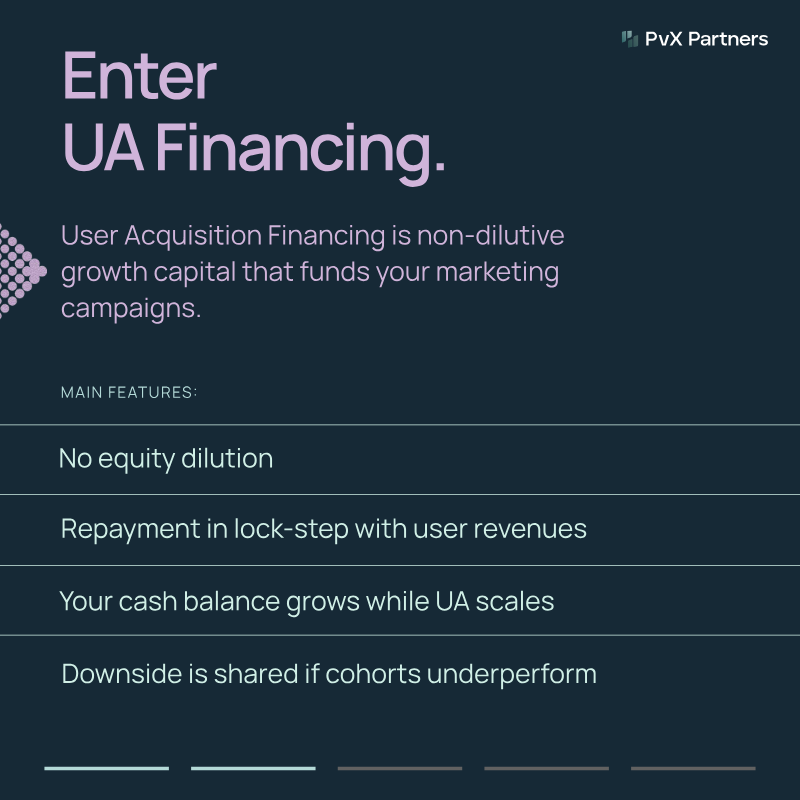
UA Financing. User Acquisition Financing is non-dilutive growth capitalthat funds your marketing campaigns. MAIN FEATURES: No equity dilution Repayment in lock-step with userrevenues Your cash balance growswhile UA scales Downside is shared if cohorts underperform
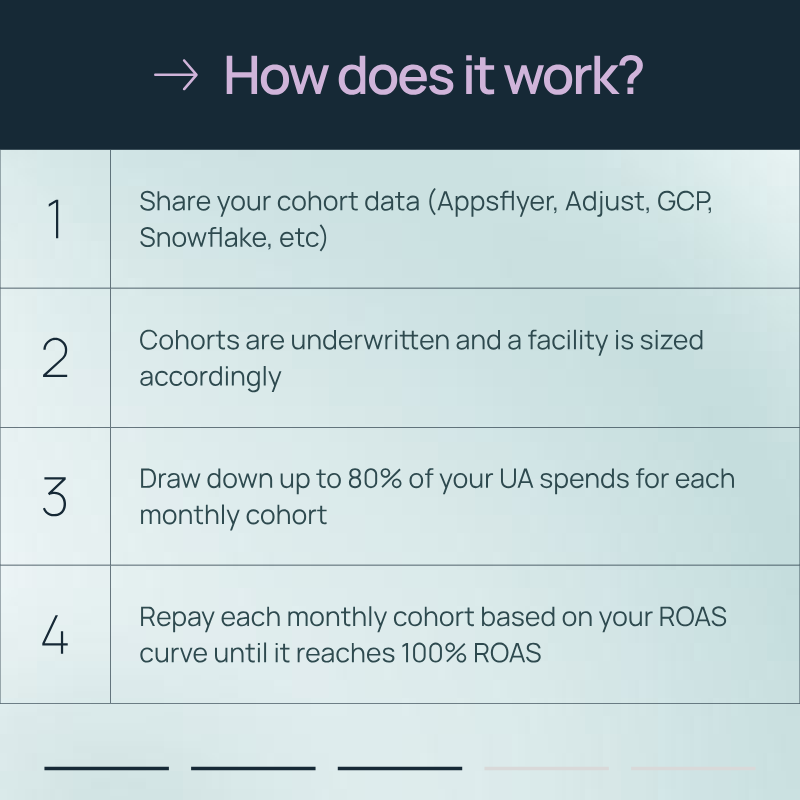
How does itwork? 1 Share your cohort data (Appsflyer, Adjust, GCP, Snowflake, etc) 2 Cohorts areunderwritten and a facility issized accordingly 3 Draw down up to 80% of your UAspends for each monthly cohort 4 Repay each monthly cohort based on your ROAS curve until itreaches 100% ROAS
Who (part1) Strong candidates tend to have: 6+ months of ROAS curves Clean MMP+ cohort history at trending toward transaction data ~$100K/month payback (attributable to spend predictably cohorts) The payback speed matters less than the predictability of the curve.
Who (part 2) The question your financing partner isreallyasking: "Do wetrust thiscohort to return the capital deployed against it?" →If your most recent cohorts are tending towards profitably similarly to historical cohortsthat have realized paybacks, you're likely fundable.
Cohort User Acquisition Financing Mobile gaming market has returned to growth Weathering a challenging 2022-2023, the mobile sector proves its resilience through innovation Mobile gaming rebounds from adversity... ... as Mobile gaming rebounds from adversity… … as industry players adapt to new environment 2020A -2025E CAGR Str TOTAL: 5.0% | IAP: 2.1% | IAA: 16.2% • ...
With Over 400,000 Advertisers Analyzed, the 2026 Global Mobile Gaming Marketing T hite Paper Decodes How Growth Is Being As the global mobile gaming market shifts from rapid expansion driven by new user acquisition to an increasingly competitive battle for existing users, 2025 marks a decisive turning point for marketers worldwide.
The interim filing presents the fourth‑quarter 2025 financial results for a midcore‑casual gaming group, emphasizing a record‑setting revenue run and the successful execution of a transformation agenda that includes the integration of the Plarium acquisition and the rollout of a new district structure in early 2026. Revenue reached SEK 3,123 million, reflecting 108 % organic growth year‑on‑year and a 25 % increase on a constant‑currency basis, while adjusted EBITDA rose to SEK 717 million, delivering a 23 % margin that matches the full‑year figure. Unlevered free cash flow amounted to SEK 878 million, with a cash‑conversion rate of 66 % and a leverage ratio of five times EBITDA, underscoring robust liquidity and disciplined capital management. User‑acquisition spending accelerated, representing 38 % of quarterly revenue—up from 37 % in the prior quarter—and grew 76 % on a reported basis, driven by heightened investment in original studios, new casual titles, and the racing franchise. The direct‑to‑consumer channel expanded by 600 basis points to 32 % of total revenue, reflecting a strategic shift toward higher‑margin in‑app purchases. Across the fiscal year, the company posted a 9 % organic revenue increase, with word‑games, racing, and RAID franchises delivering the strongest quarter‑end performance. Operating cash flow for the quarter stood at SEK 840 million, while adjusted net income was SEK 1,390 million, translating to an adjusted EPS of SEK 11.33. The financial outcomes exceed guidance and position the firm to meet its medium‑term outlook, with a pre‑IPO study for PlaySimple concluded and the midcore transformation progressing as planned.
The primary purpose of the analysis is to demonstrate how a strategic partnership between a mobile measurement partner (MMP) and TikTok’s advertising ecosystem can unlock profitable growth for app marketers. By integrating real‑time attribution, privacy‑preserving measurement, and value‑based optimization, brands can accurately credit campaigns, reduce fraud, and maximize return on ad spend (ROAS) across the entire customer journey. Key findings show that cross‑platform visibility is essential for identifying high‑value users and optimizing acquisition budgets, especially amid tightening privacy regulations on iOS and Android. AppsFlyer’s comprehensive measurement suite, combined with TikTok’s SKAdNetwork tools and self‑reporting network, delivers precise audience targeting and cost‑effective user acquisition. Case studies from Burger King, Casas Bahia, and Carrefour illustrate tangible results: a 7× ROI for coupon activations, a 44 % lift in conversion rates with a 55 % ROI gain, and a 29 % increase in in‑app revenue with triple the return compared to other channels. The document outlines best practices for app install and retargeting campaigns, recommending the use of App Event Optimization (AEO) and Value‑Based Optimization (VBO) to focus spend on high‑value actions. Automated Smart Performance Campaigns and real‑time ROAS measurement via AppsFlyer integrations further enhance efficiency and lifetime value. Geographically, the insights apply globally across major mobile markets, with a focus on the U.S., Europe, and emerging regions where TikTok’s user base is rapidly expanding. The time frame covers current privacy‑driven advertising environments and anticipates ongoing downturns, positioning the partnership as a resilient growth strategy for 2024‑2026.