VideoDeconstructor of Fun
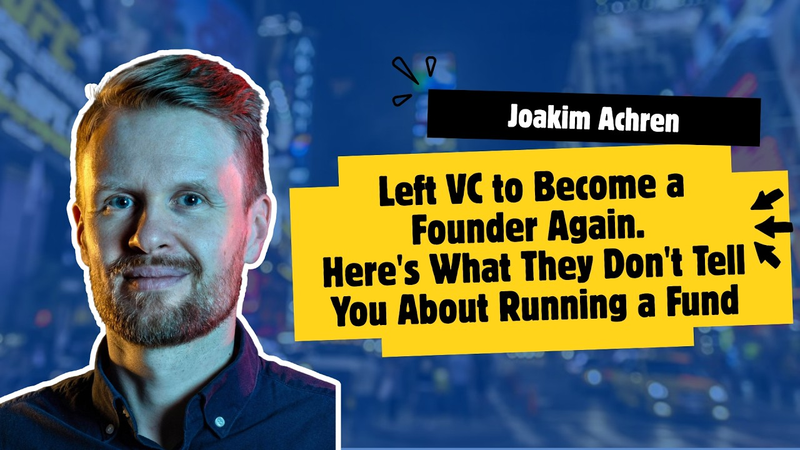
Left VC to Become a Founder Again. Here's What They Don't Tell You About Running a Fund
20 Apr 202666 min video
Transcript
the there's there's only one thing that usually is very significantly helpful for what your existing investors do is help with the next round. There is so much work there on trust, who is on board already, what why did they invest, what's going on, um and opening doors for the founder for the next tier funds. I think that's that's for me as a founder that always was amazing work from my existing investors. And I've also done it myself as a as as an angel and a VC. I feel like quite successfully.
[music]
Jussi Mäkinen, so what's happening right now? How are you doing, dude? Very good. It's I've [snorts] been uh founder again since last fall when I basically stepped down from doing any new
investments with FO Fund. I'm still involved in uh helping the founders from our first fund where we invested in about 29 companies. So, it's a good set of like activities that I still have with a portfolio of companies plus my uh earlier angel investments. Um So, what happened is that the AI stuff just got to me. That was that was basically it because like it was 6 years since I left uh the entrepreneur realm, um became an angel and then VC. And I was playing around with the tools last summer. All the cloud code stuff just got to me as something like this is just crazy. And it was like every day they were pushing out a new update on cloud code where I could see, okay, now they fixed this that was annoying.
And then something else got fixed and they introduced some new things. And it's continuously been that for the last 6 months where it's just constant crazy stuff happening. Um so, I made a decision last summer that this is like much bigger than any other shift where I've been involved with uh or in the midst of where things have gotten really crazy like the days when social media came along with Facebook gaming. And then the mobile stuff happening, seeing that first hand when I was at Supercell and then with Next Games. And this feels like a lot bigger. It's just I I guess um I'm doing well and it's it's so much more fun to to do ding things differently because this is very different from what happened like 15 years ago with mobile. Yeah. [snorts] So, I'm talking about 15 years, I've probably known you for 15 years. Yeah. Um and during the sort of a
previous phase of your career, so you worked at at Next Games, a company that you founded. Uh you left the company at one point and and essentially became a content creator uh with Elite Game Developers. I was looking at from the side. I was like, this guy is going to be the next Harry Stebbings. The way I looked at it is that you did all the steps right and like this is how you accelerate yourself to a VC career. Set up a couple company, one fails, one succeeds, produce content, produce material, make an angel syndicate, and then work with a fund and then build your own fund. What hap- like why did you leave that? Because you're saying that you got bit by AI bug. So did every VC in the world. Like you could have just stayed there and continued investing and doodled in in AI tools and and tweeted about the latest updates. Yeah. Yeah, I I guess like that's something I kind of realized along the way. I remember 2019 slash I was having
a breakfast with one bigger VC fund, like general partner at a fund. And I was talking about thinking about like starting a VC fund already in 2019. Although it took 3 years from there still to get to that point. But the discussion really went to that place where they told me that the that I should really think that is this something that since I've been an entrepreneur for so long that is this something that is really something for me. But it's kind of hard to know because you really don't know unless you do it really like in the weeds. And I think the the biggest thing that people really don't talk about is how hard it is to raise funds for a VC fund where there's kind of like timing there as well where
during the pandemic VC money from limited partners like endowments, uh family offices, everything in between like high net individuals, people were putting a lot of money into technology funds at that stage and it uh it was kind of like everybody was tapped out in 2023 on VC and it hasn't gotten better, to be honest. It's still the reason is that like the the funds that invested during the pandemic, they're not seeing exits the way that it was kind of anticipated because there was so much heatness in the market of IPOs and everything crazy happening in 2020. Uh so, since that hasn't been realized kind of those promises, those LPs don't dare to write new checks before they see returns. So, it kind of like even though you're like Harry Stebbings 2.0, it's
still tricky to pull that capital out of the market. It it kind of you having like cloud in an industry is less valuable compared to like what your actual like relationship and connections with the LPs are and how they can sort of call their senior GPs at the tier one fund and ask like this guy about this guy. Um So, I think the the Harry Stebbings playbook requires an an approach where you actually build relationships with the tier one people in in capital markets, uh private especially. So, I think that was something I didn't do and I was I was intentionally focusing on just nailing down kind of like the the entrepreneur sector, the people there and knowing them well because that was like where my interest is lie versus like how do I raise a fund, what is the
playbook for that, what is the the way to do it efficiently is to talk to all the people who have big cash and also the people who have raised money from them. For sure, like I had from the Next Games days a lot of top tier VCs that knew me and I knew them and I did kind of use them also for connections, but it's still like very challenging because the the markets are so tough after the pandemic. So, that was that was one one reason why it felt like, okay, my work here as a VC is more about raising this fund than having a break for 12 months and then starting again. That's how it felt.
Actually, let me let me circle back. So, the biggest mistake you did as a VC, according to you, is you got your own experience, walked more than a mile in founder's shoes, walked, you know, way way more than a mile. Um so, you perfectly understood what
founders are. Uh and then you had close relationships with investors, so a bunch of VCs. And through that you had access to deals and you actually set up a angel syndicate and and ended up investing about 50 50 investments through that. So, you perfected the access, but you forgot that as when you go full-time VC, you're not working for founders. You're not working you're working for LPs. And that is the key relationship. It's the capital because once you have the capital, then the access is going to open up as well. Heroic Labs has spent over a decade quietly building the back end that powers some of the largest games on the planet right now across every single platform. Their products, Nakama for multiplayer and social, Hero for metagame systems, Satori for live ops and experimentation, and Heroic Cloud to scale the whole thing. The pitch is simple. Stop burning senior engineers on infrastructure problems that were solved years ago.
Build your game. Let Heroic handle the rest. Go to heroiclabs.com. Mobile, web, CTV, PC, a dozen channels, a hundred creatives a week now that AI writes them for you. And somewhere in that mess, the signal that tells you where to double down and where to cut. Good luck finding it in a spreadsheet. AppsFlyer gives you growth teams one source of truth across every platform and every channel. So, you stop debating whose dashboard is right and start making the call. In an AI-first user acquisition world, the winners aren't the ones with more data. They're the ones who trust theirs. appsflyer.com for the single source of truth. Mhm. Yeah, and it's it's in a way founders turning VCs is not necessarily like a you know, like it it sounds like intuitively really powerful. But there's there are these uh issues with it as well where under
unless you're you're coming in at at the right time where there's a lot of capital available and then you can get your foot in the door for fund two, three, and four to be raised. Um So you mentioned the the fund difficulty of fundraising. And there's there's two types of difficulties that you talk about. So what is the notion of timing? And and timing is a very interesting thing. It it's not only a VC thing. It's mostly a founder thing where where we as founders we we push through. It doesn't matter. Even if it's hard, we think that hard is even actually good. And we don't care about timing even though we analyze others and saying like, "Ah, it's a bad timing. This product is, you know, coming in too late or this product is too early." But we never think about ourselves. The other part that you were talking about fundraising difficulty is raising for gaming specifically. So you coming in and setting up a gaming fund
after gaming is overfunded, after gaming stopped growing, after gaming essentially is not a VC case anymore arguably. And a lot of LPs are not maybe looking at that, but they're looking at I put in X amount of money into a gaming fund and it's not even close at returning. So why would I invest again into gaming when gaming is doing much worse than it was back in COVID years when it was red hot. So unpack me the the fundraising difficulty and what that means for a venture capital and unpack the other timing. I just want to understand.
Yeah. Yeah, for F4 fund we were an R uh a consumer fund. So it was a lot broader. And it has its its good sides and bad sides. I think the good side is that you're not only kind of you're the slave of the the dynamics in
one industry. If there's like, you know, like rising tides, it's great to be a gaming fund. If it's not like the best days of the industry, then it's really going to be rough. Um so we did that, but then then you go through you can go too broad where it is like, "Okay, uh an LP has already invested into these kind of, you know, sectors in um maybe health care, longevity." Then they want to do something in in consumer, but they've decided that they're going to write five checks into consumer funds. But then you get somebody who's saying, "We we're going to do all consumer." And it's more like, "Oh, no, but we want like sectors. So could you do gaming instead only?" So there's a lot of conflict. It's not every LP is a bit different on what they want. Uh but generally it's it it did seem that being in a niche like gaming where the
best days are not right now is super challenging. And we have those uh smaller gaming funds out there who typically have their biggest LPs directly from strategic investors um like bigger gaming companies, organizations like these massive conglomerates who are then putting in uh checks into those funds basically to get intel on what's bubbling in the startup scene. So I think that's the only route and there's so many people knocking on those doors already. So it's also a bit like what are you bringing into the table? Uh the challenge is there. And I think that's where the mistake came to life because you did not build that part of the relationships. You built the founder and the VC relationships, but not the other capital relationships. And had you built the capital relationships, then you would
have known what specific capital allocators are really looking for and that would have allowed you to focus on them, cater your offering to them, and get bigger checks from those few ones, kind of anchor your fund, and get the rest of it. So, right? Yeah, the the the thing is like it's an on ever go like you never stop doing that. So bigger funds kind of do have to have a team who are just focused on LP relationships because these dynamics change so much. Some LPs say they're not going to do any more VC for the foreseeable future. So you need to find new ones. Um It was not like just plainly for me it wasn't really exciting uh as something I would like to do in this day and age where there's crazy technology developments. Um so I think frankly that is kind of the reason. We'll talk about that because uh
you you called me what I think it was before just when the news went live when you informed that you're leaving F4.
[snorts]
And we had the conversation about it. And you were very frank in terms of this wasn't what you thought it would be. And that came to me as a surprise as equally probably as to you in the sense that you've done so much more investments than I have. Like, you know, if I'm hovering at around 20, then you were at like uh by that time you were probably at 75 to 80 investments deep. Yep. Realizing at that point that this isn't what I want to do. Exactly what the the VC told you in 2019. What it what wasn't what you thought it would be? Like what was the positive side of being a VC exactly what you expected? And what was something that wasn't actually that you know Yeah, exciting you. Yeah, I think the the whole thing about
just spending times with time with dozens of founders consistently seeing where they're going. Um Everybody's at different stages. Some are very stuck for many years in a similar position where they have a game which just is really hard to make uh really good income on. And it's hard for them to decide what do they pivot or do they change? But that's that's an amazing situation to be involved with and try to give advice. Try to to find people that could be helpful for them in that stage where I'm not as helpful. Uh so that was the best thing to work with founders. I think the negative thing is that it's so much about the fundraising for the next fund. Unfortunately, that's where um the energy goes a lot. It's probably
like more than 50% that usually typical like smaller fund managers need to spend their time on. Um when you scale your operations and you have a team on the VC fund, then you can specifically get people involved with more like the LP chasing aspects. Um Why don't you like the selling part? It's just not exciting. I don't know, man. It's like there's so much like as a builder I feel like that's not a part of um that was not an exciting thing to be building like a uh capital sort of structure system. I think like there was excitement there. Without AI coming up, I would have definitely continued learning and pushing. But that that's kind of like a uh it was an opportunity cost more or less. Like from deciding which one to do.
Um And and it it wasn't easy to raise money for a
Yeah, yeah. I'm I'm I'm just curious about because like I love [snorts] selling. I I think it's um I enjoy tremendously. Uh I enjoy the the chase, uh the closing of a deal, the negotiation part. Um I I enjoy the ups and downs of of, you know, being so close and then ah god damn it. And it's like it it feels bad. I can say like it feels bad to you to to lose a lead, but but I enjoy that part. Don't you enjoy like like what is it about it? Does it feel like the the selling feel kind of like dirty to you? Because I know many Finns hate selling because it's it's down it's looked down on culturally. I think it's more about like what I'm selling. And um
[snorts]
cuz I didn't per se hate selling a VC fund because we knew what we were doing. And even though it's gaming has so much
parallel with any kind of consumer company when it comes to like data driven uh product development, uh just running a company. So in a way we were selling the right thing. Um it's just the timing made the selling brutal. So you were accumulating the no's. Like everybody is saying no, no, no. And that when you hear no too many times, it kind of breaks you, right? Like we've gone through funding rounds that failed. And it is brutal. It seems like you take everything personally because you're especially in this case it's your fund and everybody is saying no and there's nothing really you can do against it. With funds it's a bit different because we had like a lead list of 400 LPs. And you know, you're not looking for one to say yes, but it's more like it comes from small tickets from all over the place. So, it the dynamics are a bit different.
So, one no isn't, you know, not the end of ever at the end of the day in a VC fund, but it's just uh it wasn't a good time to to raise a VC fund. That's That's the really like the real issue. Um especially for for gaming, it's it was even Why did you do it then? Like Like if the if every sign points that now is not the time, then why would you Why would you push forward with it? It's like I mean, we talked before recording, it's almost like, you know, you're planting seeds, and yes, planting seed makes sense cuz you're going to have a harvest, but it doesn't make sense if you do it in December. The seeds are going to die. You need to do it, you know, in May.
Uh fund one was a lot easier because things were not as bad in like late 2022 and 2023. Yeah, recovery. But it was kind of like you're already in the startup, you raised the seed, and
then it's you still see that it's getting worse and worse. So, it it it was it was kind of like that. Um But then, at the same time, we did have a lot of credibility from our first fund performance, where we had a lot of the startups raising like Series A, which just give you the ability to show that there's results happening here with the first fund. So, it wasn't all bad, but it still was like, "Okay, we're going to have a really hard time here to raise a fund where it makes sense to have two GPs." Um
Yeah. Yeah, talk to me about the uh the fund um fund economics, if you will. You have two GPs, so two general partners are running a fund, and let's say that fund is $10 million. What is your salary in in this type of a case? How many people do you have working? Is it like only the two people?
Do you have analysts? Like talk to me about the day-to-day life, the week-to-week life of a of a GP, of a small micro fund, essentially. Yeah, it's it's usually a typical model here is that you have uh 2% annual management fee, which you take from the fund on top of that. So, gross 200K, let's say Let's say 10 million fund, 200K K annually, given to the two LPs. That 200 is 100 and 100 for both, or it's not even that, because you have some kind of running fees, probably, with a with the admin.
Correct. There's constantly some admin cost. So, you you're basically needing to leave behind 5 to 7K a month from that, uh typically, for admin. So, it Yeah, it's not like very lucrative. It's impossible if you if you're dependent on the salary. Both me and David have had exits, so it was like a
to to start off with a smaller fund, it kind of wasn't a problem at all. Um Yeah. So, it it's in a way like, do you want to do that for for 2 years, then another 2 years, another 2 years? Like, how do you How do you get away from being a small fund for a long time? And a lot of smaller funds started during the pandemic that then went out to raise a bigger fund. Many did succeed, but many didn't. Um So, there's also the dynamic of how do you level up as a company, as a fund. Um And it's challenging in these times, in these markets. So, basically, what you're saying is if you have a micro fund, there's no way to justify doing it full-time, because you there's no money in it. You have to be, you know, already
wealthy and not in need of month-to-month check to be able to run a micro fund. So, it's almost like a hobby. It's almost like a Not even a hobby, it's like a trainee session. You have to put in 2 years of work. 2 years bootstrapping. Yeah, correct. It's like a company. Um and you don't really know if it's going to become a big company. If you do if you do be advising somebody else who's raising their first fund, essentially bootstrapping their themselves into VC, would you tell them like, "Hey, put everything on it. Just focus on Like you did this. You stopped your newsletter or like half the newsletter, stopped the podcast, really went all in on on the VC fund." Is that a good idea hindsight, or should have you Should you have kind of like push forward with a media that is a secondary income for you? It's also a good platform, and then you're not as reliant on the small check that you're getting from bootstrapping your venture
capital. Mm. I think that then you're you're basically putting your time and resources into something else, which could be poured into pushing the VC bootstrapped business to the next level. So, it it's the same. Like, you're you're kind of if you want to do a startup, but then you're doing also some other content business on the side, it's it's kind of the same. You're going to have forward. But again, going back to 20 Minute VC model, arguably, he probably pushed harder the media side, and that became the tools for access, uh the tools for visibility, the tools for connection, because he was very focused on getting the capital allocator as well on the podcast and informing relationships there. Yeah. Um And and the the the like second argument I have on that is is like, how much a VC really helps? Like, how much does the the monthly call or bi-monthly call or
like the powwow really helps? Not I'm saying it could help the founder. I'm not saying that. Mm.
But how much does it help for the investment to have a higher ROI? I've been thinking about this quite a lot, and I feel like the there's there's only one thing that usually is very significantly helpful for what your existing investors do is help with the next round. There is so much work there on trust, who is on board already, what Why did they invest? What's going on? Um And opening doors for the founder for the next year funds. I think that's that's for me as a founder, that always was amazing work from my existing investors. And I've also done it myself as a as as an angel and a VC, I feel like quite successfully.
Joakim, how many times do you raise a
year? One max, or maybe two if you're doing really fast. Well, this is the thing with the portfolio approach. I'm looking at more like, "Okay, I've done this like half a dozen times a year." Um Of course, it's not all the companies will ever even get past the pre-seed, since they they they die they can die before the seed or the Series A. But like where where it comes through is like the portfolio kind of approach, where you have those winners, then when the the win Like those companies who get to that point where they could be able to raise the next round, then the helpful existing investors who have connections, they can make a difference. They truly can. Okay. So, I fully align with you on that. So, for VCs definitely help with raising, because they help you to make a pitch
deck to another VC. Who knows better how VCs think than another VC. So, that's totally understandable. And also, VCs' job is to raise money for the for their own fund. So, essentially, as a VC, all you do is raise money. Either it goes to you, or it Now, given that, like, how when when you construct your work week as a VC, how important are the calls with all the funds or all the investments, or do you sort of um allocate your focus on only the ones that are soon to be raising? Good question. It It really depends. There's [snorts] There's companies who want support more, and they ask for it. I'm I'm more of a an investor who kind of wants the founders to ask me for the connection, versus me pushing
something on them. Uh I feel like that that works. And then, when the fundraising starts, then I'm if if they send investor up this, where they talk about a fundraise that will start, then I I usually become more proactive, where I then send the message to them, if we we're not in constant contact, that now we should talk about this. Um So, yeah, it it really depends. I've talked to some of the big big partners um big partners partners at big funds, and some of them have been very clear in private conversations that it's dumb to invest time into most of your portfolio founders. Like, there's going to be few at a time that that need need you and really you need to focus on them. Most of them are not going to exit or are going to fail at some point. So, I mean, that's the VC model. Like let's
say one out of 10 would be a good hit rate. And so you need to focus on that one out of 10 and not dilute your attention with the nine others. I think that that kind of natural approach for me was to to tell the founders that let me know if you need help versus let me help you. Let's have a call every week. Like that that's then it becomes more like, oh, we're just chatting about like random stuff and there's no like agenda in those calls. So, it's a bit outsource that side to the founder. The founders the founders tend to take it as reporting, especially the first time founders. Uh they have they they do the calls, they report, they're like, how come you didn't, you know, they think of you as an executive versus an investor and they can't, you know, find the difference almost in their head. And another thing that I've heard mainly from the first time VCs, uh especially those who are
coming in from a startup backgrounds, they talk about how hands-on they are, how they're going to really be in the trenches with you and help you. And I don't know anything more unscalable than that. Because it it in the end like every fund that grows and gets fund two, fund three, fund four, they say all the same thing regarding their thesis. We invest into exceptional founders. Why? Well, because that's the only model that scales. Find the people you believe in, give them money, help them maybe when they make the next pitch deck and shut the up in between that. Yeah. Yeah, that that's a model I would say it's probably going to work. I think one point that I would like to make is that if you don't socialize with the founders, then you're not going to have a lot of like necessary the confidence level in
them telling you when there's something really bad happening or where they really need help. So, kind of having that random time to just get to know each other is probably like something that everybody should invest in anyways, like in all your portfolio companies. Without [snorts] naming anybody, can you talk about a situation where you really helped on something that on on this type of a this type of a scenario where they were socializing with you and through that they had the relationship with you and that allowed them to confine with you and you were able to help them. Yeah, I felt like my newsletter is a way for me to talk to everybody in a socializing way because I try to be very personal. So, I've noticed that it helps when I talk to the founders for the first time, they know already what I usually think. So, that that's kind of one uh already So, you're making again the case for running a media because that's
one-to-many communication and it even creates a personal relationships without without you investing into a personal relationship. Yeah, I think the the newsletter that I've solely focused on for the past 3 years has been good enough for achieving that and keeping myself in kind of people's minds and me also having an outlet for creating content. Um so, that that's like one thing you want to do is make yourself known and your personal side as well and then having that time together with the founder once in a while to form a relationship is really important. Hm. And how about spending the time with your investors? Did you um did the newsletter achieve the same thing or do they need a different channel to have your personal time?
You mean the limited partners side?
Yes. Yeah. Yeah, it's uh they definitely require different kind of details. So, they they want numbers. They want uh like an updates on the companies, but for sure like whenever we were in the same city, we would have face-to-face meetings with them, having catch-up calls. Um but it's also a bit like they're usually busy people as well. So, it's more about like uh if they require something, they ping me or if I need something from them, they ping me. So, it it works both ways, I feel. The value addition like why I get access to deals is uh I tend to invest into B2B tech companies and the only value that they get is not my stupid jokes or calls with me or listening to my podcast or newsletter. It's connection. Uh can you connect me
with this CMO, with this CEO, with somebody of this of this company? And surprisingly through, you know, whatever 600 episodes of podcast and all the events, I would like, hold on. Yeah, I actually know that person. Yeah, sure. I can I can do the connection. And that kind of gives give the access. So, I'm kind of not not boosting myself. I'm just saying that the media is very powerful thing and I think that was a mistake when you stepped away from it. I think it's uh it's communication both to the founders, uh it's the communication to investors to some sense, it's building of your own network. So, uh Well, there's a there's a certain extent media can be only one newsletter. It can be multiple podcast episodes every week, having events, things like that. So, it's it's a spectrum. So, I felt like this was a model where I would have time to write
a new like regular newsletter, but then have the time to build actual businesses as well. Just tying a bow on the whole VC model. Basically, you have a three three-legged stool. You have the the limited partners who are investors into your fund. You have founders who are the receivers of those funds that the limited partners will give you. And then you have the third leg, which are the co-investors. So, those are the other VC funds that you have to work with to get access on on deals. And the challenge is is how do you keep all the three legs strong because you have to have great relationships to your own limited partners and to show them that you're getting great access to the top founders. And the access top founders comes both through your network as well as through the the the allocation from other co-investors and at the same time you're competing
with the money with the other co-investors and you're competing against the other co-investors with the founders and yet the LPs want you to win on all the sectors and have the lead. So, it is a a challenging model where you have to compete and cooperate with the same people for the for the limited resources and the limited access to the founders. Correct. It's tough.
Yeah. And you're selling more than you're investing and helping the founders. Loyalty is the rare user acquisition channel where the audience is actually high quality. But the platform you pick matters more than the channel itself. Vibes is built by game industry veterans. It runs on AI-powered targeting and optimizes for ROAS instead of just impression or specific retention number. It's the fastest growing loyalty platform in mobile games for a reason. Go to vybs.co and get yourself the best loyalty platform in mobile gaming.
Want to hear an uncomfortable truth? If Apple owns your checkout, Apple owns your player. Every receipt, every retry, every win-back moment, theirs, not yours. AppCharge flips that. Full-stack direct-to-consumer infrastructure built by monetization veterans, backed by Supercell and Playrix, trusted by studios that have pushed over a billion dollars through it. The savings are nice, but owning the relationship with your highest value players, that's the actual unlock. To get your unlock, go to appcharge.com. Yes, and we talked about timing uh and there's so many VC funds now out there. Uh so, it's very hard to differentiate at the same time. Got it. Um No. Yeah. And and in in your eyes, just to to close on on gaming, um what is the perception of from those from capital allocators, the limited partners,
uh who put money into venture funds again? Just for for those who are not uh familiar with this, how do they perceive gaming industry at the moment? When you approach them as a VC saying, "Hey, I'm a gaming founder. I have great access to gaming companies. It's a $200 million business. It's growing every year. Give me money and I'll I'll I'll bring you returns." Yeah, it's it really varies. People who have already done investments into funds that invest in VC, they typically have not seen the returns that they expected. So, many of them are pausing. But then you have the situation where you have new funds like you have new funds coming up and then you go and meet LPs who none of the existing gaming funds have talked to. That that does happen. And then you can tap into yeah, some new money or some money that was un
not allocating to VC for many years. Like there are those kind of situations cuz basically we didn't have this kind of gaming VC ecosystem before the pandemic. It just basically started in 2019 that you got all these gaming funds. Mhm. So it's it's fairly new. So it is possible that there are LPs who who have just stayed away during the pandemic. So you got bit by the AI bug and you're seeing this as as many do as radical change that is happening and you have to be at the forefront of it. What have you learned about AI that that that came out as a new thing? Yeah. It's a good question. I think the the biggest learning has been that AI in its current form and I don't really know if it's going to change or not is that
it is basically just replacing human resources in a company where previously you had to have 10 people to do something. Now you can do it one person with Claude code can do it in the same time often even faster. And it's gradually replacing different kind of aspects of kind of white-collar work where the hardest will be design um and graphics and those kind of like extremely creative jobs. But like those those things are also being caught up quite well with generative AI models. Um but the thing is like for gaming for instance, I really haven't seen an AI game that makes sense yet. It's mostly productivity increasing and that's that's the biggest
thing for me. But still as somebody who really appreciates removing friction from being an entrepreneur, making entrepreneurs' lives easier. I do appreciate uh AI agents as co-founders for for solo founders uh taking so much doing so much heavy lifting um away from this one person. So like that that's that's definitely the the biggest change or here that is happening. Um so next thing I expect to happen is actually that AI would do something that the humans cannot do. Okay. So we're at the stage where it brings efficiency. You're replacing humans with something that is better, cheaper, and faster. Got it. That's very clear. So it's cheaper to build. But at the same time when it's cheaper, faster to build
the distribution becomes the the issue, right? How do you view that? It's nobody has solved that yet. You really have to have a creative mind to do great distribution and creativity is something that AI is struggling with. So when I go to cuz I use Claude code for everything basically just everything that I would do on a computer, I go through Claude code to do it nowadays. Mhm. So I would ask Claude, hey, what what kind of campaign should we set up for running ads for this product that I've created? And it's very much like just guessing. And hey, let's do this.
Bold play. It's like, hey, let's run some Apple ads like App Store ads. That's the thing where it would want to start. And then I tell tell it to let's do like a
a research, go online and search for the the most recent articles on doing user acquisition. And then does that and it comes up with something that is much better, but still it is very much like just averaging into something. So distribution is definitely something that's harder for AI. So you So you mentioned the where it struggles is creativity and probably where it struggles, at least what I've noticed, is authenticity. Um another element of of being human. You're saying it's replacing humans better, cheaper, faster. I would say it's replacing juniors. And so when you say I rely I have a lot of these agents like, okay, so you have a startup where you hired a bunch of people who you pay $1,000 a month. Yeah. I want to push back on the junior thing.
When I talk to Claude code it doesn't feel like a junior. That's it it feels more like you know your regular developer. That's how it feels. It's not like somebody who's going to push back that often cuz that's what I really like about seniors is that there's push back. Mhm. Where here it is more about like okay, you want to go down this route? Well, I'm going to do it the best way I can and that's how it goes about things.
Okay, so staff level. Very much staff level. Very reliable. Um knows everything. But never push back. And essentially everybody has this workforce. So how do you how do you differentiate the products you're building with AI if everybody has these resources? Like that's my biggest challenge is that there's no moat. There's no uniqueness when with with
these companies that are building. It's like I have a I have a bunch of agents running. We can build that already exists cheaper. It's like, okay. I'm not interested.
Yeah. It's a bit like what are we where is the sort of disruption happening now? It's a really good question. Um I've been focusing on since January mainly on writing my books. Like I have the sleep book coming if you want to dive into that a bit, but I'll just share what I've done there with AI cuz I wrote I started writing this book 2 years ago and I had the manuscript ready last year already. Um but then what I noticed is that Claude code can be my sort of publishing company uh where it does everything related to you need to put this file there to run it through Amazon
like orders stuff um test like how the print works. It's done everything for me. It's basically been my publishing company. Um so it's in a way
Except the distribution. Except the distribution which publishing company is E- Exactly. There's no it's it's not going to go out and build the relationships right now. That's something it's not really good at where it would build the relationships for me with the distribution partners to do all that marketing. But that is I don't feel that that's something that won't be solved. Uh but it's still that's not the place where it's doing the best work still. But I do feel like the opportunity when everybody has the same tools comes from picking niches that can be disrupted. I feel everybody's focused on making
consumer apps with AI is like, okay. You don't you don't really differentiate at all. Um I think I actually let me ask you one thing before I tell you what I think. Um what was something that you thought AI could deliver, but it actually didn't deliver? Well, it's kind of been obvious that it doesn't deliver users.
[laughter]
That's uh that's never been the case. It's more like, you know, you build stuff with it and it's the the efficiency that you get from it. Um it cannot create magical experiences. It it can only emulate something that already existed. So in a way it struggles so much with creativity that it it sort of hurts. Like I've been doing this AI
game development course where I talk about um how I created like a level level design tool with AI where AI basically builds the levels. And it was a lot of work to get there. Um and eventually it works as long as I have so much guardrails that AI just doesn't give up because it doesn't know the same patterns that need to be taken uh from its training data. So but I feel like the the whole thing that I got wrong was that I I AI should be used to build tools for humans. But I've I've been more thinking about that it's it's more about you build tools for the AI to do a better job. Because you're going to have more efficiency if they're doing something that is very much rules-based.
Uh and they do that job. But then you they need some tools for that like to run more efficiently, more properly, not to hallucinate, do things like that. So I think that was that was kind of probably my biggest lesson in the last 6 months is to just focus on letting AI have the tools to do the best job it can. Mhm. I like you have a very positive view on AI and I have as well. I I mean I use AI daily. I go through the courses and I try to educate myself, build my own agents, et cetera. What I have noticed is I've actually pulled back from some of the AI tools because I've noticed that this efficiency and this speed hurts results and it hurts my own thinking when I let AI to do too many things. And you even notice this when I at least I noticed it when I'm flying and I I typically spend my time when flying writing stuff. And at some point like
during the last year or so maybe during the last 6 months I was like Ooh, I need to prompt bunch of stuff so that during the flight I can edit it. That's a such a bad approach and it and I felt that I've lost the ability to generate and I've become an editor of mediocre stuff. And putting the mediocre to like oh it's now it's maybe okay plus. But it's not my original thinking. And by moving really fast, by producing content really fast with AI, be it memos, be it blog posts, be it podcast scripts, it takes away my own thinking. And when it takes away my own thinking, it does it it removes the authenticity of of of the content. And then going back to distribution, I kind of thought about it from from the [snorts] element of like personal trainer. I mean I consume a lot of sports information and stuff like that. And I can generate with AI as good of training
models and diets as any professional coach. The problem is is that I do not respect the that AI produces. I do not respect I can say, "You know what? you. I'm today I'm doing differently." Or whatever you say, this is computer-generated, it's not the same versus when it's given to me by a coach that I have some kind of relationship whether it's one-to-one or whether it is even through online. Uh I have a relationship with this person. I respect this person. I respect what they've put out. I might disagree on on some program that they've sent me. But you know what? I'm going to follow it because I respect it. With AI, I don't feel the same way. And so I'm not obliged to to do it. And then that sort of a authenticity, again going from from this very simple example, going to distribution is is that I think in the age of AI where
producing tools and content and um apps and products is so much easier, I think media becomes more important. Media by by creators, by content creators, and by real people becomes key for distribution. And I think it's very fragmented as it is media and getting more and more fragmented. But nevertheless, having these channels whether they're using creators or influencers or or independent media or whatnot is is becoming even more important as a distribution channel because it's not AI. Yeah. Yeah, I like the I I agree with what what you're saying, all of it. And this other thing that comes to my mind is like I saw this saying now that's popping up that uh before AI, I used to work 12 hours a day and now AI I'm working 18 hours. So
Yes. because of this kind of dopamine that
comes from producing things quickly, it's all of a sudden you are actually wanting to get more of it because it is available there 24/7. Uh I noticed that a lot late last year where I was really starting at 7:00 a.m. like stopping at 9:00 a.m. 9:00 p.m. like coding with uh cloud code something. I noticed that I I wanted to remove myself away from there uh after I noticed that okay, it's not going to generate results because the distribution is still going to be the key thing versus like me building yet another thing I want to try. Um so going back to the distribution thing, it is clearly the biggest advantage
as creators like just just as solo people. If I'm talking about the way that AI is now letting people build solo companies in a totally different way than before, then the solo person putting themselves out, creating content, being an interesting person is still going to be mattering for a long time. Yeah. And and even going back to like again tying this back to VCs, I A16Z launched late in last year in November new media fellowship. So basically what I felt through their uh Substack that they've been talking about the importance of media in your distribution. And in some cases they've been pushing startups to also start their own media channels so that they build their media to distribute and their product because product building is now easier. Focus on distribution from the get-go. Build your own
channels, distribute through your own channels as well as the other paid channels. Yeah. Yeah, I agree. It's like people will still want good content. People will still want originality. Like something cool. And I think it's the value just increases when you see yet another app which isn't differentiating and then you see somebody who's doing something really cool and different. So yeah. So talking about cool and different and doing some you know and shipping and distributing, the the sleep book. Uh what what made you write a sleep book? Cuz it's like don't get me wrong, there's plenty of sleep sleep experts. I've listened to them on Modern Wisdom, on Diary of CEO, on Joe Rogan. Um you're not a sleep expert. You but you wrote a book probably because you've struggled with sleep. And and so what's the what's the angle of your sleep book and why did you write it? And who is it for?
It's very much for entrepreneurs. So all the chapters really focus on what are the situations where founders will struggle. And of course like it's it's anybody who has a lot of activity in their life, up ups and downs, stress, will suffer from bad sleep. But then it's like relatability, uh talking from my own experience, I've I've been a consumer of nonfiction books for a long long time where I feel like most of the interesting nonfiction books are from people who talk about their own experience to to an extent where they've actually gone through it versus just talking about what other people say. Um my sleep problems really started after my burnout in 2019 and it feels like it shifted the way I'm able to have
like solid sleep without having the wired but tired feeling when I wake up super early. Um so then the book project itself started 2 years ago when I had had my Apple Watch. I I became a late Apple Watch user only
Mhm. 3 years ago I got it and started tracking sleep and understanding that okay, it's there's stuff I can do here. Um to to get these numbers to a better state and then after year it felt like okay, I'm I'm doing all this stuff and I like writing books. Let's just start logging everything I'm doing. And there was so much that I was trying. So it the book is kind of like a result of that um from experimentation to learning a lot.
Why is sleep so important? It's like it it gives a happier life feels. There's a few things like I had a I think it was a Tim Ferriss podcast that that was a Matthew Walker who has this Why We Sleep book where he they were talking a lot about the the way that sort of different kind of diseases like Alzheimer's are related to like chronic bad sleep Uh, where there's like some substance that collects into the brain uh and it's pretty much like proven that that happens if you're suffering from chronic bad sleep for for many, many decades. So, there's just it was just like a oh, I don't really want to go through this. So, what do I need to know? So, it's mostly about like having a better life for me. Yeah.
You know, when I when I listen to these sleep experts, I felt irritated because they talk for 2 hours about the benefits of the sleep. But, if you're talking about benefits of the sleep to somebody who's stressed out and when he goes to bed thinks about these different things, the last thing you want to do is stress out about not sleeping when they're trying to fall like it's counterproductive what they're doing. They're talking about, "Well, you should sleep 9 hours." It's like, "Dude, my company's falling apart. I have kids. I'm I don't know what I'm going to do if this fails. And now you're stressing me out that I'm going to get an Alzheimer like a memory disease for not sleeping enough." And so, just to counter that, what I've you know, I've had these issues as well. What I've turned to is actually there are
[snorts]
there are these special operators in the military, you know, whether you're talking about Navy SEALs or Rangers. You see these guys, they are sleeping on their way to a kill zone, which is
absolutely insane. In an airplane or in a helicopter, they're just dozing off before they're being shot at. So, I'm like, "If they know how to sleep, I need to learn from these guys because whatever stress I'm feeling is nothing compared to be, you know, in a situation you where people will try to kill you for the next 24 hours and you'll be killing others. And now it's time to take a nap." I talk about it in a book in a way like now I was writing the epilogue at the ending of the book. I was just saying that, "Okay, last night I slept like 5 hours because AI is like the thoughts about what I should do next with AI. I'm just keeping me up. And it's not about solving sleep, but it's more about being more informed about hey, this is like possible and then you you make the decision if you want to do it or not. And I'm currently a bit in the realm
where I'm decided that I'll I'll just focus on this for now as a sort of like a a sprint in my life where I do want to focus on building a new company and then there's going to be opportunities to have the better sleep later. Um, if you have that opportunity. Not everybody will have it, but like that's a place where you want to get to. I believe that you can have the choice.
[snorts]
So, we'll put in a pre-order link to the description of this podcast. I'm very curious to read it. I think, you know, I agree with you that sleep is hugely important. But, what makes it interesting for me as a read is because of it's authentic. It's coming from you who has had issues with sleeping, who I know has gone through multiple ventures, is going through multiple ventures, is having these
challenges and and shares his experience, his playbook on how he has um, tried to and then to somewhat succeeded with with uh, with getting some sleep back, but yeah, I I think it's it's very interesting. It's not scientific, it's more like practical advice.
[snorts]
Yeah. Well, Joachim, it's always a pleasure to having conversation with you. You're very authentic person. Uh, you do a lot of things. You do them methodically. You're not afraid to let go. Uh, and you're not afraid to talk about you not only your success, but also your shortcomings. Uh, and that is sleep book is a perfect example of it. So, when you have a shortcoming, you try to figure out why and even write a book about it. So, that's a truly entrepreneurial way of approaching your shortcomings is turning them into products.
All right. Folks, uh, link in the description to Joachim's latest book. If you're having challenges sleeping, let Joachim put you to sleep. On that note, thank you, Joachim. You did it. You made [music] it to the end of the episode. As a fan of the show, it would help us out if you'd subscribe [music] and leave us a review on the podcast service of your choice. Those stars and likes, while a small action on your part, mean a lot to us and help to grow the show. More importantly, are you a member of the Deconstructor of Fun Slack group? If you have 5 years or more of games industry experience, go to deconstructoroffun.com/slack [music] and apply to join. Join the games industry's best professional community filled with peers [music] always willing to lend a hand or subscribe to our newsletter to get all the latest insights from the Deconstructor of Fun content [music] creators.
Thanks for listening.
Auto-generated captions from YouTube — names and numbers may be misheard.



















Comments