Investment reports and market data
Documents

Why Disney Wants To Buy Epic | Design Club
Disney is actively pursuing a strategic acquisition of Epic Games to address a critical deficiency in its corporate portfolio: the lack of a robust, internal first-party gaming infrastructure.
- Disney lacks strong internal game development capabilities, making the acquisition of Epic Games a strategic move to gain control over high-value gaming assets and infrastructure.
- Epic Games provides three critical pillars for Disney: the Unreal Engine for content creation, the Fortnite platform for user engagement, and the Epic Games Store as a distribution channel.
- Integrating Epic into Disney's ecosystem would allow for massive content bundling, such as offering legacy Disney, Marvel, and Star Wars game titles as part of a Disney+ subscription.

🚨📢 Breaking News: Apple AI money, rewarded roll-up, mobile funding wave
The mobile gaming industry is currently defined by three major trends: the indirect monetization of generative AI, a resurgence in venture capital funding for game studios, and the consolidation of rewarded user acquisition (UA) platforms.
- Major industry players are prioritizing control over distribution infrastructure, evidenced by NCSoft’s $202 million acquisition of a 70% stake in Just Play and Nazara Technologies’ $100 million investment in Blue Tile and Best Play.
- The mobile gaming industry is undergoing a consolidation of rewarded user acquisition firms, allowing companies to build proprietary ecosystems that bypass traditional ad networks.
- Apple is projected to generate nearly $1 billion in annual revenue from third-party generative AI applications by collecting 15% to 30% commission fees on subscriptions through the App Store.

TWIG #374 GDC 2025: The Honest Debrief
The gaming industry is currently navigating a period of profound structural transition, characterized by a cautious atmosphere and a growing disconnect between traditional development models and emerging consumer preferences.
- Investors are shifting capital away from traditional PC and console development, viewing these sectors as low-growth publishing models and instead prioritizing gaming-adjacent AI tools and emerging markets like Turkey.
- The gaming industry faces a structural crisis defined by rising customer acquisition costs, declining download volumes, and a significant contraction in venture capital investment.
- Gen Alpha is abandoning traditional high-fidelity narrative titles in favor of low-fidelity, social-first experiences on platforms like Roblox, rendering established development playbooks increasingly obsolete.
Video Games Ecosystem Report: Cyprus 2025
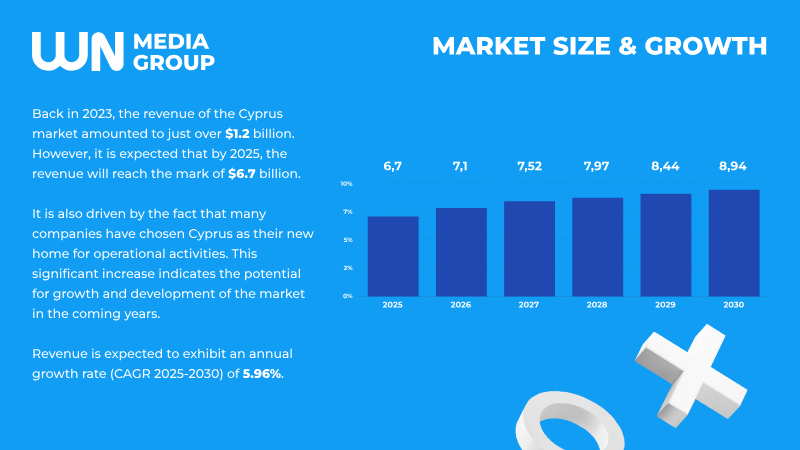
The report outlines a rapidly expanding video-games ecosystem in Cyprus, projecting market revenue to surge from $1.2 billion in 2023 to $6.7 billion by 2025, with a compound annual growth rate of 5.96% through 2030.
- Cyprus's video game market revenue is projected to grow from $1.2 billion in 2023 to $6.7 billion by 2025, with a compound annual growth rate of 5.96% through 2030.
- The local ecosystem has expanded to over 600 companies, including 282 startups as of July 2025, with 39 funded, 15 in Series A rounds, and one unicorn.
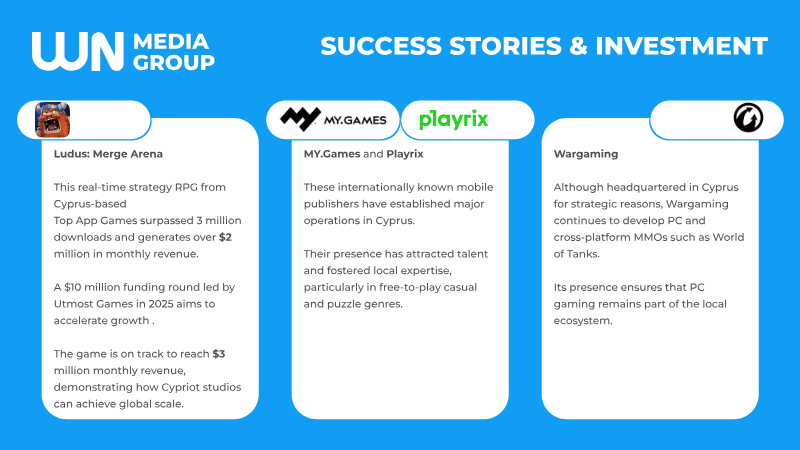
- Mobile gaming remains the dominant segment, led by major players such as Playrix, Easybrain, and Outfit7, while PC and console development is represented by firms like Wargaming and Digital Vortex Entertainment.

TWiG #373: Turkey Funds Game Dev, WB Games Uncertainty & Discord Drama
The global gaming industry is currently navigating a period of intense structural realignment, characterized by shifting monetization strategies, aggressive government intervention, and the consolidation of major intellectual property.
- Major publishers are facing significant strategic instability, with Ubisoft narrowing its focus to core franchises and WB Games potentially facing divestment or asset licensing due to parent company debt.
- Government-backed initiatives in Turkey are providing a sustainable growth model for studios by subsidizing employee salaries, platform commissions, and marketing expenses.
- Mobile developers are increasingly utilizing direct-to-consumer web shops to bypass platform fees, though these margin improvements are being offset by rising user acquisition costs and stagnant organic growth.

Scopely's $1bn Loom Games deal and Matthew Ball's big industry report | Week in Mobile Games podcast
The mobile gaming landscape is currently defined by a widening divide between established franchises and new market entrants.
- Scopely has secured a significant investment in the hybrid-casual game Pixel Flow, which has achieved daily seven-figure revenue since its October launch and is one of the few games in the last year to break into the top 20 grossing rankings.
- Activision will shut down Call of Duty: Warzone Mobile on April 17, 2026, citing a failure to meet performance expectations and the strategic difficulty of competing with other successful shooters.
- Unity shares have declined by 91% since November 2021, a trend attributed to the lingering negative impact of the runtime fee controversy, restructuring challenges, and market pressures from AI-driven competition.

The state of video games with Matthew Ball – Part One
The global video game industry currently exists in a state of paradox, characterized by record-high consumer spending alongside widespread studio instability, mass layoffs, and a contraction in venture capital.
- The video game industry faces a paradox of record consumer spending coupled with widespread studio instability, mass layoffs, and a contraction in venture capital.
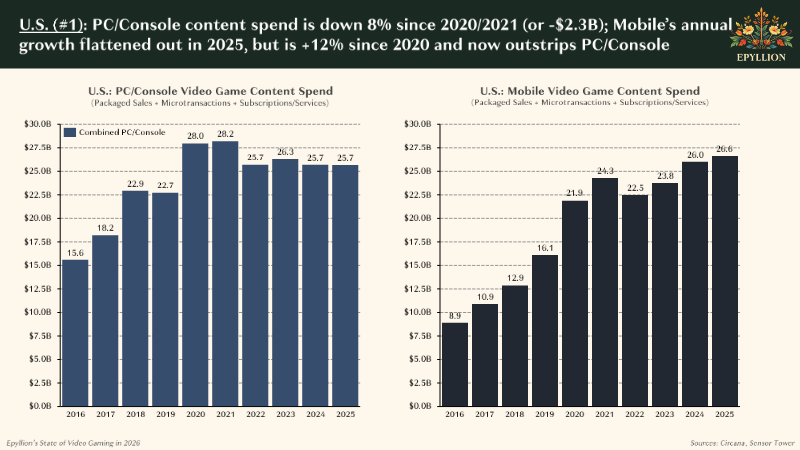
- The U.S. market is projected to see only 3% growth by 2026, a figure heavily reliant on major hardware cycles and tentpole releases like Grand Theft Auto 6.
- Surging demand for AI data center components is creating supply chain shortages for essential hardware like RAM and storage, threatening to increase production costs and delay future console generations.

The State of Video Gaming in 2026: Growth and Where to Find It
The global video game industry in 2026 stands at a critical juncture, characterized by record-high consumer spending that masks deep structural instability.
- The industry is experiencing a sharp bifurcation where record-high revenue masks structural instability, evidenced by a 55% decline in private funding and 44,000 industry layoffs.
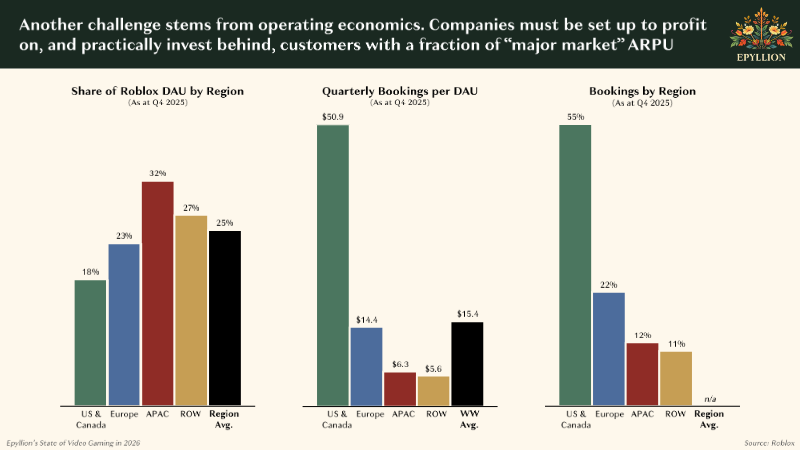
- Growth is increasingly concentrated in emerging markets like Southeast Asia, Latin America, and the broader APAC region, which have seen a 41% surge in value since 2022.
- Chinese developers and platforms like Roblox are the primary drivers of global expansion, accounting for approximately 50% of all industry growth since 2021.

Panel: The State Of AI: Sustainable Or A Bubble Waiting To Burst?
Artificial intelligence in the gaming industry is transitioning from a phase of speculative experimentation toward a period of pragmatic, value-driven integration.
- AI adoption in gaming is currently bifurcated, with mobile studios integrating it faster than PC and console developers due to smaller team sizes, faster iteration cycles, and fewer institutional legal hurdles.
- The primary barrier to AI integration within game engines is the need for reliability, speed, and trust, as current LLM-based solutions often suffer from latency and hallucinations that disrupt player experience.
- Rather than a sudden market crash, the industry expects a period of consolidation among AI service providers driven by rising costs and the need for tools to demonstrate clear, measurable value propositions.
Session: Future of UA: Creatives, Predictions & Funding - Halil Ibrahim Özdemir, Leus Capital.
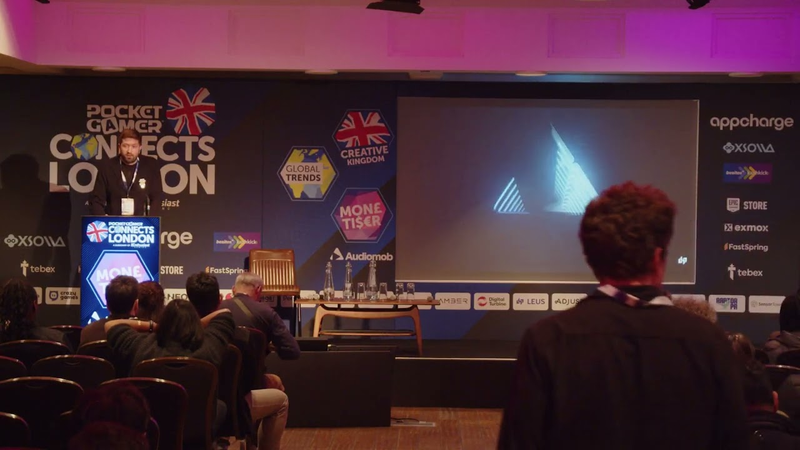
The mobile gaming industry faces significant challenges in user acquisition (UA), specifically regarding the identification of high-performing creative assets, the accuracy of long-term return on ad spend (ROAS) and lifetime value (LTV) predictions, and the availability of sufficient marketing capital to scale effectively.
- Leus Capital provides marketing capital funding for mobile game studios, covering up to 80% of monthly User Acquisition (UA) budgets to help scale operations without requiring traditional equity investment or publishers.
- The firm utilizes a predictive analytics tool that claims 99% accuracy in forecasting app performance, including ROAS and LTV metrics, across channels, countries, and companies for up to 52 weeks.
- Leus Capital offers a 'Visual' search tool that allows studios to identify 'heat creatives' by analyzing competitor strategies, hook types, and CTA performance across various ad networks.

🚨📢BREAKING NEWS: Gaming Stocks Crash, AI Panic Spreads, Meta Quietly Dominates 🤯
The gaming industry is currently experiencing a significant disconnect between market sentiment and operational reality.
- Gaming stocks including Unity, AppLovin, Roblox, and Take-Two experienced a disproportionate sell-off of up to 40% in one week due to investor panic over Google’s Project Genie, significantly outpacing the 4.5% decline of the broader NASDAQ.
- Meta continues to demonstrate massive scale, reporting 3.6 billion daily active users—a 7% year-over-year increase—and total company revenue exceeding $200 billion.
- Market capital is shifting away from experimentation toward operational discipline, as evidenced by Stillfront’s margin expansion through portfolio cleanup and MTG Group’s record profits via disciplined user acquisition.

Google's Project Genie, Take-Two, Stillfront, Ares, January's top games and more
The mobile gaming industry is currently navigating a period of significant financial restructuring and technological speculation.
- Take-Two Interactive reported a 19% year-over-year increase in mobile revenue, which now accounts for 49% of the company's total net bookings.
- Google's Project Genie generative AI technology caused a temporary market sell-off in game stocks, though industry leaders like Unity and Epic Games clarified that such models are intended to supplement, not replace, professional game engines.
- Stillfront Group is undergoing a restructuring that includes further game closures and the sale of its narrative games division, despite achieving a 27% EBITDAC margin in Q4 2025 through cost savings and disciplined user acquisition.