In-Game Advertising reports and market data
Documents
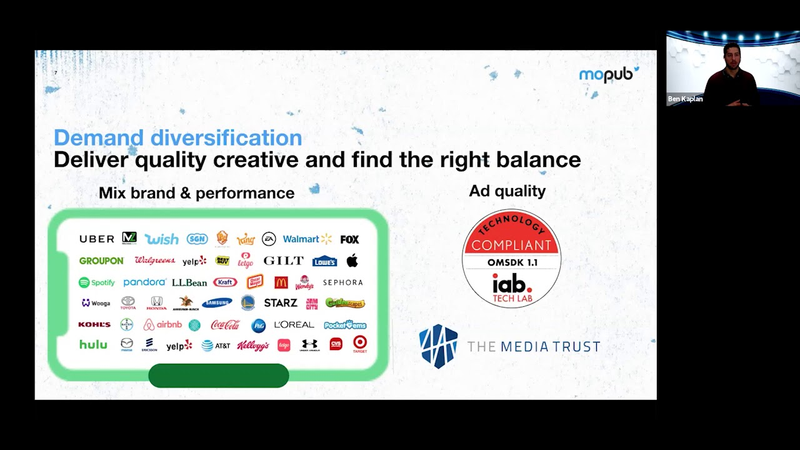
#ElevateYourGame: Improve Revenue & Retention With the Right Ads Approach
Modern mobile game monetization increasingly relies on a hybrid model where in-app advertising functions as a core component of the player experience rather than a disruptive afterthought.
- Approximately 65 percent of developers now utilize a hybrid monetization model, integrating in-app advertising alongside in-app purchases to improve both revenue and player retention.
- Transitioning from traditional waterfall structures to a unified auction model using real-time in-app bidding increases operational efficiency and maximizes gross revenue by allowing demand sources to compete for every impression.
- Rewarded video is the industry’s fastest-growing and most player-accepted ad format, making it the primary vehicle for integrating ads into the player experience without disrupting engagement.

Superstar Speed Panel: Navigating Uncertainty: Apple Privacy Changes & the Impact on Ad Monetisation
Apple’s implementation of stringent privacy changes and the subsequent loss of Identifier for Advertisers (IDFA) data have fundamentally altered the mobile gaming landscape, forcing developers to navigate a period of significant financial uncertainty.
- The loss of Identifier for Advertisers (IDFA) data has forced a strategic pivot away from granular user tracking toward a model prioritized by product quality and diversified monetization.
- Studios are offsetting downward pressure on eCPM rates by focusing on increasing session duration and long-term retention metrics to maintain profitability.
- Developers are reclaiming user data ownership by implementing third-party login systems and integrating in-app purchases to reduce reliance on external ad networks.

Panel: Lessons Learnt in Game Monetisation
Modern game monetization is defined by a strategic shift toward hybrid models that integrate in-app purchases, subscriptions, and advertisements to accommodate diverse player behaviors and genre-specific requirements.
- Modern monetization relies on hybrid models that integrate in-app purchases, subscriptions, and advertisements to cater to diverse player behaviors rather than relying on universal industry benchmarks.
- Developers should prioritize iterative testing and data-driven insights to balance complex in-game economies and maintain long-term player retention.
- Machine learning and automated bidding systems have replaced manual waterfall management to improve the precision of user acquisition and targeted offer delivery.

Mo Money Less Problems! Increasing Revenue Without Damaging Retention
Non-intrusive audio advertising represents a viable strategy for mobile game developers to generate incremental revenue without compromising player retention or disrupting the core gameplay experience.
- Non-intrusive audio advertising generates incremental revenue without cannibalizing existing monetization models like rewarded video or negatively impacting player retention.
- Audio ads achieve click-through rates between 6% and 8%, significantly outperforming standard banner ad benchmarks.
- Developers can secure CPMs ranging from $6 to $10 by implementing audio advertising strategies that respect the player's environment.
How to Monetise Mobile Games in 2021
The mobile gaming industry faces significant monetization challenges in 2021, primarily driven by Apple’s iOS 14 privacy updates.
- Apple’s iOS 14 App Tracking Transparency framework restricts IDFA access, necessitating the integration of SKAdNetwork IDs and updated SDKs to maintain ad performance and mitigate declining eCPM rates.
- Publishers should adopt a hybrid monetization strategy combining in-app purchases (IAP) and advertising to maximize lifetime value, as fewer than 5% of users typically engage in IAP.
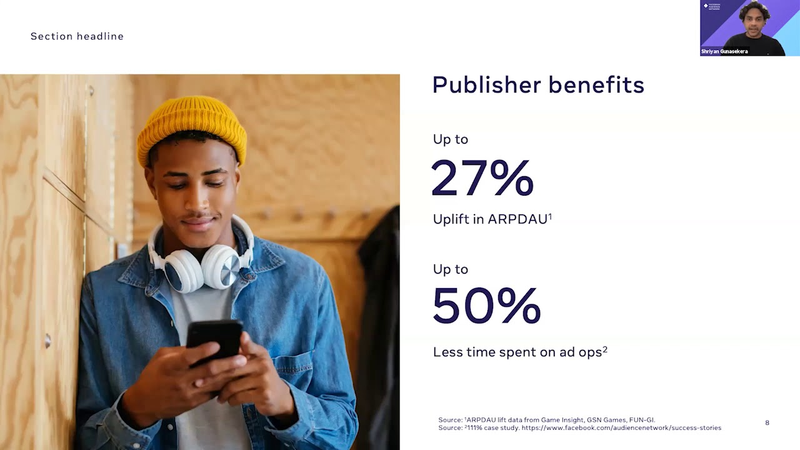
- Transitioning from manual waterfall management to automated bidding systems can increase ARPDAU by up to 27% and reduce ad operations time by 50%.

The Future of Mobile Game Monetisation - A New Revenue Stream to Your Games with In-play Brand Ads
Mobile game monetization is undergoing a strategic evolution, shifting away from disruptive ad formats toward seamless, integrated experiences that preserve player retention.
- Mobile game revenue is currently heavily skewed toward in-app purchases, which account for 90% of total earnings compared to only 10% from advertising.
- The in-play brand advertising market is projected to reach a billion-dollar valuation as the industry shifts toward non-intrusive, integrated ad formats.
- New 'Seamless In-Play' and 'Seamless In-Menu' formats allow developers to embed ads into virtual environments, such as billboards, without forcing users to exit the app.
#ElevateYourGame: How Impression-level Data Can Take Your Game to the Next Level
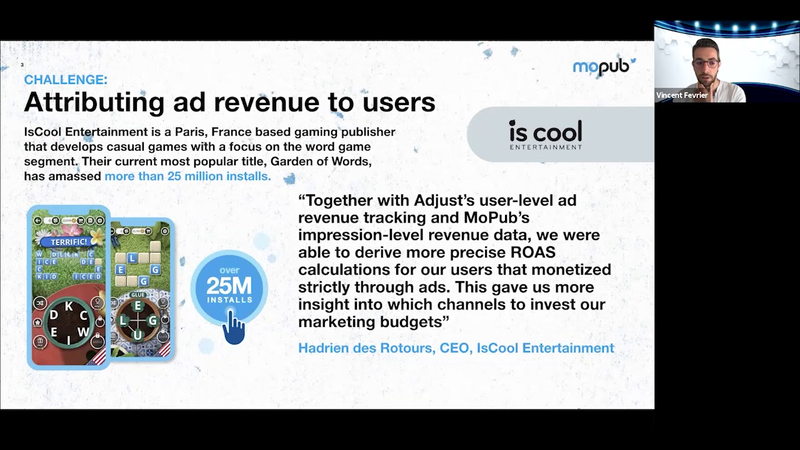
Mobile game developers are increasingly leveraging impression-level revenue data to transition from aggregate performance metrics to precise, user-centric optimization.
- Integrating impression-level revenue data allows developers to forecast long-term lifetime value within one week of installation, enabling faster user acquisition decisions.
- Adopting granular, user-centric revenue attribution has been shown to yield a 15 percent increase in incremental return on ad spend (ROAS).
- Studios are shifting from manual waterfall management to real-time bidding systems to capture monetization efficiency that traditional processes often overlook.

TWIG 120: Supercell CEO Annual Letter, Zynga To Build Ad Network, Bad Robot Getting into Games
The gaming industry is currently undergoing a significant shift toward vertical integration and cloud-based infrastructure as companies navigate a landscape defined by mobile privacy constraints and evolving consumer habits.
- Zynga is internalizing its advertising network to mitigate the impact of Apple’s SKAdNetwork limitations and recapture margins lost to mobile privacy constraints.
- Supercell maintains a 31% profit margin and over five billion lifetime installs, though the company is experiencing a decline in annual revenue and EBITDA.
- Supercell faces internal friction as it attempts to reconcile its traditional small-team, prototype-focused culture with the resource-heavy demands of modern live-service operations.

Mobile Ad Revenue in 2021
The mobile gaming industry is undergoing a fundamental transformation in 2021, driven primarily by the deprecation of the Identifier for Advertisers (IDFA).
- The deprecation of the Identifier for Advertisers (IDFA) in 2021 has triggered a market shock, with experts projecting CPM declines ranging from 30% to 50%.
- Publishers are shifting away from traditional waterfall mechanisms toward unified, real-time bidding to improve monetization efficiency and reduce latency in a post-IDFA environment.
- To mitigate the loss of granular tracking, the industry is pivoting toward contextual targeting, machine learning, and non-identifying data points to maintain ad performance.
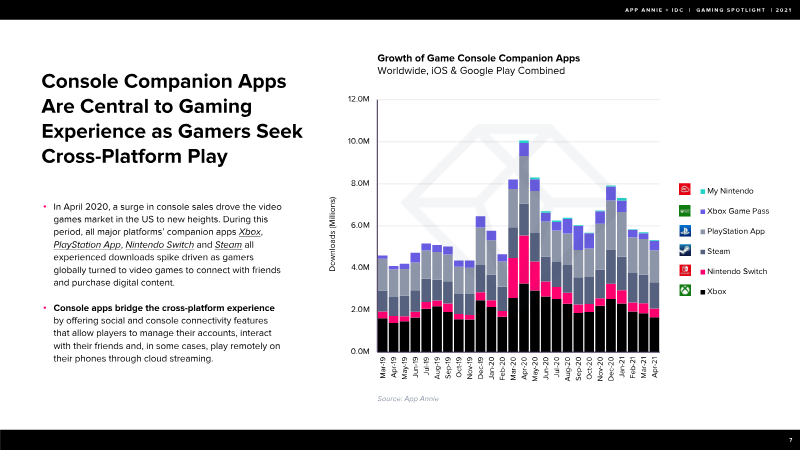
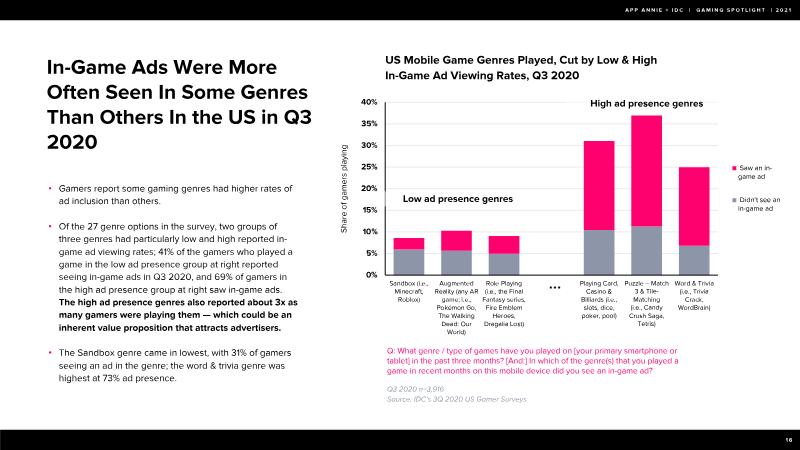

Gaming Spotlight: 2021 Review
The 2021 Gaming Spotlight provides a comprehensive analysis of the global digital gaming landscape, emphasizing the dominance of mobile gaming and the increasing integration of cross-platform experiences.
- Mobile gaming is the primary industry growth driver, with its global lead over home consoles projected to reach 3.1x by the end of 2021.
- Mobile game downloads and consumer spending in Q1 2021 rose by 30% and 40% respectively compared to pre-pandemic levels in late 2019.
- Cross-platform integration is essential for scale and engagement, as evidenced by the success of titles like Roblox and Genshin Impact across mobile, PC, and console.


Audio Ad Engagement in Mobile Games
This analysis examines the efficacy of in-game audio advertising as a non-intrusive alternative to traditional video and banner formats within the mobile gaming industry.
- Audio ads achieve a click-through rate (CTR) of approximately one click per 1.4 listens, vastly outperforming the 0.08% average CTR of static banners.
- A Warner Music Group campaign targeting 18-to-30-year-olds achieved a 1.78% CTR, representing a 1,000% increase over traditional banner standards.
- Behavioral testing shows 100% of participants continued gameplay during audio ad delivery, with 100% brand recall when ads were paired with a companion banner.


White Paper on Global Mobile Games
The white paper argues that mobile-game advertising has entered a new phase of intensity and sophistication, driven by rapid creative growth, the dominance of video formats, and evolving privacy regulations.
- Mobile advertising has shifted toward a video-first model, with video ads now accounting for over 85% of total spend and vertical formats outperforming horizontal ones with conversion rates near 0.15%.
- Privacy regulations have forced a move toward probabilistic attribution models like SKAN, shifting industry focus from granular user targeting to high-quality creative design.
- Ad creative volume surged 200% year-over-year in 2021, while CPMs increased by 34%, reflecting a period of intense market competition.