1 free read left. Create a free account for unlimited reading + AI research.
Create free account
How to Monetise Mobile Games in 2021
Key insights
6 takeaways- 01Apple’s iOS 14 App Tracking Transparency framework restricts IDFA access, necessitating the integration of SKAdNetwork IDs and updated SDKs to maintain ad performance and mitigate declining eCPM rates.
- 02Despite regulatory challenges, the long-term outlook for in-game advertising remains positive with substantial revenue growth projected through 2025.
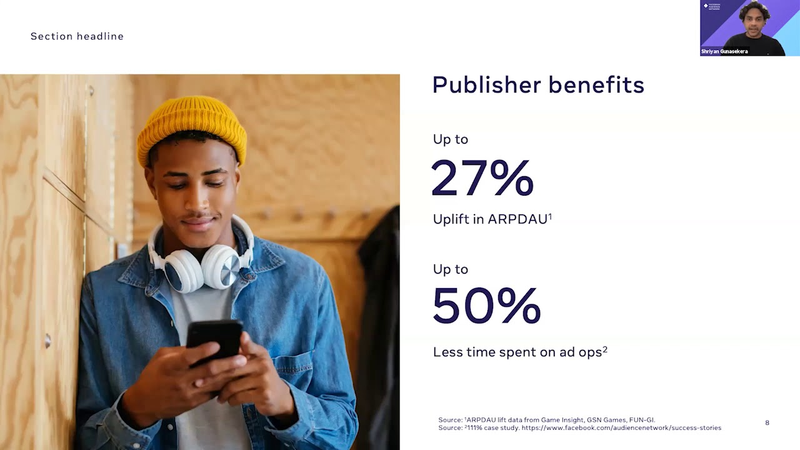
- 03Transitioning from manual waterfall management to automated bidding systems can increase ARPDAU by up to 27% and reduce ad operations time by 50%.
- 04Publishers should adopt a hybrid monetization strategy combining in-app purchases (IAP) and advertising to maximize lifetime value, as fewer than 5% of users typically engage in IAP.
- 05Rewarded video is the most effective ad format, with 79% of developers citing it as their top performer and 71% of hardcore gamers reporting positive or neutral sentiment toward the value exchange.
- 06Diversifying distribution through cloud gaming and platforms like Facebook’s Instant Games allows publishers to reach massive, non-download audiences and create additional revenue streams.
Ask AI about this video
Transcript
next we're going to have facebook join us um we've got sri from facebook audience network uh hopefully shri will join us um uh shortly so he's gonna talk to us about uh how to monetize mobile games in 2021 for me um i'm finding i'm increasingly using uh facebook kind of ads to essentially do my testing and and prioritization of games as we're getting them ready to go live so that we know which games are worth you know not worth but are going to have the potential to be successful but obviously growing that and monetizing that over time is going to be a different thing and that's why i'm really keen to see what sheree has to talk to us about so shari how you doing hey oscar doing well how are you not too
bad not too bad i'm going to hand over to you so i'll keep my mic open just long enough so if you've got slides i can tell you they're working but i will hide my face because people see enough of me let me just start screen sharing uh so uh i guess to start off hi everyone thanks so much uh for the time as mentioned uh i work at facebook audience network uh where i'm a strategic partner manager and today i'd love to give you all four key tips for how to drive monetization growth in 2021 uh so kicking off the presentation before we get started a quick intro for anyone who isn't familiar facebook audience network uses facebook demand to help publishers monetize their mobile apps using high performance ad formats including rewarded video and interstitial ads and also one quick plug before we get started my colleague alicia will be giving a talk tomorrow on facebook login which i highly
recommend everyone attend it's a follow-up to this session and my colleague chloe gingrich also gave a talk yesterday i believe which is available on demand so please check those out if you haven't already so jumping into today's talk i think it would be impossible to speak about ad monetization in 2021 without you know first addressing the the upcoming changes uh with ios 14. as many of you will know uh late last year apple announced that beginning with ios 14 app publishers would be required to collect permission through their app tracking transparency framework in order to access a user's idfa this change was huge news for ad monetization as typically idfa had been the identifier used by ad networks in order to serve people personalized ads the most recent news from apple is that apps will be required to obtain permission to track users starting
in early spring of this year so while we still don't know you know the exact date when these changes will will come into effect uh the expectation is in the the next few months we should start to see the the impact of these changes uh facebook we've released a number of public statements on uh our position uh and one thing we we've been clear on throughout is that we expect you know these changes to negatively affect app publishers ability to to monetize their ios apps publishers should expect to see lower cpms from audience network as well as likely other ad networks as a result of these changes as it becomes more difficult for advertisers to accurately target and measure their campaigns and it's important i think for for u.s app publishers to understand this heading into those changes just so you're able to you know plan and prepare effectively so with all that said uh there are steps
you should already be taking uh in order to ensure you're in the best place possible uh heading into to these upcoming changes so i'll speak specifically to audience network and things that you should be doing right now but really you should consult with each of the ad networks you use to understand what their recommendations are as you prepare for for these ios 14 changes in terms of audience network specifically basically there are three things that you should be doing right now uh so first update your sdk to our latest sdk version 6.2.1 and if you're using mediation as i i imagine many of the publishers uh listening to this talk are make sure the adapter you're using is updated to the latest version compatible with sdk 6.2.1 uh secondly implement what we call a set advertiser tracking enabled flag this is unique to facebook and basically
it's a flag that allows us to understand whether or not we should be serving personalized ads to a user you can go on facebook's developer website uh for more info on how to implement this flag but this this is the second requirement as far as audience network is concerned uh and lastly uh at our suggested sk ad network ids uh in accordance with apple's uh requirements uh so again these are are specifically the the three things you should be doing to prepare for ios 14 as it pertains to audience network but as mentioned to consult with each of the ad networks you use to understand the steps that they require so clearly 2021 uh it's going to be a year full of challenges but the news isn't all all doom and gloom uh what's really encouraging is that even in spite of you know the expected idfa loss uh analysts are still very optimistic about the future of mobile gaming and in-game advertising um on screen you can
see quotes from analysts who are quite bullish on the future of in-game advertising and i think what's especially notable is is that first quote uh from guillermo escofat who's an analyst that research from omdia uh he predicts you know even despite the new idfa changes uh ad revenue should grow to 183 billion uh in 2025 so in terms of being a mobile games publisher depending on ad revenue there's still quite a lot to be excited about when you think about the future so with all that said what should you be focusing on in 2021 to help uh drive monetization growth and the first topic i'd love to cover today is bidding throughout the last year uh bidding has gained increasing momentum uh more publishers demand sources mediation platforms and the wider ad tech ecosystem have adopted bidding as their preferred approach for ad
monetization and really there are two key reasons why we've seen this first bidding has helped has proven to help publishers increase their revenue when every demand source bids in an open and fair real time auction you see more competition for your inventory which means better prices for every impression facebook actually uh put together a report on how app bidding is transforming businesses and and one thing we found was some businesses saw as much as a 27 increase in arc dao as a result of making the move to bidding so the revenue impact is quite clear but more than just that publishers also report reducing their time spent on ad operations by up to 50 as a result of moving to bidding and this is huge you know by removing the burden of having to to manage a complex waterfall it frees up your team to focus on other key areas of growth which can be really huge
for any mobile games publisher and we've seen you know the impact of bidding first hand with some of the publishers we work with on screen now you can see a case study that audience network put together with with voodoo basically voodoo we're looking you know as many publishers are to increase their arc dial and also reduce the time spent on on waterfall maintenance as a result they be tested bidding and the results for them were they saw a 12 percent increase in art out and a 10 reduction in time spent on ad operations uh and what was especially encouraging for us to see was uh you know following this a b test they decided to move all their apps over uh to bidding which really speaks to you know what an impact it can have on a business uh on screen you can see a quote from their ua monetization team lead david ribeiro where he mentions you know the arc de uplift they saw and the fact that they've now moved over all of their inventory to bidding
uh and what's even more encouraging when it comes to bidding is is seeing the impact it has on publishers of all sizes on screen now you can see another case study we've put together with a studio called lucky cat lucky cat based in the netherlands they're a smaller team of around 20 people but like voodoo they they were facing the same challenges wanting to increase our doubt wanting to reduce time spent on ad operations they too tested bidding uh and the result for them was they saw a 20 increase in arced out and a reduction on time spent on ad operations by uh six hours a week so six hours less spent on ad operations each week uh which is huge especially for a smaller agile team but beyond just the the revenue and the time savings benefits offered by bidding um there's also an ios 14 impact to take into consideration uh our expectation is once these ios 14 changes go into effect
the waterfalls will become even more inefficient and even more complex to manage basically what we expect to happen is a two-tier system to be created where you have some users who have opted in to sharing their idfa and receiving personalized ads and others who have opted out uh and as a result will be receiving or won't be able to to receive personalized ads um in this system it becomes even more difficult to manage waterfall uh and bidding is really the only way to ensure you're getting the maximum value for every impression you're serving so for all of these reasons the the revenue impact the time savings impact uh and the ios 14 impact it's so crucial uh for you to move to bidding today if you haven't already but beyond bidding uh the next topic i'd like to cover is uh hybrid monetization the changes coming with ios 14 have shown us the importance of hybrid monetization which is
uh basically a strategy of using both ads and in-app purchases to monetize your game on screen you can see some of the partners we work with who already are are utilizing the value of of hybrid monetization by driving revenue from both ads and in-app purchases you as a publisher are able to drive the maximum ltv from you your users uh which makes you much more resilient to any changes in ua costs that may be coming due to to the upcoming ios 14 changes uh and you know if you're a publisher right now and then and you're not already using hybrid monetization what should you be doing basically if you're a publisher a hyper casual publisher totally relying on ads at this point in time you should be thinking about you know how can you add depth to your game uh and integrate ads and iaps excuse me in a meaningful way and on the flip side if you're an iap publisher who doesn't use any ads in your game test
ads in your game with the understanding that you know 95 percent of users will never make an in-app purchase as you can see on the slide research has shown fewer than five percent of users will will ever make an in-app purchase in a game so using a combination of both ads and in-app purchases is the best way to maximize uh monetization and the ltv you're driving from your user base but beyond uh hybrid monetization it's important also to think about the sort of ads you're using in your games which is why i'd like to speak a little bit about rewarded video you know one year ago some publishers still needed to be convinced that that rewarded video would not hurt their game uh in 2021 players of all genres that will will come to expect rewarded video in the games they play facebook actually recently commissioned a report on rewarded video which had some really interesting findings uh
specifically we found 32 percent of users actually find rewarded video to be the the format uh that is twice as useful as all other ad formats and the reason is is because they actually are able to get something uh in-game as a result of using rewarded video there's actually a value exchange happening uh and moreover uh what was interesting was a study that i idc uh did which showed that actually 71 percent of hardcore gamers like or are okay with rewarded video um which is really huge it shows you know sentiment actually is quite positive towards ads it just depends on on the sort of ads that you use in your games and that 71 figure it makes sense especially when you think about um you know just the way games work the vast majority of your users you know want to unlock content quicker in the games they're paying but they're very unlikely to ever make
an in-app purchase rewarded video gives them this alternative way to continue playing your games unlock content quicker while still generating significant revenue for for you as a publisher and it's not just develop and it's not just players rather that like rewarded video developers uh agree reward video is beneficial to their games over 79 of developers surveyed say that rewarded video is actually their most successful format and that can help with in-game metrics like retention and also even encourage in-app purchases um on-screen you can see quotes from from develop developers who use reward video in their games and what's clear is you know sentiment is quite positive rewarded video can work uh it's just about implementing it uh in the right way so for you as a publisher you know what should you be thinking about when it comes to rewarded video and really there are three key things to to remember at
facebook we call them reward placement and design but really what you should be thinking about is you know the what where and how what do players receive as a result of watching a rewarding video where should you be inserting your reward of video ads in your game and how do you get players to engage with with the rewarded video that you put in your game the right combination of these three things will lead to the best engagement rates possible with your reward of video units and will also ensure that you're driving maximum revenue from ads in in your games so moving on to the last topic i'd like to cover today uh and that's instant games and cloud games in terms of uh you know instant games and cloud games i think the last year has shown us that policy changes can lead to incredible volatile volatility and uncertainty and the more diversified your business is
the better equipped you are to deal with new challenges as they present themselves with this in mind let's talk a little bit about instant games and cloud games so for those of you who don't know instant games are games that can be played directly in the facebook app and don't require any downloads at all as instant games are html5 games they're generally generally very quick to develop and as the games are hosted in the facebook app itself players can easily connect and share games with friends allowing them to go viral and reach a massive audience and here in this screenshot you can see uh you know what the the ui looks like how uh players can access instant games directly from the facebook app itself via our gaming tab uh really the point i want to make with instant games is uh specifically you know if you're a
publisher who's making games that are already social in nature more casual instant games really are a platform you should be exploring because it does offer just an entirely new revenue stream and an ability to utilize facebook's massive audience but beyond instant games if you're a publisher that has games that are a bit more complex with a bit deeper gameplay facebook also announced late last year the ability to publish cloud games with facebook cloud games similar to instant games are native games hosted and streamed by facebook and like instant games they're playable instantly on mobile web and on mobile and web and don't require any downloads um so i think another exciting opportunity um publishers should be considering and really as mentioned you know that the value in instant games in cloud
games is the ability they both offer to leverage facebook's massive audience as you can see from the slide above uh 700 million people are engaging with games on facebook today so it's really worthwhile for you as a publisher to be considering publishing to both of these platforms as the revenue potential is is is quite significant and in terms of monetization as obviously that's key both instant games and cloud games can be monetized using ads using audience network uh as well as in-app purchases on android and mobile web so to recap and just kind of bring everything together uh here are the key things you should be focusing on uh in 2021 to drive monetization growth first as mentioned uh in preparation of the changes coming with ios 14. as it pertains to audience network update your sdk enable to set advertiser tracking flag
and include our skid network ids per apple's requirements beyond that as you look to you know grow revenue uh move to 100 bidding is proven to increase revenue and also reduce the time your team spends on ad operations use a hybrid monetization model using both ads and in-app purchases to drive the maximum ltv from your user base use interactive ad formats like rewarded video as it's been proven that users actually you know like engaging with these formats and lastly launch instant games and test cloud games as they can offer an entirely new revenue stream which can be huge for for your businesses so with that i'll wrap it up and i'll pass it back to oscar uh to to take back control thanks sorry that's what that's great and i think that you've hit on some really interesting stuff for me as well particularly because
um i i was the uh original evangelist for a well-known rewarded ad network uh i think i was probably the first person to sit down with the developer on a stage and talk about how to place rewarded ads properly and effectively uh which was the guys from uh hipster whale so you know we were talking about crossy road matt hall and i had a uh i think it was a casual connect uh in or maybe of white nights i'm not too sure i think it's a casual connect in um amsterdam feels like a long time ago probably about six years uh that was great stuff i understand that you've got to head out because you can't take questions um so really sorry for everybody who wants to ask questions i'll try to answer some of them um hopefully i can uh i can do that for you uh but sheree thank you thank you so much for that really good stuff in the um in the particular question so we've got a couple of anonymous questions raised here so one of them is for a hyper casual game would a broad audience targeting in facebook also bring iap players in proportionately um uh you're using a couple of uh acronyms i'm not
familiar with vo and ao uh maybe it's because i'm not a specialist in um uh kind of uh adds uh specific uh elements i'm a more generalist but what i know from you know years experience is that uh essentially what you're doing in terms of identifying a a paying as opposed to an ad viewing audience is more about the engagement of the player it's a lot more effective to focus on the live operations of a game to be able to identify uh and convert users into paying the the thing that we we've learned a lot about in the last few years is about how to use uh rewarded ads effectively to to identify the audience that wouldn't necessarily pay but also to help communicate the value of your in-app purchases so smart planning and targeting and placement of ads is as important as communicating the value proposition
of the uh the iap items in itself so um i've done a few lectures on this sort of stuff uh in fact i'm going to be running a master class on how and when to save a failed game shortly um with the pocket gamer guys and i will be covering some of those elements about monetization design in that master class if anyone's interested obviously please feel free to shout um so uh another anonymous um um person talks about why does casual games use interstitial world there's a really fascinating thing for me anyway about why that happens and that's because of the instance of frustration i know it sounds uh a bit weird but what i'm saying is in a hyper casual game we have this intensity and we need a moment of relief because hyper casual games are simple they're very easy to go back to back to back to back but what actually happens with an interstitial is it forces the player who pause whilst and that is played what that does is it creates a moment of
relief and prevents burnout so that counteracts the negativity that you often get with interstitial in a more casual or more hardcore game which interrupts the flow though the fact of interrupting the flow of high-percentage game is actually a positive uh for a hyper casual game in my opinion so hopefully that makes sense um so that's hopefully also answers why uh you know it's it's therefore used more often um android cpms will increase more as ua budgets go to android um that's not necessarily the case but it's probable um i'm not gonna make judgments calls over where the friends are because i'm often you know um i'm not very good at forecasting what happens with market but i would expect we're in a very interesting situation right now um the the negative impact in terms of brand advertising in terms of the you know the crowbar crisis and so on and so forth although that has had positives as well um so we're in a very
very messed up time to try and work out any predictive predictions so um i'd love to be able to give you a thought on ecpms my feeling is that things are just going to be more complicated and we're going to have to find our way through it i know it's not much of an answer but hopefully at least uh i'm kind of expressing the complexity that's going on right now um how can you be part of cloud games being a small indie well there's lots of different ways that you can use uh cloud elements uh there are uh platforms out there which are looking for content and there are also uh pools essentially where you can use cloud technology to deliver elements within your game um but it's probably too big a conversation to uh kind of have in terms of general stuff but i think what the um uh what sheree was talking about with facebook was basically utilizing their instant game model uh and um obviously that's something you know go and look up on what facebook are doing with instant game i'm i'm not going to be honest fortunately um but what i hope
you are what i've taken from shari's talk which i hope you guys have as well um is that there is a a really kind of interesting time that we're in uh you know both in the sort of um the curse and the and the positivity of that the opportunity of that so as we are facing all these changes and all these cultural environment changes that's happening in the industry we're having to think more about the connectivity of the gamer and how we monetize them whether it's from mika's talk about how we can look for other platforms how we can look at payment mechanisms you know for uh web-based content whether we're looking at the facebook ad mechanisms where we're looking at in-game iaps what we're having to think about is where is the value for the player where is the utility where is their lifestyle fit and actually i think this is increasingly about how do we think about retention because the biggest driver for revenue is when you can get more players doing more things more often and the
longer that's how we're going to be able to scale games and so understanding how the value of hyper casual to be able to identify amazingly fast rapid mechanics and monetize through this simple kind of interstitial ad mechanism and how we can transition those game mechanics into things which are more sustainable over time so that's kind of how i look at things hopefully that will make sense i'm very happy to take you know further questions on that but obviously i'm not a speaker i'm merely a host so you know don't let me get in your way you
Summary
The mobile gaming industry faces significant monetization challenges in 2021, primarily driven by Apple’s iOS 14 privacy updates. These changes, specifically the App Tracking Transparency framework, restrict access to the Identifier for Advertisers (IDFA), which is expected to complicate ad targeting and measurement, leading to lower effective cost per mille (eCPM) rates for publishers. To mitigate these impacts, publishers are advised to update their software development kits (SDKs), implement advertiser tracking flags, and integrate SKAdNetwork IDs to maintain ad performance.
Despite these regulatory headwinds, the long-term outlook for in-game advertising remains positive, with industry analysts projecting substantial revenue growth through 2025. To capitalize on this, publishers are encouraged to adopt a hybrid monetization strategy that balances in-app purchases (IAP) with ad revenue. Because fewer than 5% of users typically make in-app purchases, integrating ads allows developers to maximize the lifetime value (LTV) of their broader user base. Rewarded video remains a high-performing format, with data indicating that 79% of developers view it as their most successful ad type, and 71% of hardcore gamers reporting a positive or neutral sentiment toward the format due to the clear value exchange it provides.
Operational efficiency is another critical focus for 2021. Moving to automated bidding systems is recommended to replace complex, manual waterfall management. Bidding allows for real-time auctions that increase competition for ad inventory, with some publishers reporting up to a 27% increase in average revenue per daily active user (ARPDAU) and a 50% reduction in time spent on ad operations. Furthermore, diversifying distribution through platforms like Facebook’s Instant Games and cloud gaming services offers publishers additional revenue streams and access to massive, non-download audiences. Ultimately, success in the current climate requires a shift toward deeper game design, improved retention strategies, and a more sophisticated approach to balancing user experience with diverse monetization mechanics.























Comments