Game Studies reports and market data
Documents
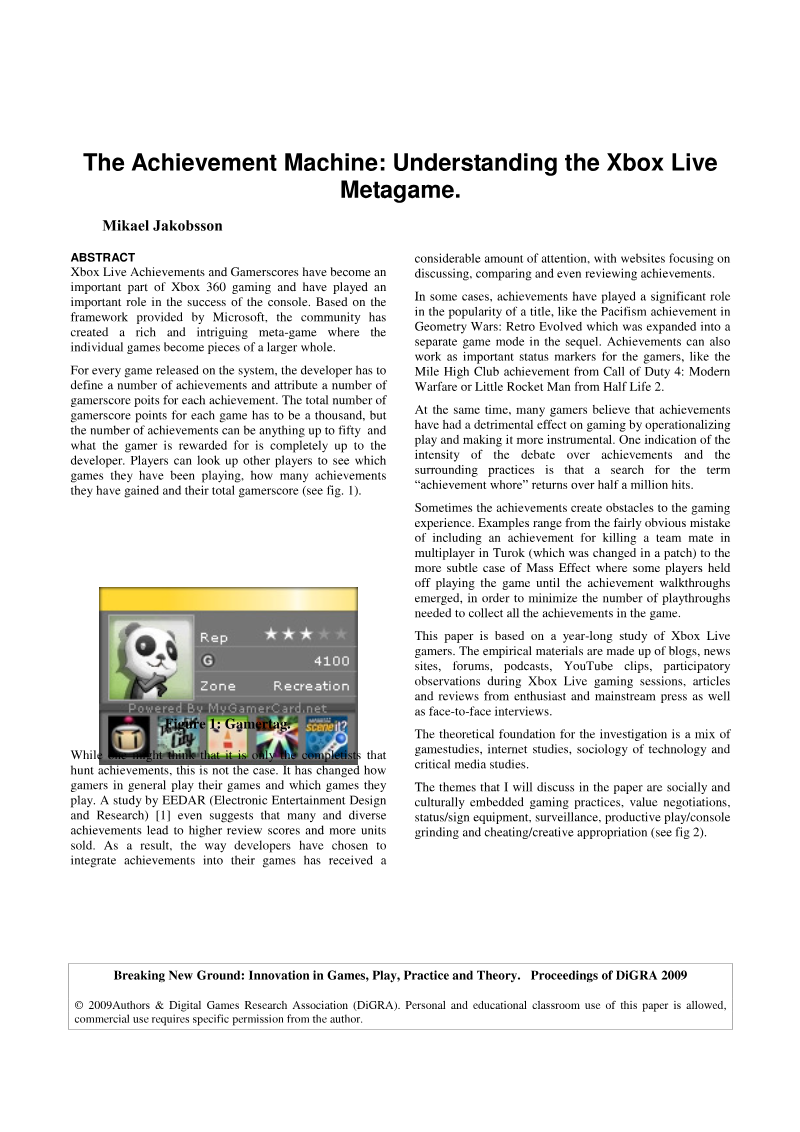
The Achievement Machine: Understanding the Xbox Live Metagame
Mikael Jakobsson's paper examines achievements on Microsoft's Xbox Live service, arguing that they have created a "meta-game" in which individual titles become pieces of a larger system of collection, status, and community practice.
- Achievements and Gamerscore, defined by developers per game (standard total of 1,000 points, up to fifty achievements per title), have become central to Xbox's identity and to how players and critics evaluate games, forming a larger 'meta-game' of collection, status, and community practice.
- Jakobsson's paper draws on a year-long study of Xbox Live gamers, combining blogs, forums, podcasts, YouTube, participatory observation, press reviews, and face-to-face interviews.
- An EEDAR study cited in the paper suggests well-designed achievements correlate with higher review scores and stronger unit sales, leading developers to treat achievements as a commercial consideration.
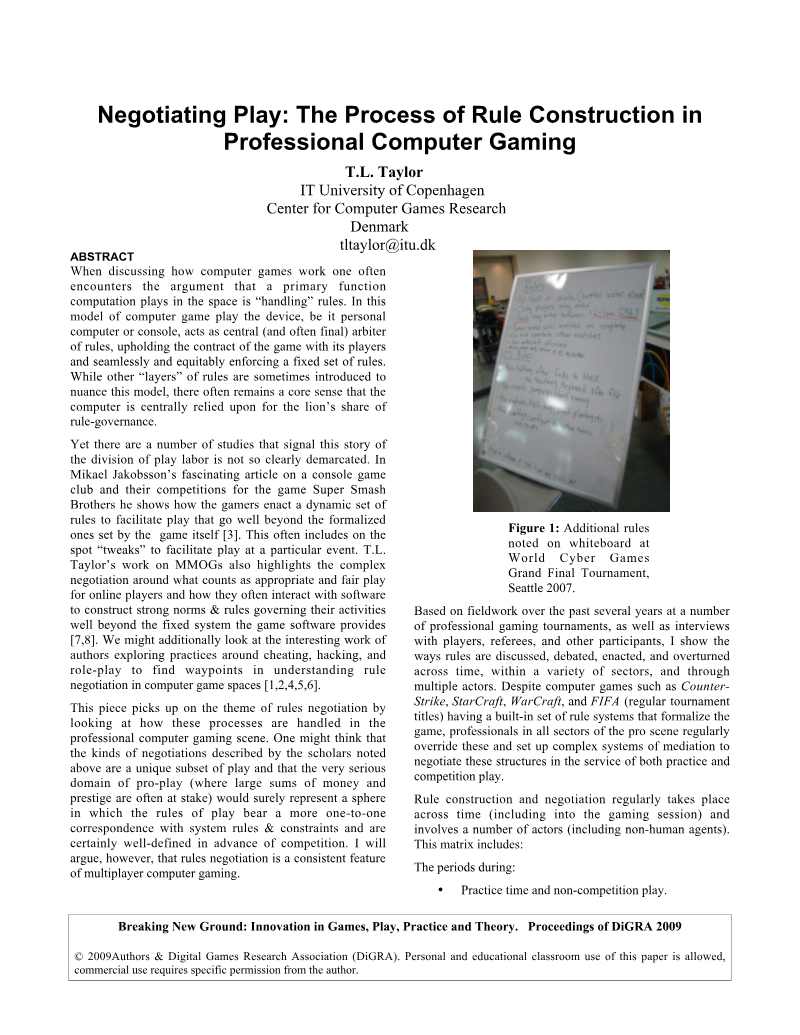
Negotiating Play: The Process of Rule Construction in Professional Computer Gaming
T.L.
- Taylor challenges the view that the game software is the central, neutral arbiter of rules, arguing instead that rule construction and negotiation are a consistent feature of computer gaming, including professional competition.
- Professional gaming is presented as a particularly revealing site for studying rule production, since it might be expected to adhere most closely to formal system rules, yet professional sectors routinely override, supplement, and mediate those rules through complex procedures.
- The study draws on several years of fieldwork at professional tournaments plus interviews with players, referees, and other participants, examining competitive play in Counter-Strike, StarCraft, WarCraft, and FIFA, all of which have built-in rule systems.
Simulating a Quasi-Simulation: A Framework for Using Multi-Agent Simulation Techniques for Studying MMORPGs
This paper proposes a conceptual framework for using Multi Agent Simulation (MAS) techniques to study Massively Multiplayer Online Role-Playing Games (MMORPGs) as a bridge between social simulation and virtual world research.
- The paper argues that social simulation faces three persistent challenges: modeling human subjectivity, the pervasive contingency of real social systems, and validating simulation outputs against empirical data.
- It proposes that MMORPGs are partially suited to address these challenges because they involve real human participants rather than purely AI-driven agents, and their sandbox structure limits the range of unmodeled contingencies.
- The central thesis is that MMORPGs function as "quasi-simulations" that can yield research data for understanding the relationship between virtual and real social life.
Making Sense of Game Aesthetics
This panel proposal argues for an expanded conception of game aesthetics, moving beyond visual presentation ("eye candy") to examine the overarching principles and qualities of the gameplay experience, including embodied play, tangible interfaces, and creative player activity.
- The panel proposal argues for expanding game aesthetics beyond visual presentation to the overall qualities of gameplay, including embodied play, tangible interfaces, and creative player activity, in a field the authors describe as still emerging.
- Graeme Kirkpatrick frames games as "post-representational" forms, using allegory to explain their dreamlike qualities, preoccupation with death, cartoonish stylization, and emphasis on space, with dot.hack as his case study.
- Kirkpatrick argues that meaning in dot.hack arises from bodily tensions such as controller grip, shifts of visual focus, and attention to sound, as well as from the game's sense of totality or "worldness."
Workshop: Ethics in Videogames
This workshop proposal, presented at the DiGRA 2009 conference, examines the emerging field of ethics in videogames, arguing that games offer a rich environment for practicing ethical reasoning, moral judgment, and critical thinking.
- Games are framed as both a site of ethical controversy, often blamed for social ills such as youth violence and child obesity, and a potential tool for teaching ethical decision-making.
- The authors define ethics as the practice of enacting choices and moral judgment, arguing that games offer a rich environment for practicing ethical reasoning and critical thinking.
- A 2008 Pew Report cited in the workshop found that 63 percent of teens who play games have witnessed people being mean or overly aggressive, and 49 percent have seen hateful, racist, or sexist behavior.
What We Talk About When We Talk About Game Aesthetics
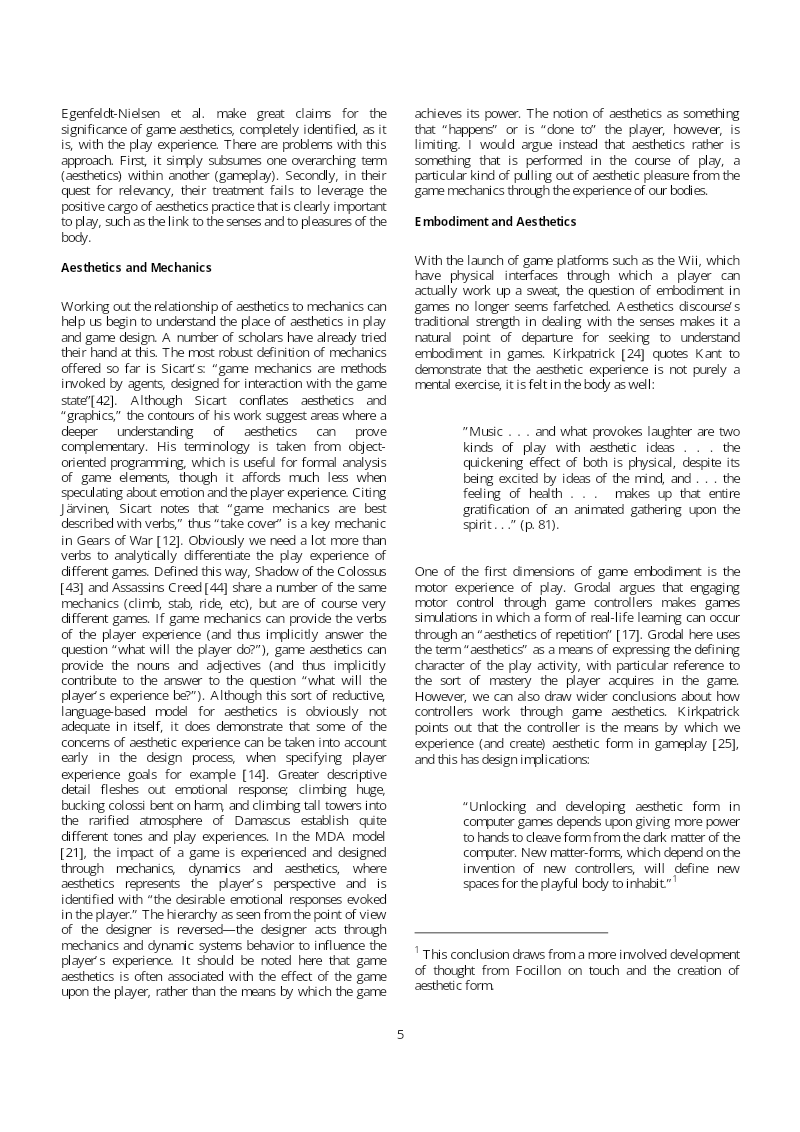
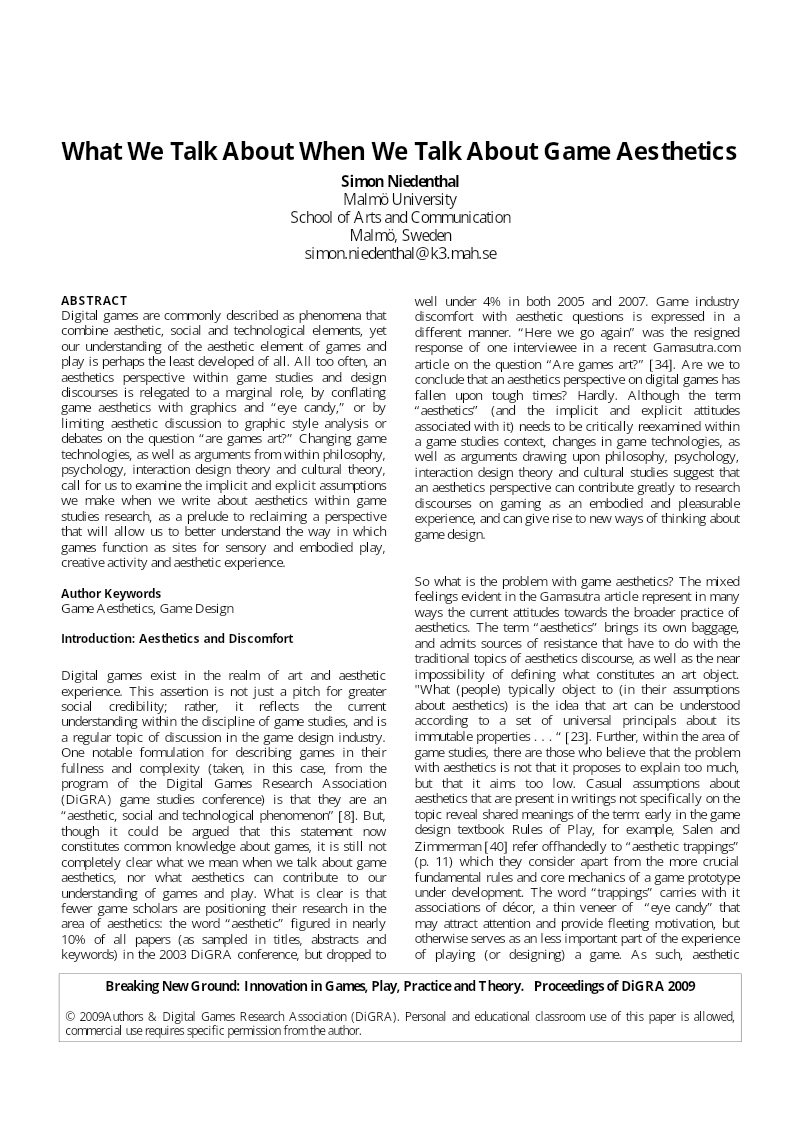
Game aesthetics has long been undertheorized, often reduced to graphics or "eye candy" despite its capacity to illuminate games as embodied, sensory, and pleasurable experiences.
- Game aesthetics has been undertheorized and often reduced to graphics or 'eye candy', despite its capacity to illuminate games as embodied, sensory, and pleasurable experiences.
- The core thesis holds that aesthetics cannot be separated from play: sensory experience, bodily engagement, and the physical context of play all shape how games produce meaning and pleasure.
- Aesthetic terminology appeared in roughly 10 percent of DiGRA 2003 papers but fell to under 4 percent by 2005 and 2007, which the authors read as evidence that dominant design frameworks have marginalized the topic.
Evolution and Digital Game Studies
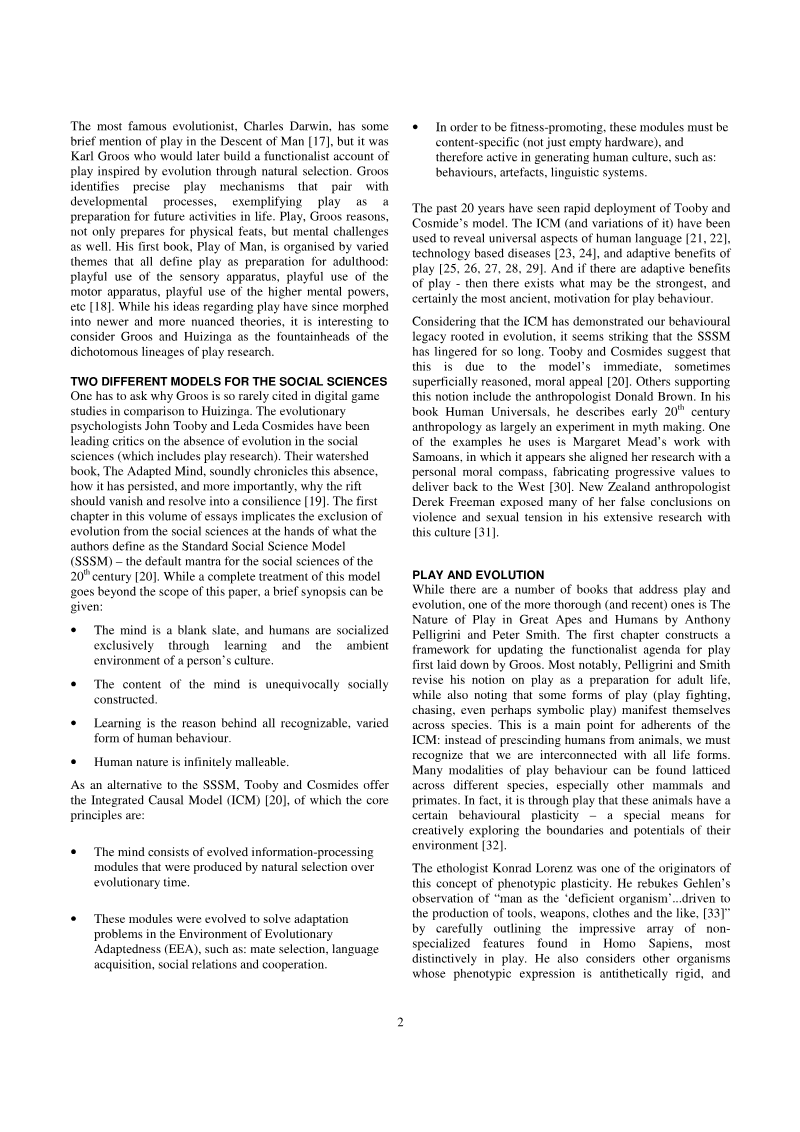
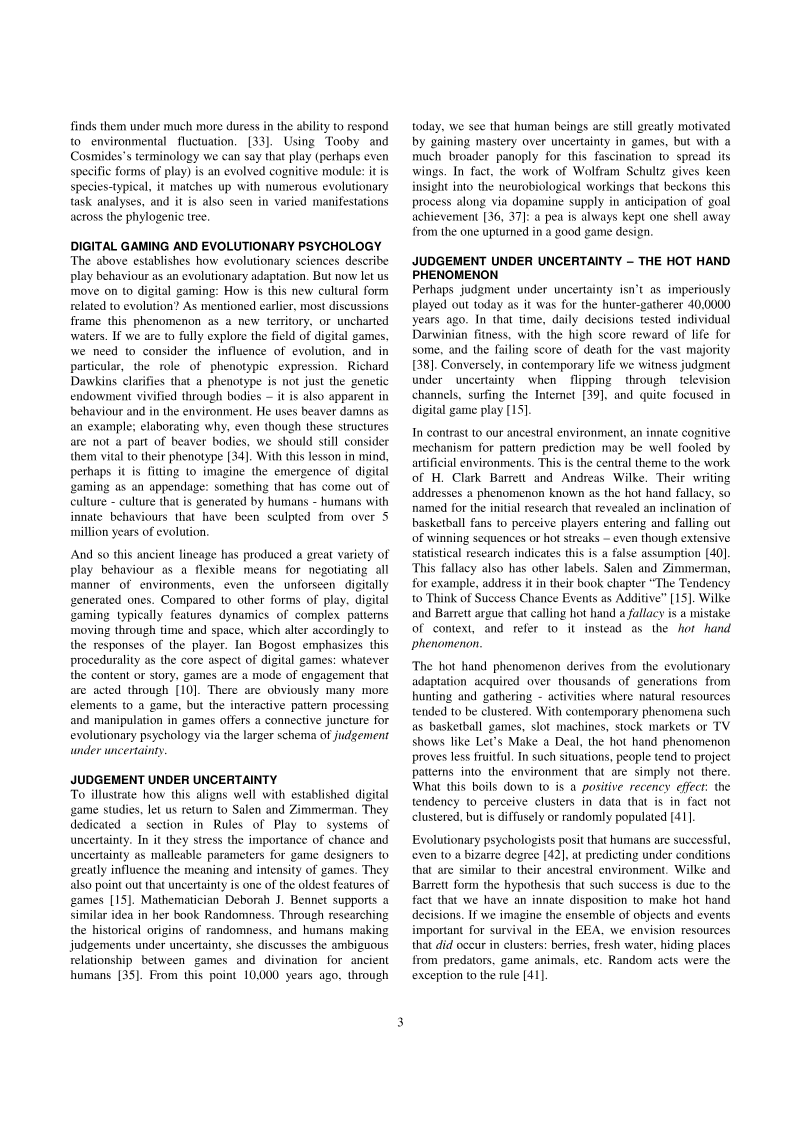
This paper argues that evolutionary psychology can make a valuable contribution to digital game studies, which have largely been shaped by cultural and humanities-based frameworks such as those of Johan Huizinga and cultural relativist approaches to play.
- The paper argues that digital game studies have been dominated by humanities and cultural frameworks (notably Huizinga's view of play as cultural), and that evolutionary psychology can make a valuable complementary contribution.
- It contrasts two lineages of play research: Karl Groos's functionalist view of play as evolutionary preparation for adult life, and Huizinga's cultural-phenomenon account.
- The authors use Tooby and Cosmides' Integrated Causal Model to critique the Standard Social Science Model, which treats the mind as a blank slate and separates culture from biology, and propose examining digital gaming through evolved cognitive modules.

The Game Frame: Systemizing a Goffmanian Approach to Video Game Theory
Sebastian Deterding's paper argues that Erving Goffman's Frame Analysis (1974) offers a valid and underused sociological theory for understanding play, games, and video games.
- Deterding argues that Erving Goffman's Frame Analysis (1974) is a valid but underused sociological framework for understanding play, games, and video games, offered as an extended abstract for DiGRA 2009.
- The paper proposes treating the video game as a social frame: a convention of mutual expectations stabilized through metacommunication, joint attention, interpretation, and action among participants.
- Frame analysis is positioned as an alternative to the long-dominant 'magic circle' metaphor, which many scholars regard as socially constructed but have never explained mechanistically.



International Journal of Role-Playing: Issue 1
The inaugural issue of the International Journal of Role-Playing positions itself as a hybrid knowledge network linking academia, industry, the arts, and player communities, and its central aim is to establish a more rigorous scholarly foundation for the study of role-playing games.
- The inaugural International Journal of Role-Playing identifies the lack of a widely accepted definition of a role-playing game as a major obstacle to research, and proposes a provisional working definition built on participants, game world, player-controlled characters, character development, interaction, and emergent narrative.
- Markus Montola characterises role-playing as a social process governed by an imaginary game world, a distributed power structure, and personified characters, with objectives arising from diegetic and exogenous frames rather than endogenous rules.
- Erik Champion's case study of Bethesda's The Elder Scrolls IV: Oblivion finds the game strong in environmental presence but weaker in social and cultural presence, and suggests design remedies such as dynamic NPC responses and persistent player-influenced artefacts.
Play and the Private
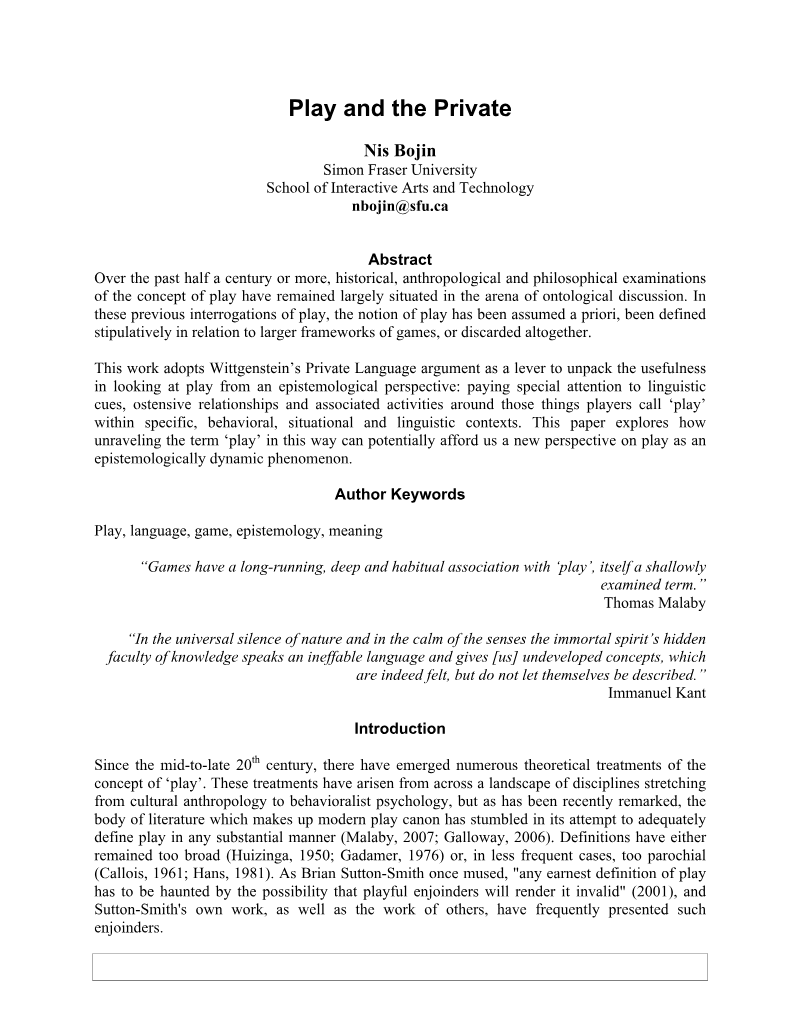
Traditional attempts to define play through rigid, ontological frameworks fail because they overlook the inherent subjectivity and fluidity of the experience.
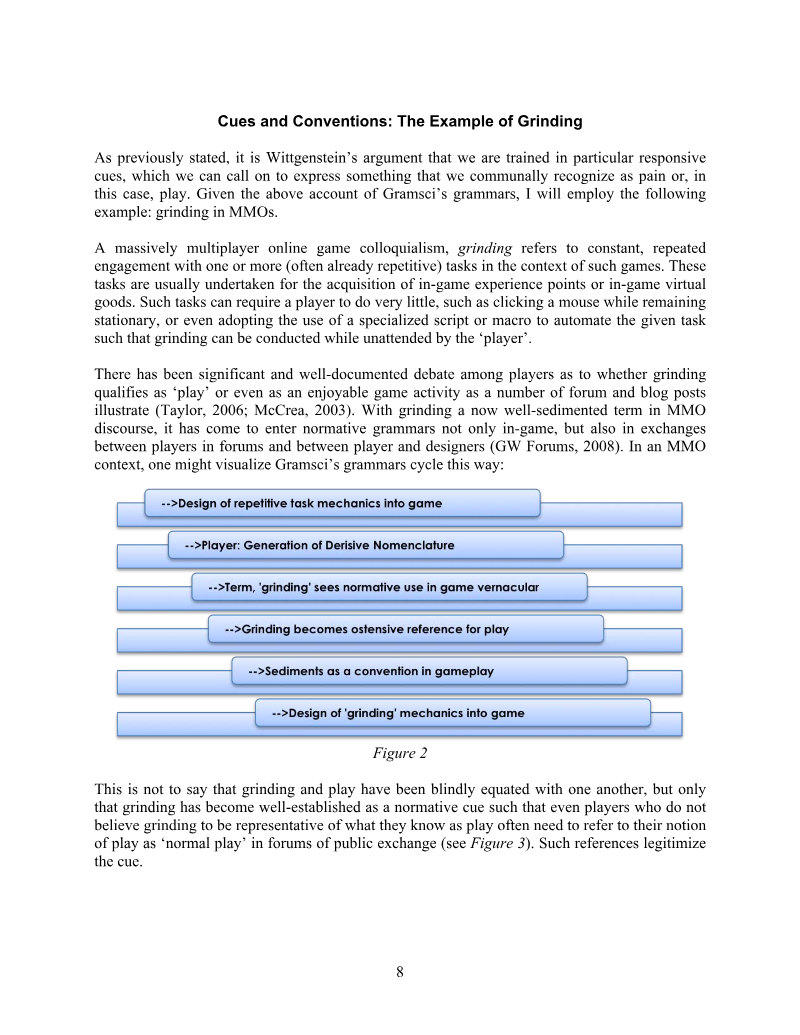
- Play should be analyzed as a series of learnable, communal cues rather than a universal, rigid ontological concept.
- Developers can better understand market dynamics and user engagement by analyzing player-generated linguistic grammars, such as the evolution of terms like 'grinding'.
- The industry must move away from binary frameworks like 'work versus play' in favor of studying how individuals subjectively label their experiences within social contexts.
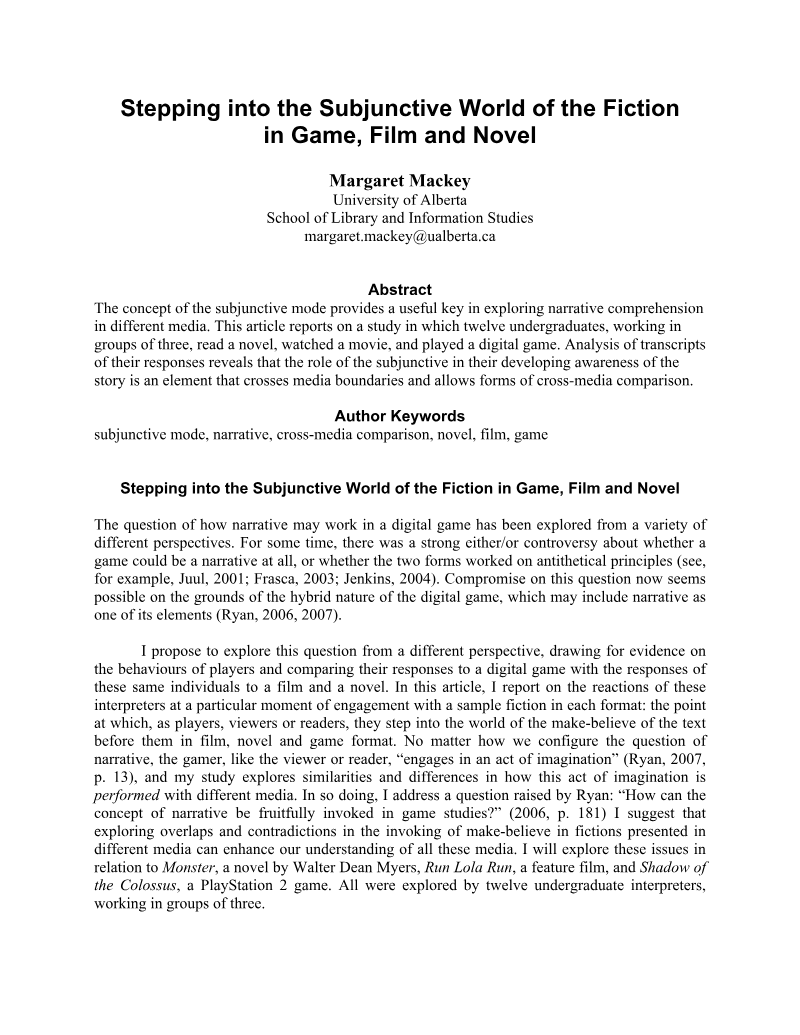
Stepping into the Subjunctive World of the Fiction in Game, Film and Novel
The subjunctive mode serves as a universal cognitive framework for engaging with fictional narratives, defining the psychological state where audiences navigate possibilities, hopes, and fears regarding a story’s trajectory.
- The 'subjunctive mode'—a cognitive framework defined by navigating narrative possibilities, hopes, and fears—is the primary engine for audience immersion across games, film, and novels.
- Audience engagement relies on a constant, dual tension between immersion in a story world and a critical awareness of its underlying construction.
- The fundamental cognitive process of narrative synthesis remains consistent across media, even when audiences encounter hybrid texts or disruptive storytelling conventions.
The Significance of Jeep Tag: On Player-Imposed Rules in Video Games
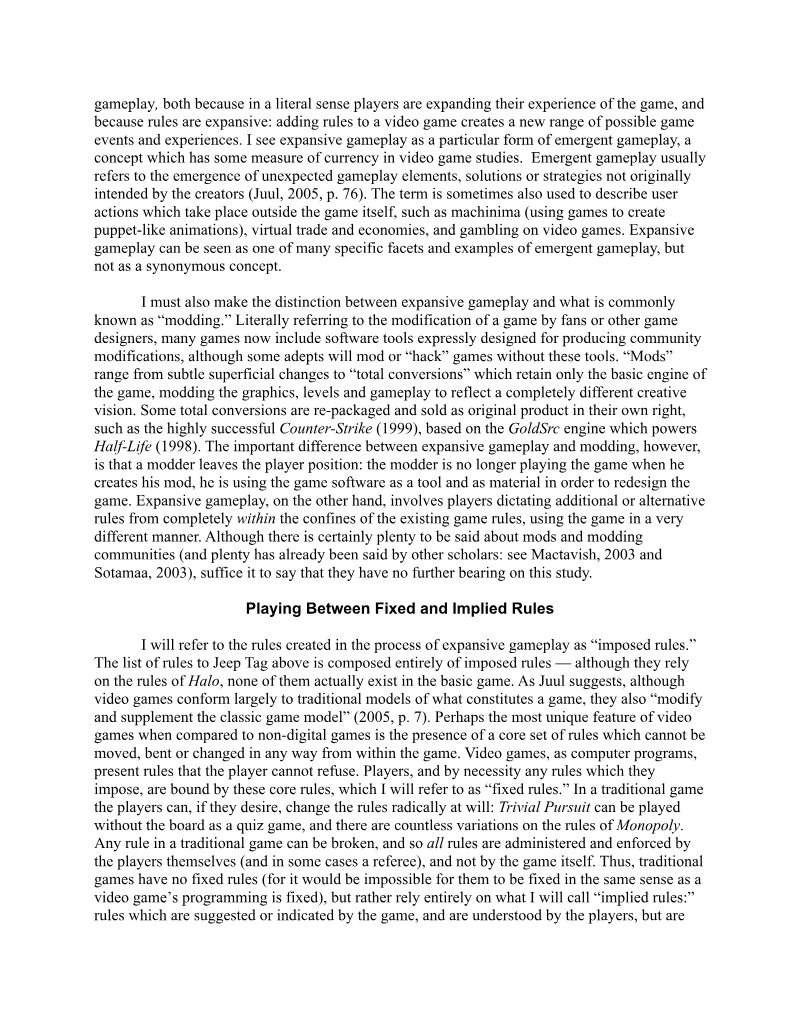
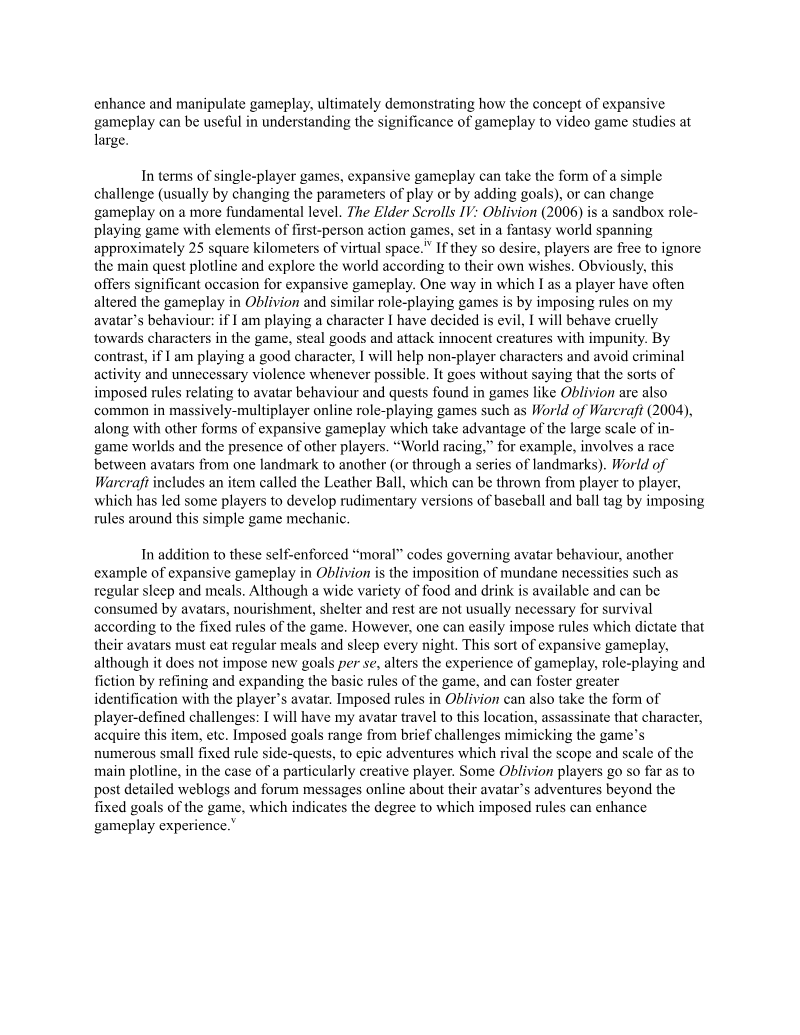
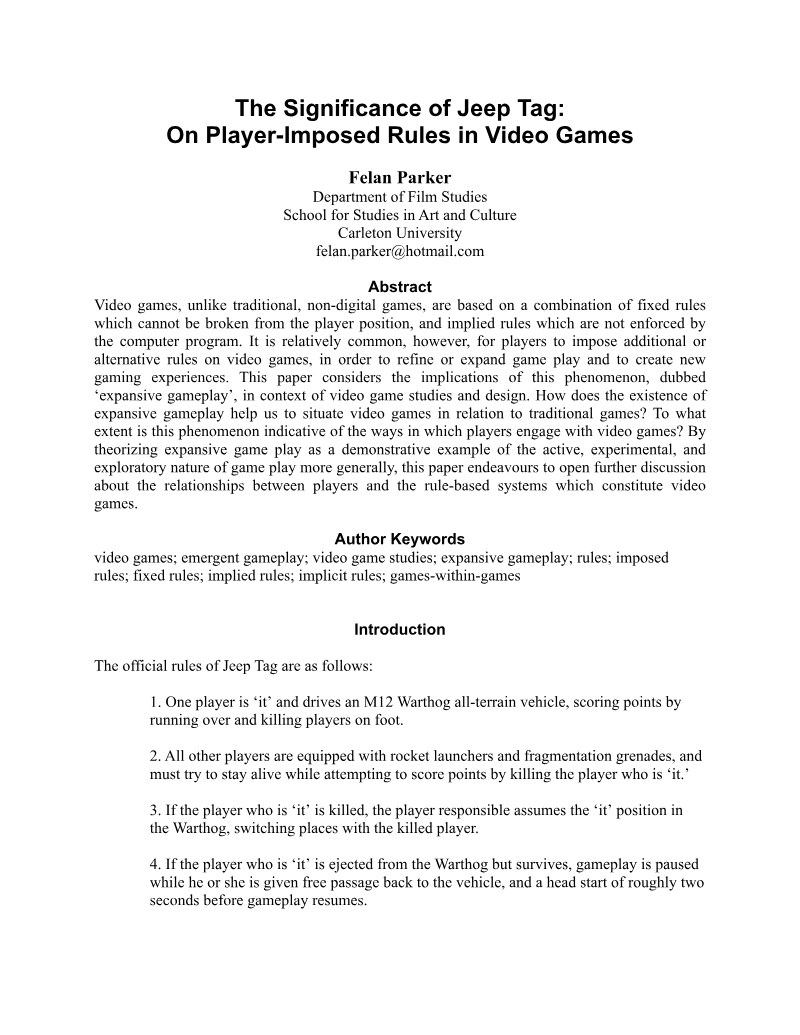
Expansive gameplay refers to the phenomenon where players impose self-defined rules upon existing video game systems to create new experiences.
- Expansive gameplay occurs when players create self-imposed rules within a game's existing, fixed architecture, distinct from modding which requires altering software code.
- Game rules are categorized into three types: fixed (hard-coded), implied (suggested by design), and imposed (created by players to refine or expand experiences).
- Players successfully transform standard game modes into new activities by manipulating implied rules, as seen in community-invented games like 'Jeep Tag' in Halo: Combat Evolved and 'Cat and Mouse' in Project Gotham Racing 2.