1 free read left. Create a free account for unlimited reading + AI research.
Create free accountWhitepaper DiGRA
1 free read left. Create a free account for unlimited reading + AI research.
Create free accountWhitepaperDiGRA
Taylor challenges the view that the game software is the central, neutral arbiter of rules in multiplayer games.
T.L. Taylor's paper challenges the common view that computers serve as the central, neutral arbiter of rules in multiplayer games, arguing instead that rule construction and negotiation are a consistent feature of computer gaming, including at the high-stakes level of professional competition. Drawing on prior studies of console clubs, MMOG play, cheating, and role-play, the author positions professional gaming as a particularly revealing site for examining how rules are actually produced in practice, since one might expect such contexts to adhere most closely to formalized system rules.
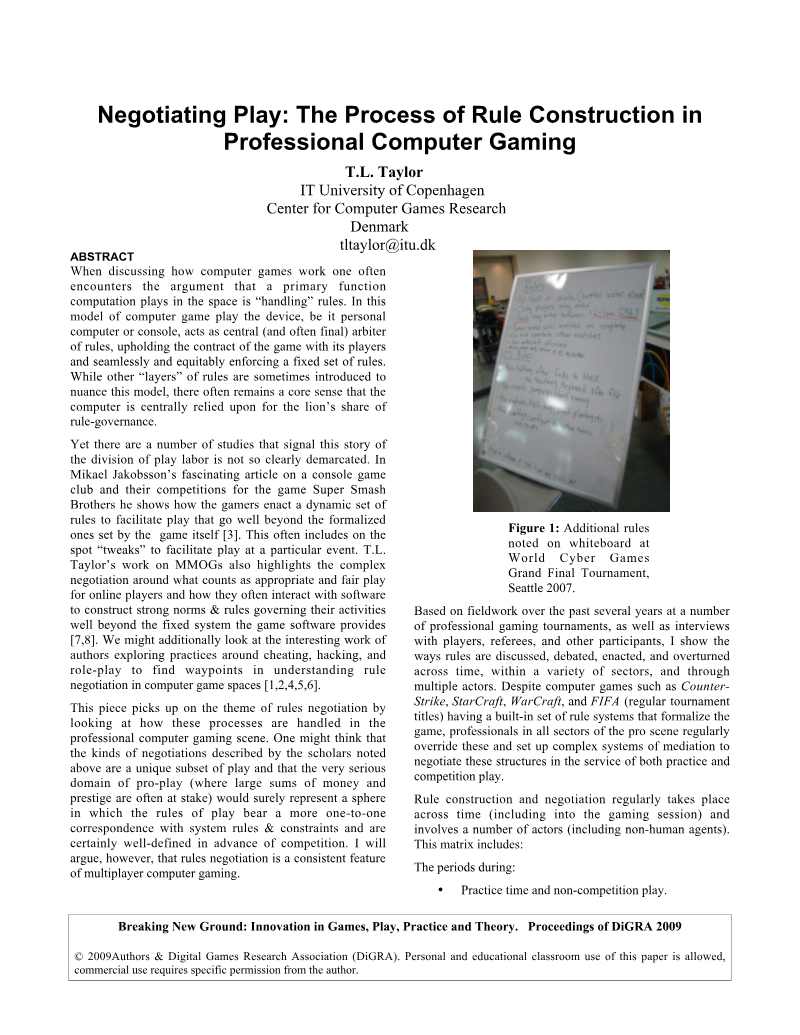
The study is based on several years of fieldwork at professional gaming tournaments, supplemented by interviews with players, referees, and other participants. The research examines competitive play in titles such as Counter-Strike, StarCraft, WarCraft, and FIFA, all of which include built-in rule systems. Rather than treating these formal systems as sufficient, the author documents how professional sectors routinely override, supplement, and mediate them through complex procedures to serve both practice and competition.
The paper maps rule negotiation across a range of temporal and social dimensions. Temporally, it spans practice sessions, regional qualifiers, finals, and post-game analysis, as well as conversations between tournaments. Socially, it involves multiple actors, including game software and its users, players and teams, organizers, sponsors, referees, software modifications created for specific events, and competing technologies such as broadcast media. Through this framework, the author contends that the game software is not a totalizing authority but one actor among many in the ongoing construction of play.
Each row is a game or company this document names, each column a document, oldest first. A mark means that document names it. Select a row to see those documents.

DiGRA · 2026

DiGRA · 2026



DiGRA · 2026



DiGRA · 2026



DiGRA · 2026



DiGRA · 2026



DiGRA · 2026



DiGRA · 2026



DiGRA · 2026

DiGRA · 2026



DiGRA · 2026



DiGRA · 2026
Zurich University of Applied Sciences · 2026