1 free read left. Create a free account for unlimited reading + AI research.
Create free accountWhitepaper DiGRA
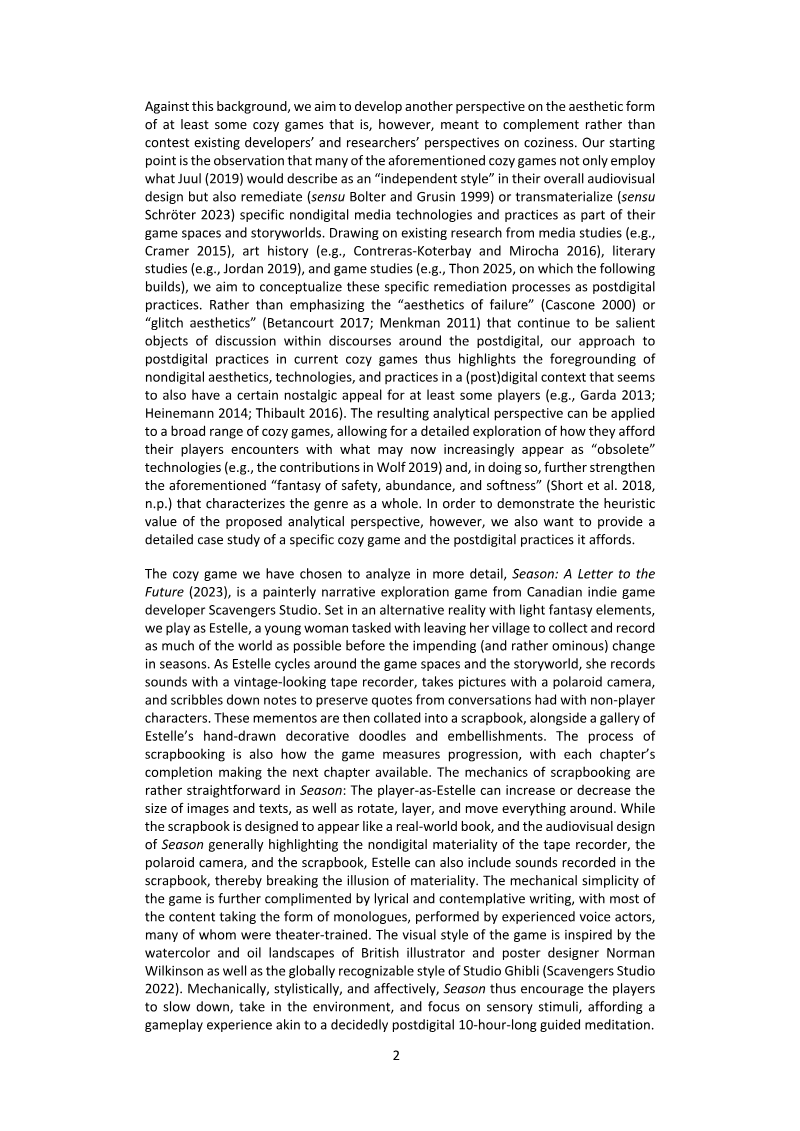
1 free read left. Create a free account for unlimited reading + AI research.
Create free accountWhitepaperDiGRA
The panel proposal argues for a broader conception of game aesthetics that includes embodied play, tangible interfaces, and creative player activity. The authors describe the field as still emerging.
This panel proposal argues for an expanded conception of game aesthetics, moving beyond visual presentation ("eye candy") to examine the overarching principles and qualities of the gameplay experience, including embodied play, tangible interfaces, and creative player activity. Drawing on cultural theory, art history, visual semiotics, psychology, and interaction design, four scholars each analyze a single game in depth: dot.hack, Flower, Okami, and Hitman. The stated aim is to demonstrate the breadth and relevance of current aesthetic approaches within game studies, a discipline that the authors describe as still emerging.
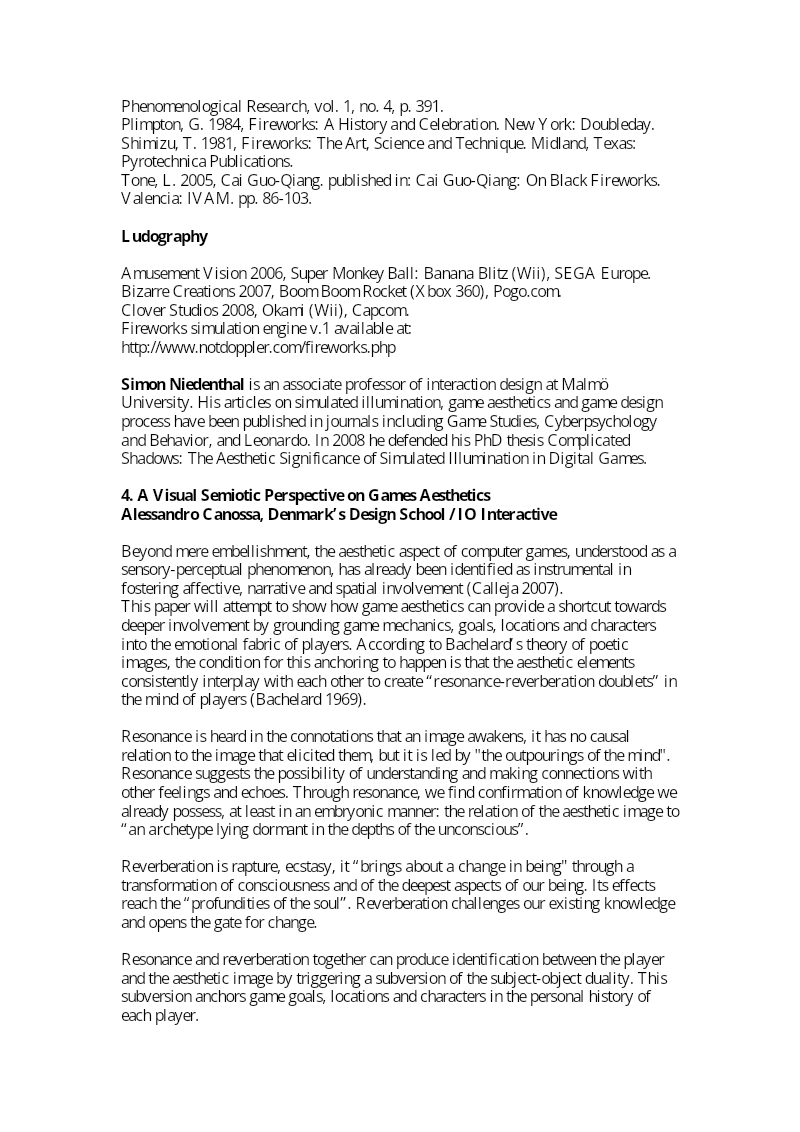
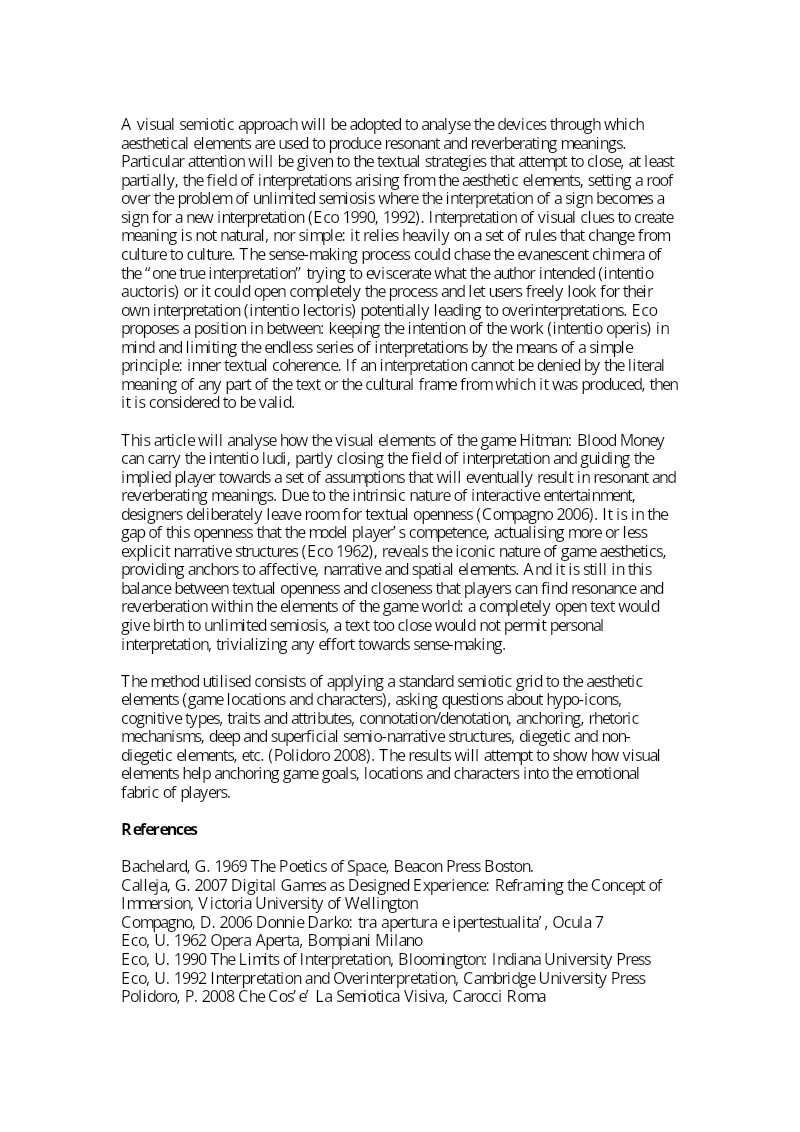
Graeme Kirkpatrick frames games as "post-representational" forms, claiming that allegory best explains their dreamlike qualities, preoccupation with death, cartoonish stylization, and emphasis on space. Using dot.hack, a game about massively multiplayer online role-playing games whose fictional world appears to spill into reality, he argues that meaning arises from the bodily tensions a player experiences, such as grip on the controller, shifts of visual focus, and attention to sound, and from the sense of a game's totality, or "worldness." Cindy Poremba examines Flower, arguing that experiential intensity can be a design starting point rather than rules alone, and that gameplay is defined by the quality of the action performed rather than only by its mechanics. Simon Niedenthal treats fireworks in games as felt, boundary phenomena, tracing how Okami and rhythm games use framing, temporal structure (firing, flight, burst), and narrative figures to produce sensory disruption and "dynamical joy." Alessandro Canossa applies Bachelard's concepts of resonance and reverberation together with Eco's theory of interpretation to Hitman: Blood Money, using a standard semiotic grid to show how visual elements anchor goals, locations, and characters in players' emotional lives while keeping interpretation bounded by textual coherence.
The collection is written largely in a theoretical and interpretive register rather than an empirical one. It draws on no surveys, sample sizes, or quantitative data, and its scope is defined by four titles from roughly 2001 to 2009, with examples spanning Japanese, Western, and independent productions. Its methodological strength lies in the variety of analytic lenses applied to specific games, while its evidentiary basis rests on close reading of game design, the authors' own play, and the cited theoretical literature.
Each row is a game or company this document names, each column a document, oldest first. A mark means that document names it. Select a row to see those documents.

DiGRA · 2026

DiGRA · 2026



DiGRA · 2026



DiGRA · 2026



DiGRA · 2026



DiGRA · 2026



DiGRA · 2026



DiGRA · 2026



DiGRA · 2026

DiGRA · 2026



DiGRA · 2026



DiGRA · 2026
DiGRA · 2026