Game Studies reports and market data
Documents

Backyard Survival: Ecology of Killer Insects and Violent Nature in Grounded (2022)
This article, a conference paper from the DiGRA 2025 proceedings, examines how insect non-playable characters and the survival genre in the open-world game Grounded (Obsidian Entertainment, 2022) challenge the division between nature and culture.
- The paper argues that Grounded (Obsidian Entertainment, 2022) portrays nature as violent, unfamiliar, and dangerous, which can prompt players to reconsider the benign view of nature found in traditional ecological thinking.
- Three ludonarrative features drive this representation: the monstrous scale and behavior of insect NPCs, the intimate proximity of natural and human worlds in the backyard setting, and disasters caused when players act as god-like manipulators of the environment.
- The author contends these features can cultivate respect for nature through fear of a more powerful existence, interpreted through Haraway's Cthulhucene, Morton's dark ecology, and Braidotti's posthumanism.
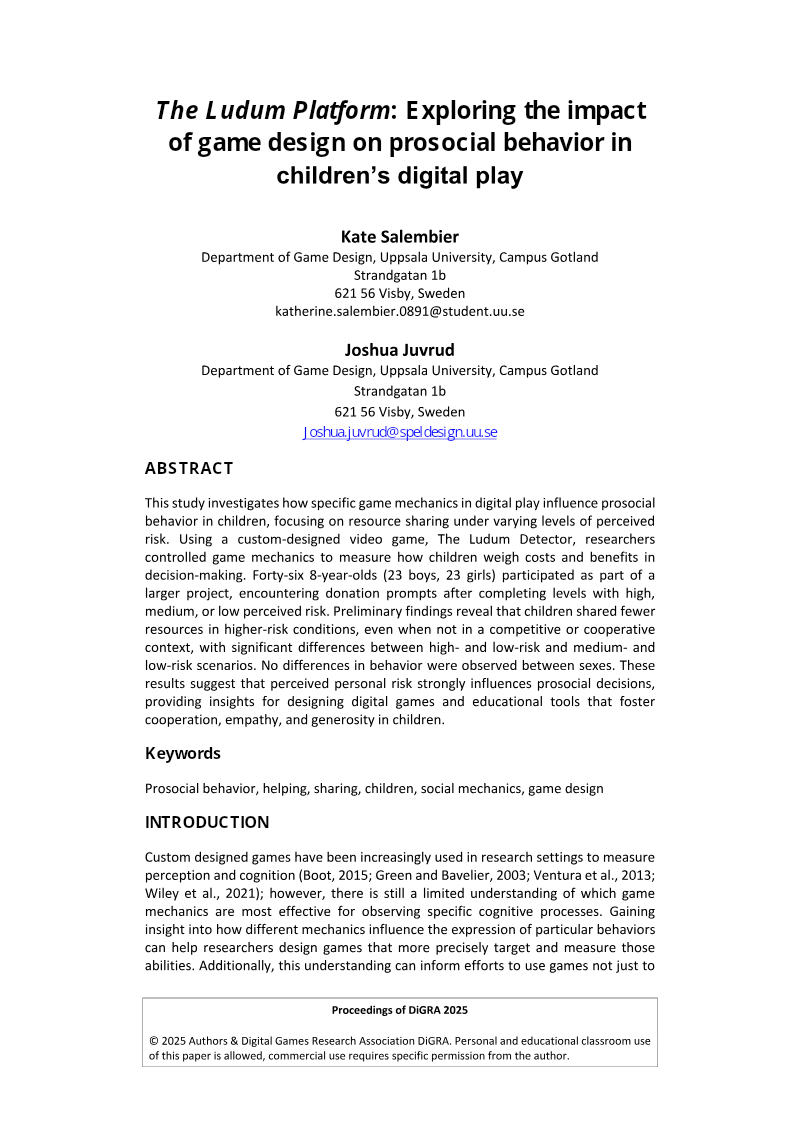
The Ludum Platform: Exploring the Impact of Game Design on Prosocial Behavior in Children's Digital Play
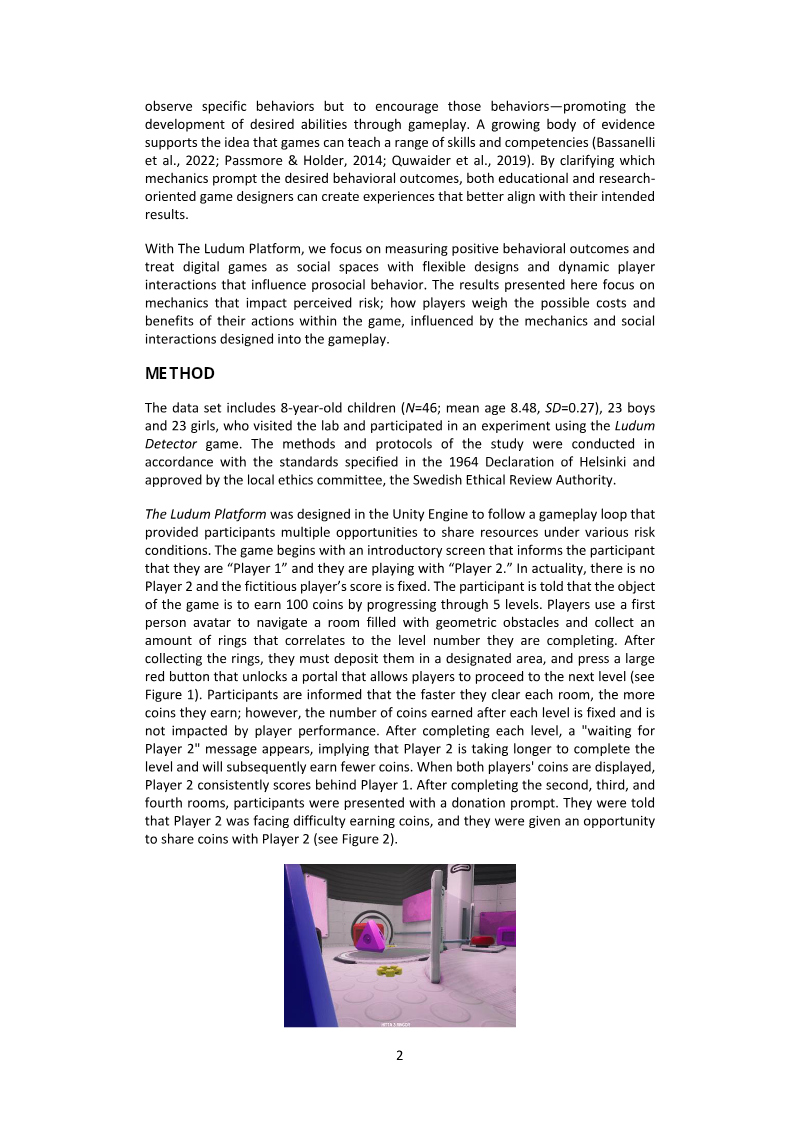
This study examines how perceived personal risk shapes resource sharing among children in a custom-built digital game, The Ludum Detector, which is part of the broader Ludum Platform project.
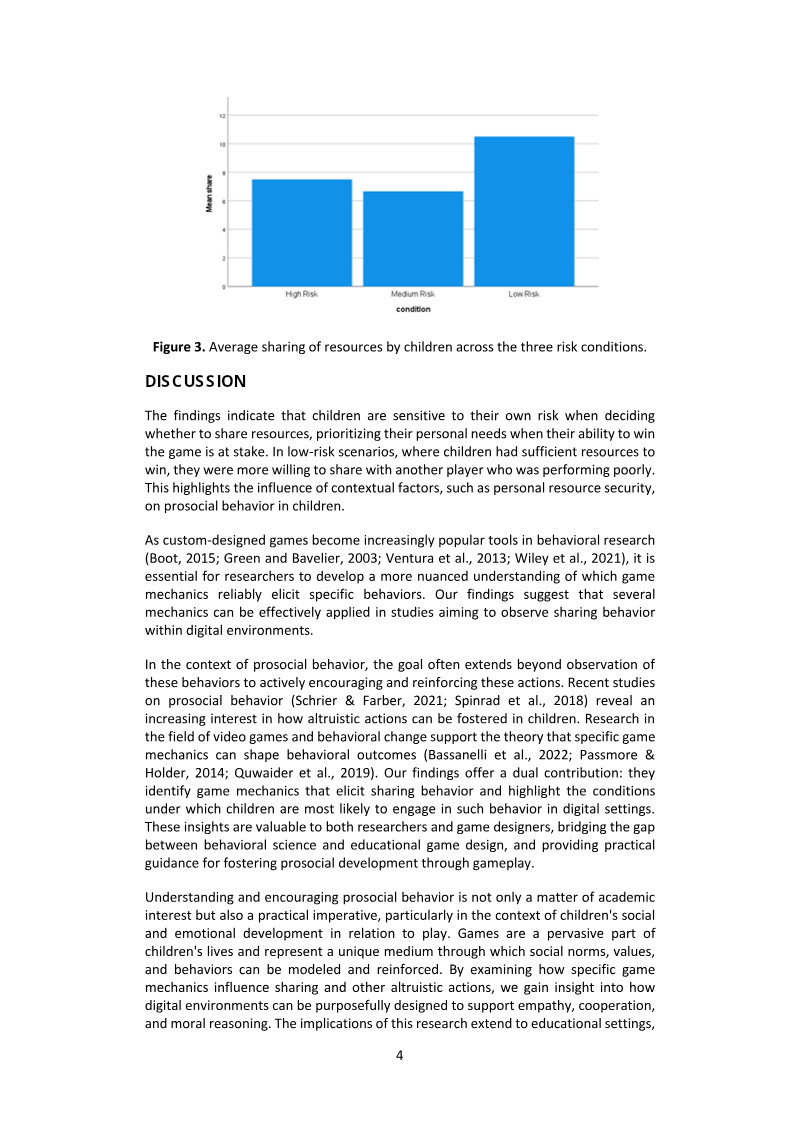
- Children share fewer resources in a digital game as their personal risk rises: in a 46-child study of 8-year-olds, sharing differed significantly between high-risk and low-risk conditions (p = .015) and between medium-risk and low-risk conditions (p = .002).
- The authors conclude that children prioritize personal security, and that resource sufficiency is a strong contextual driver of prosocial decisions in digital settings.
- No significant differences in sharing emerged between boys and girls, suggesting similar responses to risk across sexes.



Test Trophy Please Ignore: Achievements as Paratexts in Palimpsestic Readings of Remasters and Remakes
This paper argues that achievements, or trophies, function as paratexts in Genette's sense, offering authorial commentary that reveals the palimpsestic relationship between original video games and their remakes and remasters.
- The paper argues that achievements/trophies act as paratexts in Genette's sense, offering authorial commentary that exposes the palimpsestic relationship between original games and their remakes and remasters.
- Trophy lists persist, change, or are newly created across versions, and these traces of revision can be read as interpretive, navigational, and commercial thresholds, a dimension the authors say previous scholarship on remakes as paratexts has largely omitted.
- A 2007 industry study cited in the paper correlated higher achievement volume with higher Metacritic scores and sales, and achievements became mandatory on Microsoft and Sony platforms after the Xbox 360's 2005 launch.
Rhetorics of Puppy Love and Death in The Pale Beyond (2023)
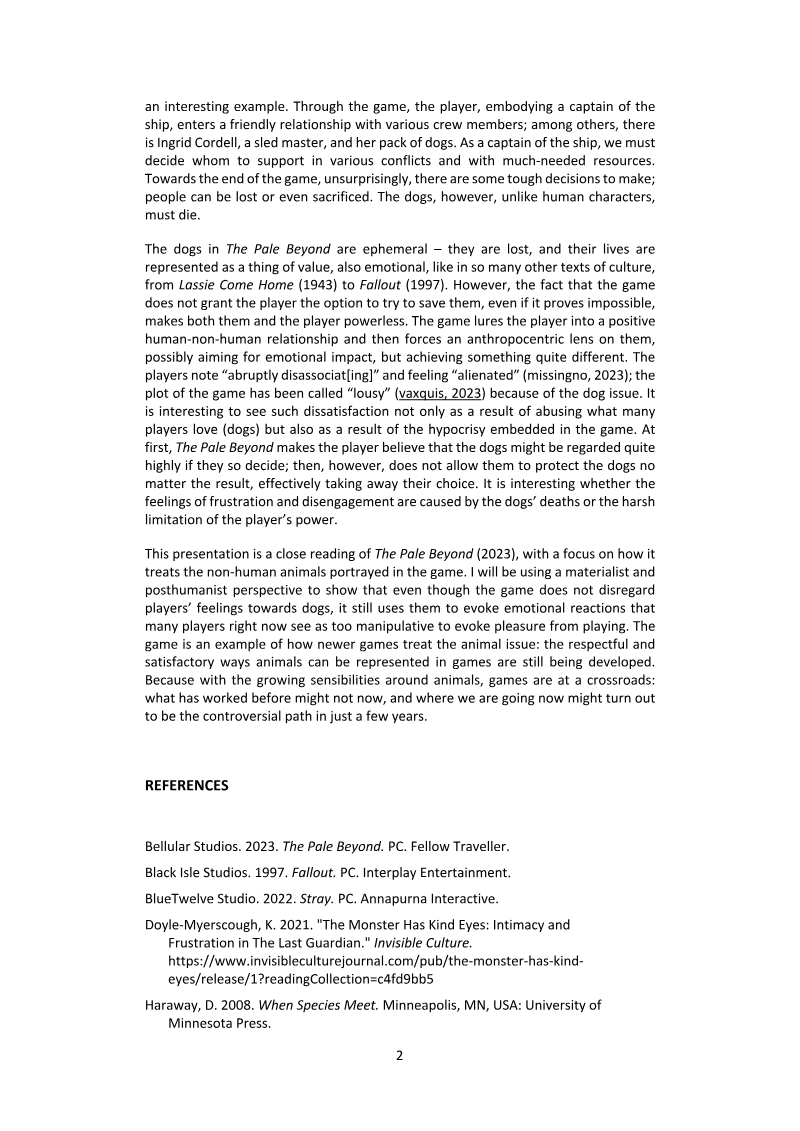
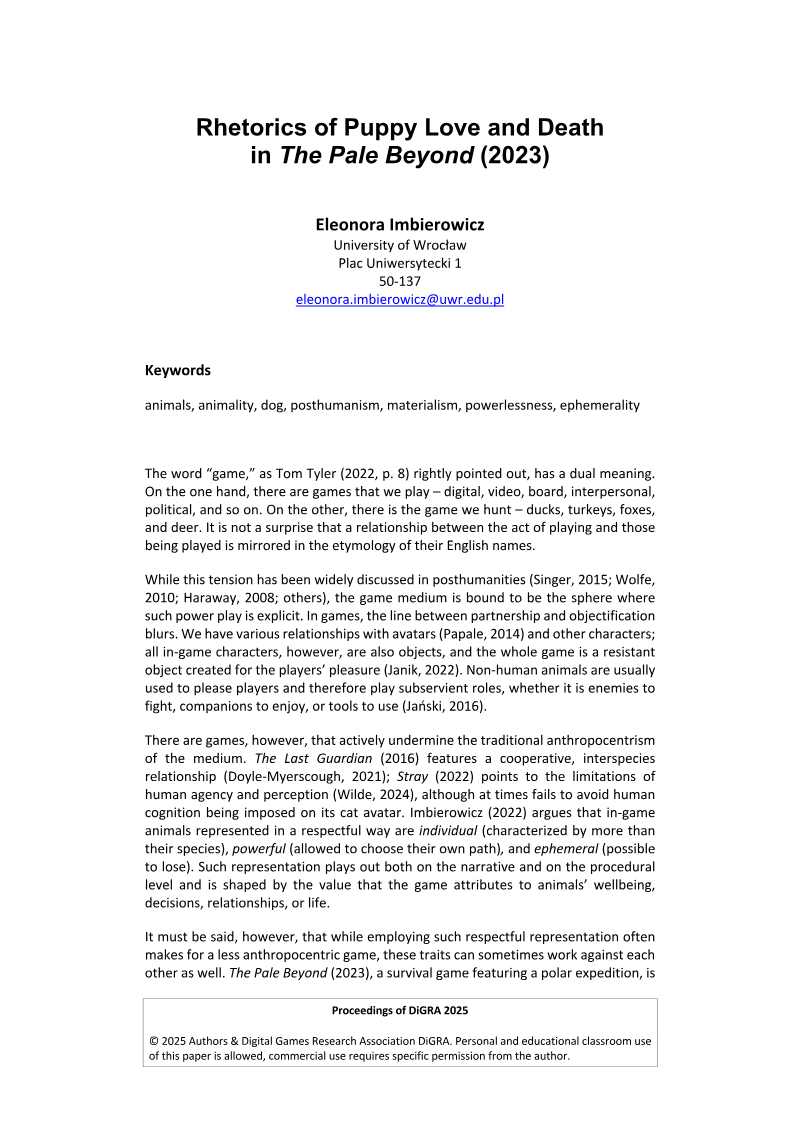
This paper offers a close reading of the 2023 survival game The Pale Beyond, examining how it portrays non-human animals, specifically the sled dogs under the care of crew member Ingrid Cordell.
- The paper's central claim is that The Pale Beyond (2023) builds a warm human-animal bond with its sled dogs and then removes the player's ability to intervene, forcing their deaths, which many players experience as manipulative rather than meaningful.
- The author argues that respectful animal representation in games rests on three traits (individuality, agency, and ephemerality), and The Pale Beyond creates conflict among them by giving the dogs emotional weight and narrative value while denying them any power over their own fate.
- The game is framed as a tension between promised player choice and later revoked agency, and the author interprets player frustration as stemming both from the portrayal of animal death and from this perceived hypocrisy.



Cozy History? Frameworks, Contrasts, and Affect in Cozy Historical Video Games
Alexander Vandewalle's paper argues that cozy historical video games, including titles with mythological content, constitute a distinct mode of "doing" history that departs from the dominant conventions of historical gaming.
- Alexander Vandewalle argues that cozy historical video games constitute a distinct way of 'doing' history, departing from the conventions of violence, conquest, technological progression, and cinematic realism typical of historical gaming.
- The paper introduces the concept of 'cozy history': an affective form of engagement in which players invest emotionally in a self-constructed presence within a loosely defined past, rather than in an authentic reconstruction of a specific region or era.
- Cozy historical titles such as Tiny Glade, REKA, Valheim, Dawn of Defiance, and Manor Lords emphasize building, nature, collectivity, and non-photorealist aesthetics while largely removing combat and stressful mechanics.
Speak with Blocks: Minecraft, Environmental Education and Activism
This paper by Gaia Amadori examines how digital games, specifically the sandbox title Minecraft, can serve as platforms for environmental education and ecological activism.
- The paper argues that video games should be analyzed as nodes in a network of stakeholders (NGOs, corporations, public institutions, developers, and gaming communities), not as isolated software products.
- It proposes an analytical model with three dimensions: the ecological issue addressed, the network of actors, and the video game ecosystem (assets, affordances, and paratexts such as user-generated content and streamer discussions).
- Greenpeace's 'To The Last Tree Standing' campaign recreated Poland's Białowieża Forest in Minecraft and then altered the map to show near-total deforestation; the paper says it reached millions and helped build public pressure that contributed to halting real-world logging there.
Preserving Japanese Indie Games at BitSummit Drift 2024
This extended abstract, authored by Michael Pennington and James Newman of Bath Spa University, argues that Japan's contributions to videogame history are at serious risk of being lost, both because digital games are becoming unplayable and because English-language histories tend to privilege American and Eurocentric…
- Japan's videogame heritage is at serious risk of being lost, both because digital games are becoming unplayable and because English-language histories tend to privilege American and Eurocentric perspectives.
- A central finding is that many Japanese indie developers worry their games will become unplayable due to hardware breakage or financial constraints that prevent ongoing maintenance.
- The authors conclude that audiovisual documentation of gameplay and spectatorship is itself a meaningful form of preservation.
Music beyond Gameplay: Embodied Experience of Acoustic Music in the Covers of Original Game Soundtracks
This paper examines fan-produced YouTube videos in which musicians perform acoustic covers of video game original soundtracks, treating these uploads as a form of participatory culture, prosumption, and meaning-making within game culture.
- Fan-produced acoustic covers of video game soundtracks are framed as active reconstructions rather than imitations: moving a digital, interactive score to traditional instruments forces performers to interpret the material and creates a distinct embodied musical experience.
- The authors treat these YouTube covers as de-centered paratexts and player-produced texts that document game reception and function as artistic expression within participatory game culture.
- The authors argue that a soundtrack's popularity tracks the size of its fandom and the cultural visibility of its publisher, citing Nintendo series such as The Legend of Zelda, Super Mario, and Pokemon as enduringly prominent.
Copyright and Games Preservation: Lessons and Opportunities in De-colonization
This extended abstract examines how copyright law and institutional preservation practices struggle to accommodate video games in a global, post-colonial context.
- Copyright frameworks and heritage institutions were built around static, physical, territorially bounded objects, while digital games require ongoing copies, updates, and platform maintenance, exposing these limitations.
- Digital distribution and 'service' business models mean libraries and archives often hold only licenses rather than ownership, which limits their long-term capacity to preserve games.
- Territorial licensing creates uneven global availability; the authors cite Sony's PlayStation Network restricting access to roughly 85 countries.
Mutual Incorporation: On Eating and Being Eaten in Bugsnax (2020)
This paper is an extended abstract from a DiGRA 2025 proceedings that offers a phenomenological and affect-theory analysis of Bugsnax (Young Horses, 2020), using the game as a case study for rethinking eating in digital play.
- The paper is a conceptual, text-based analysis of the single game Bugsnax (Young Horses, 2020), drawing on close reading and secondary literature rather than empirical data, sample sizes, or quantitative findings.
- Its central thesis is that Bugsnax literalises 'incorporation' through a comedic body-horror premise in which players capture hybrid bug-snacks and use them to recompose the limbs and bodies of non-player characters.
- Drawing on Annemarie Mol's Eating in Theory and Calleja's model of incorporation, the author argues the game moves beyond eating as sustenance or resource management toward 'mutual incorporation', in which eaters are themselves eaten by what they consume.
Playing the Othered Self as Wukong: A Resilience in Speculative-Mythological Games
This paper examines how Sun Wukong, the Monkey King of Chinese mythology, is reimagined within speculative and science fictional settings, and how such reimaginings in video games shape players' experience of selfhood.
- The paper's central argument is that speculative-mythological worlds, which juxtapose historicism (preserving cultural memory and trauma) with futurism (pushing myth toward adaptive transformation), give players a way to work through existential crisis, marginalisation, and disorientation in a rapidly changing techno-social environment.
- The Monkey King Sun Wukong is treated as a site of temporal friction, where archiving cultural memory and imagining redemption meet within reimagined speculative and science fictional settings.
- The analysis applies precedents including Chen Leng's late Qing novel Neo-Journey to the West (1909) and Ken Liu's short story The Litigation Master and the Monkey King (2013) to three single-player action-adventure games: Sun Wukong VS Robot (Bitca, 2019), The Crown of Wu (Red Mountain, 2023), and Black Myth: Wukong (Game Science, 2024).



At the Crossroads of Art and Games: NPCs in Contemporary Video Art
This paper examines how contemporary video artists are using the figure of the non-player character (NPC) to explore questions of agency, labour, race, and subjectivity.
- The paper examines how contemporary video artists use the non-player character (NPC) to explore agency, labour, race, and subjectivity, scoping 'game art' as artworks that reference videogames or appropriate game content.
- The term 'NPC' migrated from gaming communities into online political discourse in the late 2010s, where it was used both to ridicule perceived conformity and to reinforce racialised and gendered hierarchies, before creators reclaimed it to describe constraints of economic and sociotechnical systems.
- Larry Achiampong and David Blandy's GOD MODE (2023), shown at the Wellcome Collection, uses game-engine imagery to reflect on scientific racism, eugenics, and how popular media shapes ideas about heredity and race, contrasting the free player with the pre-ordained, labouring NPC.