Game Studies reports and market data
Documents

City Beyond the City: Manifestations of Contemporary Flâneurism in Video Games
Video games serve as sophisticated digital environments that facilitate a contemporary form of flâneurism, transforming the act of movement into a primary method of narrative construction.
- Video games function as a unique medium for urban representation by allowing players to experience virtual space through movement, mirroring the way individuals navigate and assign meaning to physical cities.
- The player's movement in virtual environments is an intuitive process based on real-world navigation strategies, where physical actions like climbing or opening doors translate directly from daily urban life.
- Contemporary game design often bifurcates into two distinct modes of spatial interaction: the 'traceur' model, characterized by high-speed, kinesthetically dynamic movement, and the 'flâneur' model, focused on contemplative, slow-paced exploration.

gamevironments 2015
The document announces the establishment of a new Video Gaming and Religion Seminar within the American Academy of Religion (AAR), a major professional body for religious studies scholars.
- The AAR Program Committee approved a new Video Gaming and Religion Seminar for a five-year term (2015–2019), with one session at each Annual Meeting.
- The seminar was founded to address the marginal status of video games within Religious Studies, with author Kerstin Radde-Antweiler arguing that video games now depict religious themes just as film did in the twentieth century.
- The seminar aims to build a multidisciplinary, international network covering personal computer, console, and mobile games, with a steering committee of six scholars from the United States, Canada, Germany, and Finland.

Current Key Perspectives in Video Gaming and Religion
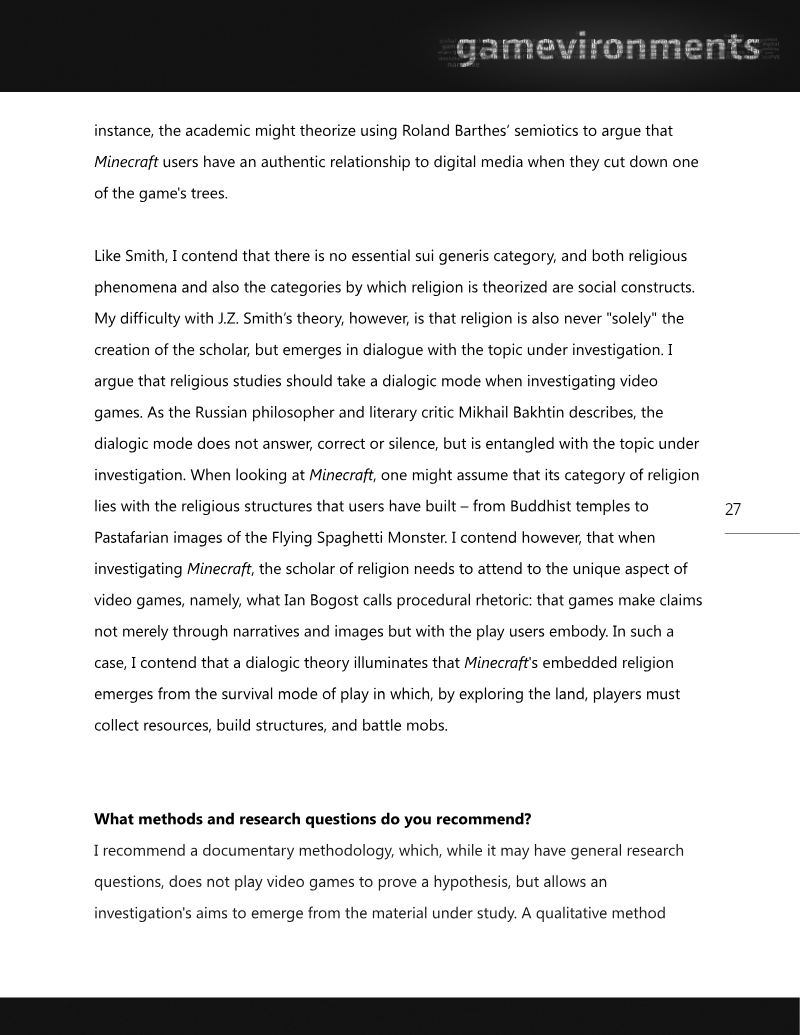
Gregory Grieve's contribution to this special issue on video gaming and religion argues that religious studies should examine video games through a "cultural dialogic mode," treating games as a space where religion and human meaning-making emerge rather than as objects that either hide timeless sacred symbols or serve merely as…
- Gregory Grieve argues that religious studies should examine video games through a "cultural dialogic mode," treating games as spaces where religion and human meaning-making emerge, rather than as hiding timeless sacred symbols or as mere products of the scholar's imagination.
- Grieve draws on Mircea Eliade, J. Z. Smith, Mikhail Bakhtin, and Ian Bogost's concept of procedural rhetoric, contending that in Minecraft religious meaning arises from the embodied experience of play, especially the survival mode's cycle of exploration, resource gathering, construction, and combat.
- Grieve proposes a documentary methodology called "close play," which requires scholars to actually play the games they study, since procedural meaning cannot be fully grasped through narrative or imagery alone.

Current Key Perspectives in Video Gaming and Religion
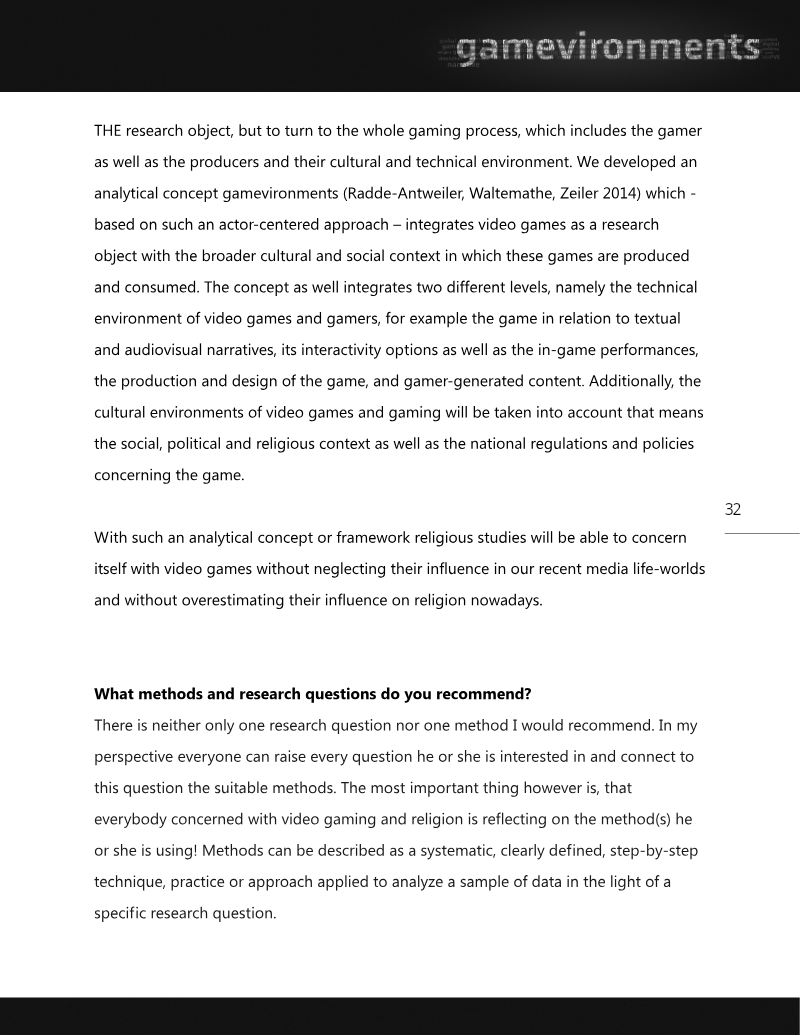
Kerstin Radde-Antweiler's theses, published in a 2015 special issue on video gaming and religion, argue that religious studies cannot ignore video games, since games form part of today's mediatized life-worlds in which online and offline religious practice increasingly merge.
- Religious studies cannot ignore video games because they form part of today's mediatized life-worlds, where online and offline religious practice increasingly merge.
- Games reach well beyond 'digital natives': German data showed at least 20 percent of players in 2006 were aged 40 to 64, and gaming shapes religious identity construction generally, not only within digital culture.
- Radde-Antweiler warns against overstating any single medium, arguing that media change interacts with individualization, globalization, and economization, so research should start with actor-centered inquiry into gamers' mediatized worlds rather than games as isolated objects.
Hackers and Cyborgs: Binary Domain and Two Formative Videogame Technicities
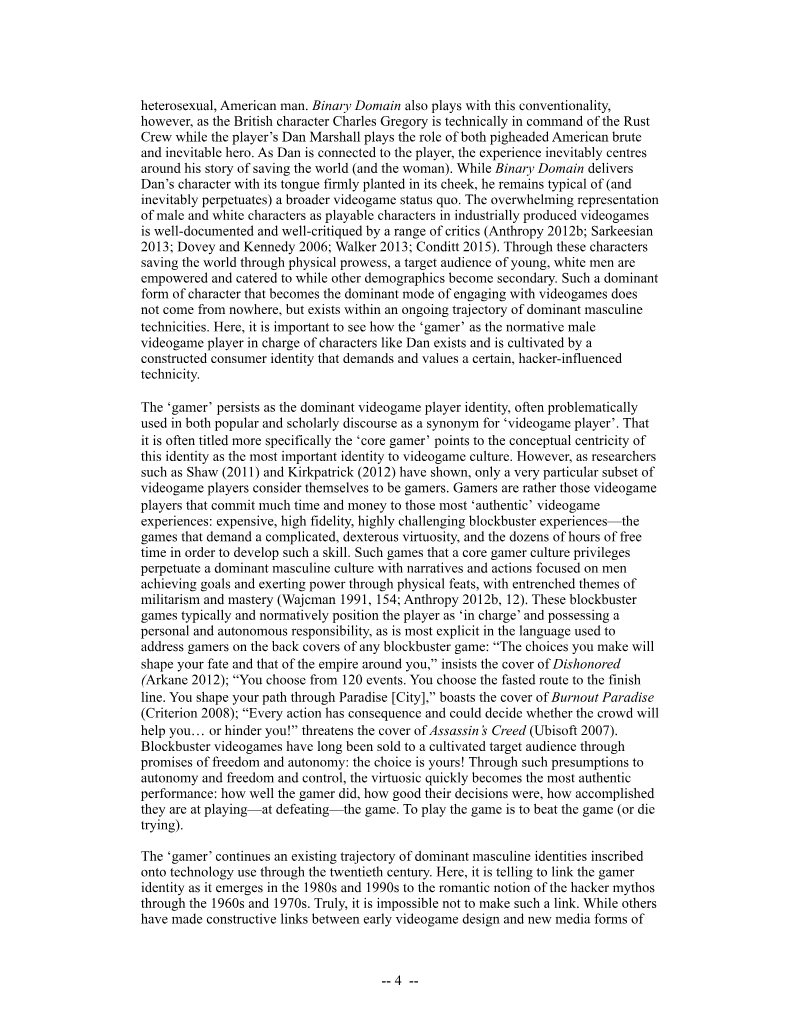
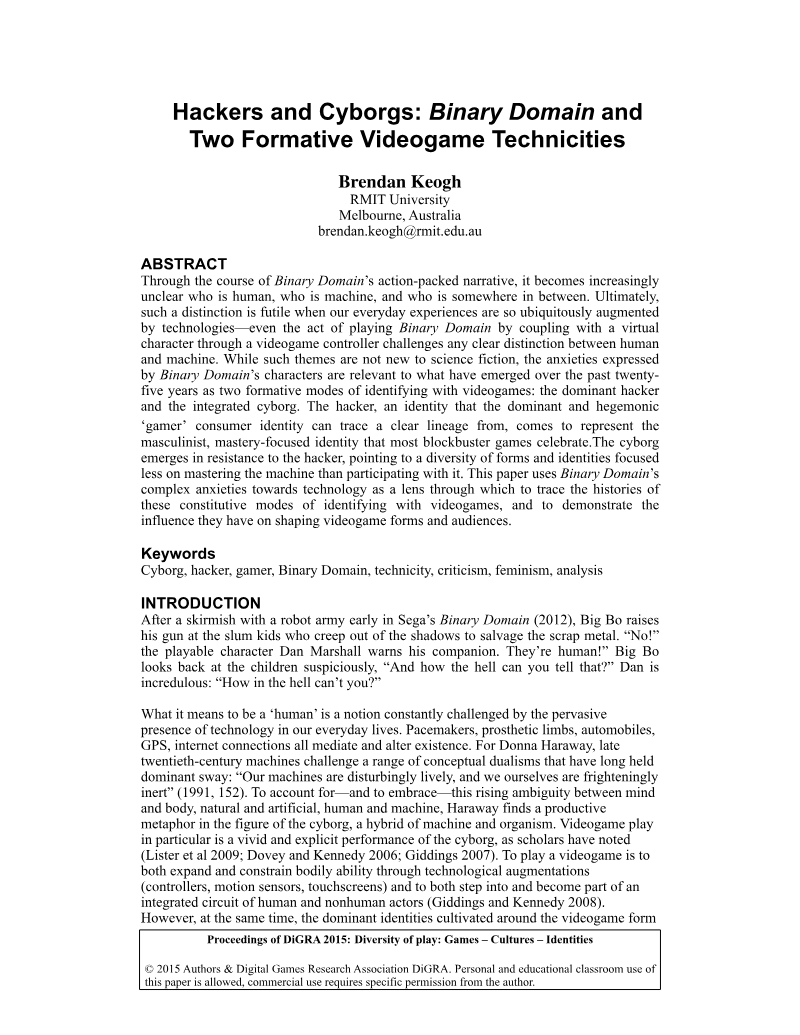
Brendan Keogh's paper "Hackers and Cyborgs: Binary Domain and Two Formative Videogame Technicities" uses Sega's Binary Domain as a lens for arguing that two competing modes of identifying with videogames have shaped the medium.
- Using Sega's Binary Domain as its lens, the paper treats the cyborg as a resistant and complementary perspective rather than a strictly opposed one, arguing the two identities are entangled and interdependent.
- The author contends the hacker ideal is masculinist and that this "technicity" influences which games get made, which are celebrated as exemplary, and how scholarly and popular discourse values the medium.
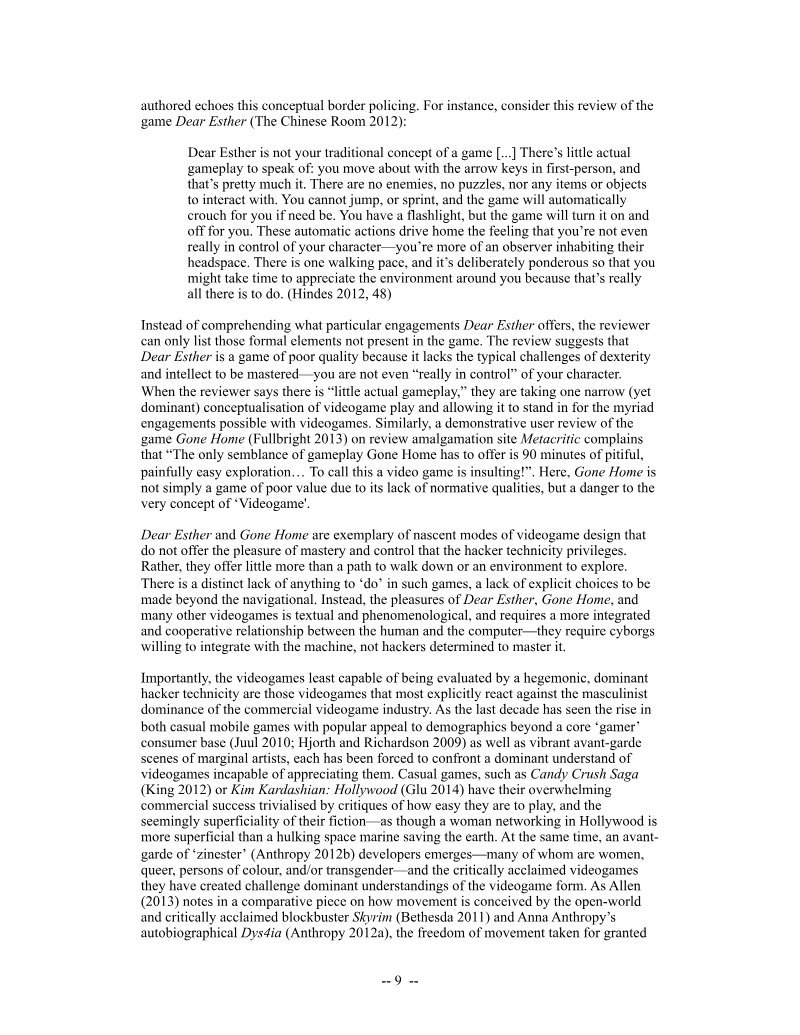
- Mainstream journalism and design privilege skill-based mastery, leading critics to dismiss exploration-focused and queer or women-created titles such as Dear Esther and Gone Home as "not real games," a rhetorical policing that also hits casual and avant-garde games reaching broader, more diverse audiences.

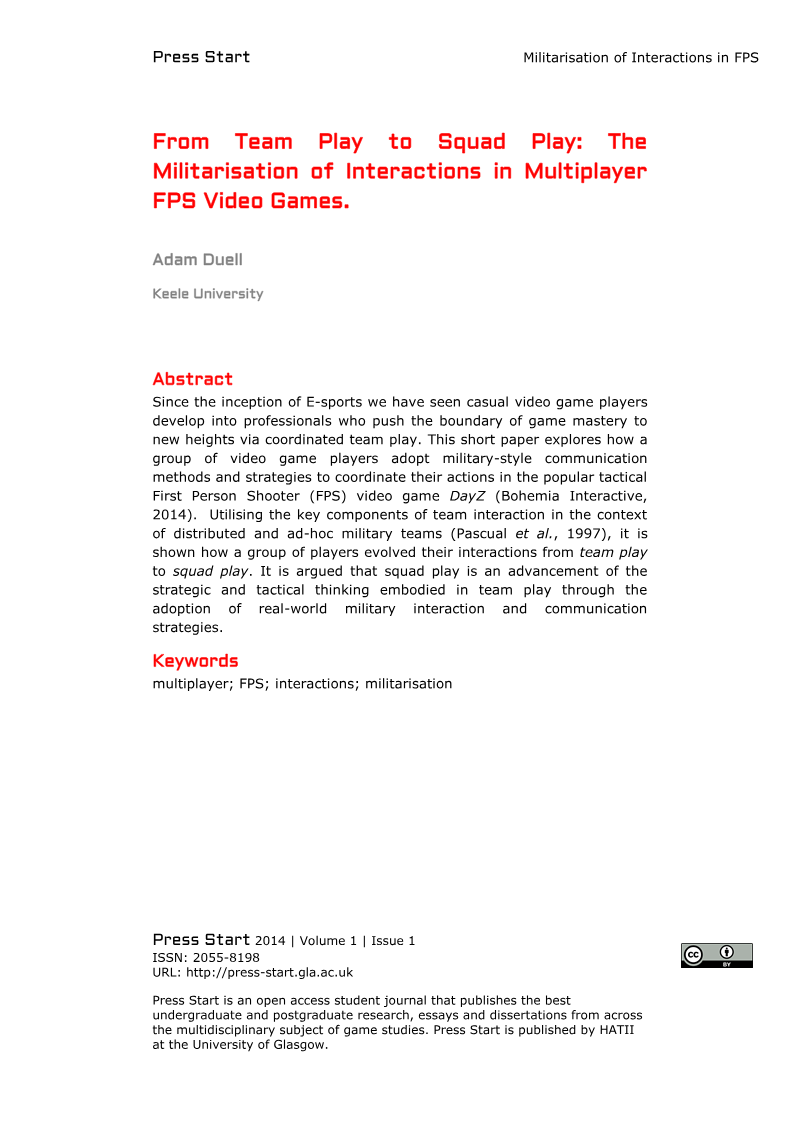
From Team Play to Squad Play: The Militarisation of Interactions in Multiplayer FPS Video Games
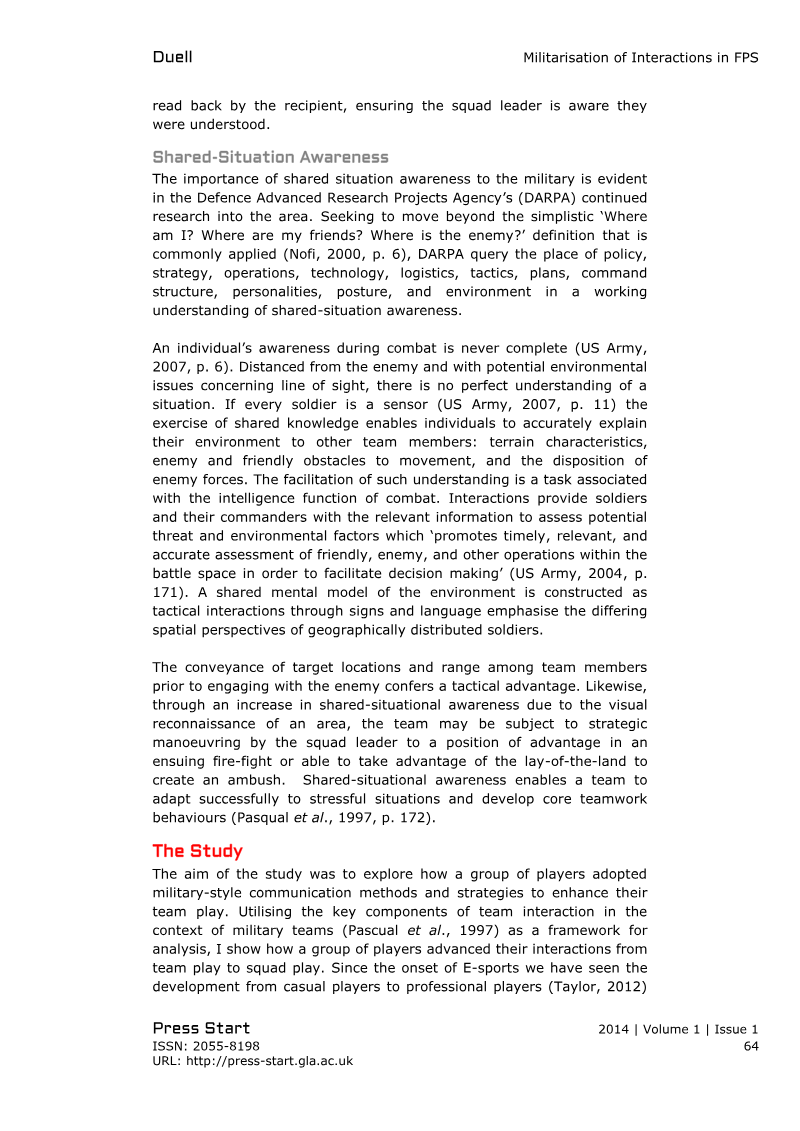
Multiplayer first-person shooter games increasingly rely on the adoption of real-world military communication doctrines to facilitate high-level coordination.
- Expert multiplayer FPS players evolve from 'team play' to 'squad play' by adopting real-world military communication protocols to improve tactical coordination.
- Squad play utilizes standardized military terminology—such as 'enfilade,' 'overwatch,' and 'defilade'—to eliminate ambiguity and ensure shared situational awareness among distributed players.
- Effective squad communication relies on precise, brevity-focused voice procedures that allow players to act as individual sensors, creating a collaborative, multi-perspective view of the battlefield.
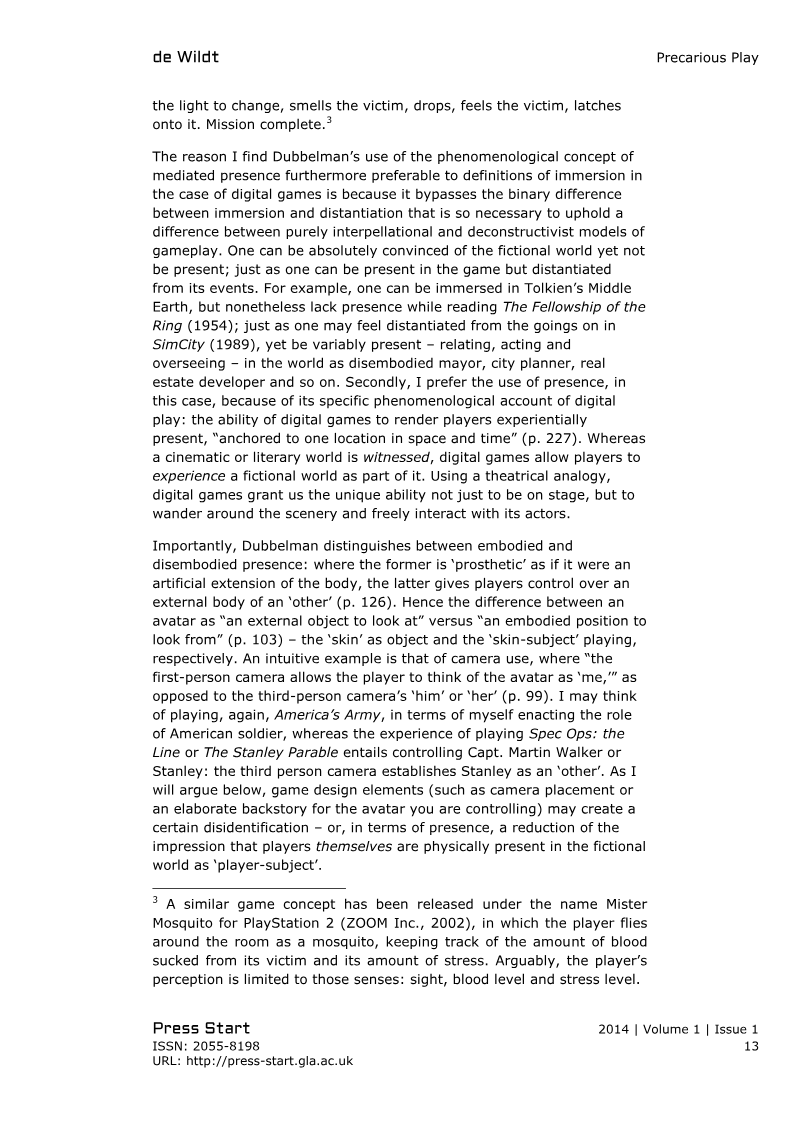
Precarious Play: To Be or Not to Be Stanley
The tension between player agency and systemic control defines the contemporary digital gaming experience.
Brechtian Alienation in Video Games
Brechtian alienation serves as a sophisticated analytical framework for game design, challenging the industry-wide preoccupation with seamless immersion.
Compassionate Play in the Ludic Century
Games have ascended to become the primary cultural framework of the modern era, fundamentally restructuring human experience and systemic interaction.
An Analysis of Open World Player versus Player in The Lord of the Rings Online
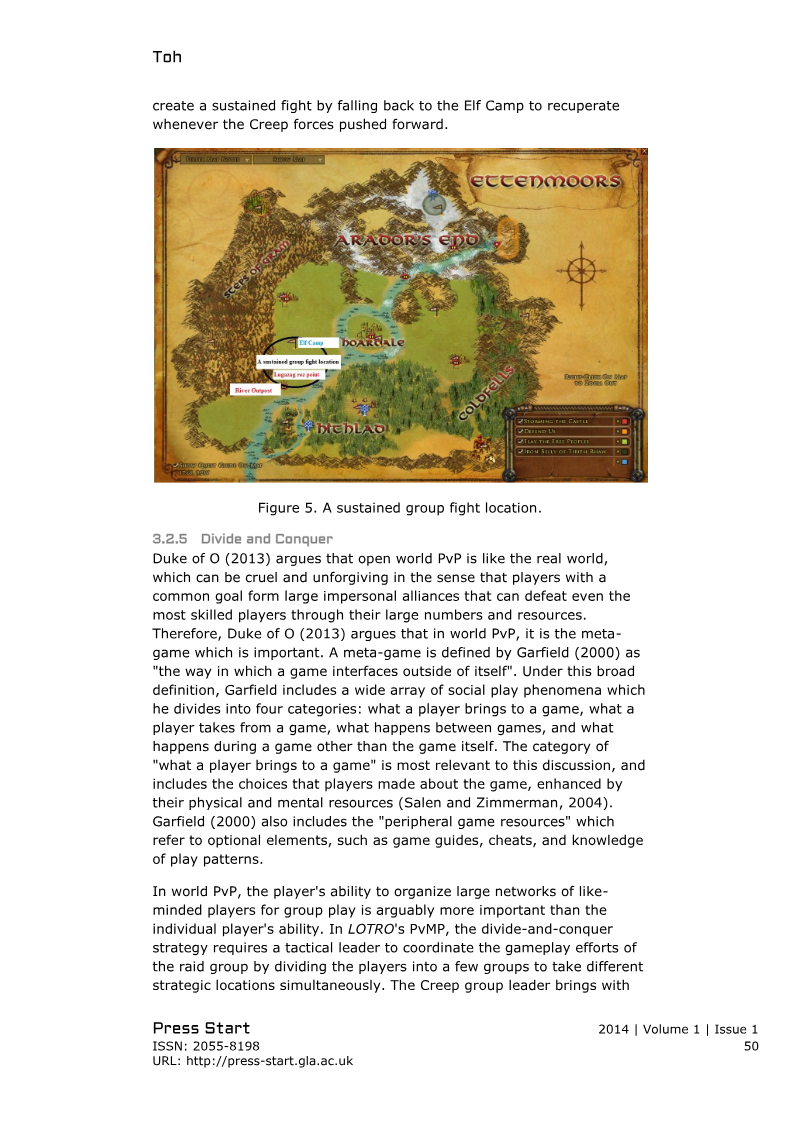
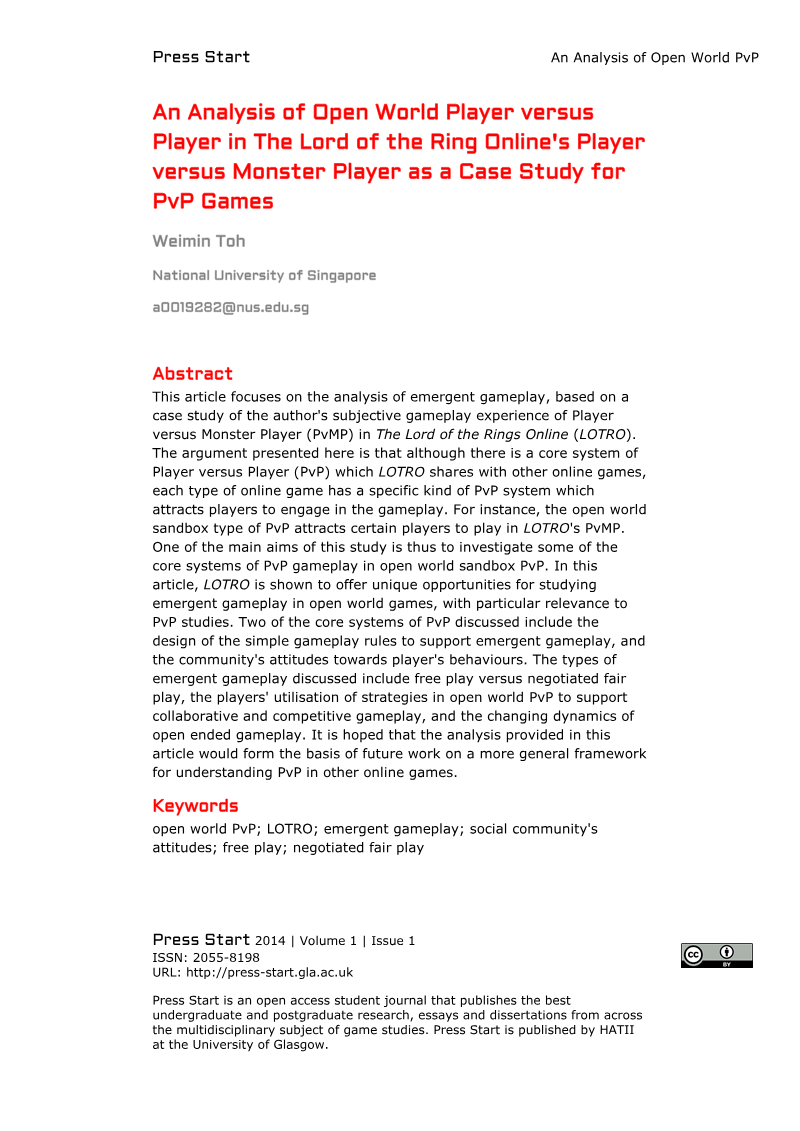
The open-world Player versus Monster Player (PvMP) environment in The Lord of the Rings Online serves as a primary case study for understanding how sandbox design fosters emergent gameplay.
Ethics for Cyborgs: On Real Harassment in an Unreal Place
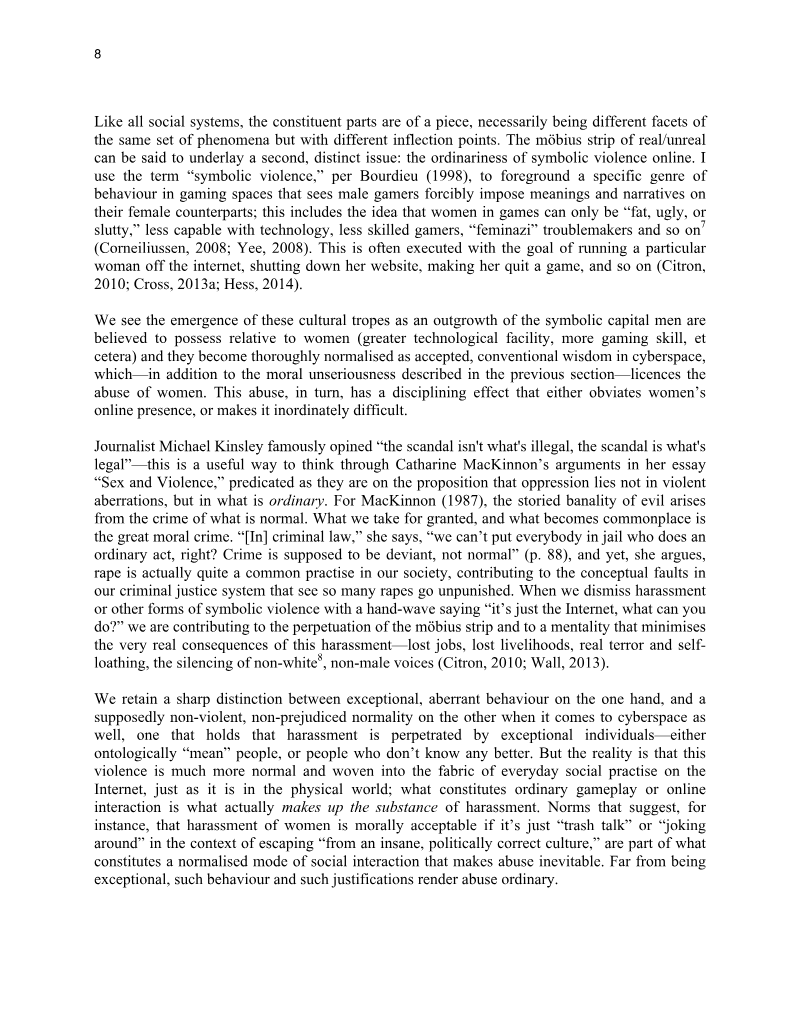
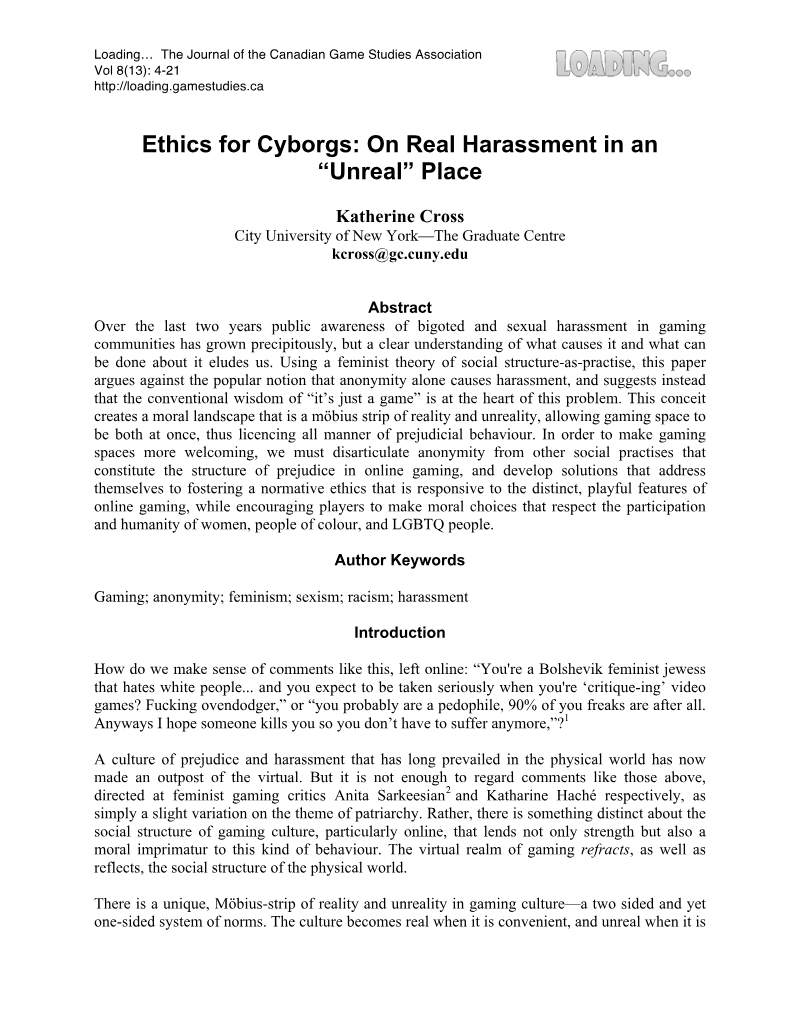
Online harassment within gaming environments is a systemic issue rooted in patriarchal social structures rather than a mere byproduct of digital anonymity.
- Online harassment in gaming is a systemic issue rooted in patriarchal social structures rather than a byproduct of digital anonymity, leading to real-world consequences like doxxing and threats.
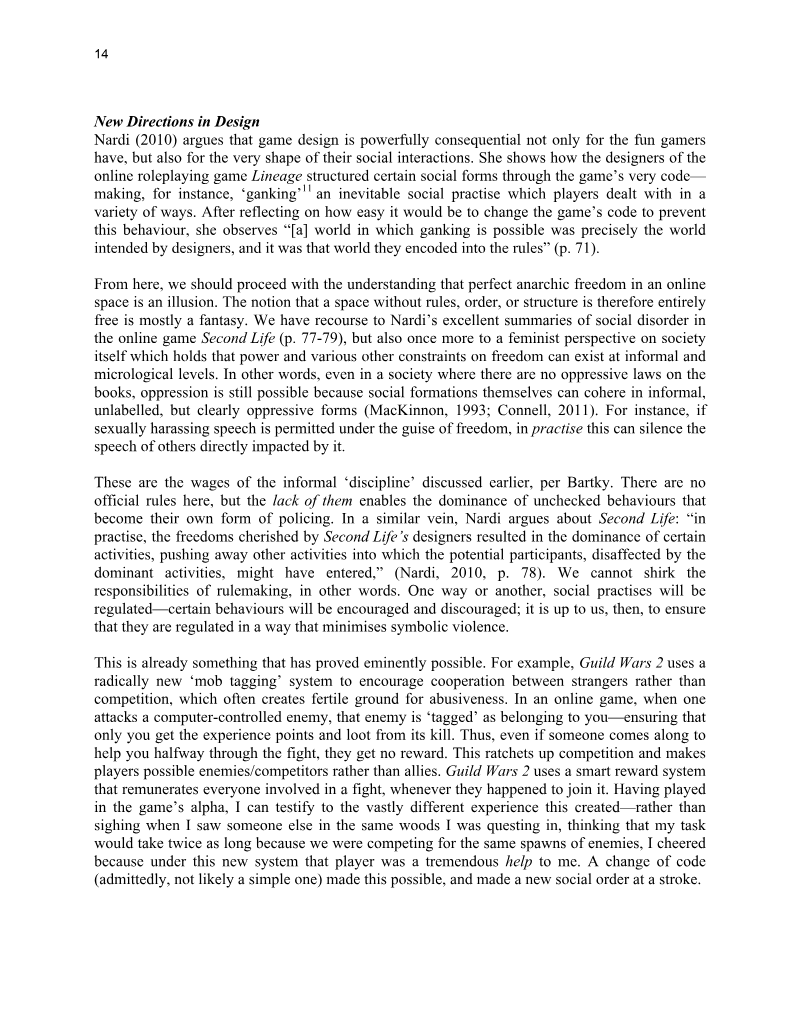
- Passive moderation models are insufficient to address the pattern of systemic violence, necessitating a shift toward proactive social engineering within game design.
- Developers should encode social structures that discourage prejudice by implementing reward mechanics that prioritize collective success and user-controlled communication tools.
Career Paths of Women in the German Games Industry
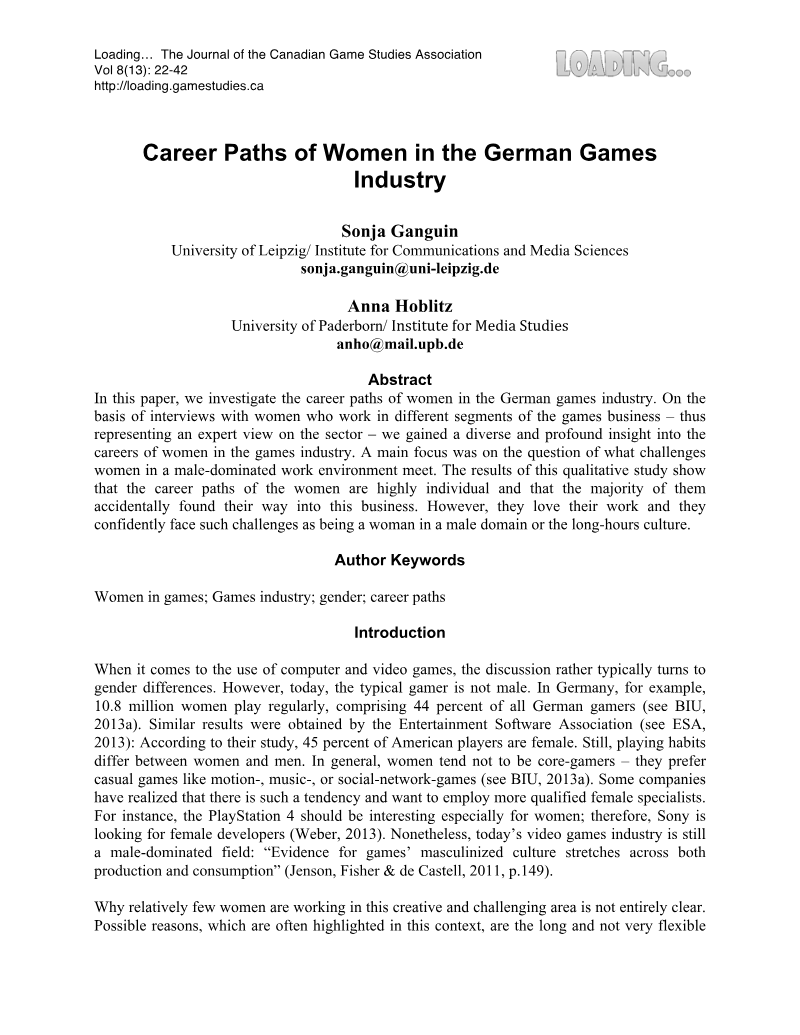
The German games industry is characterized by a stark gender imbalance, with women comprising only 5 to 6 percent of the total workforce.
- Women currently represent only 5 to 6 percent of the total workforce in the German games industry.
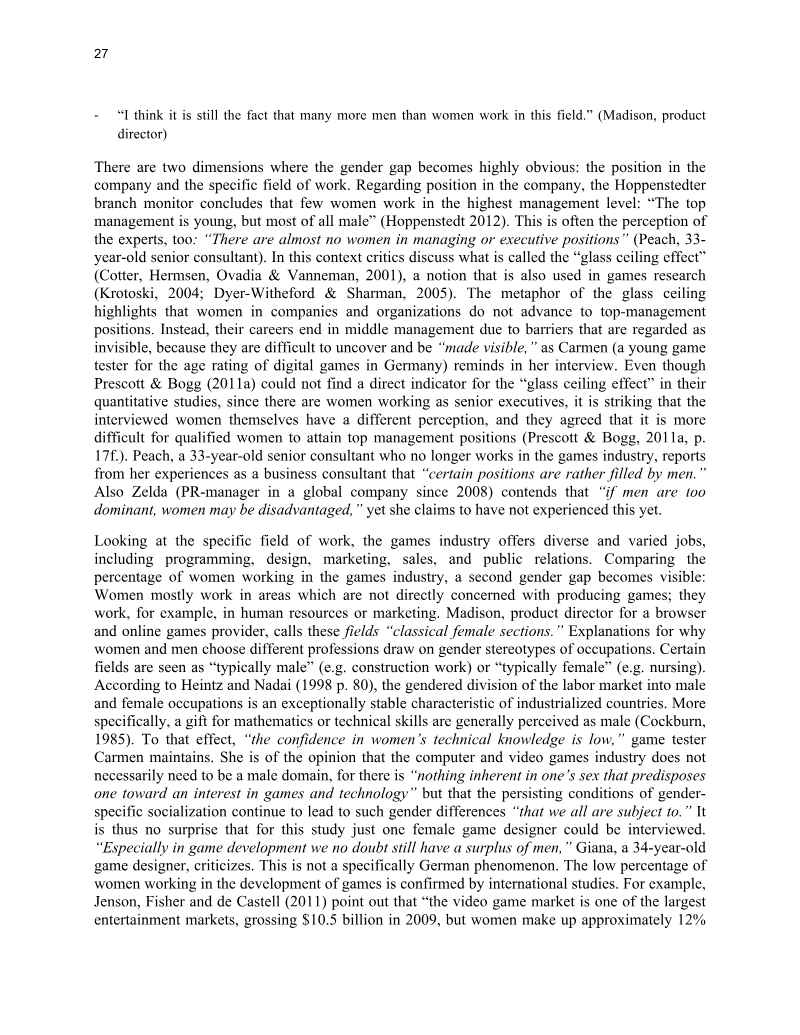
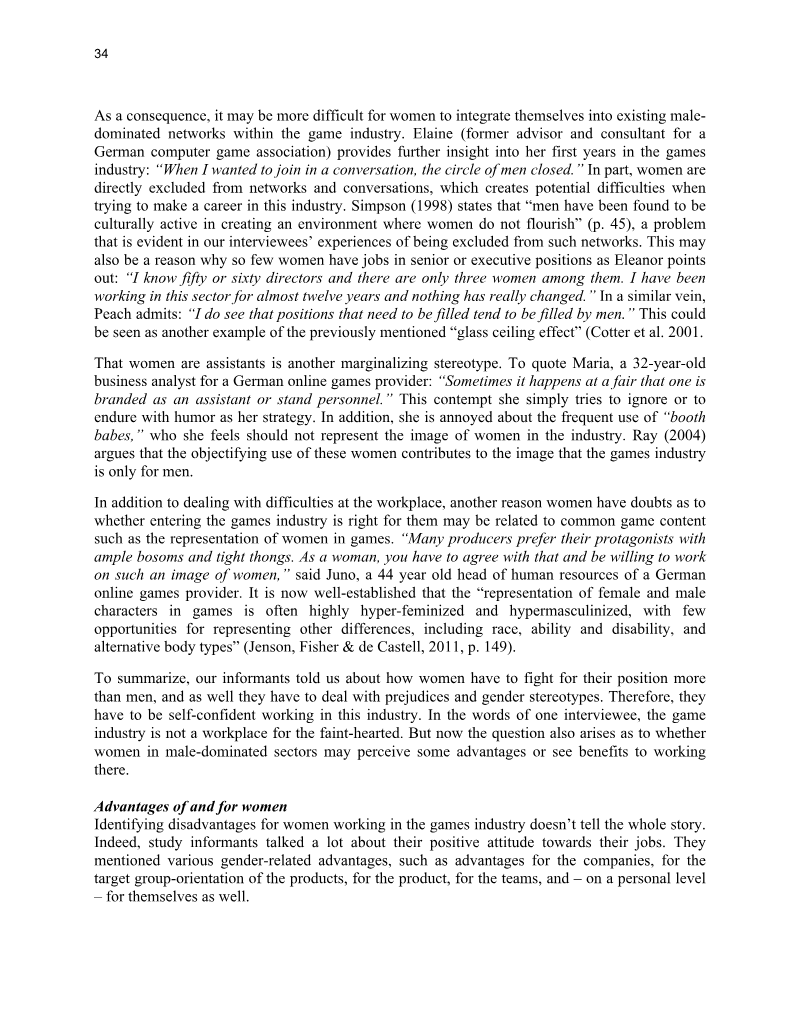
- Professional advancement for women is restricted by a glass ceiling that limits access to technical development and top-management positions.
- The industry's high-pressure, long-hours culture and frequent crunch periods create significant barriers for women balancing professional roles with family responsibilities.