Game Studies reports and market data
Documents
Visuospatial Abilities Training with Digital Games in a Primary School
The A me gli occhi project establishes a clear link between targeted visuospatial training via digital games and enhanced mathematical performance among primary school students.
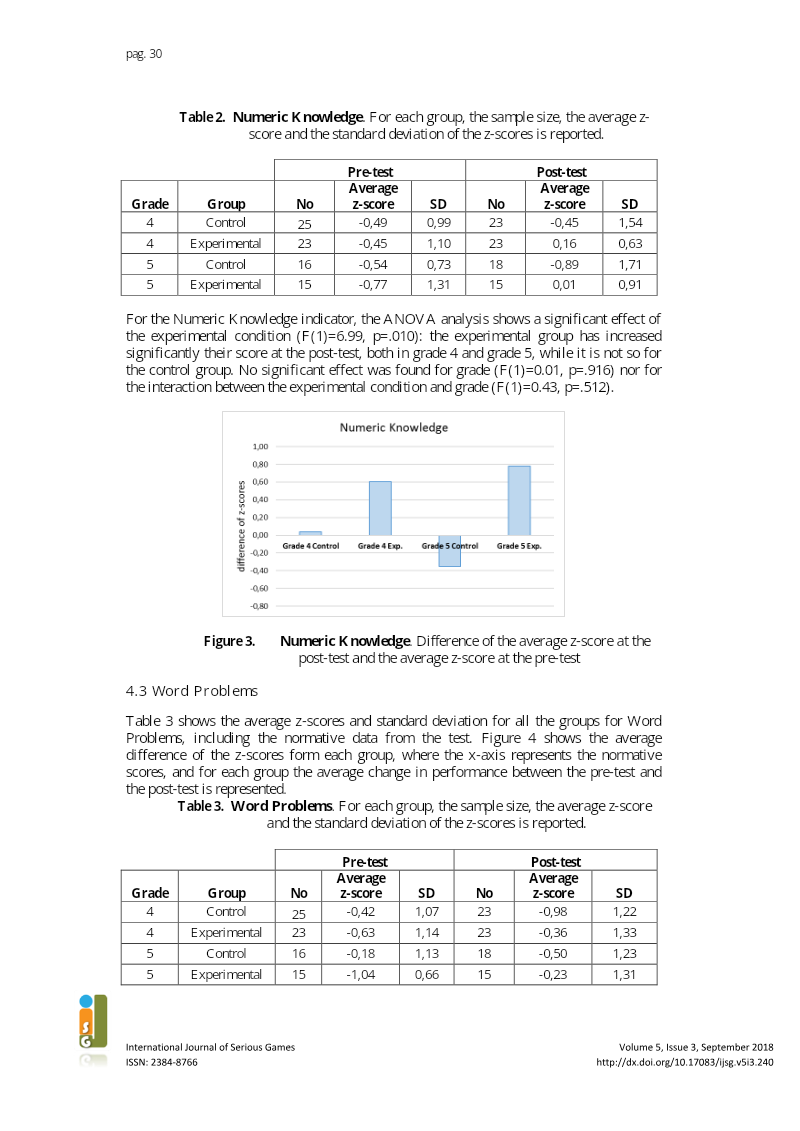
- Targeted visuospatial training through digital games significantly improves mathematical performance in primary school students aged nine to eleven.
- Students participating in the 'A me gli occhi' project outperformed traditional curriculum methods in standardized assessments, showing gains in numeric knowledge, word problems, and written operations.
- Fifth-grade students demonstrated the most notable progress, particularly in the execution of complex written operations.



A Serious Game to Improve the Verbal Resilience Against Doorstep Scams
The primary objective of this initiative is to enhance the verbal resilience of elderly individuals against doorstep scams through the application of serious gaming technology.
- A tablet-based serious game successfully trains elderly users in verbal resilience against doorstep scams using six expert-validated, branching scenarios.
- The platform utilizes a voice analysis module powered by a support vector machine algorithm to classify user assertiveness with 86.56% accuracy.
- The system provides a responsive feedback loop by dynamically adjusting scenario outcomes based on both the content and vocal delivery of the user's responses.
Nano-Games for Cultural Venues: The HEAL Game
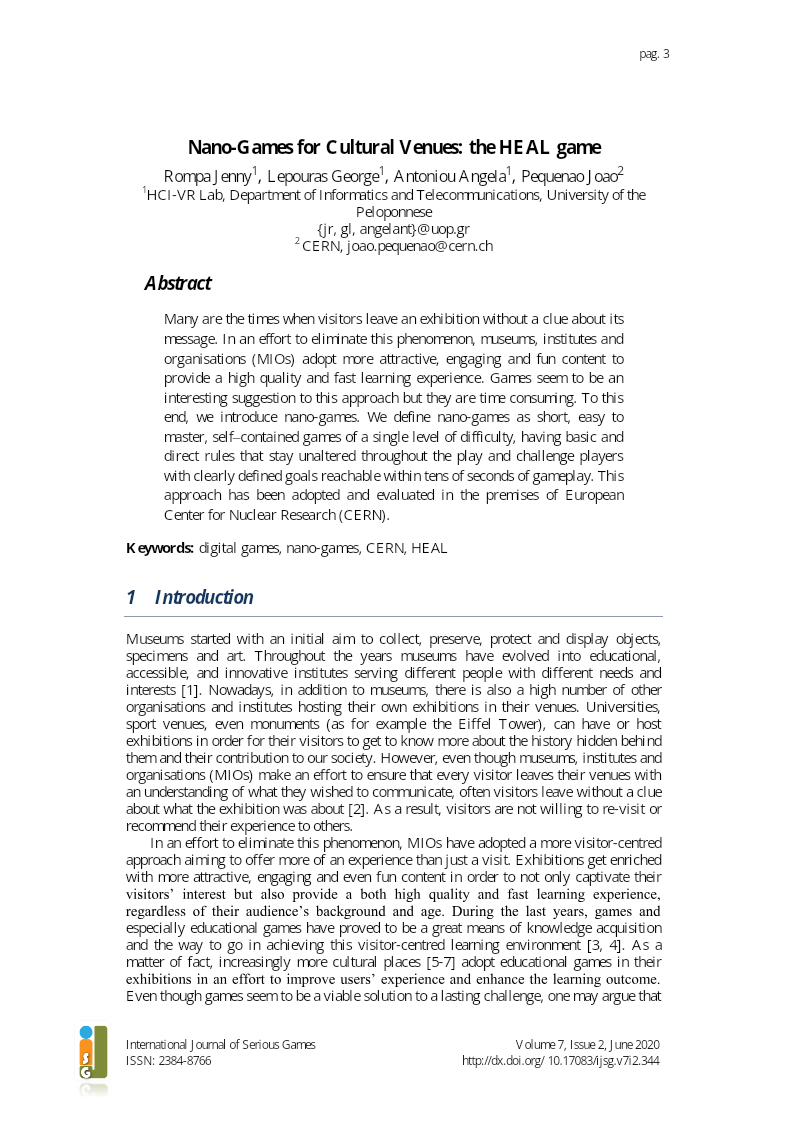
Nano-games represent a strategic solution to the pervasive challenge of visitor disengagement and time constraints within cultural and educational institutions.
- Nano-games effectively communicate complex scientific concepts like Hadron Therapy to diverse audiences through short, intuitive, and gesture-based interactions.
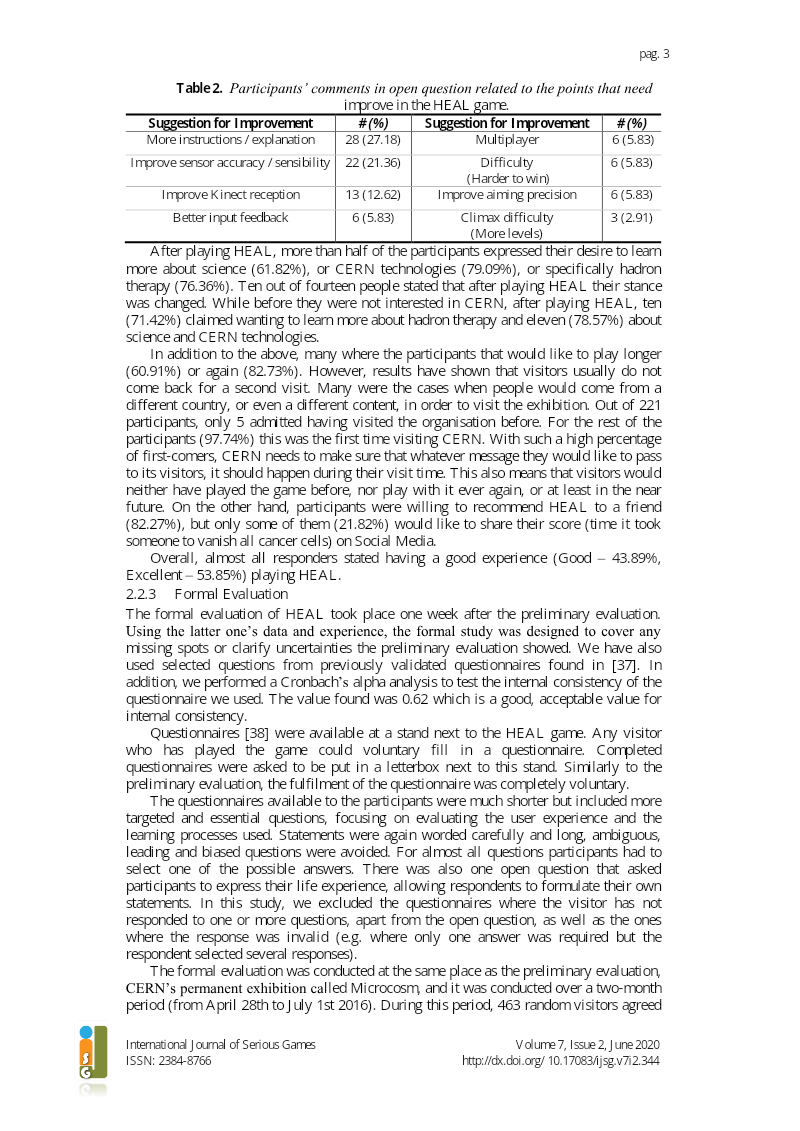
- Evaluation of the HEAL game at CERN’s Microcosm exhibition showed that 80 percent of 221 participants successfully internalized the presented scientific information.
- Learning outcomes occur rapidly, with data indicating that users grasp core concepts within the first minute of interaction.
Results and Insight Gained from Applying the EnergyCat Energy-saving Serious Game in UK Social Housing
The EnergyCat serious game initiative sought to evaluate whether gamified interventions could effectively promote energy conservation among social housing residents in the United Kingdom.
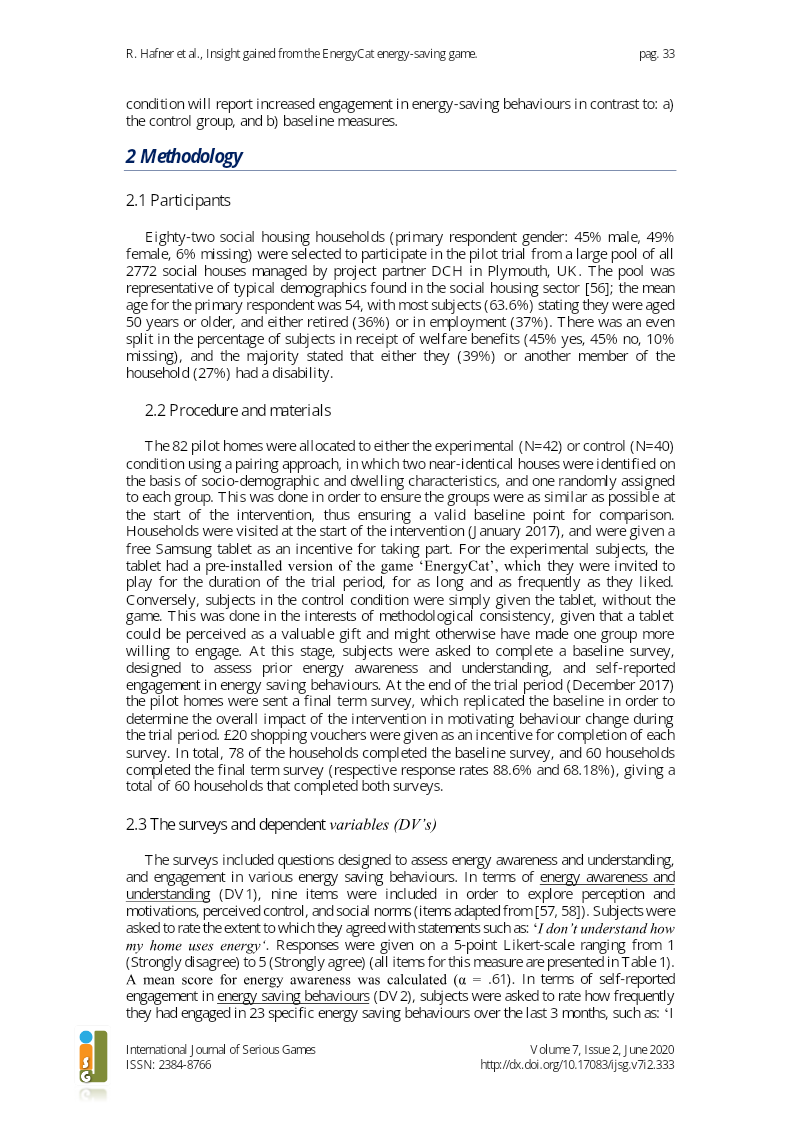
- The EnergyCat serious game failed to produce statistically significant changes in energy usage or awareness levels among the 82 participating UK social housing households over the 12-month study.
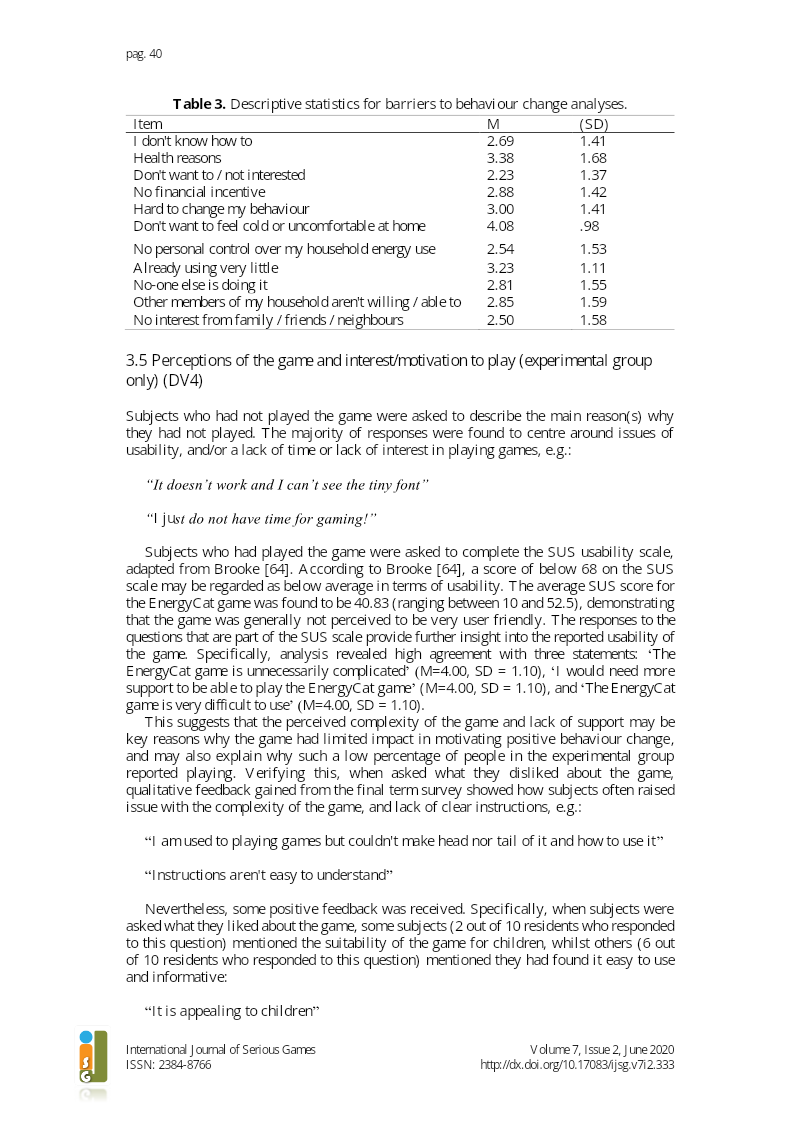
- The software received a poor System Usability Scale score of 40.83, driven by design flaws including excessive complexity, small font sizes, and unclear instructions.
- Low IT literacy and usability barriers significantly hindered engagement, preventing the game’s mechanics from effectively influencing user behavior.
It’s About Fate, Among Other Things: Digital Games, Dialogical Teaching, and Ethics
This paper presents preliminary findings from a study of how teachers use digital games as tools for dialogical teaching of ethics.
- Digital games do not automatically produce ethical learning; their educational value depends on teachers talking students' gameplay experiences into meaning and linking them to curricular goals.
- The study uses two qualitative case studies observing seven teachers and their classes, plus semi-structured retrospective interviews, focusing on teachers as an underrepresented group in game-based learning research.
- The game The Walking Dead (Telltale Games, 2012) was used in classrooms: teachers paused at moral dilemmas and had students apply consequentialist, duty-based, and virtue-based ethical theories before discussing competing solutions.
Playful Practices in Ancient Greek Philosophy
Sebastian Weichelt's "Playful Practices in Ancient Greek Philosophy" challenges the longstanding assumption, associated with Johan Huizinga, that play and rationality are opposites.
- Sebastian Weichelt argues that play and rationality are not opposites, since rationality has several distinct forms (instrumental, economic, procedural, epistemic, critical) under which play can be considered rational.
- The central thesis is that the core intellectual practices of ancient Greek philosophy were forms of play, examined through Aristotle's contemplation, sophistic debate, Socratic dialogue, and thought experiments.
- Socratic dialogue and theoretical contemplation satisfy Johan Huizinga's criteria for play and reflect Thomas Henricks' notion of joyful inquiry.

Cultural Heritage and Environmental Communication Through Digital Games
The PAC-PAC research project at the University of Cagliari investigates whether digital games can promote and communicate cultural heritage, particularly lesser-known sites, and whether such experiences can stimulate tourism and knowledge of local traditions.
- The PAC-PAC project at the University of Cagliari tests whether digital games can promote lesser-known cultural heritage sites and stimulate tourism and interest in local traditions, premised on player-driven narratives creating emotional bonds with places.
- The project uses photographs, videos, and 360-degree views rather than conventional rendered graphics to strengthen players' connection to real environments, and it built a custom authoring tool for point-and-click adventures.
- Production follows a structured pipeline: site selection and game design documentation, location scouting with local authorities, onsite filming with a specialist crew, and post-production editing.
The Tragedy of the Art Game
The paper argues that a fundamental and unresolved tension is built into computer games understood as a medium: the game artist seeks self-expression through the work, while the player seeks an instrument to play with.
- The paper argues that a fundamental, unresolved tension is built into games as a medium: the game artist seeks self-expression through the work, while the player seeks an instrument to play with, and art games' progress has depended on overlooking this conflict (the 'tragedy of the art game').
- The author concludes the two kinds of satisfaction cannot coexist, so artist and player remain in conflicting positions.
- The author suggests these two approaches may mark the ends of a continuum on which individual art games could be placed, but this continuum has not been tested through a systematic survey of art games.

Gamification Does Not Belong at a University
Gamification in higher education has drawn strong criticism from students who saw it as manipulative, and this analysis examines how such resistance played out in practice at a university setting.
- Gamification's reception depends heavily on role positioning, whether participation is voluntary, and the competing framings held by students, designers, and the institution.
- A bug that failed to apply a cooldown to experience points from clicking article links let one student reach level 9073, against an intended range of 8 to 12.
- In a Canvas-based case, students scripted thousands of automated submissions and reached levels in the thousands within days.
Popular History: Historical Awareness of Digital Gaming in Finland
Popular accounts of Finnish digital gaming history took shape in the 1980s, well before any academic historiography of games in Finland existed.
- The analysis draws on roughly 800 items from Finnish computer and hobbyist magazines such as Potti, MikroBitti, and Printti to trace how popular narratives of Finnish digital gaming history first took shape in the 1980s, before any academic historiography existed.
- Popular histories tend to canonize an official narrative built around an origin and turning point tied to commercial or technical success, which can overshadow personal and unorthodox recollections of gaming.
- Discourse across the periods studied is classified into four waves, moving from early-1980s popular articles through mid-1980s chronicles and nostalgic player accounts to a 2000s national narrative shaped by institutions such as Neogames and the Finnish Museum of Games, which opened in 2017.
Anthropocene Temporalities in Climate Change Video Games
This extended abstract, presented at DiGRA 2020, proposes a temporal framework for analyzing climate change video games, arguing that the notion of "Anthropocene temporality" offers a productive way to understand how these games address the abstract and pervasive nature of climate change.
- The paper is a theoretical and conceptual proposal, not an empirical study, and reports no survey data, sample sizes, or quantitative findings.
- It uses the notion of 'Anthropocene temporality' as a chronotope, drawing on environmental humanities scholarship by Barbara Adam, Michelle Bastian, and Mary Louise Pratt, to analyze how climate change video games handle the abstract and pervasive nature of climate change.
- Its central argument is that climate change games produce a 'thickening of time', with examples ranging from SimEarth (1990) and Fate of the World, Anno 2070, and Civilization VI: Gathering Storm to independent works such as The Stillness of the Wind.

Disciplined Play: Finding Foucauldian Architecture in Virtual Worlds
This paper, by Lawrence May of the University of Auckland, examines how virtual architecture in videogames both reinforces and destabilizes ideological positions, drawing on Michel Foucault's writings on space, power, and governmentality.
- The paper argues that videogame spaces discipline players both inside and outside the game, with environments, rules, interactivity, and narrative working together as a discursive circuit rather than as separate elements.
- Through textual analysis of Red Dead Redemption 2 (2018), the author reads its late-nineteenth-century American frontier settings through Foucault's panopticon, arguing that invisible surveillance by programming and AI systems creates permanent visibility that regulates player conduct.
- The analysis suggests the game's spaces reinforce its thematic critique of a collapsing cowboy masculinity, linking architecture directly to the title's ideological content.