Game Studies reports and market data
Documents
Big Brother Meets Joystick: Ethical Perspectives on Surveillance Imagery in Digital Games
This paper examines how surveillance is depicted in digital games and evaluates those depictions from an ethical and epistemological standpoint.
- Games shape players' imaginaries of surveillance, and their depictions, both visual and mechanical, can either normalize questionable monitoring practices or make distributed surveillance visible and open to critical reflection.
- The authors propose a two-dimensional framework for analyzing surveillance in games: visual aesthetics (e.g., eye-in-the-sky cameras, scan lines and glitches, blue/green overlays and binary code) and ludic, rule-based embedding.
- Many games, including some ostensibly critical of surveillance, reward players for hacking cameras or data mining in consequence-free minigames, which can create a false sense of empowerment.
Gaming the Future: How Games Help Us Play What's to Come
This paper argues that science fiction videogames can serve as critical tools for examining technology's social and ethical implications, rather than merely providing aesthetic backdrops.
- The paper argues science fiction videogames can serve as critical tools for examining technology's social and ethical implications, not merely as aesthetic backdrops, drawing on Cameron Kunzelman's concept of "mechanics of speculation."
- Speculative play works best when player action is necessary and outcomes remain uncertain, turning games into virtual playgrounds where players imagine alternative futures and confront the consequences of technological change.
- The study contrasts escapist SF titles such as the Mass Effect series, Starfield, and Titanfall, which treat advanced technology as set dressing, with newer games that foreground contested technologies like artificial intelligence, biotechnology, and brain-computer interfaces.
Cursed: A Ludic Genealogy of the Myth of El Dorado
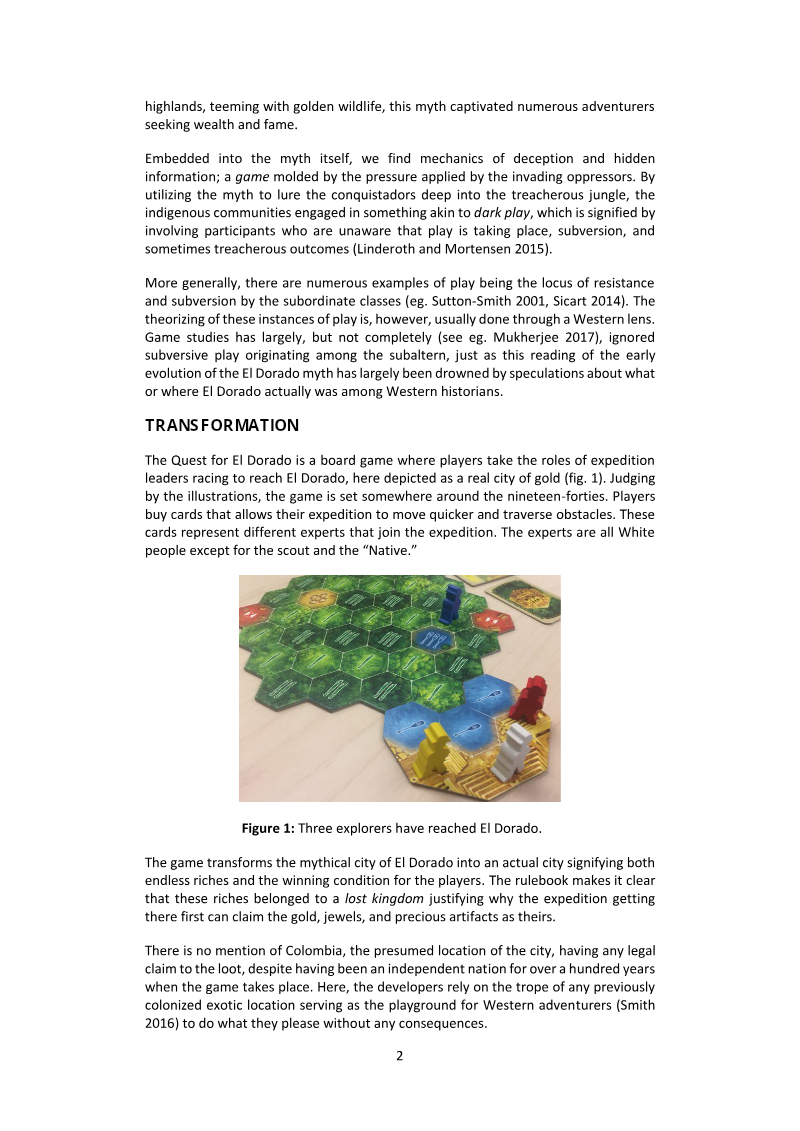
This paper offers a critical genealogy of the El Dorado myth as it has been remediated across board and video games, drawing on Foucault's approach to history as a series of interpretations shaped by power.
- The paper applies Foucault's view of history as power-shaped interpretation, using interaction criticism to trace how the El Dorado legend was reshaped by Spanish and Indigenous storytellers and later by contemporary tomb-raiding games.
- Close readings of The Quest for El Dorado and Uncharted: Drake's Fortune argue that games carry forward colonial assumptions, presenting El Dorado as a winnable city of gold and framing Western actors as heroes despite appearing to be neutral entertainment.
- The board game is criticized for casting predominantly White expert characters and for treating Colombia's sovereignty as irrelevant to the expedition's claim on the riches.
1-Bit Skin: Materializing Abjection in World of Horror (2023)
This extended abstract, presented at DiGRA 2024, proposes an interdisciplinary study of how the videogame World of Horror (Ysbyrd Games, released October 2023) materializes abjection, drawing on Julia Kristeva's theory from Powers of Horror (1980).
- The paper is a DiGRA 2024 proposal-stage abstract analysing World of Horror (Ysbyrd Games, released October 2023) through Julia Kristeva's theory of abjection from Powers of Horror (1980).
- Its central argument is that videogames, unlike film or text, let players interact with grotesque imagery rather than merely react to it, and that this interactivity reshapes the experience of the abject.
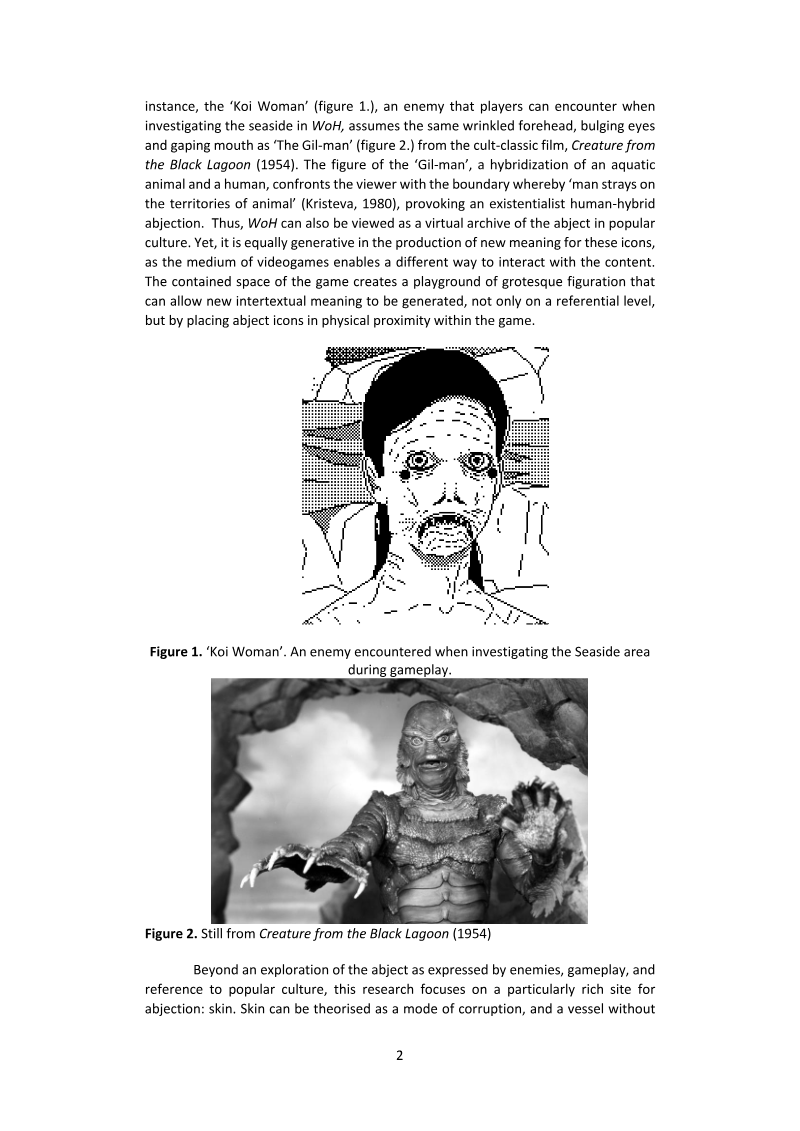
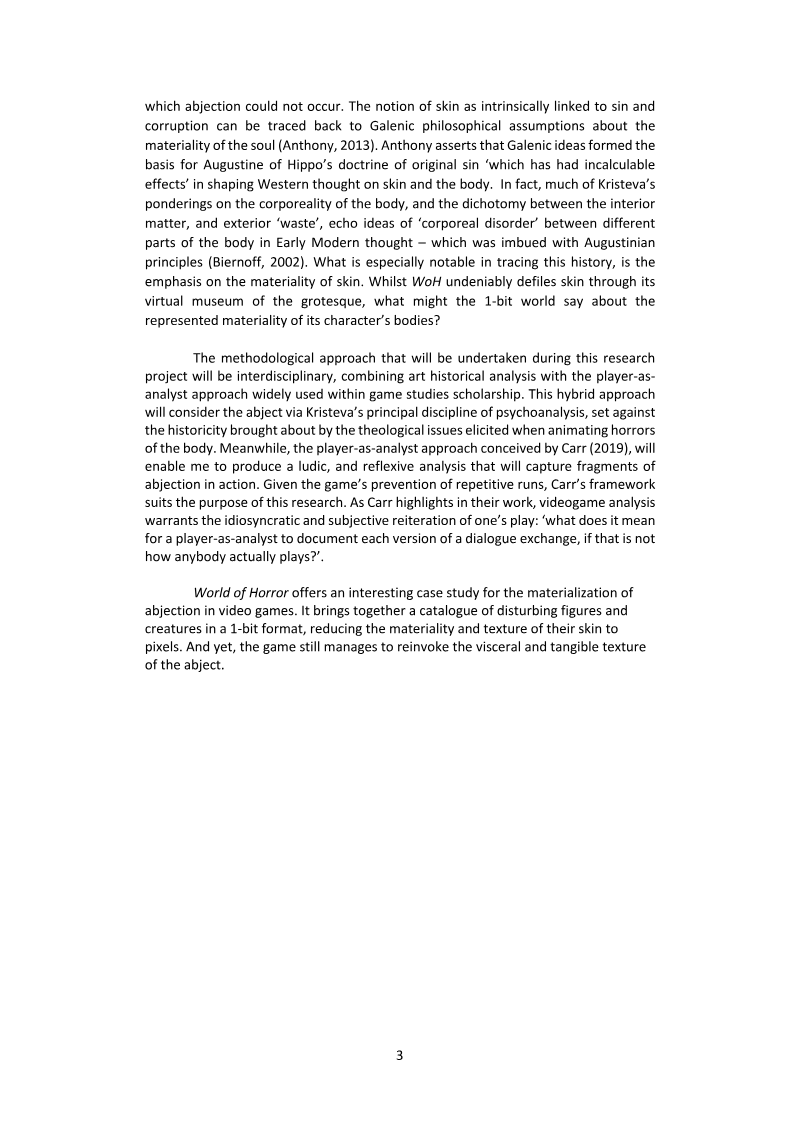
- The author treats the game as a virtual archive of cosmic and body-horror references, including Junji Ito, H.P. Lovecraft, and the 1954 film Creature from the Black Lagoon, where these icons gain new meaning through proximity.
Order in Chaos: Toward a Theory of Videoludic Noise
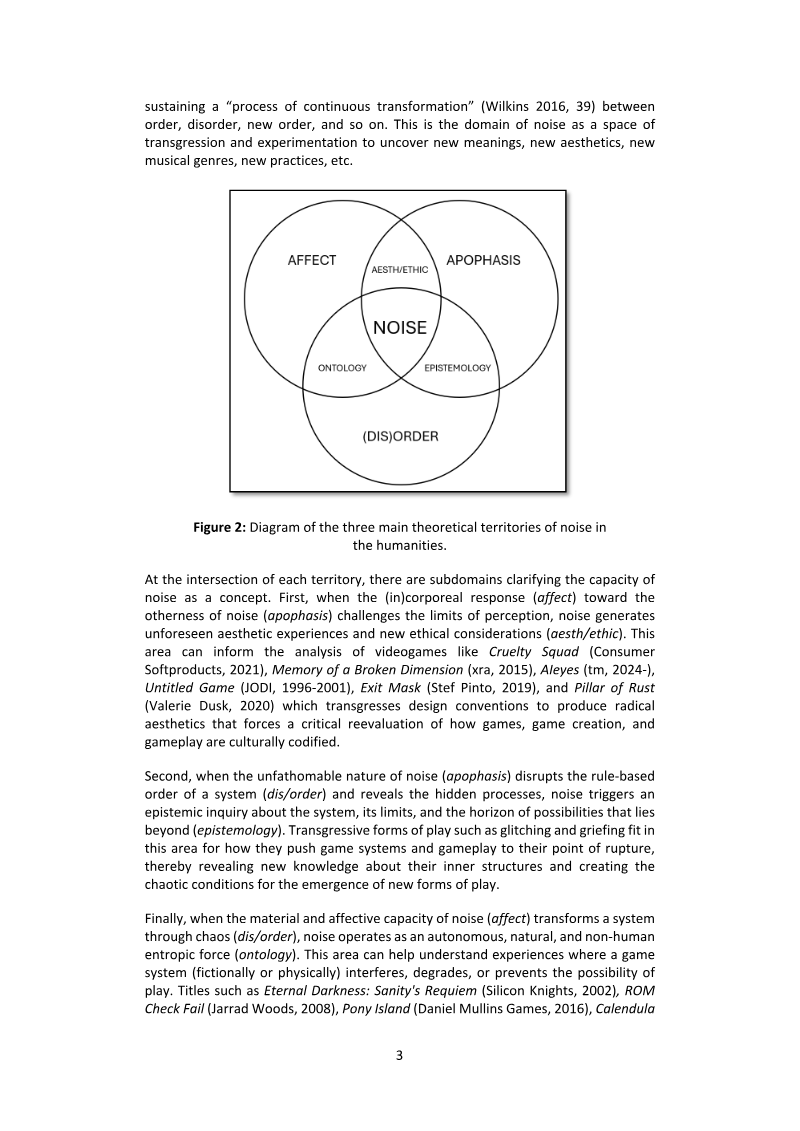
This paper proposes a theoretical framework for understanding "noise" within video game studies, arguing that the field has only begun to engage with a concept that has long been central to information theory and the humanities.
- The paper argues that 'noise' in video games should be treated as a productive analytical category that can generate new knowledge about games, play, and game culture, rather than merely as a technical error or game-breaking nuisance.
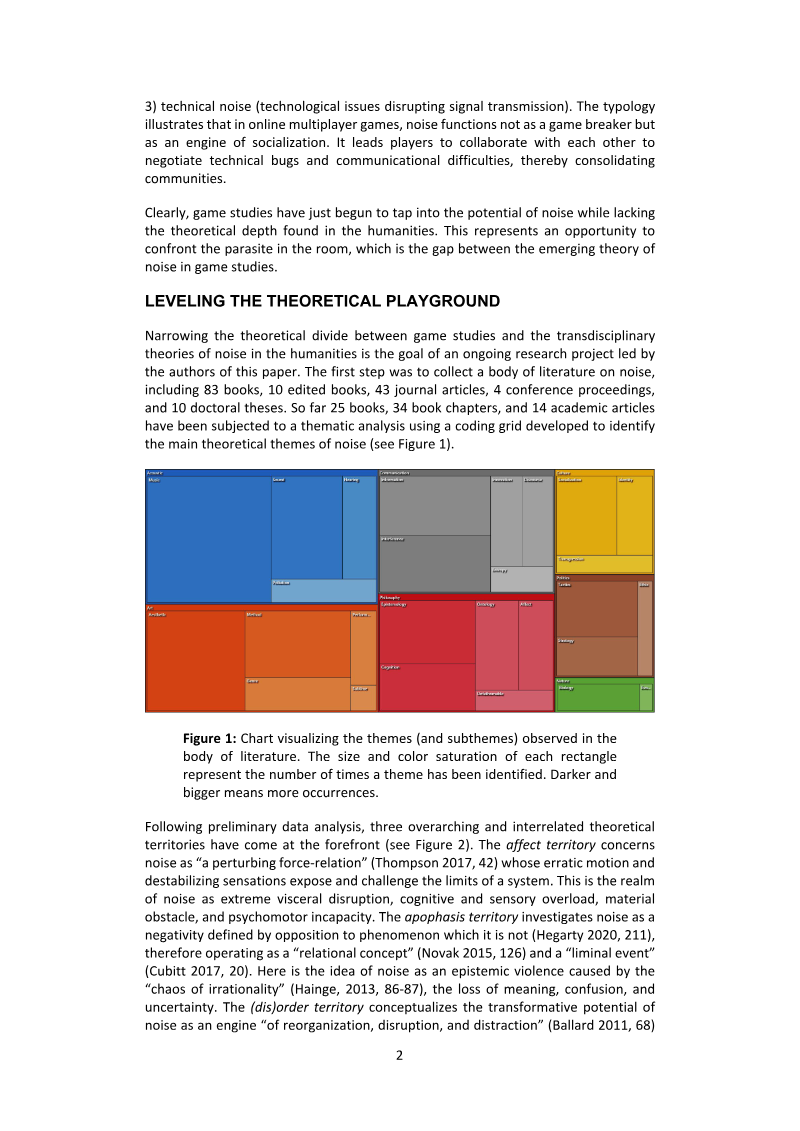
- The authors aim to bridge emerging game-studies discussions of noise, such as Salen and Zimmerman's treatment of chaos within rule systems and Consalvo's typology of cultural, semantic, and technical noise in online multiplayer spaces, with more developed transdisciplinary theories from media, sound, film, and philosophical scholarship.
- The research is based on a corpus of 83 books, 10 edited volumes, 43 journal articles, 4 conference proceedings, and 10 doctoral theses, of which 25 books, 34 book chapters, and 14 academic articles were thematically coded.
Poverty (Is All Fun) and Games
This paper examines how poverty and minimalism are represented in digital games, arguing that games simulating financial hardship occupy an ambiguous space between social education and playful entertainment.
- The paper argues that games simulating financial hardship, such as Spent, Ayiti: The Cost of Life, Broke: the game, and Nanopesos, can build empathy and awareness of privilege, but risk trivializing poverty when played purely for pleasure.
- The author links the trivializing risk to 'slumming' and to the exploitative genre of 'poornography,' cautioning against treating poverty as entertainment.
- Most of the poverty-themed games analysed are 'broken games' that make victory difficult or impossible, a design choice the paper suggests serves their didactic purpose.
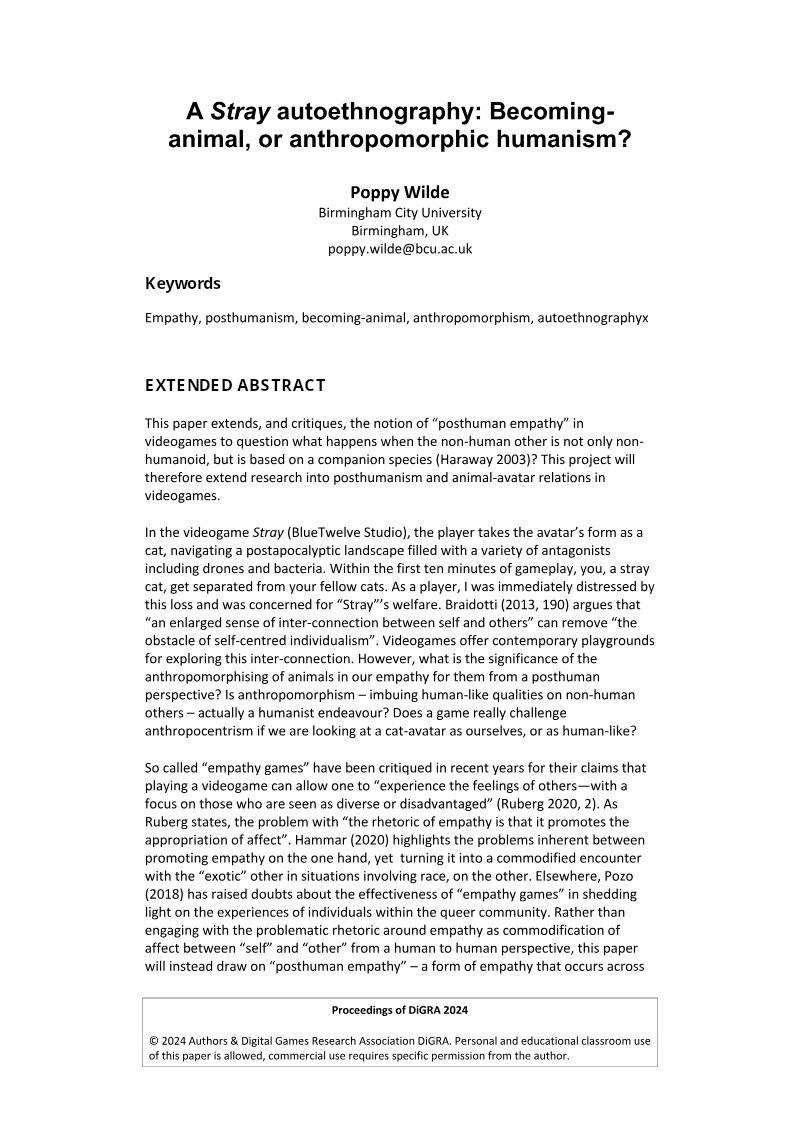
A Stray Autoethnography: Becoming-Animal, or Anthropomorphic Humanism?
This paper, by Poppy Wilde of Birmingham City University, examines whether the player's empathy for the cat avatar in the 2022 videogame Stray represents a genuinely posthuman relation or instead reinforces anthropocentric humanism through anthropomorphism.
- The paper asks whether players' empathy for the cat avatar in Stray (2022) is a genuinely posthuman relation or reinforces anthropocentric humanism through anthropomorphism.
- The author argues that the game's emotional force depends heavily on the primacy of human feeling, which complicates claims that becoming-animal experiences in videogames fully escape anthropocentrism.
- The analysis draws on Braidotti's critique of anthropomorphising animals, Deleuze and Guattari's becoming-animal, and Haraway's companion species framework.
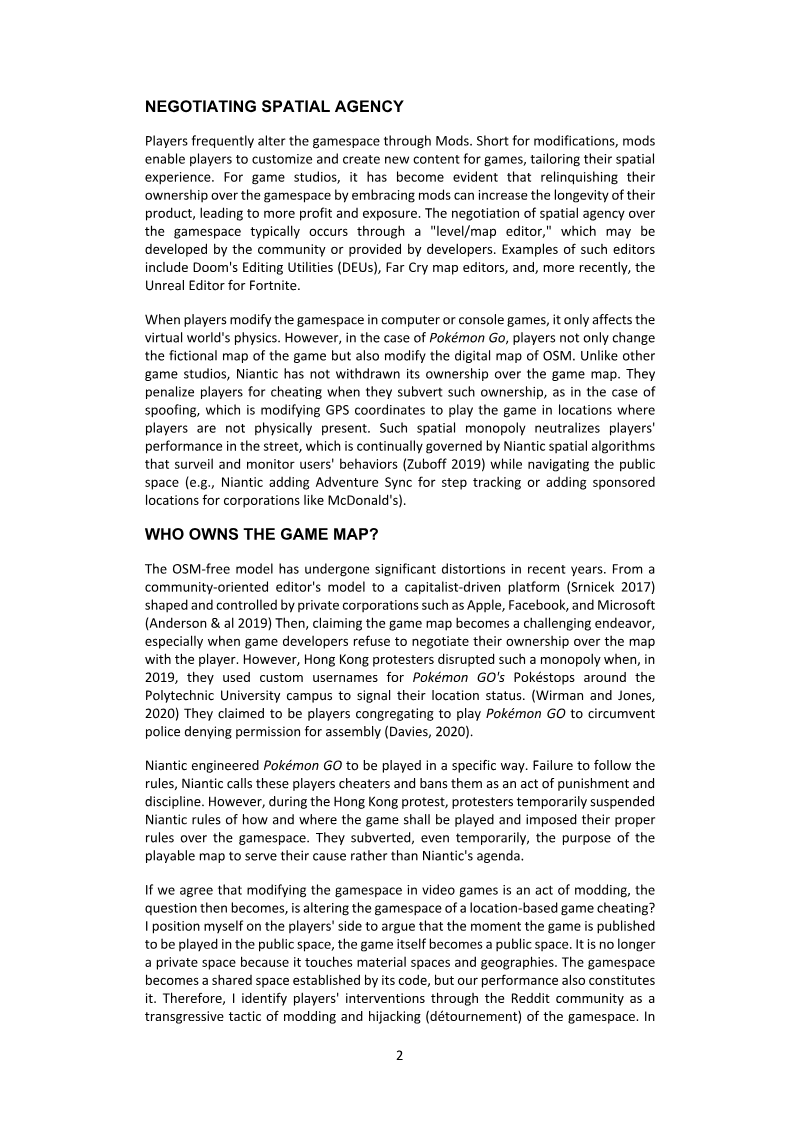
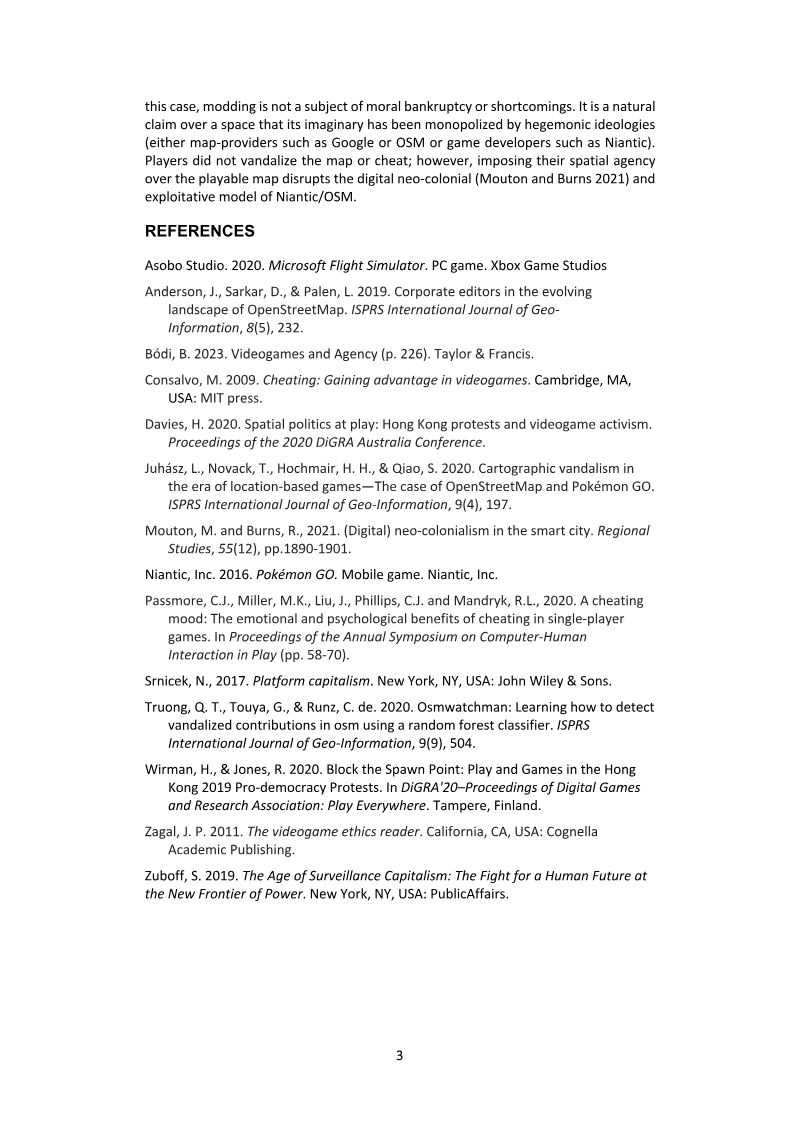
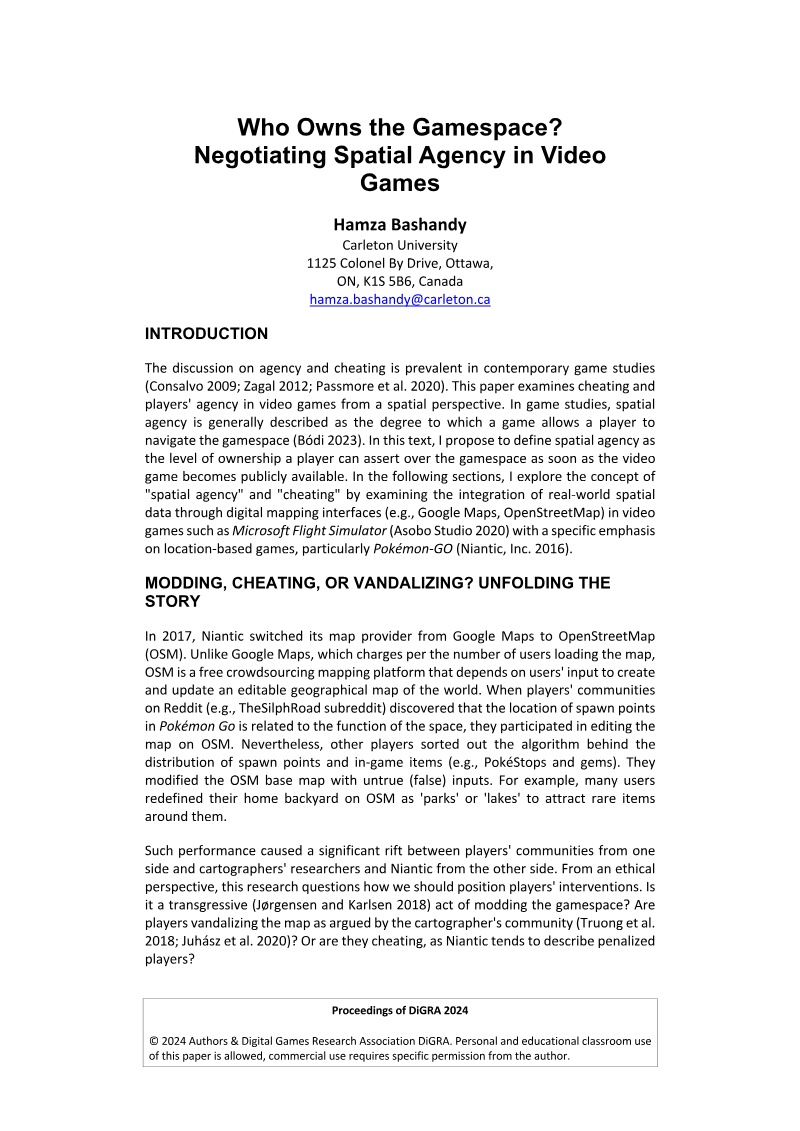
Who Owns the Gamespace? Negotiating Spatial Agency in Video Games
This paper examines spatial agency in video games, defining it as the degree of ownership a player can assert over the gamespace once a game becomes publicly available.
- The paper defines 'spatial agency' as the degree of ownership players can assert over the gamespace of a location-based game once it is publicly available, and asks whether player alterations of game maps amount to modding, vandalism, or cheating.
- Its central case study is Pokémon GO and Niantic's 2017 switch from Google Maps to the crowdsourced OpenStreetMap, after which Reddit players edited OpenStreetMap with false inputs (such as relabeling residential backyards as parks or lakes) to attract rare in-game items.
- Niantic treats such map manipulation as cheating and penalizes it, while cartographers regard it as vandalism, producing friction among players, cartographers, and the company.

Metanarrative Horror: The Existential Dread of Choice
This paper, by Claire Stricklin and Samuel Muscente of Rutgers University-Camden, argues that the opposing design paradigms of "sandbox" and "railroad" games each carry a distinct existential horror, and that these horrors can be deliberately exploited as a resource for self-reflexive horror design.
- The paper argues that the sandbox and railroad game paradigms each carry a distinct existential horror: the sandbox becomes aimless wandering through infinite choice, while the railroad becomes restrictive control that strips players of meaningful agency.
- Its central claim is that both extremes can be deliberately exploited as a resource for self-reflexive horror design, through alternating cycles of freedom and restriction.
- Black Mirror: Bandersnatch is analysed as a railroad exemplar, where binary choices and metanarrative framing make the player feel as pressured as the protagonist, and where a single decision is overridden regardless of input, revealing the apparent meaninglessness of choice.
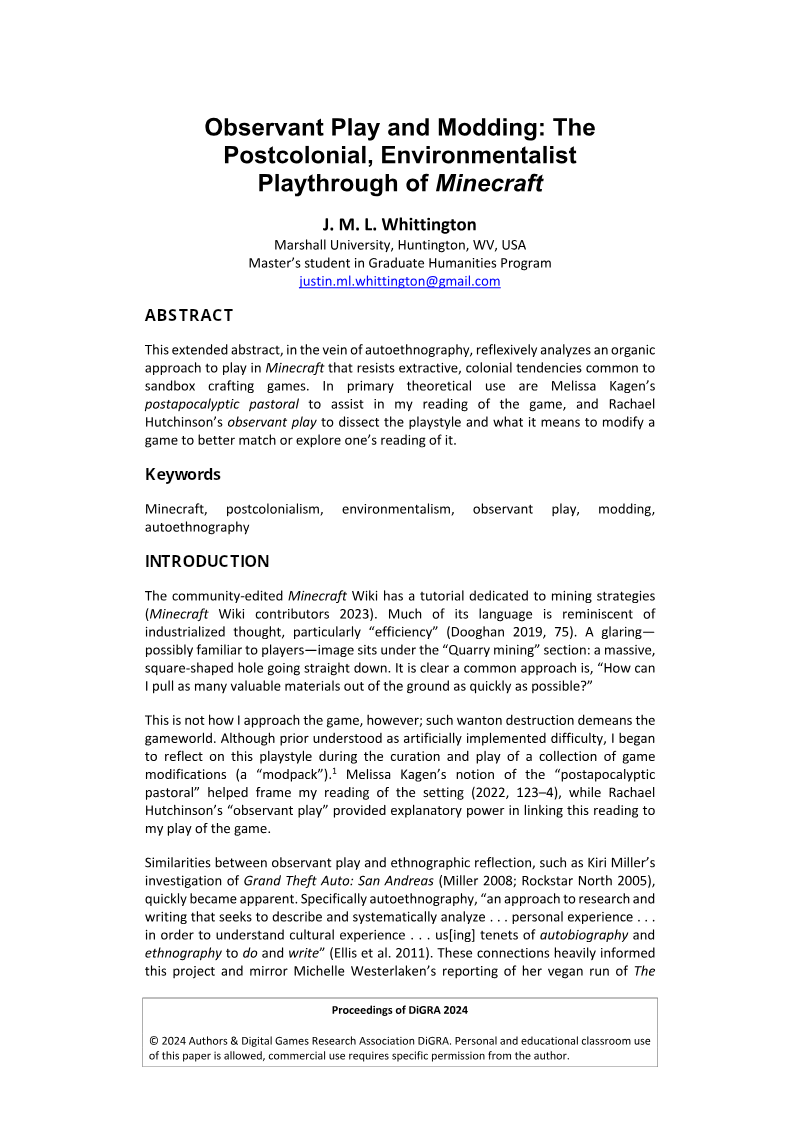
Observant Play and Modding: The Postcolonial, Environmentalist Playthrough of Minecraft
This autoethnographic extended abstract by J. M. L. Whittington examines an alternative, non-extractive way of playing Minecraft that resists the colonial and industrial logics the author sees embedded in sandbox crafting games.
- The paper is an autoethnographic extended abstract by J. M. L. Whittington that reads Minecraft's depopulated, post-civilization Overworld as a postapocalyptic landscape, drawing on Melissa Kagen's "postapocalyptic pastoral" and Rachael Hutchinson's "observant play."
- Its central argument is that players can choose a non-extractive, anti-colonial, environmentalist way of playing a sandbox crafting game, heeding the lessons of resource exploitation embedded in the game world.
- The evidence rests entirely on the author's own reflexive play through a Minecraft Java Edition 1.18.2 / Forge modpack with one other player, with no survey or quantitative data.
Impact of a Cognitive Training on Reading of 6-Year-Old Children
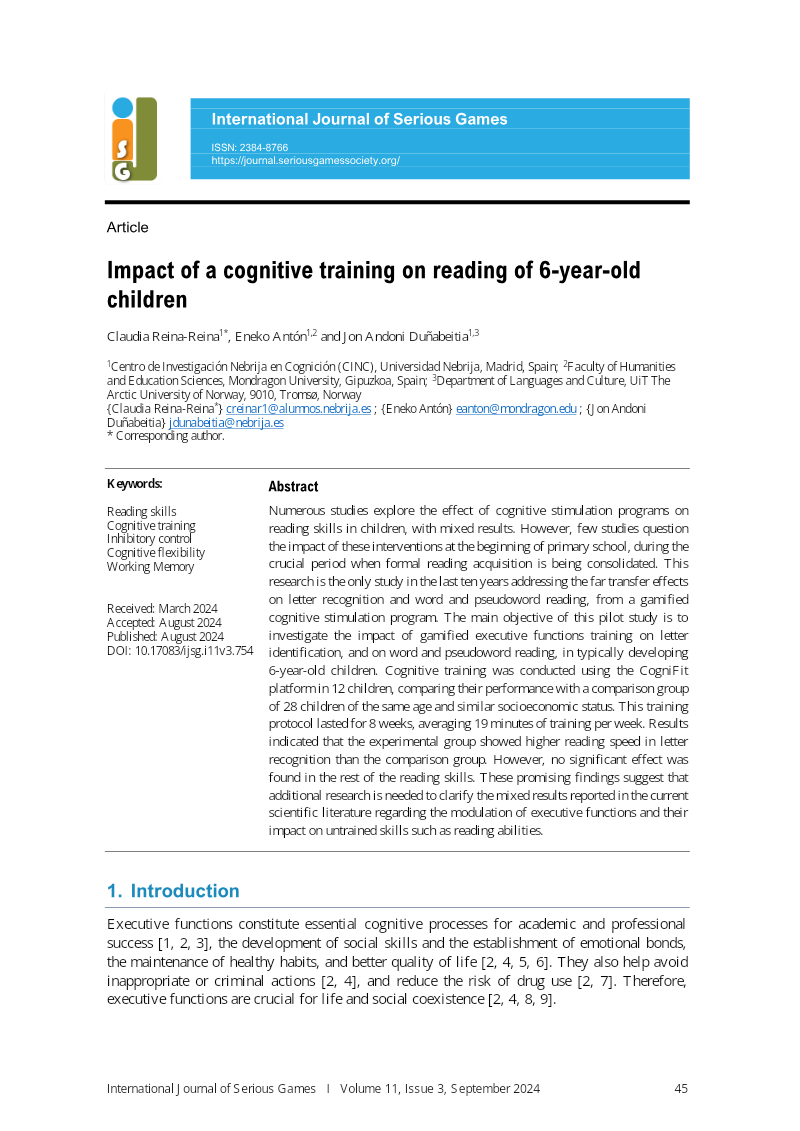
The integration of gamified executive function training into early childhood education aims to determine whether cognitive stimulation can produce far transfer effects on foundational literacy skills.
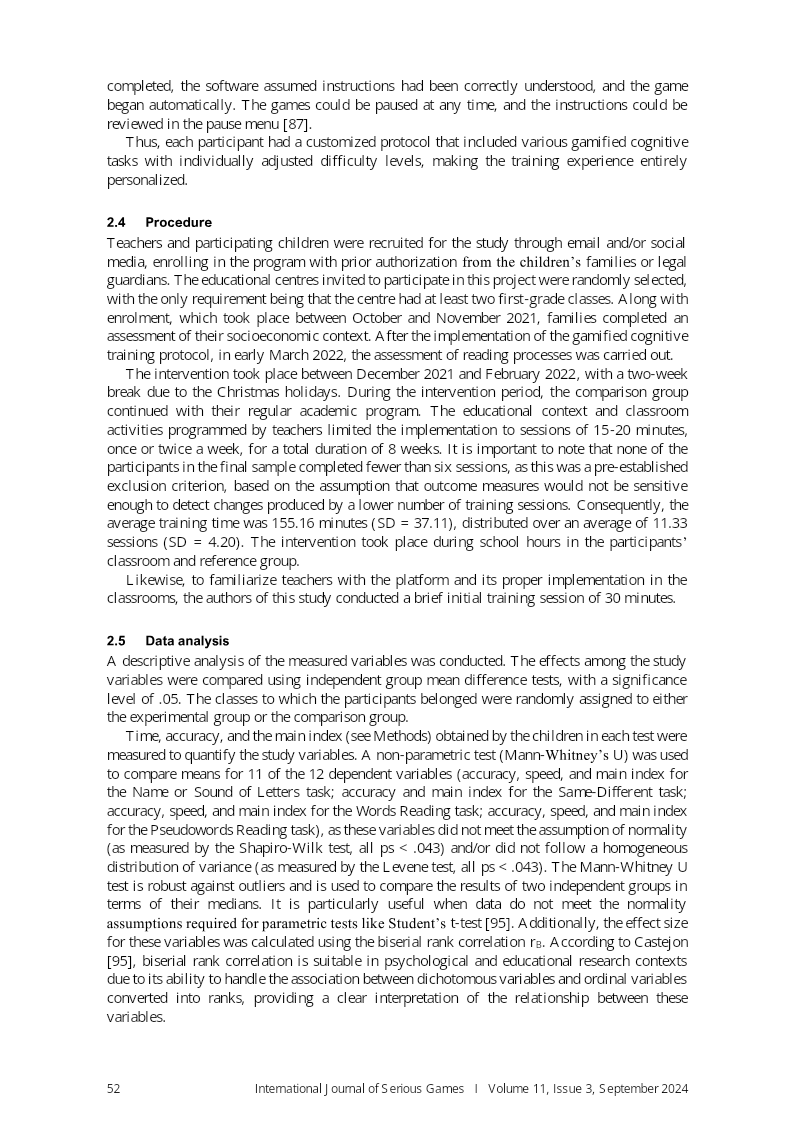
- Gamified cognitive training using the CogniFit platform showed limited impact on early literacy, failing to produce meaningful gains in word decoding or pseudoword fluency for 40 novice readers.
- The eight-week intervention resulted in a statistically significant improvement only in the speed of letter recognition among the five-to-six-year-old participants.
- The study suggests that while the training successfully enhanced inhibitory control, it did not adequately engage the working memory and complex lexical processing required for advanced reading.
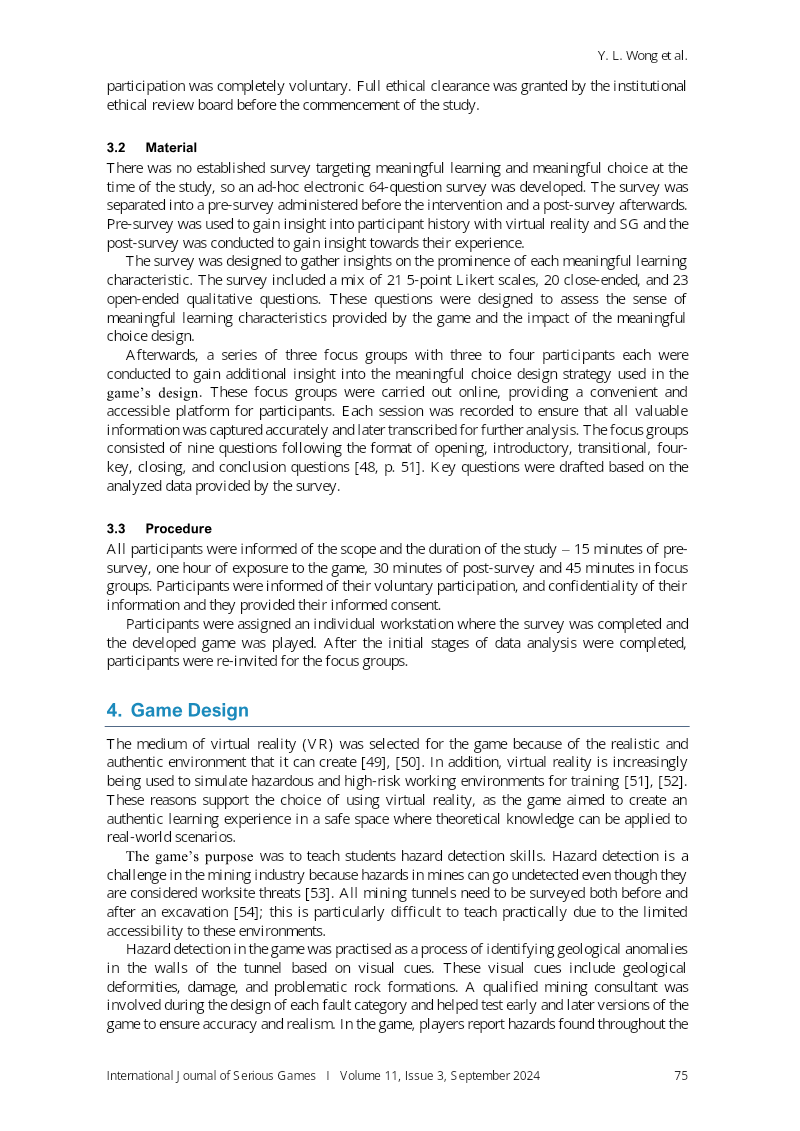
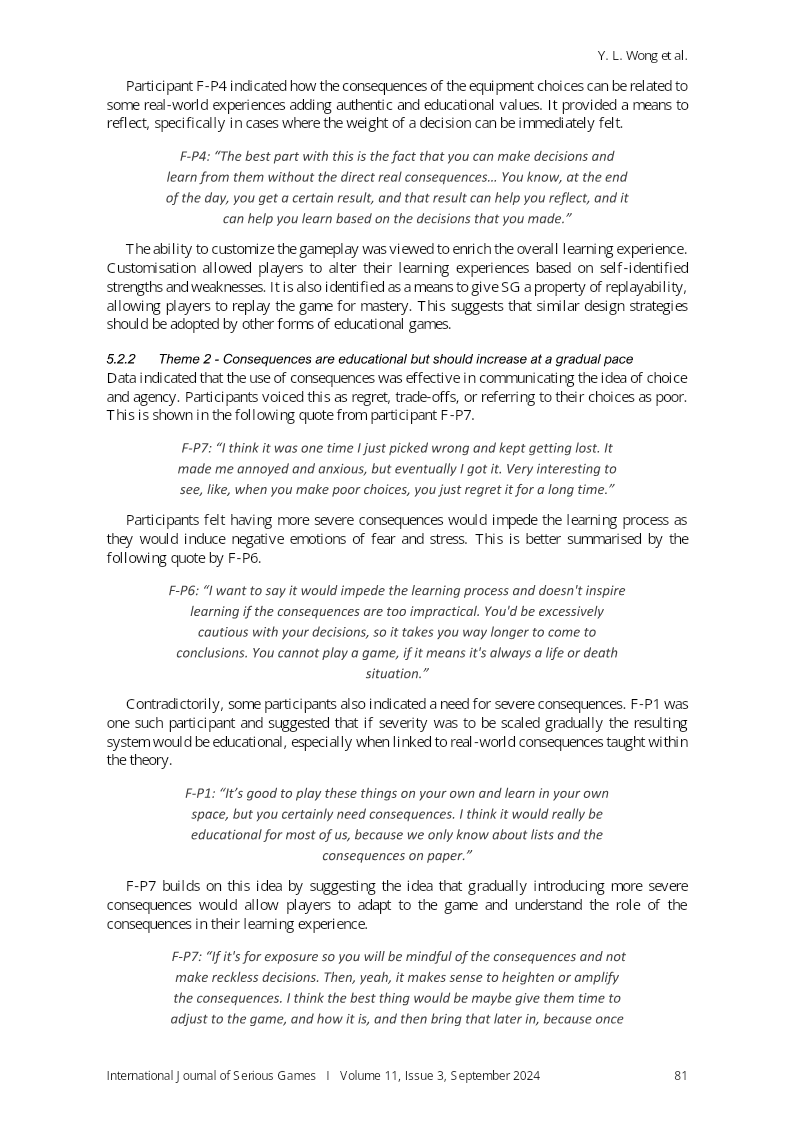
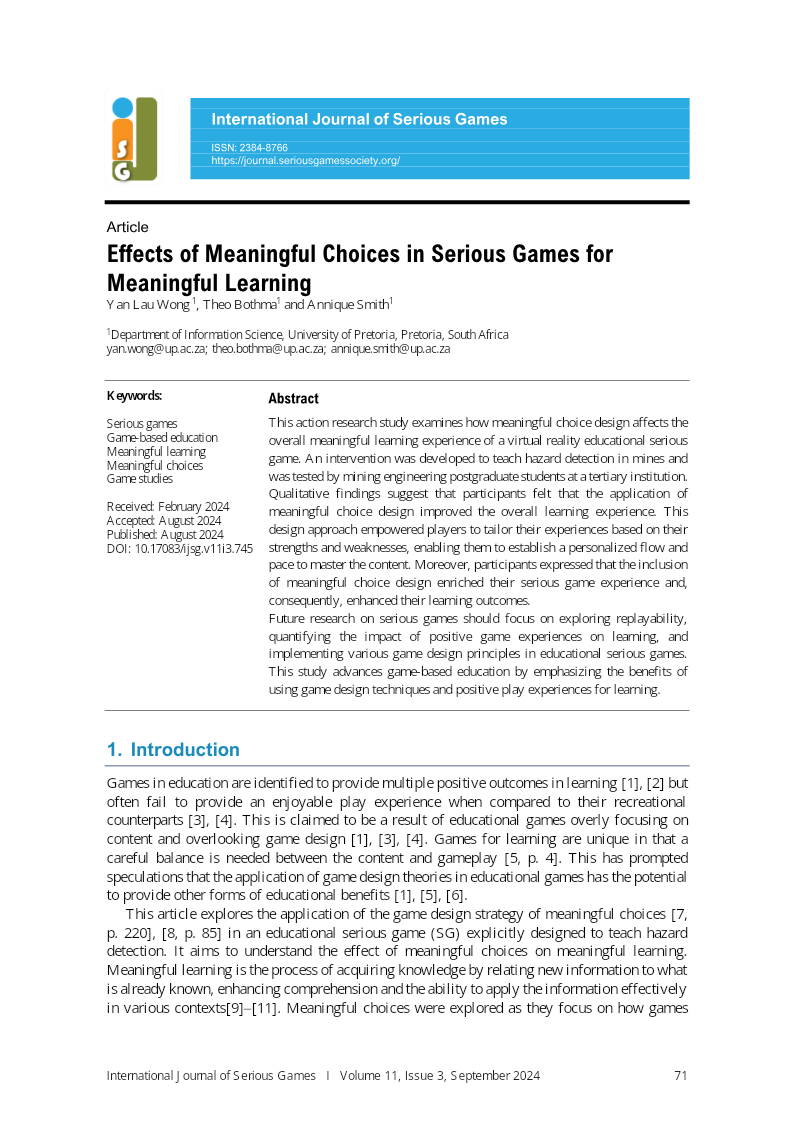
Effects of Meaningful Choices in Serious Games for Meaningful Learning
Meaningful choice design serves as a critical pedagogical framework for enhancing learning outcomes within serious games, particularly in high-stakes fields like mining hazard detection.
- Meaningful choice design acts as a core pedagogical framework that bridges the gap between theoretical engineering knowledge and real-world application in high-stakes fields like mining.
- Effective serious games must balance player autonomy with structured feedback loops to ensure the learning process remains both challenging and supportive.
- Integrating tangible consequences for player decisions fosters accountability, though these outcomes must be calibrated to avoid inducing counterproductive stress in learners.