Game Engines reports and market data
Documents

Build Great Tools: Workflow Guidelines from Vicarious Visions
Engineers must prioritize human-centered design to transform game development utilities from mere functional requirements into cohesive, efficient ecosystems.
- Prioritize human-centered design to align complex engine architectures with the conceptual models of content creators, transforming functional utilities into efficient ecosystems.
- Reduce technical friction by implementing intuitive task clustering, seamless context switching, and keyboard acceleration to ensure tools augment rather than impede the creative process.
- Implement robust, universal features such as comprehensive undo/redo, automated source control, and actionable error messaging to eliminate reliance on tribal knowledge and reduce cognitive load.

I Built an Infinite Bathroom In Unity
The development of an infinite, procedurally generated public restroom within the Unity game engine serves as a practical exploration of the Wave Function Collapse (WFC) algorithm.
- The Wave Function Collapse (WFC) algorithm enables the creation of complex, self-consistent 3D environments by treating level design as a logic puzzle governed by adjacency and rotation rules.
- Successful implementation of the WFC system required the creation and precise labeling of 75 distinct modular 3D puzzle pieces, including toilets, cabinets, and structural elements.
- Infinite space is achieved by generating modular segments that are duplicated and arranged in a continuous loop, utilizing camera wrapping to create a seamless, endless environment.

Workshop : How to Implement Video Chat into Unreal Engine
Integrating real-time video communication into Unreal Engine projects requires a structured technical workflow centered on the Agora SDK.
- Integrating real-time video into Unreal Engine projects is primarily achieved by utilizing the Agora SDK, which provides the framework for managing communication channels.
- The implementation requires initializing the Agora engine with a unique App ID and creating custom actor blueprints and UI widgets to render local and remote video feeds.
- Developers must configure specific callback events to manage connection states and bind video streams to dedicated video holder blueprints within the game environment.

Breaking the Sound Barrier with Elias Software Featuring Kristopher Eng and Philip Bennefall | 235
Adaptive audio technology is transforming game development by shifting creative control from programmers to composers and sound designers.
- Adaptive audio technology shifts creative control from programmers to sound designers by using visual scripting interfaces to decouple audio logic from core game code.
- Implementing real-time, iterative audio environments early in the production cycle reduces technical bottlenecks and minimizes late-stage development crunch.
- Modern, code-free audio tools allow for immediate adjustments without requiring a restart of the game engine, facilitating more agile development workflows.

Unity Software IPO Analysis: Growth, Risks, & Stock Valuation
Unity occupies a central position in the gaming ecosystem, functioning as a dual-revenue engine that combines a foundational software development platform with a robust suite of monetization and analytics tools.
- Unity operates a dual-revenue model combining a software development platform with monetization tools, maintaining high gross margins of 80 percent despite current operating losses.
- The company faces significant concentration risk in its advertising segment due to its heavy reliance on mobile platform gatekeepers like Apple and Google and the deprecation of mobile identifiers.
- Unity’s valuation trades at a premium compared to established software peers, reflecting venture capital-style multiples that require near-perfect execution to justify.

Physical Animation in Star Wars Jedi: Fallen Order
Star Wars Jedi: Fallen Order integrates physical animation to bridge the gap between authored character poses and dynamic physics simulations.
- Star Wars Jedi: Fallen Order utilizes a hybrid animation system that blends authored poses with dynamic physics simulations to eliminate geometry clipping and improve movement fluidity.
- The system employs motors, velocity-based drives, and custom constraints to ensure characters maintain natural, physically grounded presence during complex actions.
- Combat interactions for NPCs, such as force-pulls and death sequences, use intelligent transitions to freefall ragdoll states when obstacles are detected.
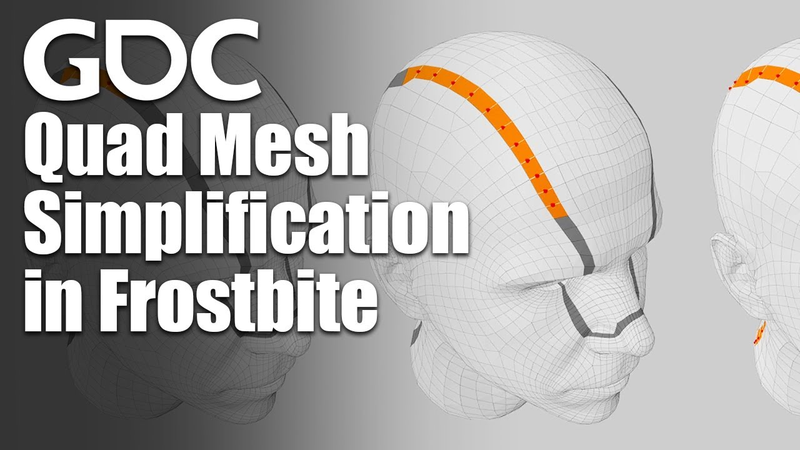
Quad Mesh Simplification in Frostbite
The Frostbite engine’s quad mesh simplification technology, developed in collaboration with BioWare starting in 2012, addresses the limitations of traditional triangle-based level-of-detail (LOD) generation.
- Frostbite’s quad-based simplification technology, developed with BioWare since 2012, preserves intentional edge flow in character models to prevent deformation issues common in traditional triangle-based LOD generation.
- The system utilizes 'poly-quad' collapse operators that treat sequences of adjacent quads as atomic units, ensuring the structural integrity of the mesh is maintained during reduction.
- Artists can exert granular control over the simplification process through a priority-painting system and sub-poly-quad collapse capabilities, which allow for local refinement in critical areas like faces.
Extreme SIMD: Optimized Collision Detection in Titanfall
Optimizing collision detection for Titanfall requires a fundamental shift toward data-oriented design, specifically through the implementation of a four-way Axis-Aligned Bounding Box tree structure.
- Titanfall's collision detection was optimized by implementing a four-way Axis-Aligned Bounding Box (AABB) tree structure, which replaced traditional binary trees to improve traversal efficiency.
- The team utilized SSE3 SIMD instructions to perform four-way collision tests in parallel, significantly reducing the computational overhead of ray-box intersection checks.
- By leveraging IEEE 754 floating-point properties, the engine treats plus/minus zero and infinity as limits, allowing the collision code to naturally handle edge cases without explicit branching.
Cloth Self Collision with Predictive Contacts
Predictive contact systems offer a high-performance solution for simulating cloth self-collision in real-time environments, effectively addressing the computational limitations of traditional continuous collision detection.
- Predictive contact systems achieve high-performance cloth self-collision by using predicted trajectories to generate simplified constraints, avoiding the computational intensity of traditional continuous collision detection.
- The implementation maintains a stable frame budget of approximately 380 microseconds per frame, enabling high-fidelity physics without compromising real-time gaming frame rates.
- The system utilizes dynamic collision radius approximation and velocity projection onto discrete separating directions to prevent common simulation artifacts like tunneling and interpenetration.
Inertialization: High-Performance Animation Transitions in Gears of War
Inertialization serves as a high-performance alternative to traditional crossfade blending within the animation architecture of Gears of War.
- Inertialization replaces traditional crossfade blending with a post-process approach, eliminating the need to simultaneously evaluate both source and target animation states.
- The system utilizes a fifth-order polynomial curve to calculate pose differences and initial velocities, treating transitions as a mathematical smoothing problem rather than a dual-state blend.
- By evaluating only the target animation, the system achieves a fixed frame cost and avoids the performance spikes associated with multi-state evaluation.

Unreal Engine 5 Reactions, And Last of Us 2 Ending a Generation | Game Dev Unchained Roundtable News
The introduction of Unreal Engine 5 marks a pivotal shift in game development, primarily driven by the integration of Nanite geometry and Lumen real-time global illumination.
- Unreal Engine 5 introduces Nanite geometry and Lumen real-time global illumination to automate light-baking and eliminate traditional optimization bottlenecks for high-fidelity assets.
- Despite technological advancements, Unreal Engine 5 does not remove the need for rigorous character animation, physics simulation, and efficient asset management in full-scale production.
- Industry experts view high-end tech demonstrations as aspirational marketing tools rather than immediate standards, as most studios continue to prioritize cohesive art styles over raw photorealism.
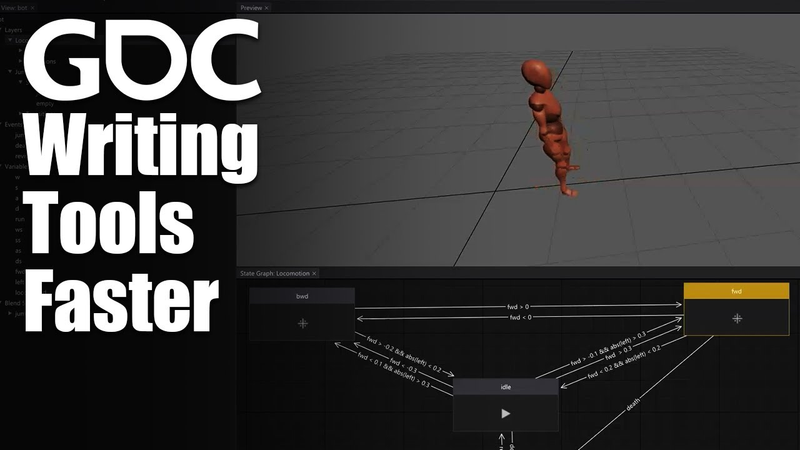
Writing Tools Faster: Design Decisions to Accelerate Tool Development
Game engine tool development often suffers from architectural bloat, where frequent transitions between volatile frameworks like WinForms, WPF, and web-based technologies create fragmented, unmaintainable codebases.
- Architectural bloat in game engine tools is primarily driven by fragmented, multi-layered stacks like WinForms, WPF, and web-based frameworks, which increase maintenance costs and debugging complexity.
- Implementing a unified, schema-driven data model—the 'truth'—enables automation of serialization, undo/redo functionality, and real-time collaboration through atomic pointer swaps.
- Transitioning to an immediate-mode UI system powered by C and Vulkan eliminates the need for complex state synchronization, as the interface is rendered directly from the data each frame.