Game Engines reports and market data
Documents

Get into HTML5 and WebGL now to solve distribution, says Goo's Sara Lempiäinen
HTML5 and WebGL represent a critical evolution for the gaming industry, offering a viable solution to the persistent challenge of game distribution.
- HTML5 and WebGL provide a strategic alternative to mobile app stores, allowing developers to bypass market saturation and reach users directly through browsers.
- Browser-based gaming functions as a viral distribution funnel, enabling the rapid sharing of game demos or levels to drive interest in full-title downloads.
- Industry-wide adoption of web standards is currently limited by developer skepticism regarding the maturity and reliability of these technologies.

Mobile games industry news (w/e 30 August 2013)
The mobile games industry in late August 2013 was defined by significant shifts in hardware strategy, developer tool accessibility, and the evolving role of platform holders in publishing.
- Unity Technologies expanded its business model to include game publishing, leveraging its developer base to curate and distribute titles while forming a strategic partnership with Facebook for social integration.
- Nintendo launched the 2DS to address hardware costs, despite the 3DS platform reaching 32 million units sold, highlighting the company's ongoing struggle to adapt its hardware-centric model to the modern mobile market.
- Autodesk released Maya LT, a streamlined and affordable version of its 3D software, signaling a trend toward making professional-grade production tools accessible to independent mobile studios.

Havok explains how its free Project Anarchy engine fits into its mobile strategy
Project Anarchy represents a strategic expansion for Havok into the mobile gaming sector, offering a comprehensive, end-to-end game engine designed to democratize high-end development tools.
- Havok launched Project Anarchy as a free, end-to-end mobile game engine supporting iOS, Android, Tizen, and low-end PC platforms.
- The engine integrates core technologies from AAA titles, specifically utilizing physics from Uncharted, AI from Halo 4, and animation tools from Skyrim, all optimized for mobile hardware.
- Project Anarchy employs a dual-workflow system that supports C++ for low-level development and a Lua-based scripting environment for more accessible programming.

Sean Paul Taylor on how BlackBerry is pushing mobile gaming
BlackBerry is actively expanding its mobile gaming ecosystem by prioritizing developer accessibility and hardware integration for the BlackBerry 10 platform.
- BlackBerry is incentivizing developers to port iOS and Android titles by making the BlackBerry 10 deployment tier free within the Unity mobile standard.
- The company has implemented a unified library within Unity that automates controller detection and button mapping, eliminating the need for developers to manage individual SDKs for peripherals.
- BlackBerry is prioritizing hardware integration for the MOGA Pro controller to facilitate a seamless transition between handheld mobile play and a micro-console experience via HDMI.

CEO David Helgason explains how Unity has democratised game making
Unity has established itself as a dominant force in game development by democratizing access to high-quality tools, currently supporting a community of 400,000 active developers and a total user base of 1.5 million.
- Unity currently supports 400,000 active developers and a total user base of 1.5 million, positioning itself as the industry-standard engine for cross-platform development.
- The company’s core strategy focuses on lowering barriers to entry for small teams of one to ten people to foster creative and financial independence.
- Unity has secured a strategic partnership with Sony to provide engine support for all of the hardware manufacturer's future platforms.

Mozilla talks up its HTML5-based Firefox OS
Firefox OS represents a strategic effort to expand smartphone accessibility by targeting feature phone users transitioning to mobile internet for the first time.
- Firefox OS utilizes open web standards and HTML5 to target feature phone users transitioning to smartphones, aiming to lower development and consumer barriers.
- The operating system extends standard HTML5 capabilities to grant web applications hardware-level access to features like Bluetooth and local storage.
- Firefox OS replaces traditional app store dependency with a content-first search model that dynamically surfaces web-based applications directly from the home screen.
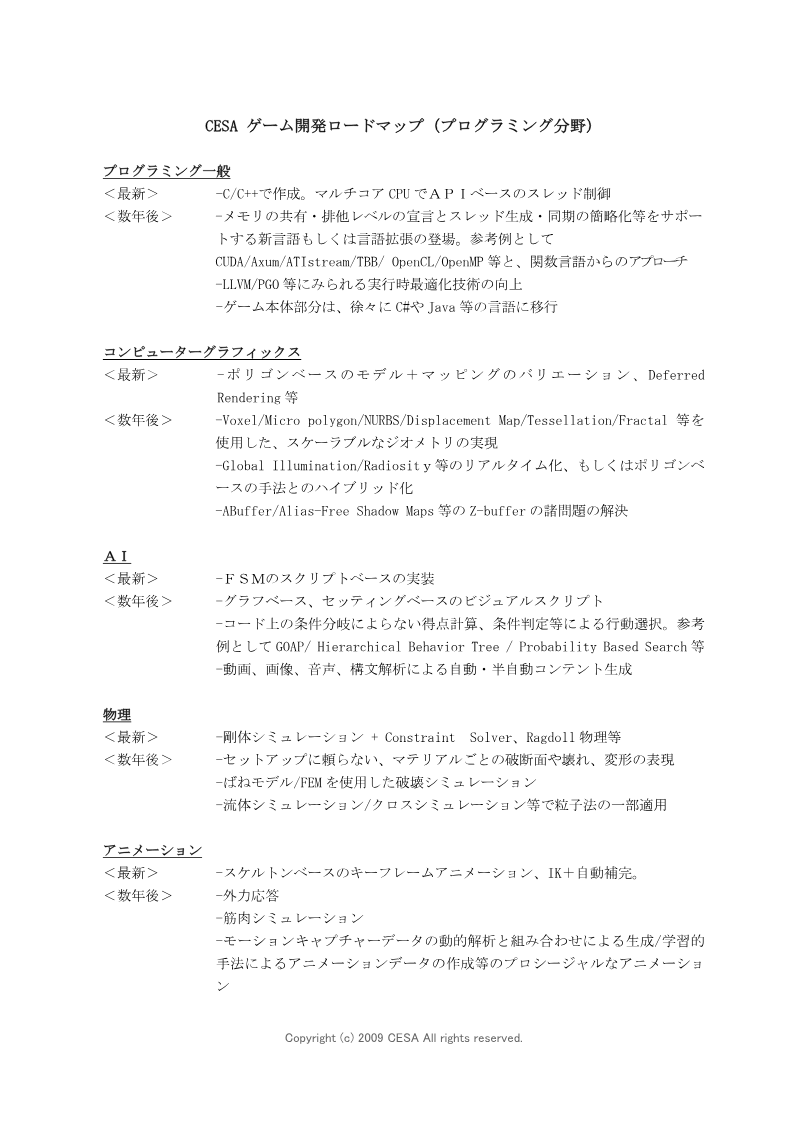

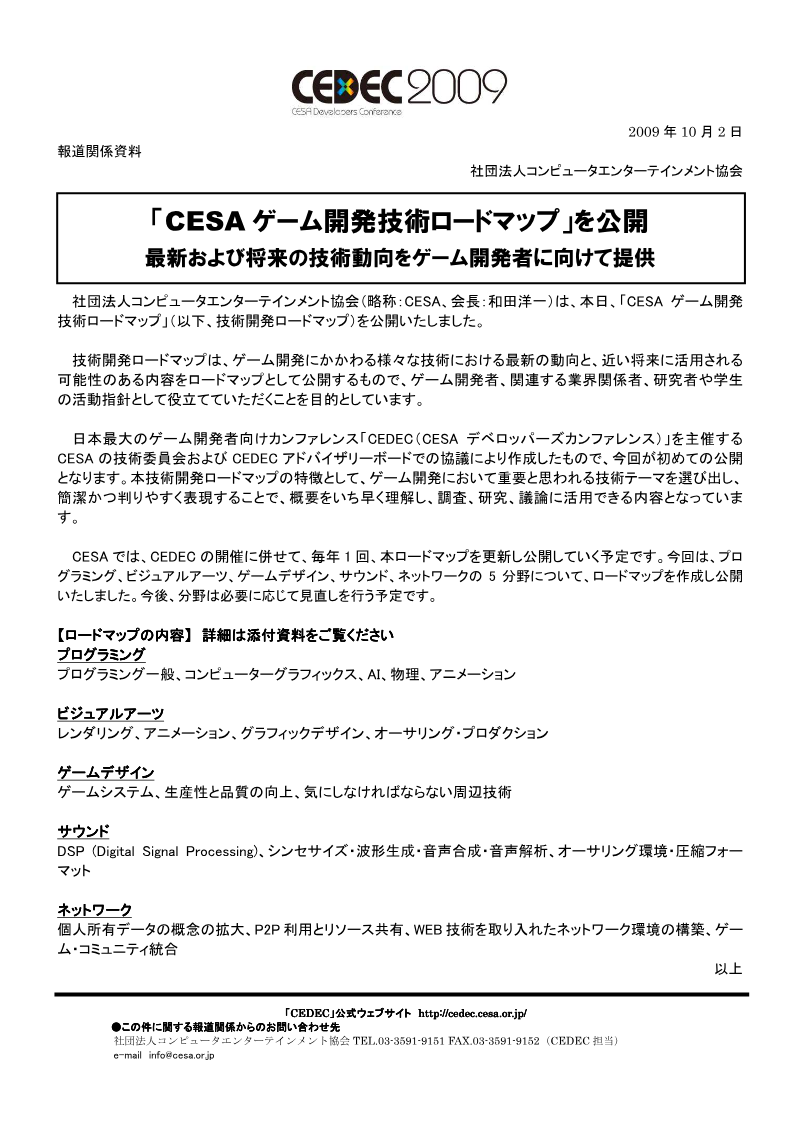
CESA Game Development Technology Roadmap: 2009
The 2009 CESA Game Development Technology Roadmap serves as a strategic guide for industry professionals, researchers, and students to navigate the evolving landscape of game production.
- The industry is shifting toward automated, scalable development systems, emphasizing the integration of sophisticated asset management and automated testing to increase productivity.
- Programming efforts are prioritizing multi-core optimization and the adoption of higher-level languages to handle increasing technical complexity.
- Visual arts production is transitioning toward procedural generation, physical simulation, and real-time rendering techniques.
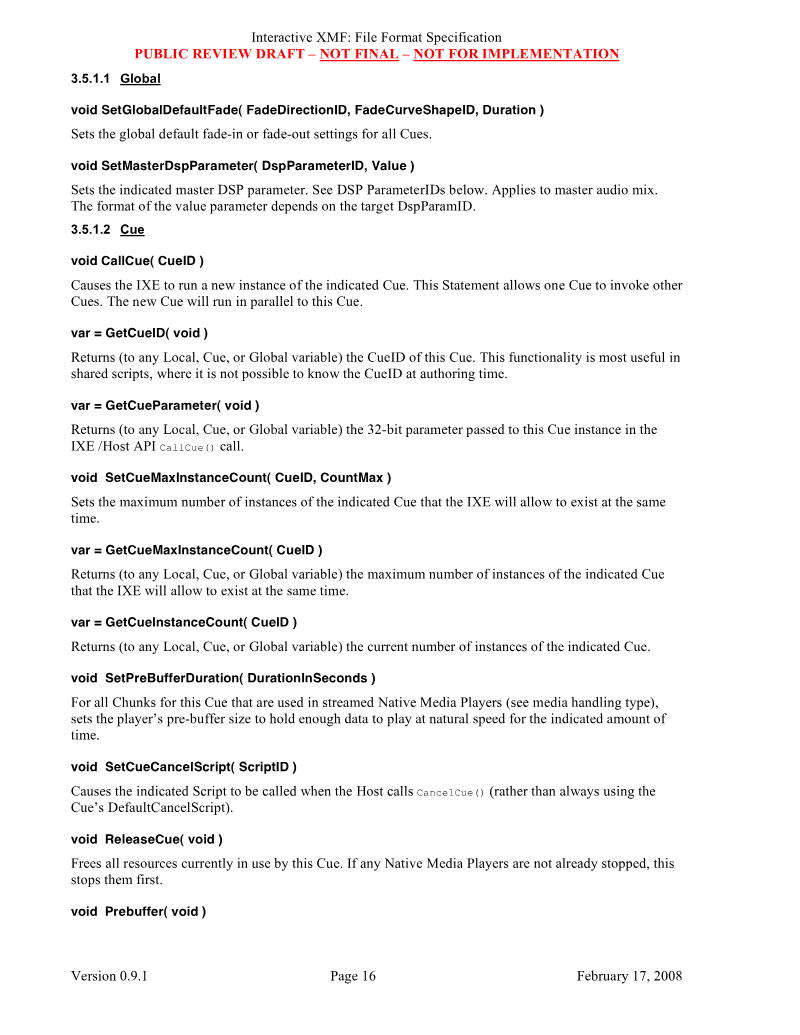
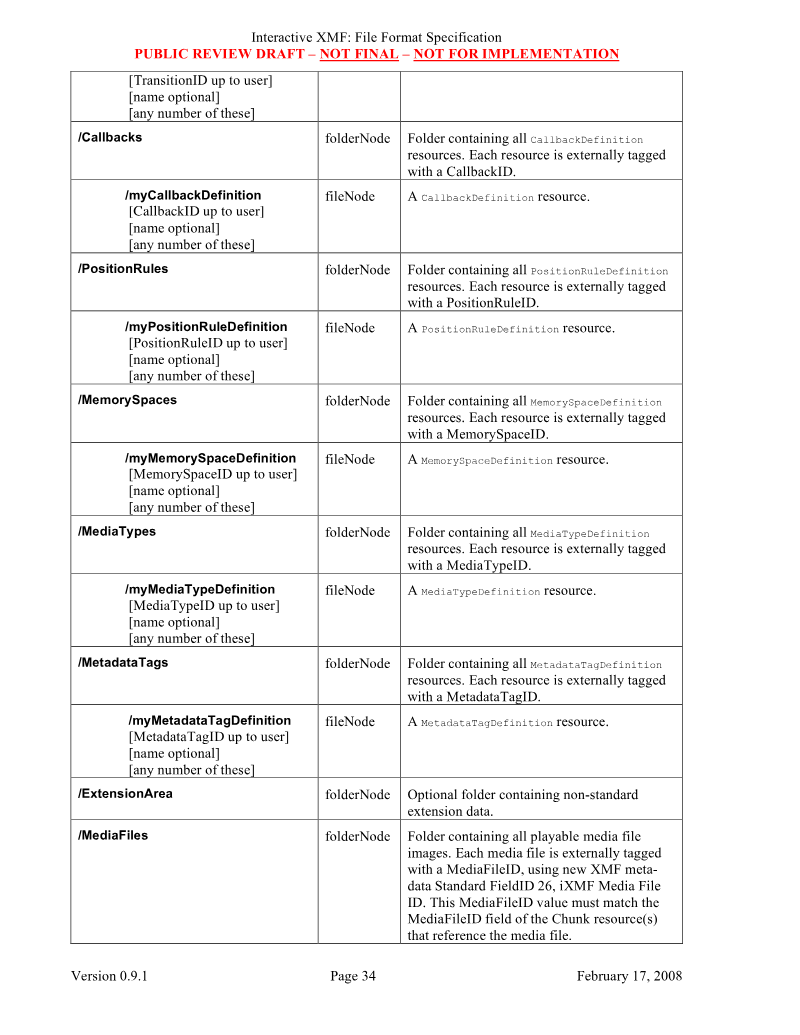
Interactive XMF: File Format Specification
Interactive XMF (iXMF) serves as an open, interoperable standard for adaptive audio in gaming and interactive media.
- Interactive XMF (iXMF) is an open, interoperable file format that bundles MIDI, digital audio, and scripting into a unified structure for dynamic, event-driven game audio.
- The iXMF Engine utilizes a stack-based expression processor to manipulate 32-bit signed integer variables across global, cue-specific, and instance-specific scopes.
- Developers can implement complex, non-linear audio through a built-in scripting language that supports conditional logic, DSP parameter adjustments, and memory management.
3Dxp: DirectSound 3.0 Extension API
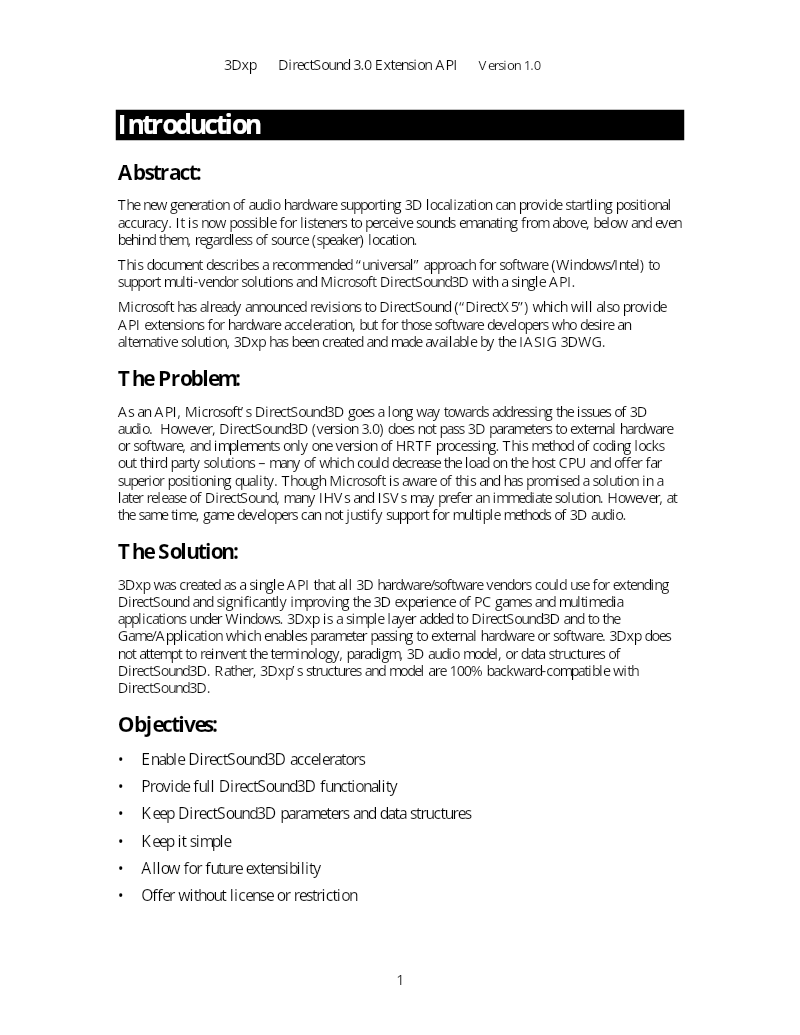
The 3Dxp API, developed by the Interactive Audio Special Interest Group’s 3D Working Group in 1997, serves as a standardized extension to Microsoft’s DirectSound 3.0.
- The 3Dxp API was introduced in 1997 as a standardized extension to Microsoft’s DirectSound 3.0 to enable hardware-accelerated 3D audio positioning on Windows PCs.
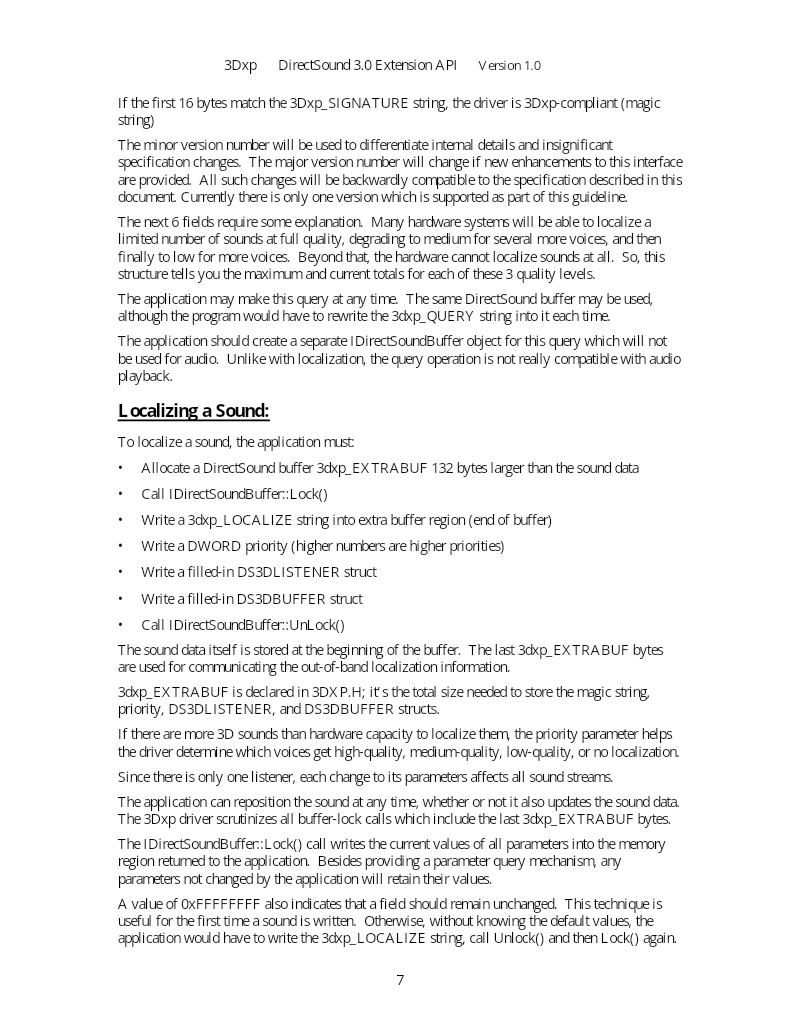
- The API functions by appending a 132-byte data structure to standard DirectSound buffers, allowing developers to pass 3D parameters like position, velocity, and cone orientation to external renderers.
- A reference wrapper enables automatic detection of 3Dxp-compliant drivers, proprietary solutions such as Aureal’s A3D, or a fallback to standard DirectSound3D.