Game Development reports and market data
Documents
Increasing Coherence in Impact: Crossing Disciplines and Framing
The document argues that the field of game design for "impact" is growing rapidly but fragmenting, as researchers, designers, and funders struggle to compare proposals and communicate effectively.
- The field of game design for impact is growing rapidly but fragmenting, making it hard for researchers, designers, and funders to compare proposals and communicate effectively.
- The authors propose new umbrella language and shared frames to enable meaningful comparison across domains and improve impact outcomes, framing this as an open, iterative conversation rather than finished solutions.
- An earlier report, based on dozens of interviews with mainly U.S. sector leaders, identified five areas of concern, including a widening gulf between research and practice and the need for common language to compare impact across domains.
Resisting Patches and Errata: Motivations and Tactics
This paper examines the motivations and tactics behind player resistance to video game patches and errata, arguing that updates are not merely technical corrections but instruments that shape and enforce preferred ways of playing while retroactively labeling other play styles as aberrant.
- Patches and errata are framed as rhetorical documents rather than neutral technical fixes: they shape and enforce preferred play styles while retroactively labeling other play as aberrant.
- The study centers on mainstream PC and home console games, comparing single-player and multiplayer contexts, and anchors its analysis in four cases.
- The 2012 Call of Duty: Black Ops 2 balance update weakened sniper rifles and quickscoping, provoking threats against its design director.
Smash Mods, Smash Creativity: Nintendo, Project M, and Enclosure
This paper examines video game modding through the case of Project M, a community modification of Nintendo's Super Smash Bros.
- The paper argues that creative play in games takes two linked forms, iterative play through modding and virtuosic play through a competitive scene, and that Nintendo's enclosure of the first ultimately curtails the second.
- Project M, a community modification of Super Smash Bros. Brawl (2008) for the Wii, is used as the central case study of how player-made content interacts with corporate control of games.
- Nintendo initially ignored the competitive community around Melee and Project M, even though Brawl was designed to be non-competitive, before shifting toward engagement.
Format(ive) Wars: Formation of the British Videogames Industry in the 1980s
This paper, presented at the 1st International Joint Conference of DiGRA and FDG, examines how the British videogames industry took shape during the 1980s, arguing that the familiar "format wars" framing, which casts the rivalry between Commodore and Sinclair Spectrum machines as a defining moment, is an incomplete account.
- The paper argues the familiar 'format wars' narrative, centred on the Commodore versus Sinclair Spectrum rivalry, is an incomplete account of how the British videogames industry formed in the 1980s, and that linear, generational histories overemphasise technology.
- It reframes the industry as an interdependent network of developers, publishers, distributors, high street retailers and journalists, rather than a story driven by hardware alone.
- The author identifies specific business practices of the era, including the 'chain of approval' linking gamers, retailers, publishers, software houses and developers, and the publisher acting as an 'Artist and Repertoire' agent for developers.
Ruinensehnsucht: Longing for Decay in Computer Games
Mathias Fuchs' paper "Ruinensehnsucht: Longing for Decay in Computer Games" argues that the abundance of ruins, dust, rust, and decay in contemporary computer games cannot be explained by technical necessity or by a drive toward realism, since many games display more decay than reality would produce.
- Mathias Fuchs argues that the abundance of ruins, dust, rust, and decay in computer games cannot be explained by technical necessity or realism, since many games display more decay than reality would produce.
- The paper proposes 'Ruinensehnsucht' (longing for decay): a melancholic yet compelling affective attachment to disintegrating environments, examined through media history, art history, psychoanalytic theory, and the concept of a transmedia megatext.
- Early games, constrained by limited resolution and processing power, rendered clean, simplified worlds, while later graphics hardware made fog, dust, and weathering possible and eventually a defining aesthetic.
Game Jams as an Opportunity for Industry Development
This study examines whether game jams can strengthen community and lay groundwork for industry development in Tasmania, a small and isolated Australian state where the games sector has been weakly supported and poorly visible.
- Game jams are proposed as a bottom-up way to connect isolated developers in Tasmania, a small Australian state with a weakly supported, poorly visible games sector, with the authors arguing community-building must precede formal industry growth.
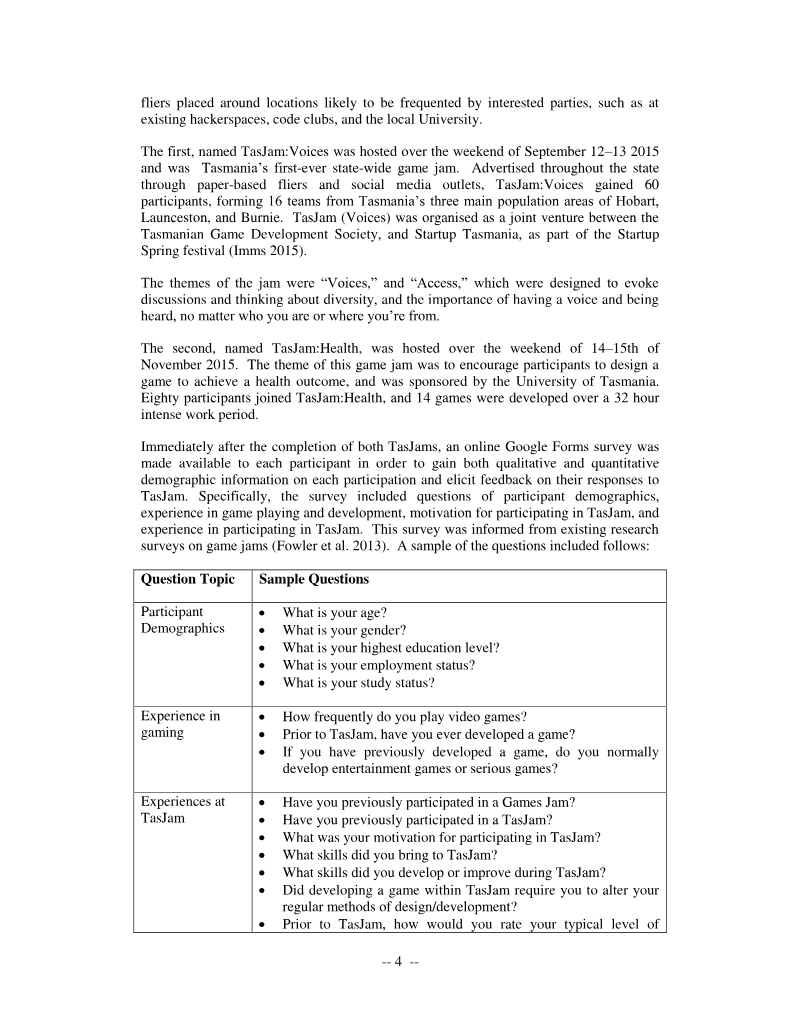
- The two 2015 state-wide jams drew 60 participants forming 16 teams at TasJam:Voices and 80 participants producing 14 games over 32 hours at TasJam:Health.
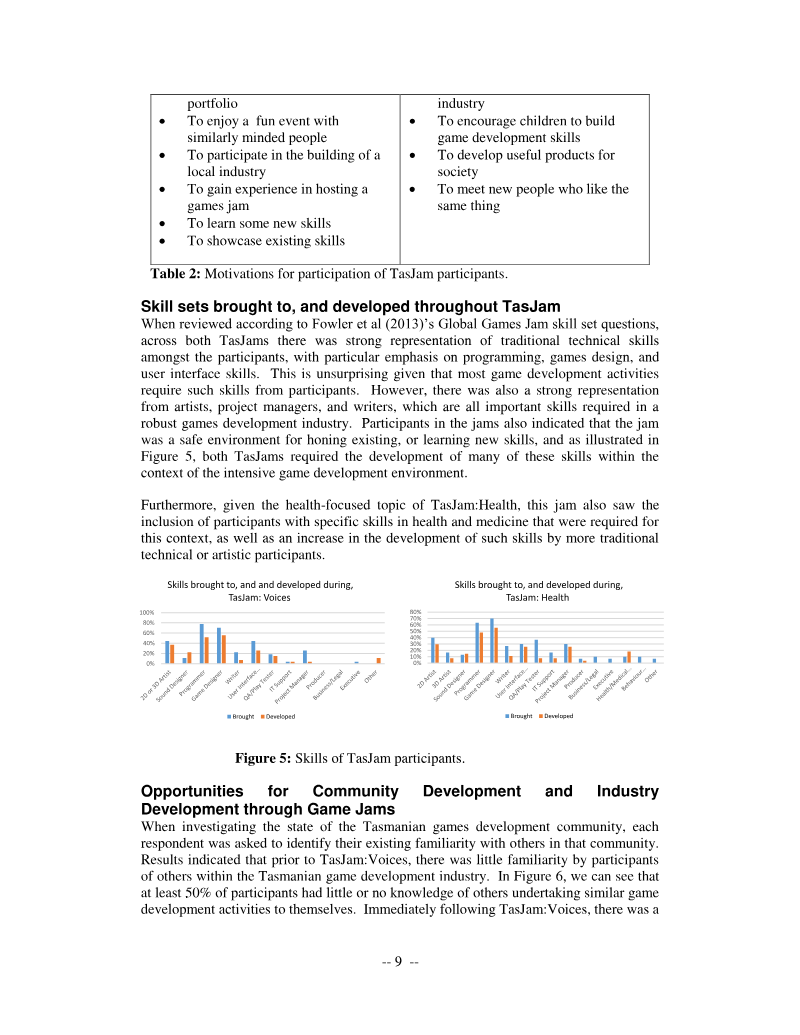
- Familiarity among local developers was low before the jams and rose markedly afterward, with over 70% of respondents reporting increased familiarity and most reporting new professional and personal contacts.
A Lightweight Videogame Dialogue Manager
This paper presents a lightweight procedural dialogue manager designed for videogame non-player characters, extending the Talk of the Town framework so that knowledge exchanges between NPCs render as naturalistic conversations rather than purely symbolic transfers.
- The paper presents a lightweight procedural dialogue manager for videogame NPCs that extends the Talk of the Town framework so knowledge exchanges between characters render as naturalistic conversations rather than symbolic transfers.
- The approach aims to avoid the authoring burden, limited player agency, and weak state-responsiveness of conventional branching dialogue, relying on speech-act-like "dialogue moves," preauthored conversational goal plans, and stackable conversational frames activated by world-state preconditions.
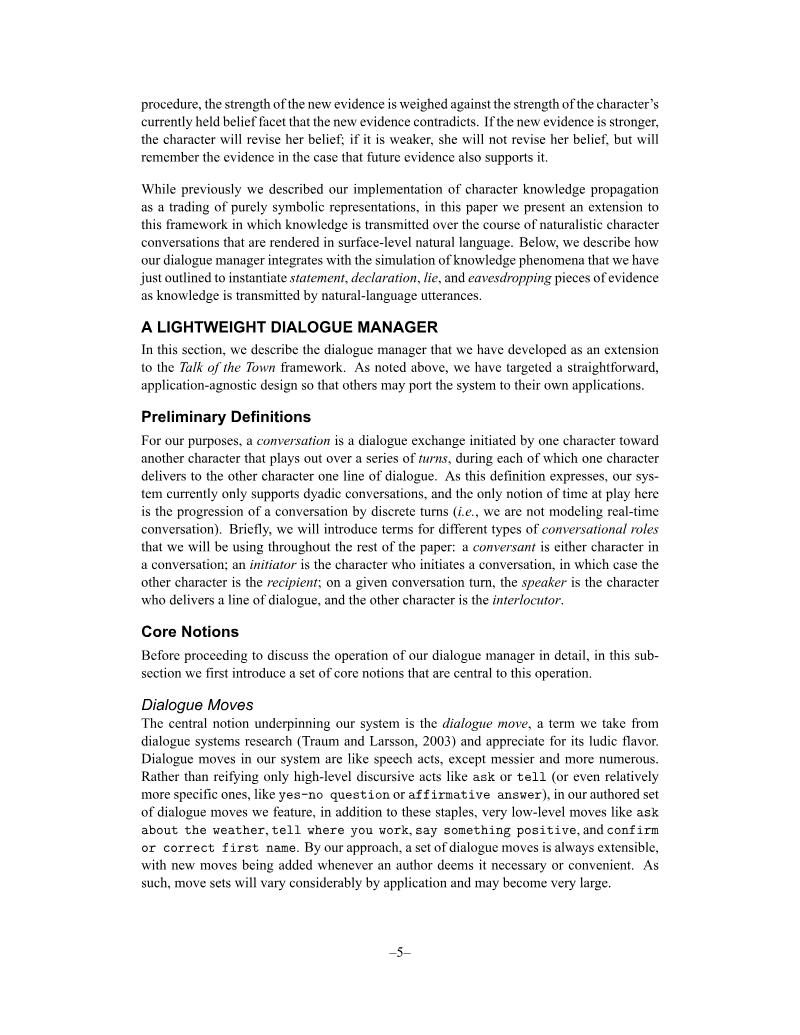
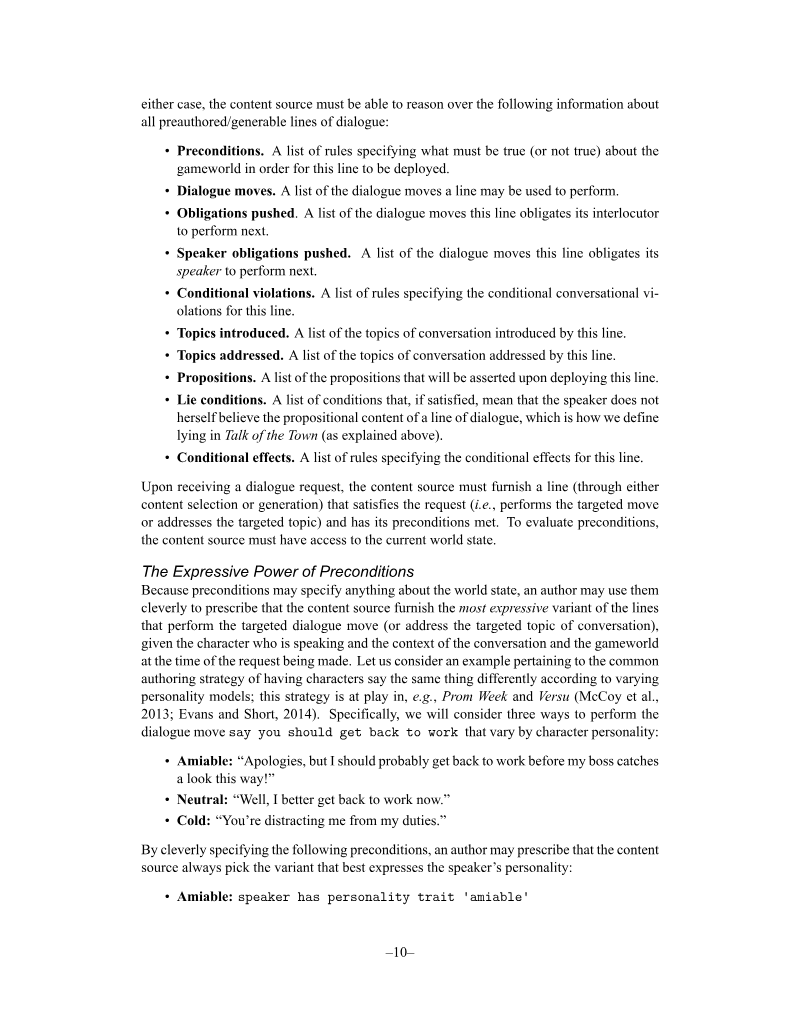
- The system models four knowledge-propagation evidence types (statement, declaration, lie, and eavesdropping) and uses per-line metadata for preconditions, moves, obligations, lie conditions, and effects, with obligations governing local coherence and goals governing global coherence.
Rapidly-Exploring Random Tree Approach for Geometry Friends
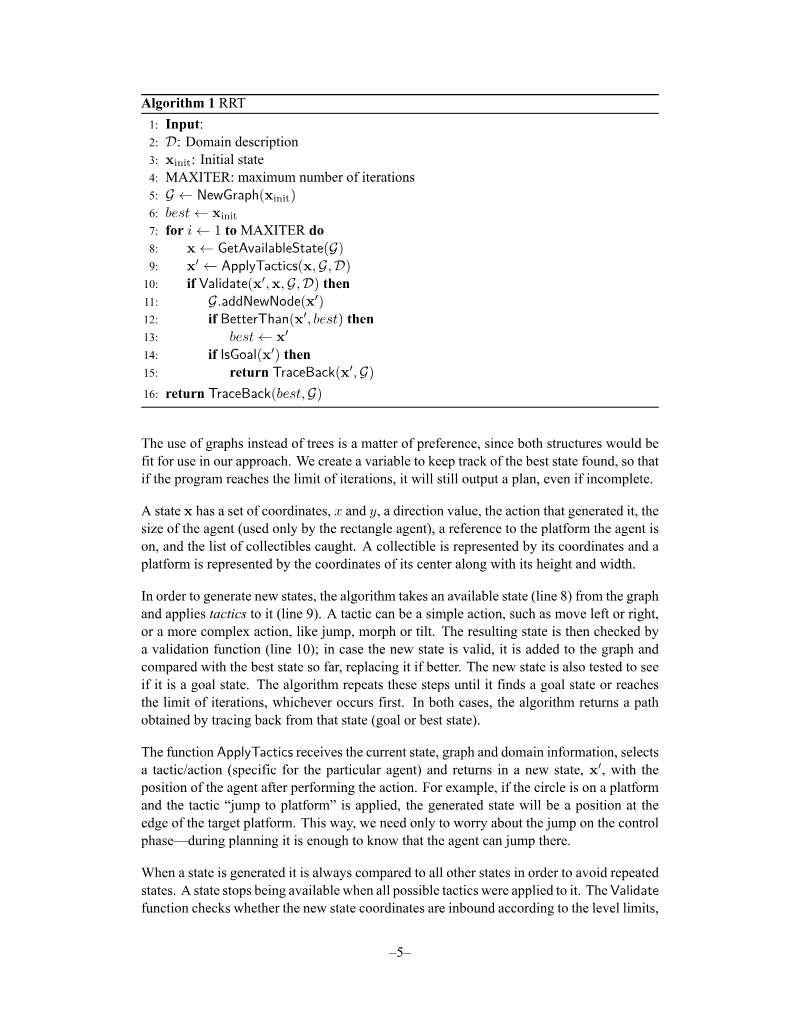
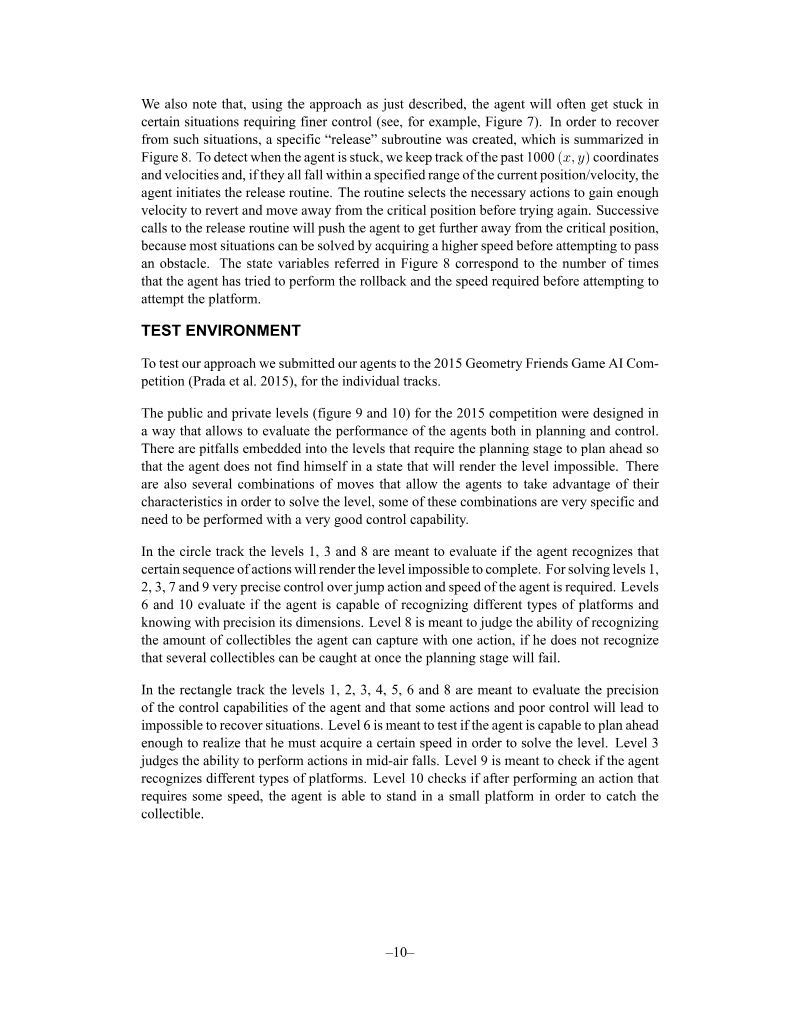
The paper presents a two-stage agent design for Geometry Friends, a physics-based cooperative platform game, using a Rapidly-exploring Random Tree (RRT) for high-level planning and a PID controller for real-time execution.
- The paper proposes a two-stage Geometry Friends agent: a Rapidly-exploring Random Tree (RRT) handles high-level planning and a PID controller handles real-time execution, with the aim of a generic, map-feature-independent method that generalizes to unseen levels.
- The circle agent placed first on the circle track of the 2015 IEEE Computational Intelligence and Games competition with a score of 2096, while the rectangle agent placed third on the rectangle track with 1487.
- Success rates were 0.32 on public circle levels and 0.38 on private levels, which the authors cite as evidence that performance does not collapse on unseen maps.
Paratextual Play: Unlocking the Nature of Making-of Material of Games
Glas's "Paratextual Play" examines making-of material for digital games, including behind-the-scenes documentaries, concept art, and audio commentaries, and argues that such material has moved from peripheral marketing extra to an integral component of the play experience.
- Making-of material for digital games, such as documentaries, concept art, and audio commentaries, has shifted from a peripheral marketing extra to an integral part of the play experience, and it is never a neutral account of development but a curated, celebratory one.
- Game paratexts are woven into gameplay, with access tied to playing and succeeding: Star Wars: Episode I – Battle for Naboo hid material behind cheat codes, and Rare Replay locked its "Rare Revealed" section, unlike film DVD extras that are typically reached through menus.
- Achievement systems such as Xbox Gamerscore and PlayStation Trophies, along with medal points and in-game currency, gate bonus content like the "Tech Dive" video in Uncharted 2, which costs $120,000 in-game to unlock, turning collecting this material into a goal in itself.
You Say Jump, I Say How High? Operationalising the Game Feel of Jumping
This paper investigates the mechanics of jumping in 2D platformers, arguing that "game feel" can be measured and modeled empirically rather than described through designer intuition or player self-report.
- Gravity differs sharply across the three games studied: Mario at 75 units/s², Super Meat Boy at 41, and Limbo at just 6, making Limbo the only title with earth-like proportions.
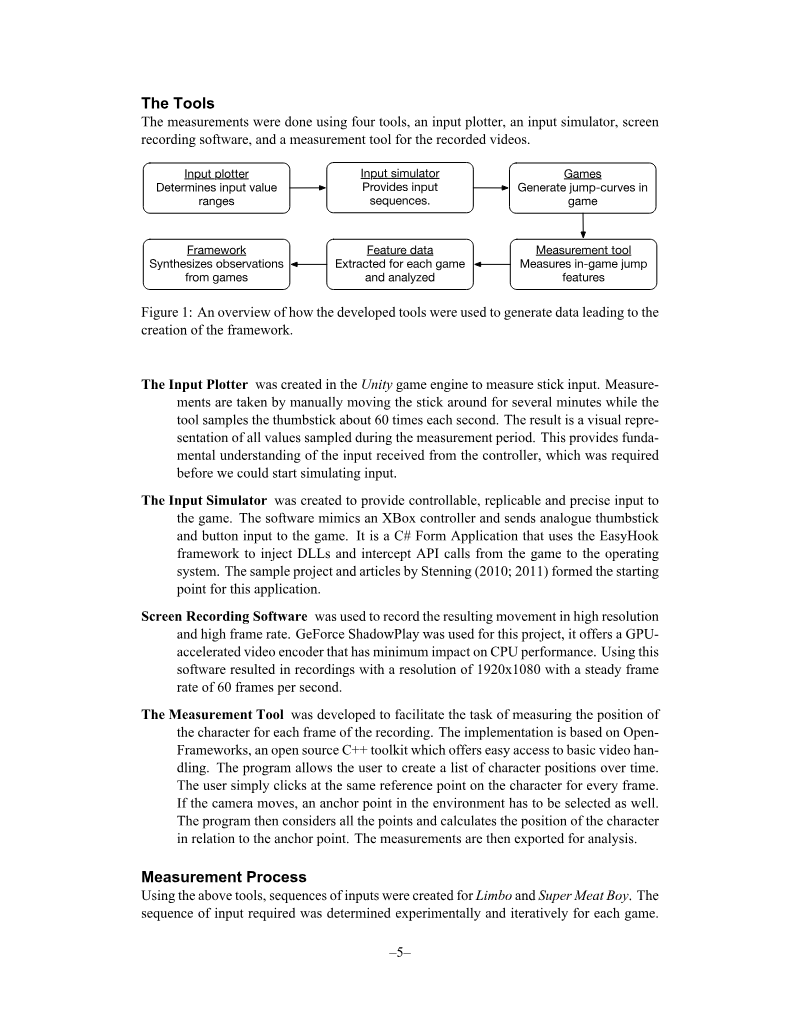
- The authors model jump mechanics empirically via input simulation, frame-by-frame video analysis, and model fitting, with Limbo's jump fitting tightly (RMSD 0.025) and Super Meat Boy's fitting looser (RMSD 0.109).
- All tested controllers overshoot their expected input limits, and blowback (the stick bouncing past center after release) occurs in every game examined but is handled in none of them.
Designing Unconventional Use of Conventional Displays in Games: Some Assembly Required
This paper argues that unconventional spatial arrangements of conventional display hardware constitute an underexplored design space for social, installation-like games.
- The paper argues that unconventional spatial arrangements of conventional display hardware form an underexplored design space for social, installation-like games, with physical placement of screens and player positioning shaping both social dynamics and strategy.
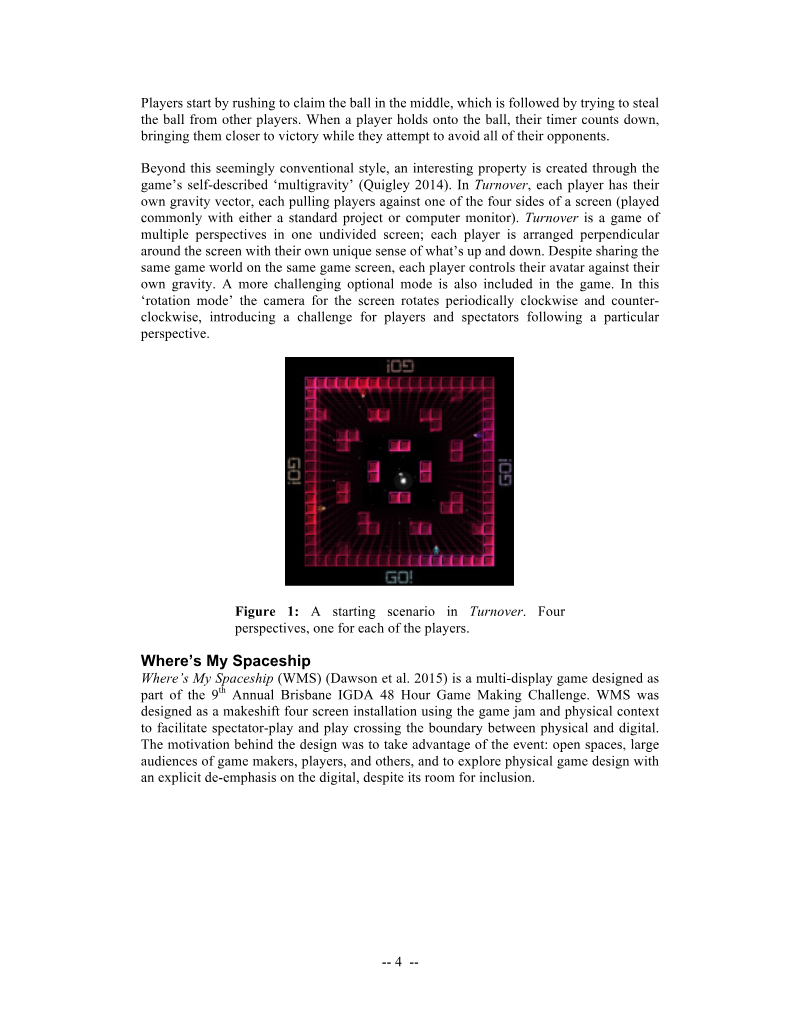
- Two co-located experimental multiplayer games, Turnover and Where's My Spaceship, serve as the case studies, using horizontal and perpendicular multi-screen configurations to create multi-screen asymmetry without any custom sensing hardware.
- The games occupy roughly 20 square meters and rely only on commercially available displays, controllers, and projectors, and both originated in game jams before being refined for public exhibition.
Playing RPG Maker?: Amateur Game Design and Video Gaming
Hurel's study examines amateur game makers who work with tools such as RPG Maker, arguing that their activity is best understood as an extension of video game play rather than as a path toward professionalization or formal education.
- Amateur game makers using tools like RPG Maker are best understood as extending video game play rather than as a path toward professionalization or formal education, according to Hurel's study.
- Most amateur creators make games primarily for personal enjoyment and to share their playing style with friends, designing their projects as personal versions of genres or franchises they love, with design choices mirroring what they find pleasurable as players.
- The study's findings rest on exploratory interviews with twelve respondents, mostly men aged 25 to 42 based largely in Belgium and France, plus forum analysis and autoethnography, and are presented as preliminary rather than a formal theory.