Game Development reports and market data
Documents
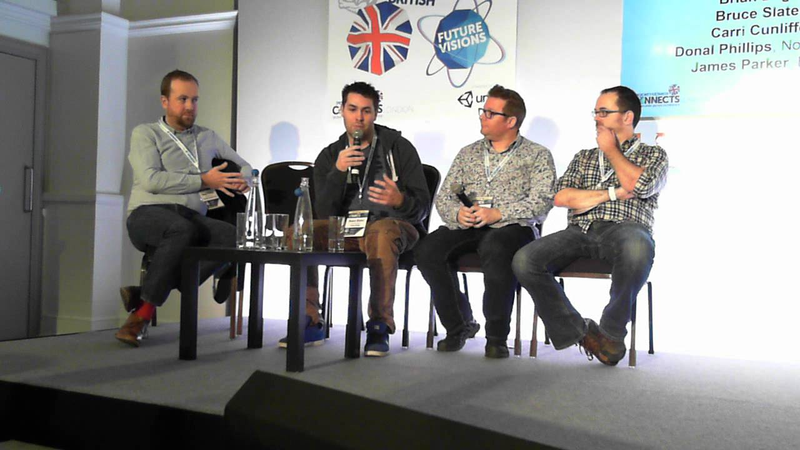
Why game hubs matter
Game development hubs serve as essential infrastructure for mitigating the inherent isolation of the industry, providing a collaborative environment where developers can share knowledge, resources, and equipment.
- Game development hubs act as essential infrastructure that mitigates industry isolation by providing shared resources, equipment, and collaborative environments for independent developers.
- These hubs serve as regional catalysts that bridge the gap between individual studios and broader creative ecosystems, facilitating professional resilience and creative growth.
- Localized support networks are critical for sustaining long-term industry health, particularly for independent creators who otherwise lack access to mentorship and peer-to-peer problem solving.

Return To Adventure Mountain 2015
The year 2015 served as a period of significant professional transition and creative output for an independent game developer based in Phoenix, Arizona.
- In 2015, a Phoenix-based independent developer shifted to rapid prototyping of small-scale titles following the dissolution of a previous business partnership.
- The developer released a diverse portfolio of experimental games throughout the year, including Wizard Golf RPG, Rogue Drop, Drill Planet, and Ride Share Z.
- Wizard Golf RPG achieved international press coverage, though the developer reported that it failed to reach significant commercial success.
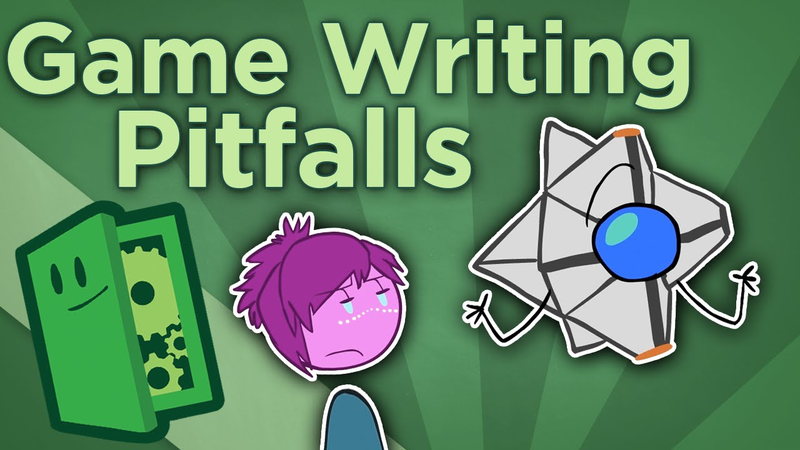
Game Writing Pitfalls - Lost Opportunities in Games - Extra Credits
Video games face a unique narrative challenge: they possess a significantly lower word count per minute compared to other media like television or film.
- Games face a severe narrative constraint with an average of only 16 words per minute, compared to 120 words per minute in television scripts.
- Every line of dialogue must serve at least one of four functions: world-building, character development, plot progression, or revealing information about other characters.
- Functional gameplay instructions and filler dialogue used to mask transitions often result in flat, unengaging narratives, as seen in the case of Destiny.

Can Supercell make mobile MOBAs successful with Clash Royale?
Supercell’s entry into the mobile multiplayer online battle arena (MOBA) space with the soft launch of Clash Royale represents a strategic effort to adapt complex, hardcore genres for a broader, casual mobile audience.
- Supercell is attempting to adapt the complex MOBA genre for casual mobile audiences by blending it with tower defense and card-based deck-building mechanics.
- The game leverages the established Clash of Clans intellectual property to lower the barrier to entry and increase player familiarity.
- The soft launch phase is being used to rigorously test player retention and monetization metrics, consistent with Supercell’s practice of canceling projects that fail to meet internal quality standards.
OFabulis and Versailles 1685: A Comparative Study of the Creation Process Behind Video Games on Historical Monuments
This paper by Edwige Lelièvre compares the creation processes of two point-and-click investigation games set in historical monuments: Versailles 1685, released by Cryo Interactive in 1996, and OFabulis, a free experimental multiplayer game released online in 2014 covering nineteen monuments managed by the Centre des Monuments…
- The paper argues that heritage games share three inherent traits: cultural institutions participate in design from the outset, the scenario must negotiate a compromise between history and fiction, and multimedia systems are built around limited gameplay and realistic rendering to showcase monuments.
- The study compares Versailles 1685 (Cryo Interactive, 1996), which used the Omni 3D system to let players explore fully rendered reconstructions of 1685 Versailles, with OFabulis (free experimental multiplayer game, online in 2014), covering nineteen monuments managed by the Centre des Monuments Nationaux.
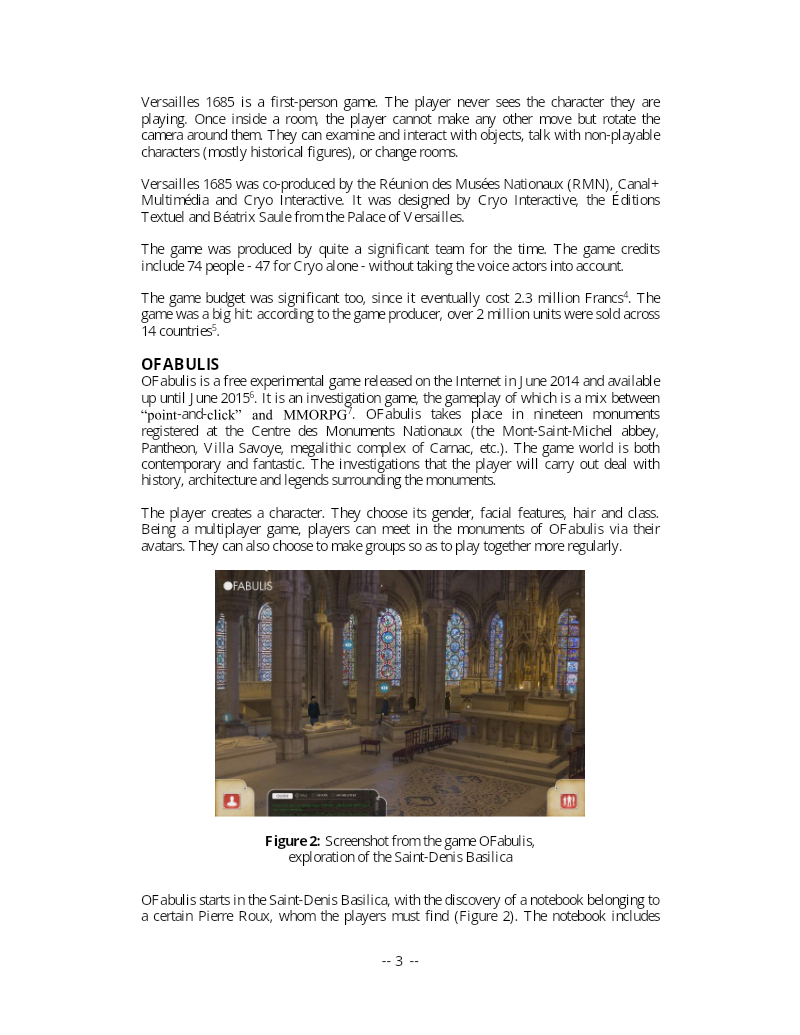
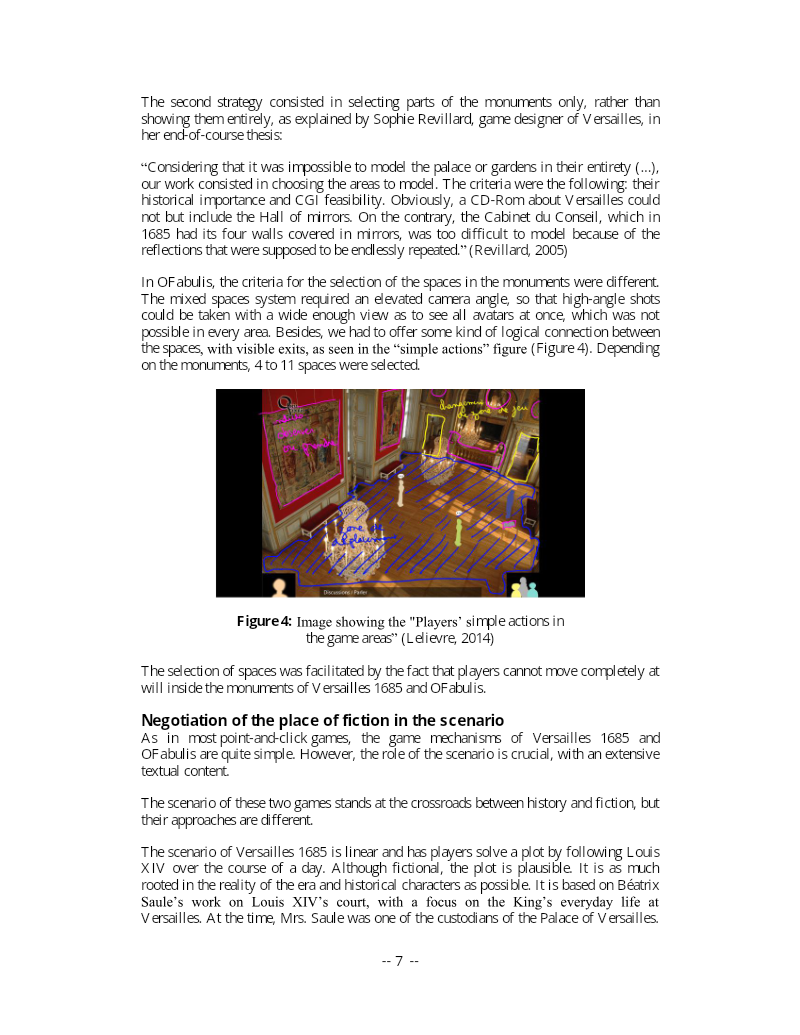
- OFabulis combined photographs, 3D avatars, and filmed agents into "mixed spaces" that could run on modest hardware, while Versailles 1685 relied on fully rendered 3D reconstructions.
A Machine-Learned Framework for Automatic Content Generation, Evaluation, and Critique
This doctoral proposal, written by Adam Summerville at the University of California, Santa Cruz, argues that procedural level design should move away from human-authored rules and heuristics toward machine learning systems that learn directly from existing creative artifacts.
- Adam Summerville's doctoral proposal (University of California, Santa Cruz) argues that procedural level design should shift from hand-authored rules toward machine learning systems that learn from existing creative artifacts, because designers struggle to introspect and formalize their own creative reasoning.
- The proposed workflow has designers curate positive and negative examples rather than write formal constraints, and models then infer style, playability, and structure from those examples.
- The proposed end-to-end framework has three components: learning entity properties and annotating 2D levels (ideally extracted from video), training generative models that match input style while learning likely player paths, and using trained models to suggest edits, critique levels, and visualize probable player routes.
Exploration of Open Data through Procedural Content Generation
This paper explores the emerging field of data games, in which open data is used to procedurally generate game content that is both engaging and informative.
- The core argument is that using open data in procedural content generation can make dry or difficult information more accessible, since players engage more readily with material they already know, such as their hometown or familiar public figures.
- The approach rests on a reusable two-part framework: a crawler that gathers and pre-processes data from sources like Wikipedia, DBpedia, OpenStreetMap, and Wikimedia Commons, and a parser that converts that data into game content, so the same crawled data can yield items, dialogues, or levels by swapping parsers.
- The author identifies three core challenges for data games: data acquisition, transforming data into game content, and balancing gameplay enjoyment against faithful, understandable representation of the source information.
Solving Belief-Driven Pathfinding Using Monte-Carlo Tree Search
This paper proposes a stochastic extension to Belief-Driven Pathfinding (BDP), a method for helping non-player characters navigate based on what they believe about the state of a map rather than its actual state.
- Stochastic BDP (SBDP) extends Belief-Driven Pathfinding by replacing binary open/closed states for entrances such as doors with a probability of being open, initialized at 0.5, so NPCs plan under uncertainty about the map.
- The authors frame SBDP as a special case of the Canadian Traveler Problem (a stochastic shortest-path problem with recourse) that can be reduced to a Markov Decision Process, requiring a policy covering possible outcomes rather than a single fixed path.
- Beliefs are updated through sensing, which sets an observed entrance's probability to 1 (open) or 0 (closed), and through knowledge decay, which drifts probabilities back toward 0.5 at a rate set by a decay parameter.
Diversity Scale: An Evaluation Algorithm for Terrain Generators
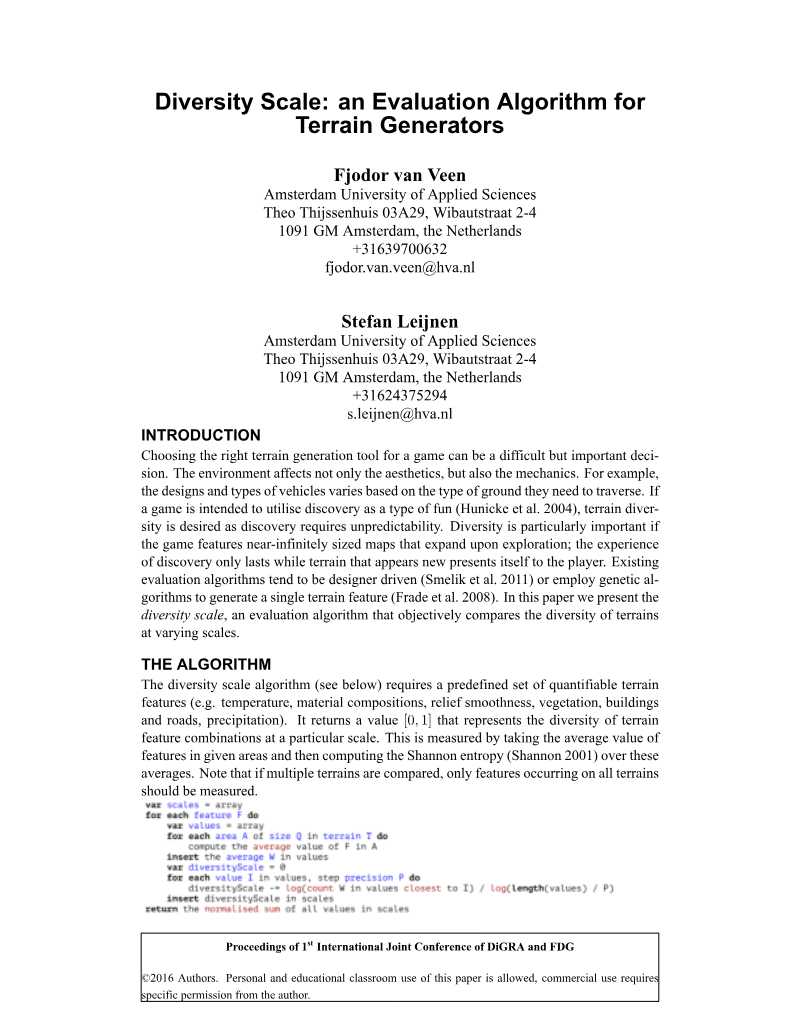
This paper introduces the Diversity Scale, an objective evaluation algorithm for comparing the feature diversity of procedurally generated terrains at varying spatial scales.
- The Diversity Scale is an objective algorithm that returns a value between 0 and 1 measuring how diverse the feature combinations of a procedurally generated terrain are at a given area size, addressing a gap where prior approaches were designer-driven or evaluated only a single feature with genetic algorithms.
- Terrain diversity is framed as critical for games built on discovery and near-infinite maps, where the sense of exploration depends on continually encountering terrain that feels new.
- The method works by computing average values of predefined features (such as temperature, material composition, relief smoothness, vegetation, buildings and roads, and precipitation) across areas of a chosen size, applying Shannon entropy to their distributions, and aggregating per-feature results with weights reflecting each feature's importance to the game.
Design Paradigms and Principles for Free-to-Play Games: A Developer Interview Study
This study examines the design paradigms and principles that game developers consider important when creating free-to-play (F2P) games, a revenue model in which the core game is free while premium content is sold through in-game purchases.
- The study is a qualitative interview study of 14 game developers from six Finnish companies (interviews of 50–100 minutes each), with experience ranging from one to twenty years; ten had worked on free-to-play games and six on gambling games.
- Transcripts were analyzed with a Grounded Theory approach and organized into five themes: generic paradigms, F2P paradigms, generic principles, F2P principles, and poor F2P design.
- The report distinguishes abstract design paradigms (e.g., a game must be fun) from concrete principles (e.g., chokedown levels), and separates generic design approaches from those specific to free-to-play.
Improving Interaction With Non-Player Characters Through Physiological Data
This work-in-progress paper proposes using physiological data to estimate players' emotional states so that non-player characters (NPCs) in video games can respond to how players feel rather than relying solely on their prior choices.
- The paper proposes using physiological signals to estimate players' emotional states so NPCs can respond to how players feel, not just to their prior choices, filling a gap in conventional NPC design that lacks access to emotional cues.
- The prototype is built in Unity and connected to an Arduino via the eHealth toolkit, using galvanic skin response as an estimate of arousal and electromyography as an estimate of valence, mapped onto the Russell arousal-valence plane.
- Baseline physiological measures are recorded during calm phases before key choices, and NPCs then present one of four dialogue options with matching gestures based on the detected emotional position.
Playful Fabrication: Speculative Game Designs for 3D Printers
This paper argues that 3D printing and other personal fabrication tools remain stuck in a utilitarian, engineer-oriented phase, and proposes a research agenda called "Playful Fabrication" that prioritizes expressiveness, play, and communication over practicality.
- The paper argues personal fabrication (3D printing) is stuck in a utilitarian, engineer-oriented phase and proposes a "Playful Fabrication" research agenda that prioritizes expressiveness, play, and communication over practicality.
- The authors draw an analogy to early personal computing, where a shift from calculation to creative and playful use, partly driven by games, helped bring computers into homes and classrooms, and argue fabrication needs similar catalysts such as accessible interfaces and entertaining applications before reaching a broad consumer market.
- Current fabrication workflows, including the tools used to create and send instructions to printers, still require substantial engineering expertise, and existing use is largely limited to one-off parts, repairs, and rapid prototyping in business and design settings.