Game Development reports and market data
Documents
The Salt and Sanctuary Postmortem
Salt and Sanctuary, developed by the two-person team at Ska Studios, represents a 2D action RPG heavily inspired by the Dark Souls series.
- Prioritize building robust, custom development tools early in the production cycle, as the quality of these tools directly dictates the quality and efficiency of the content creation process.
- Implement a 'task-switching' workflow where developers focus on a single discipline—such as music, coding, or animation—for at least 2–3 days at a time to minimize the mental overhead of context switching.
- Avoid launching with incomplete localization; the developers found that players notice and react negatively to 'faked' or missing language support, whereas professional localization significantly boosts engagement and sales.

Indie Advice - Fire Early - Extra Credits
Effective project management in the indie game industry requires the difficult but necessary willingness to terminate underperforming team members early.
- Delaying the termination of an underperforming team member prioritizes one individual over the collective success and morale of the entire project team.
- Procrastinating on personnel decisions creates compounding technical and operational debt that forces remaining team members to work at reduced efficiency.
- Addressing a poor fit within the first month of a year-long project limits the negative impact to 8% of the development timeline.
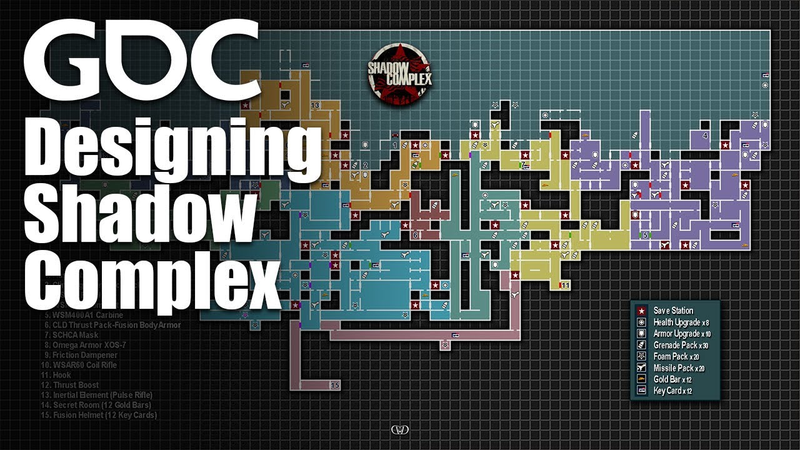
Designing Shadow Complex
Small-scale game development thrives when teams embrace inherent constraints by prioritizing high-quality, focused gameplay over the expansive, resource-heavy scope of traditional retail titles.
- Prioritize unique gameplay experiences over technical development by leveraging existing engines like Unreal, allowing small teams to focus resources on original design rather than building foundational technology.
- Maintain a lean development process by using short, concise design documents—such as the five-page document used for Shadow Complex—to facilitate rapid team alignment and iteration.
- Define a clear core gameplay loop early in development, such as the exploration-combat balance in Shadow Complex, and ensure every feature and asset directly supports that loop to avoid unnecessary bloat.
A Thousand Tiny Tales: Emergent Storytelling in Slime Rancher
Emergent storytelling functions as a core design philosophy in Slime Rancher, prioritizing the creation of unpredictable, player-driven narratives over rigid, scripted sequences.
- Emergent storytelling is generated by creating simple, robust AI behaviors that interact with game systems, rather than scripting long-form narratives.
- Designers should limit the number of 'needs' (e.g., hunger, health) to keep systems manageable, while providing a wide variety of 'wants' to drive unpredictable player interactions.
- Emergent behavior often arises from happy accidents in physics simulations, such as Slime Rancher's stacking mechanic, which players interpreted as intelligent escape attempts.
ARK: Survival Evolved: Lessons from the Trenches of Early Access
The development of ARK: Survival Evolved demonstrates the efficacy of an emergent development strategy, which prioritizes iterative growth and high-level guiding principles over rigid, pre-defined design documentation.
- Success in Early Access relies on an emergent development strategy that prioritizes iterative growth and high-level guiding principles over rigid, pre-defined design documentation.
- The development team utilizes a structured feature scorecard system to objectively evaluate updates based on development feasibility, team passion, and long-term meta-game health.
- Concurrent user counts serve as the primary metric for project success, functioning as a more reliable indicator of engagement than Steam reviews.
The Importance of Everything: Analytics of Map Design
Analytics serves as a vital methodology for iterative game design, functioning not as a definitive formula for success but as a tool to test hypotheses and refine player experiences.
- Analytics should be used as a tool for testing design hypotheses and refining player experiences rather than as a definitive formula for game success.
- Designers must distinguish between raw metrics, which merely record past events, and true analytics, which function as a social science to inform future decision-making.
- Effective map design requires moving beyond the 'where' of player behavior to uncover the 'why' behind specific actions.
Controlling Carnage: Effective Side-Scroller Controls on Mobile
The development of control schemes for mobile action games requires moving beyond traditional console-based paradigms to address the unique constraints of touchscreens, specifically the lack of tactile feedback and the physical limitations of thumb reach.
- To mitigate 'thumb drift' and the lack of tactile feedback on touchscreens, developers should implement large, invisible hit pads that leverage muscle memory rather than relying solely on visible buttons.
- Mapping actions to distinct thumb positions—vertically extended, horizontally extended, and tucked—allows players to execute complex inputs like jumping, melee, and ranged attacks without needing to visually monitor the control area.
- Control schemes must be dynamically scaled based on device screen size, with smaller devices requiring more compact layouts to ensure both visibility and ergonomic usability.

We Failed at Publishing Competitive Games so You Don't Have to
The pursuit of a competitive gaming publishing label serves as a cautionary tale regarding the disconnect between development expertise and market realities.
- Financial success in competitive gaming requires aligning development costs with market reality, as even respectable sales of 200,000 units—such as those achieved by Divekick—can fail to recoup investments if the budget and strategy are misaligned.
- Publishers must avoid the cognitive bias of attributing past successes to internal expertise rather than the inherent appeal of the product, which often leads to the repeated failure of marketing strategies for subsequent titles like Capsule Force and Gun Sport.
- A shift in strategy is required from front-loaded content models to sustainable post-release update cycles, as the former fails to maintain the long-term engagement necessary for competitive titles.
The Terrain of Halo Wars
The development of Halo Wars marked a significant technical evolution in real-time strategy design, driven by the need to transition from legacy engine architectures to a custom environment capable of running on Xbox 360 hardware.
- The development team utilized Vector Field Terrain to enable per-vertex displacement across three axes, allowing for complex organic structures like overhangs and bridges that traditional height-field systems could not support.
- To maintain performance on Xbox 360 hardware, the engine decoupled high-fidelity visual terrain from a low-resolution, CPU-optimized height field to ensure efficient physics calculations and ray casting.
- Memory usage was restricted to a 14MB footprint by leveraging DXT compression and a custom GPU-based virtual texturing cache.

Secret Hitler: Designing Conflict & High-Tension Moments
Secret Hitler functions as a masterclass in social deduction design, prioritizing high-tension interpersonal drama and narrative-driven gameplay over rigid mechanical balance.
- The core design philosophy of Secret Hitler focused on maintaining high-tension, personal conflict and a sense of a 'knife's edge' throughout the entire session, rather than prioritizing perfect game balance or deterministic outcomes.
- The game utilizes a 'rising action' structure where fascist policy enactment increases the intensity of suspicion and social interaction, ensuring the game remains engaging until the final moments.
- To prevent the 'snowball effect' where one team dominates, the developers implemented mechanics like term limits and presidential succession to force players to interact with new, potentially untrusted partners rather than relying on a fixed group of allies.

Why Do We Ship Buggy Games? - A Look Behind the Scenes - Extra Credits
The release of buggy AAA games is rarely the result of developer laziness or malice, but rather the consequence of complex, early-stage production decisions and rigid scheduling constraints.
- Shipping buggy games is primarily a calculated financial decision where the cost of fixing deep-seated technical issues outweighs the projected returns of further development.
- Fundamental bugs often originate from core engine architecture or third-party middleware, creating dependencies on external partners that are difficult to rectify late in the production cycle.
- Rigid marketing campaigns and high-cost advertising placements are locked in months ahead of time, making it logistically and financially difficult to delay a release.

The Sound and Music of Hyper Light Drifter
The audio development of Hyper Light Drifter centers on the creation of a unique, immersive sonic identity through experimental recording techniques and a highly iterative collaborative process.
- The audio team utilized unconventional field recording techniques, such as using a stethoscope modified with a garden hose spigot to record internal body sounds like blood flow, which were then processed and distorted to create ambient textures for boss battles.
- To achieve a unique, 'nightmarish' aesthetic, the developers used a 1950s wire recorder—purchased for $250—to capture and manipulate raw, historical audio, creating distorted textures that predated modern digital recording artifacts.
- The sound design process relied heavily on extreme processing of organic sounds, such as recording the creator's own voice squealing like a pig or using wolf vocalizations, which were then pitch-shifted and layered to create distinct, terrifying creature audio.