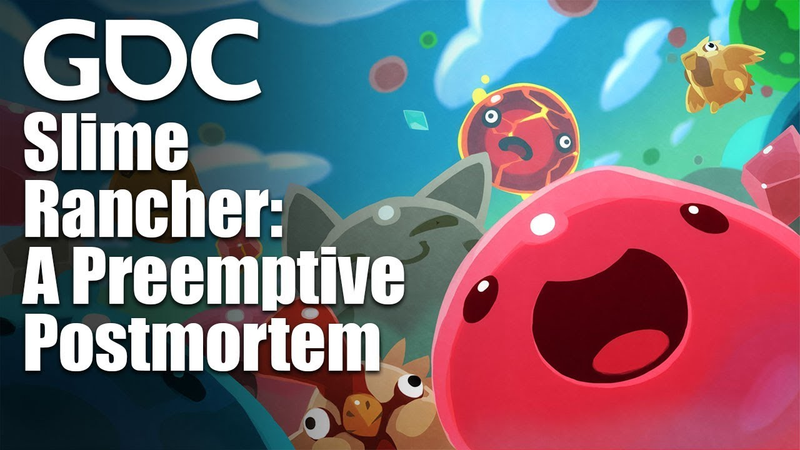
A Thousand Tiny Tales: Emergent Storytelling in Slime Rancher
23 May 201731 min video
Transcript
[Music] thank you Ryan um thank you for coming to this talk uh I like to go kind of quick because I like to you know pack in as much information as possible so this talk will be uploaded to the Vault and I've also uploaded the slides in PDF form so just feel free to let it kind of wash over you um also make sure to uh fill out the survey that I think is emailed to you um within 15 minutes especially if you enjoyed it uh check your spam folders if you didn't enjoy it it's just Spam don't worry about it um let's get started so this is a thousand tiny Tales emergent storytelling and slime Rancher um and who I am is the co-founder in CEO of Monami Park I designed slime Rancher I also designed um spiral nights back when I was at three rings in Sega um and there's me on Twitter but don't follow me yet let me earn it um let me also tell you why I'm
giving this talk um I think emerging storytelling is super valuable for Indies um it is something that effectively generates content and uh I don't think enough games are doing it so as an indie you can stand out by uh implementing this in your game and it's also what makes games surprising and I think that's one of the most important things a video game can be is surprising um is everyone familiar with slime Rancher show H maybe who's played it or oh wow awesome thank you so much uh I still need to introduce it because some people aren't familiar with it so it's a firstperson farming ranching game with slimes the the name of the game is is very um uh apt uh there's a very heavy physics simulation it's super chaotic uh and the world emphasizes exploration it has a a sort of a original zelda-like quality to it where you kind of just go off wherever you want and you are slowly unlocking portions of the world and so let's see a trailer of slime rancher in
action [Music] [Music] [Applause] [Music] [Applause] [Music] hello that's slime Rancher and now next is my my favorite slide here um it was a big hit for us uh this was Monami Park's first game and uh it did very well and the reason I'm showing you this is uh one I think it sort of validates my talk a little bit
but two um because I think a not insignificant portion of our success is because slime Rancher has emergent storytelling qualities to it um if you watch YouTube videos of it in action that becomes very apparent I think that's sort of why people enjoy this so about emergent storytelling full disclosure I am not an expert on emergent storytelling nor does slime Rancher execute on it particularly well and that is the entire point of my talk um we did not set out to make a game that is all about this subject uh but it does it a little bit and it does it pretty well and we think that that really uh uh contributed to its success so that's why I want to talk about my experience with it and my opinions on this sort of thing um because I don't think you need to be an expert in this subject in order to implement it well in into your game but first we need to know what the heck emergent storytelling is um my definition is when game systems
tell a story often through gameplay that wasn't scripted um it's often called emergence behaviors gameplay storytelling um to me it's all the same thing it's all stories at least that's how players are going to perceive them in reality it's you cook uh emergent behaviors into the actors in your game which generates emergent gameplay which is then viewed as emergent storytelling um but the terms are used fairly interchangeably so you know keep that in mind um regarding these stories too they can be really short um we're not talking about Dwarf Fortress levels of uh long form narrative that are generated here it can be a tiny little moment and often times those moments are the most memorable thing um they're basically just a sequence of and then uh the most common form of emergent storytelling in a game is just sort of a chain reaction of events that ultimately terminates and the player goes who that was crazy so um let's look at some games that uh uh
incorporate this um these are obviously sort of the Heavy Hitters here the creation or Base building games uh these games tend to be all about uh emergent storytelling um because the player is able to modify the game Space and when they do that they're disrupting uh the space in such a way that emergent behaviors can Thrive um so these are sort of some very classic examples um next we have multiplayer Focus games and the reason why these generate emergent stories is because you have other people in them and anytime you have other people in a in a shared space that's going to create emergent stories um Eve for example all the best moments ever in Eve that make the news are all these sort of emergent uh gameplay situations that play out in this sort of Space Opera fashion um battlefield for example anytime you've you know the designers probably anticipate people sitting on wings of planes and shooting other people it just happened and they
embraced it um and then you have the sort of what I like to think of is like the AAA version of um emergent uh storytelling games these big sandboxes where actors are bumping into the protagonist and uh the protagonist is causing uh these chain reactions to occur um you know uh leopards eating soldiers you were about to shoot in Farcry for example is sort of an example of an emergent behavior um and slime Rancher fits into this but only a little bit and again that's the point um but how emergent storytelling fits into a game is the capacity for emergent storytelling in a game is often linked to how much control the designer is willing to give up um and like I said a little goes a long way so incorporating emergent Behavior at all means kind of letting go a little bit um and here is a great example of two Blockbuster games that are very similar uh genre definers for their time
uh one incorporates in my opinion emergent behaviors more than the other uh and is way more memorable so Call of Duty great game the original Modern Warfare loved it um but when you're taking cover and because a Jeep just exploded and you got a sniper on you and that every time you play that it's going to play out pretty much the same Halo has lots of moments like that there's also a moment multiple times in the game where they say get an award hog and get to point B and you could do that and then it plays like Call of Duty or you can jump it off a ramp With Grenades you know fused to the back of it to get some extra push and land on the next encounter just ending it before the designer ever sort of intended uh and that is a great example of uh people kind of creating their own fun using the toys that the the developer left for them and for that reason Halo for me is way more memorable um so now how is emergent storytelling used in slime Rancher kind of the focus of this talk uh but before we begin the golden rule
is em emergent storytelling is a collision of wants and needs wants should always inform needs positively or negatively um that is how I think of emergent storytelling in slime Rancher and all other games uh your actors have wants and they have needs and uh when those Collide really interesting things happen really memorable things happen um so let's cover slime needs uh there's only three uh and one of them you're probably not familiar with uh slimes need to eat uh they need to not die um and they sometimes need to go somewhere for no reason um which is a hidden uh need um and we threw that in there just to add variance um so sometimes a slime without you knowing it decides over there is my life now and will do whatever they need to do to get over there similar to getting over there to eat which is you know has equal drive for them
um so about needs uh the more needs you introduce the harder your system becomes for you and the player to manage this is super super important um slime Rancher sort of succeeds because you need to make sure slimes don't die you need to make sure they eat that's pretty much it every other weird thing that the game throws at you is then um sort of uh dealt with while dealing with these two sort of principal needs that the slimes have so if you're making a game or if for example we made slime Rancher where they also um had temperature uh needs or uh some were scared of the dark etc etc you're just turning it into a big list of things to manage that all sort of act independently from one another um CU that's what needs are needs are binary they either are fed or they're not fed wants are way more interesting um wants are in slime Rancher there's a giant list of them and um you can see none of them are
essential for their survival um there's even more than this um but there's not a lot more because this intersection of wants and needs creates other uh sort of uh verbs if you will that the player is going to perceive as being you know uh scripted and they're not that's the whole beauty of emergent behaviors and emergent storytelling um so about wants wants can be hidden or inconsistently executed but the player should be able to learn them them in time and as I've said wants make dealing with needs more interesting um and I'll show you an example of what I mean by this uh where uh these sort of things Collide um before we get into the kind of slime wants uh uh uh discussion so this is one of my favorite moments uh from slime Rancher that was caught on film on YouTube and this is a demonstration of people sort of learning um the wants and needs in slime Rancher through discovery so these guys are eating the ports are
being collected I want to maybe start squirting some hens in here and Pogo fruit oh sorry guys I have those eat them as well no no no why did you get sucked out how'd you get out no they made like a little thing like they smart brains they use their brains to get out get back in there all right our hens are in here I don't know if uh these guys in a Corral is going to be good or not wait they jumped over they totally escaped they are they're it's like they're smart oh are they trying to get that's so cool man these guys are smart and they like like oh sorry yeah you guys can hang out in there it's like they're trying to get over to the chickens so you can't hold a food source too close or they'll escape this game is so interesting
um so the great the great thing about that moment um is that you can even watch that play the game for yourself and because of these emergent behaviors that we have you're going to get your own version of that at some point in the experience um you might even have that in mind and it takes you off guard because you didn't quite understand just the limits of their stacking behavior and everything um but all most of that is wants the only need that they had in that shot was they wanted that chicken um contrary to at least his belief slimes aren't smart uh not by a long shot uh but they knew they wanted that chicken and they Incorporated their wants uh many of them in order to achieve that um and so the first one is stacking um and you may think if you played the game that they do this willingly they don't uh when slimes are close together they may attempt to stack um they can spawn pre stacked and that's sort of our nod to uh Dragon Quest but
uh in the wild um players just sort of look at this Behavior as playing because almost never in the wild are slimes seemingly stacking with a purpose but on the ranch it's escaping yes it is uh because all they're just in a confined space and so naturally if they're near each other they stack and then they drift towards a corner cuz they're a bunch of sphere colliders and then when they see a chicken it they start trying to get to the chicken by stacking because they automatically are doing that they're like Lego blocks and then they come over the top um so this is was this Behavior was really just a happy accident the original design for slime Rancher had them just jumping higher and higher and higher until they would get out um and that kind of felt cheap they still do that uh the slimes get bouncier the hungry hungrier they are but um they uh the stacking is what really sold it and
it was because the player can then look at that and say they're cooperating but they're not they're not at all cooperating but the player writes that story for themselves and that is our little emergent story every time slimes are hungry and they want to get out um there's also flying which is perceived as rescuing a lot of the time um Foster slimes can fly simple as that but if they're stacked at the time they will carry whatever is underneath them away and there's really no limit to that um and this was once again a happy accident uh we knew they could fly and then later we added the stacking and then we just saw one of them carrying his buddy away one day we're like this is amazing um but it used to be uh that they could just fly infinitely and every once in a while they still get away with that and we're we're kind of okay with it because uh it just sort of reads as like they really wanted to get away like those two are buddies they're a bonded pair they're going to start a life together and that's okay um um so we love this
and half of it um like I said was accidents and that is sort of half of the player experience as well it it's going to seem like accidents these collisions of things um and we have some that seem kind of um uh they're more subtle like stealing um a tabby slime if if anybody owns a cat they'll know every once in a while you like find this like Treasure Trove of bottle caps and other garbage that they you know really love um Tabby Slim do a similar thing uh if they find food that they can't eat um their one of their wants that we Cod for them is find food I can't eat uh take it to another location where food is um that is really what makes Tabby slimes kind of difficult and uh this plays out in so many different ways and that's the best part of it we didn't um make the the behavior super obvious um we didn't add any layers to it by keeping it simple it's
like open connection points it allows it to receive the the connections from all these other wants and needs out there the more specific you make something the more limited it's going to be um so if like Tabby slimes only stole carrots uh at night um and blah blah blah like you're the player's just going to miss it so you make it as open as possible in in the case of stealing um he's taking food from one food pile basically to another that he's creating uh if the player observes that alone they say oh look it's just like a normal cat um it's hoarding treasure if uh if other slimes are eating at the food pile at point B the player says Oh look The Tabby slimes they bring food to other slimes they're so charitable um if other slimes are eating over here they say Tav slimes steal food from other slimes they're so Sly like that and that's the beauty of
the system they're not interacting with one another uh slimes just have a want or a need to eat so they're going to be there anyway um and sometimes they bring that carrot over and that carrot shouldn't be there because the other food pile was all fruit and the the Largos that ate over there then caus a tar outbreak because we've just introduced sort of foreign matter over there um and so it's you know this this uh Chain Reaction um next is explosions which um these probably come the closest to uh this like highly specific behavior that doesn't have as many connection points but the it's really a player Hazard um these slimes are boom slimes are designed to be more difficult their plorts are more valuable so it's really kind of a balanced thing however um it its entire purpose is to just impulse things away so it's like the Tabby Behavior but it's whatever happens to be around it in all directions and that includes actors that includes resources
it includes all the pieces that drive our emerging behaviors everything in slime Rancher is just driven by slimes wanting to or slimes intersecting with resources primarily and so by adding a slime that booms everything away from it you're you know you can uh just view that as chaos but it has a very very specific purpose and especially in the wild it causes things to um go where they shouldn't so in every um out in the wild on slime Rancher we like to think of each sort of room that makes up the world as a cell and within a cell our designers will very specifically put um hubs of activity in certain spaces and the idea is that in the beginning slimes who want to eat this food and that food and this food kind of stay in that area but if you sit in the areas long enough or you happen to be close to them and they're live long enough that they're working while you're not viewing it cross-pollination occurs and so when cross-pollination occurs you get the
laros and then eventually you get the tar so anytime you enter a cell and slime rancher in the tar are already overtaking it it's because that was sort of cooking in the background long enough for that to happen it is never going to just happen um we don't do it that way so stuff like boom slimes that are impulsing things in all directions are causing that cross-pollination to happen much much faster and then the final cherry on top for the design is the backpack itself um the primary player action in slime Rancher causes slimes food Etc to come together and interact further encouraging emergent behaviors um so if all other systems that I just described completely fall on their ass we have the vacpack as the great equalizer because at the very least everything that the player does in order to drive the action in the game to accomplish their objectives is bringing slimes and resources together um and so in doing so they're literally just firing off
emergent behaviors if they were to interrupt that process at any point which they do when they see something they want when they see a gold slime when a tar attacks them when they fall off a cliff when a tabby slime boops their nose any of those things are designed to sort of interrupt that action um we always sort of Saw slime Rancher as like uh uh sort of chaos management and that's this is the reason why the VAC uh vac tanks are so limited um is that I want the player to say oh I want some of this oh I'm all full oh those guys are about to mix with this I don't want that to happen so I'll vac them up and just fire them over my shoulder to get rid of them so I can then get at whatever's Happening Here well in doing so you're causing more chain reactions to occur behind you so the vacpack really does a great job of accomplishing this so finally I have a couple of um thoughts on emergent storytelling uh before I wrap up here um the first one is that only half the story matters um so not
only can these stories be really really short but only half of it actually matters um players don't need to observe this Chain Reaction or this sequence in its entirety to appreciate it um in the example of the Tabby slime uh you know just seeing a tabby slime arrive with a carrot in its mouth to other slimes and drop it there they just say well a tabby slime came out of nowhere and started feeding this guy um had they observed the first part of that they would say oh wait no a tabby slime stole a carrot from another slime and is giving it to another so maybe it likes these slimes I'm not sure and if they only saw the beginning they might view it as the Tabby slime stole the carrot and probably is going to keep it for himself and went off into some place that I didn't see so there's ABC there and it doesn't matter which parts you see it's a story to you um they'll figure it out later too when they finally observe that Tabby slime take carrot from point A to point B they can then start using that information so now when they are coring
Tabby slimes they have that and they feel rewarded for learning this Behavior it will still take them by surprise though because they the neat thing about wants is they're kind of unreliable um a tabby slime is not going to always steal a carrot but it's tby slime when it's hungry will always want to eat and that kind of takes me back to uh want or needs need to be limited and they need to be uh manageable because if they all of a sudden said well every time I work with Tabby slimes now I got to work on this stealing thing and that it just becomes too much and you're just managing lists at that point um finally uh players are in on the joke when it comes to emergent storytelling um emergent behaviors can disrupt The Experience like truly disrupt the experience it can cause the player to die unexpectedly when they were in the middle of trying to accomplish an objective and that sucks but um it rarely breaks immersion um in fact it is often the most memorable part of the experience um so an example of that would be um if
you were playing a first person shooter and an enemy soldier that you had in your sights was just walking running in place screaming that he was going to kill you but into a wall uh walking in place um that in a way is sort of emergent Behavior because it wasn't intended uh but is flat out a bug it is not contributing to this sort of surprising um event uh so when a player encounters a bug like that it pulls them immedi medely out of the experience they immediately say oh this game was coated so poorly uh this sucks the AI in this game is bad um but if instead let's take a a similar sort of broken action where uh enemy soldier screaming at he was about to kill you and he goes to throw that grenade and another enemy soldier who was was trying to come at you gets in front of it it Bops off of his head and it lands at the feet of the guy who immediately threw it who's still looking seriously at you and then just explodes that's totally kind of a bug um or at least not at all intended and the player
will love that they will say they'll either think they were responsible for it they'll think it's hilarious but the important thing is it had a beginning and a middle and an end um when the soldier is just running into the wall it doesn't have an end and and it just sits there it doesn't do anything um so in Skyrim for example like the you know if you you can you can um uh use these things that seem like bugs as as emergent uh behaviors for example collecting a bunch of towns people somehow to fight a dragon um that was never probably intended and it looks ridiculous when like the barid is swinging a rag trying to like kill a dragon um but again players love that they will that that is like a notch in their belt that is part of their heroic journey and it's equal to when they were like climbing up a mountain and taking on a dragon solo they will remember that the most so my final takeaway is that your game will be more memorable more interesting and have more variety if you add even a little capacity for emergent storytelling it is one of the few ways
games can still truly surprise um so thank you very much [Applause] [Music] um I think now we're going to take some questions yeah just make sure you come up to the mics in the aisles if you have a question yep and while you're asking your question ignore the giant chicken there is no giant chicken just ignore the giant chicken I'm the first all right all right all right please uh say who your name and where you're from oh my name is Steven Lumin I'm from Montreal nice to meet you um you as well thank you very much uh from a production perspective what do you do when you're talking about like how to structure and build man this Echo is like crazy so you're trying to like plan out what emergent behaviors you want to have happen how does how do you develop that idea and how do you move it into a completed sequence of events the player can discover so how do you plan uh for
emergent behaviors in a scene how do you how do you build that yeah um you you start with uh in in the case of slime Rancher you start with a single need um the slimes only needed to eat in the beginning and then you you introduce a few wants and you see how that plays um and you just grow it as soon as you have all your needs accounted for you're good and then you basically introduce these wants and uh see if it breaks the game um it's really fun to push it with wants um the problem with wants though is per your question they're they're actually pretty difficult to test and you have to just kind of live in it in slime Rancher we um have different ranches set up with different mixtures of slimes and we're basically just waiting for um chaos to occur uh but my recommendation is get those needs uh sorted immediately and it's easy because you'll have the fewest of them and then have a whole lot of fun introducing wants on top of that and waiting for them to completely break
your game and then you just you dial it just back from that and you should have a good time with it so you start from like you implement the new behavior and then you see what happens yeah the first step is is trying to force it to happen and then uh we we often say uh Monami Park we're going to live with this for a while um and you just have to kind of keep it in your head like oh now uh tabies can you know build robots when no one's looking and cause robotic cats to attack people or something like that I better remember that but the really neat thing is you do forget and uh and then you're really surprised when it happens in front of you usually when someone shouts in the office that then we know it it worked but yeah get it as close to Broken as you can dial it back a little bit thank you thanks hi I'm uh Colin mccom creative lead for torment T numara um my kids wanted me to come and talk to you about this uh you mentioned earlier about the about multiplayer being a good emergent experience um are you planning on adding uh multiplayer to slime Rancher at any point in the near future so uh my uh I I think we we would love
the idea um but as as we've said uh slime Rancher is sort of deceptively uh resource intensive um it is up there and I I I would wager the top five most physics intensive games ever made um like it's up there with Kerbal for sure uh and so because of that it's really hard to say and now we're going to double that um so uh you know you have to have both clients paying attention mentioned this so we're we're kicking around some ideas um we haven't announced anything yet I think given especially our pedigree we would love to do it um but we are very very cautious about promising anything because we literally might reach a point in looking into it where we go this is physically impossible unless you have you know um a Scorpio or something like that you know and that would be a bummer to say multiplayer is now available 10% of the of slime Ranger players can actually experience it have fun so yeah all right awesome thank you kids totally love the game MH um yes Mustafa Hawk from Bangladesh
um when you observe unexpected behaviors happening via interactions with the system how do you determine whether or not it's something you wish to keep or patch out oh so how do we determine if uh the emerging behavior is a keeper um going back to at least my my belief game should be surprising if it will generate a surprise and it will um generate a surprise maybe in a different way later on it's worth keeping um if it really feels like it's breaking the game or every time this thing crops up it kills the players's progress in in some way like it it makes it not fun then then um we're in trouble but I I I firmly believe in that there's an old um like roguelike term yet another stupid death and that is totally applicable to emergent Behavior where if you can make it fun enough to fail um you can keep that in there but as soon as it just feels cheap um we NX it uh but so far we
really haven't killed too much stuff it's just dial it back away from broken and it's usually worth keeping so but also connection points having that interact with as many other things as possible we probably wouldn't design a slime like the rad slime anymore uh which affects the player and that was it pretty much uh you know it the new objective is like it should interact with as many things as we possibly can yeah thank you MH okay yep uh so we have to wrap it up but I'll be hanging around so anyone has any other questions I'll be available thank you very much
Auto-generated captions from YouTube — names and numbers may be misheard.
Key insights
6 takeaways · ~2 min read- 01Emergent storytelling is generated by creating simple, robust AI behaviors that interact with game systems, rather than scripting long-form narratives.
- 02Designers should limit the number of 'needs' (e.g., hunger, health) to keep systems manageable, while providing a wide variety of 'wants' to drive unpredictable player interactions.
- 03Emergent behavior often arises from happy accidents in physics simulations, such as Slime Rancher's stacking mechanic, which players interpreted as intelligent escape attempts.
- 04To maximize emergence, game objects should have open connection points that allow them to interact with as many other game elements as possible, rather than being limited to specific, narrow triggers.
- 05Designers must balance system complexity with performance, as high-physics games like Slime Rancher face significant technical constraints when scaling features like multiplayer.
- 06The distinction between a 'bug' and 'emergent gameplay' is determined by player perception: if an unintended interaction creates a surprising, coherent story, it enhances the experience, whereas technical failures that break immersion are perceived as poor quality.
Ask AI about this video
Cite this video
Citation
Generating citation…














Comments