Game Development reports and market data
Documents
Level Design Workshop: A Narrative Approach to Level Design
A narrative-driven approach to level design prioritizes the story as the primary vision for gameplay, treating game events as story beats and vice versa.
- A narrative-driven design approach treats game events as story beats, ensuring that mechanics, pacing, and tone are directly derived from the project's core theme.
- Designers should categorize narrative elements into constants (immutable core) and variables (mechanics, pacing, and tone) to ensure gameplay systems serve the story rather than existing in isolation.
- The design process is structured around six fundamental questions: why (theme), who (characters), where (setting), what (plot), when (pacing), and how (presentation).
Managing Conflict on Small Teams
Effective conflict management within small game development teams relies on shifting the focus from individual ego to the objective needs of the project.
- Resolve interpersonal conflict by shifting focus from individual ego to objective, evidence-based decision-making.
- Require team members to support proposed design solutions with prototypes and transparent evaluations of potential downsides before implementation.
- Empower designated leads to make final decisions when consensus cannot be reached, ensuring choices remain aligned with the project's budget and vision.
How to Choose the Best Typographic System for Your Global Game
Effective typographic design in video games serves as a critical bridge between visual aesthetics and user experience, functioning as both a narrative tool and a functional interface element.
- Localization requirements for writing systems like Cyrillic, Greek, and Asian scripts must be planned early to accommodate unique glyph structures, accents, and vertical spacing needs.
- Typography should function as an integrated narrative and functional design element that mirrors the game's thematic world rather than serving as an aesthetic afterthought.
- Designers must prioritize legibility and clear visual hierarchy to ensure readability across diverse screen sizes and varying player viewing distances.
Signal Processing For Sound Design
Signal processing serves as a foundational creative pillar in game audio, enabling designers to convert raw recordings into immersive, narrative-driven assets.
- Signal processing is the primary tool for transforming raw recordings into immersive game assets, requiring a balance between technical mastery and creative restraint.
- Designers must manage frequency spectrums and dynamic ranges using multiband compression, transient shaping, and tape saturation to prevent audio clutter in dense, multi-layered environments.
- Complex signal chains involving granular synthesis and morphing are essential for converting mundane source material into expressive, evolving textures for steady-state assets like engine hums.
2D Animation at Klei Entertainment
Klei Entertainment utilizes a hybrid 2D animation pipeline that combines traditional hand-drawn techniques with digital symbol-based animation to achieve high-quality visuals while maintaining efficient production cycles.
- Klei Entertainment reduced character memory usage from 40 megabytes to 12 megabytes by replacing full sprite sheets with a segmented, symbol-based animation system.
- The studio uses Adobe Flash as a production tool to create a library of character symbols, which are then manipulated on a timeline rather than exported as traditional high-definition sprite sheets.
- This hybrid pipeline enables runtime interpolation, allowing 30-frame-per-second animations to appear smooth at 60 frames per second within the game engine.
The Casual (but Regal) Swipe: Creating Game Mechanics in Reigns
The design philosophy behind Reigns centers on the concept of efficient laziness, utilizing a minimalist swipe-based interface to bridge the gap between casual player input and the profound, often fatal consequences of ruling a kingdom.
- Reigns utilizes a minimalist, swipe-based interface to translate simple casual input into high-stakes narrative consequences, prioritizing player-driven storytelling over complex numerical optimization.
- The game employs a probabilistic-driven narrative engine that dynamically selects cards based on the kingdom's current state, ensuring a fluid and infinite gameplay loop.
- Development relies on a flexible, spreadsheet-based architecture that balances linear narrative elements with randomized outcomes to allow for emergent mechanics and unique death conditions.
Practical Procedural Generation for Everyone
Procedural content generation serves as a foundational pillar for modern game development, offering a scalable approach to world-building that balances technical efficiency with creative flexibility.
- Effective procedural generation relies on modular, iterative techniques like tile-based assembly, recursive grammars, and hierarchical distribution rather than complex artificial intelligence.
- To prevent content from feeling repetitive, developers must prioritize perceptual differentiation and intentional design over raw mathematical uniqueness.
- Techniques such as fractal distribution, intersection blending, and textural detailing are essential for creating naturalistic environments that remain computationally manageable.
Finding Duskers: Innovation Through Better Design Pillars
Successful game development relies on prioritizing emotional resonance over rigid, feature-based planning.
- Prioritize emotional resonance over feature-based planning by anchoring all development decisions in a singular core player fantasy.
- Use iterative experimentation to allow UI, sound design, and atmosphere to evolve organically, ensuring every technical choice reinforces the intended emotional state.
- Maintain design integrity by resisting popular but discordant mechanics, such as traditional combat or tower defense, that conflict with the game's core premise.
Forging Honor: Providing a Coherent Vision for a New IP
Establishing a coherent vision for a new intellectual property requires shifting the focus of leadership from a singular, initial sales presentation to a continuous, iterative process of communication.
- Pitching is not a request for funding, but a method to signal core values and earn the confidence of collaborators regarding the project's success and meaningfulness.
- To maintain a coherent vision for a new IP, teams should prioritize rapid iteration by building hundreds of prototypes early in development, as seen in the 18-month prototyping phase for For Honor.
- Teams should validate progress through regular, high-stakes internal tournaments every three months using stable builds, which forces developers to prove the game's viability and stability consistently.
Modular, Reusable Social Behavior In Video Game AI
This analysis examines a procedural artificial intelligence framework designed to create modular, reusable, and symmetric social behaviors for non-player characters (NPCs) in real-time, first-person interactive environments.
- The architecture decouples social interactions from specific characters and environments by using modular 'social games' that represent domains like authority or alliance, moving away from rigid, scenario-specific scripting.
- By integrating symbolic reasoning with utility-based 'soft' rules, the system achieves complex, reactive social dynamics while avoiding the brittleness typically associated with traditional symbolic AI.
- The framework ensures symmetry by processing player input—captured via whole-body sensors—through the same social state expectations as NPCs, allowing players to participate in the same social affordances as the AI.
Believable Humans (In Video Game Animation)
The pursuit of believable digital humans in video games has shifted from a focus on raw technical fidelity to the cultivation of emotional resonance and character empathy.
- The industry is shifting from raw technical fidelity to emotional resonance, using high-quality performance capture to bridge the gap between interactive gaming and cinematic storytelling as seen in titles like The Last of Us and Uncharted.
- Modern facial animation rigs now utilize over 1,000 blend shapes to achieve photorealistic micro-expressions and visual realism.
- A critical industry bottleneck has emerged due to a scarcity of specialized experts capable of managing complex, high-fidelity animation systems.
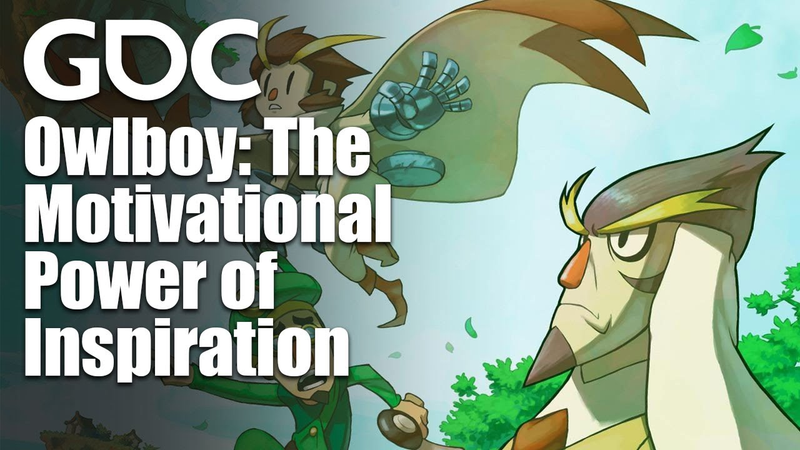
Owlboy: The Motivational Power of Inspiration
The nine-year development cycle of the indie title Owlboy serves as a case study for the critical role of sustained creative inspiration in long-term game production.
- Maintaining long-term motivation over a 9-year development cycle requires a team-wide commitment to a core vision, even when faced with significant financial hurdles and the need for secondary employment.
- Design inspiration can be sourced by internalizing experiences from other media, such as architectural elements observed during travel, and by allowing the mind to wander during periods of boredom.
- Iterative design is more effective when moving from small, rough sketches to pixel art sprites, which helps developers focus on essential shapes and silhouettes rather than getting stuck on minute details.