Game Development reports and market data
Documents
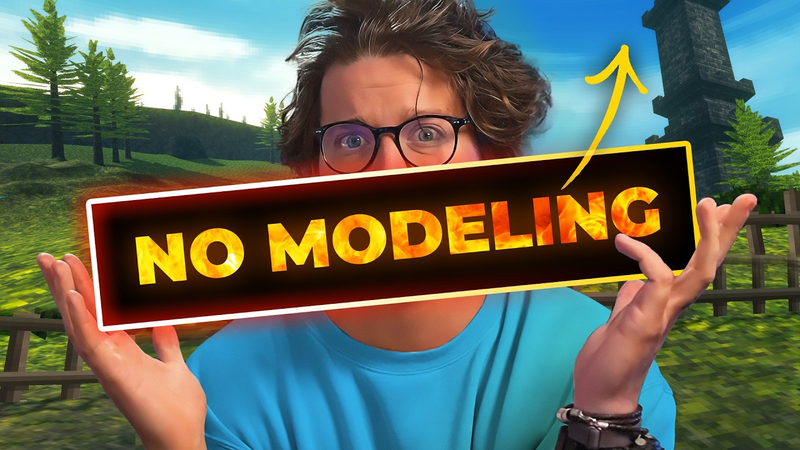
Making A 3D Game Is Way Easier Than You Think (Retro 3d Game)
The process of developing a retro-style 3D game, specifically one capturing the aesthetic of late-1990s titles like The Legend of Zelda: Ocarina of Time, can be achieved efficiently without advanced 3D modeling skills.
- Retro-style 3D games can be developed without traditional modeling skills by utilizing free assets, basic geometric primitives in Unity, and simple texture mapping.
- Visual cohesion in retro games is achieved by manually color-matching assets—such as grass, dirt, and water—to a unified palette and using a consistent skybox.
- To achieve a retro aesthetic, developers can apply post-processing effects like posterization to reduce color depth and use pixelation filters on textures to mimic early 2000s graphics.

Golden TWIG 2025: Gaming's Real Awards Show
The gaming industry in 2025 is defined by a stark divergence between the scaling success of platform-based ecosystems and the systemic instability of traditional high-budget publishing.
- Roblox has become a primary industry growth engine, recording a 70% year-over-year increase in daily active users and challenging traditional high-budget publishing models.
- Established publishers including Ubisoft, Warner Bros. Games, and Amazon Game Studios are experiencing significant commercial and reputational erosion, while high-budget titles like Concord and Splitgate 2 have failed to meet modern player expectations.
- Market success is increasingly driven by smaller-budget titles with innovative mechanics, such as Clover Pit and Animal Company, rather than the speculative, high-capital models that led to instability at firms like Forte, Bungie, Dream Haven, and TheoryCraft.

Let's Review Your Games — Ep. 038
Effective game development requires a rigorous balance between ambitious mechanics and the practical constraints of production.
- Game design is the process of reinforcing specific emotions; developers should use techniques like internal monologues to explicitly guide how a player should feel during gameplay.
- Effective game trailers must capture viewer attention within the first 10 seconds before transitioning into narrative or gameplay substance.
- Sound design should prioritize texture and dimension by mixing organic sounds with sci-fi elements, ensuring a balance across treble, bass, and mid-range frequencies.

Unity shenanigans, Space Ape postmortem, your games of the year, 2025 wrapped, more
The mobile gaming industry is currently navigating significant shifts in corporate strategy, consolidation, and monetization models.
- Unity is reportedly introducing a new 'Enterprise minimum commitment' fee for studios with over $25 million in annual gross revenue, with costs scaling from $250,000 for $25M+ earners up to $2 million for those exceeding $250M in revenue.
- Supercell completed its acquisition of Space Ape Games in November 2024, rebranding the studio as Supercell London and tasking it with applying lean live-ops expertise to legacy titles like Hay Day and Boom Beach.
- Space Ape Games' history under Supercell involved testing approximately 25 different games and numerous prototypes, a process that highlighted the studio's struggle to focus on winners and kill underperforming projects quickly enough.

Review Guesser December 17
This analysis evaluates the performance of various titles on the Steam platform by predicting review counts based on visual presentation, genre conventions, and market positioning.
- Genre selection is the primary determinant of commercial success on Steam, often outweighing visual quality or technical competency.
- Arcade-style titles, including twin-stick shooters and Star Fox-inspired flight games, consistently underperform on Steam compared to console platforms regardless of production value or IP strength.
- Visual polish and cohesive art direction are insufficient to guarantee success if the game's genre lacks a dedicated audience on the Steam platform.



Annual Review 2021: Ukie
The United Kingdom games industry experienced a period of profound expansion and heightened public visibility throughout 2021, underpinned by a record valuation of £7 billion in the preceding year.
- The UK games industry reached a record valuation of £7 billion, bolstered by a 30 percent surge in consumer spending during 2021 lockdowns.
- Ukie expanded its membership to a record 526 companies while actively managing regulatory challenges, including loot box inquiries and the Online Safety Bill.
- Despite an 11 percent decline in B2B event revenue, Ukie maintained financial stability, reporting a profit of £130,154 for the year.



Annual Review: UK
The United Kingdom games industry has solidified its status as the nation’s preeminent creative sector, achieving a valuation of £5.2 billion and a total consumer market value of £7 billion.
- The UK games industry has reached a valuation of £5.2 billion, with a total consumer market value of £7 billion.
- The sector is supported by a network of over 600 member organizations focused on maintaining global competitiveness.
- Industry policy has shifted from Video Games Tax Relief to the Video Games Expenditure Credit to improve financial effectiveness.

Retro 3D Game Workshop (No Modeling Experience Required!)
Creating a retro-style 3D game does not require advanced modeling expertise or complex production pipelines.
- Achieve a 90s-era aesthetic by stripping away modern rendering features such as normal maps, metallic properties, and high-resolution anti-aliasing.
- Prioritize manual texture manipulation, including pixelation and mosaic filtering, to ensure visual consistency across all environmental assets.
- Bypass high-poly modeling by utilizing gray-boxing, simple geometric shapes, and 2D billboards to construct game environments.

Annual Review: 2025
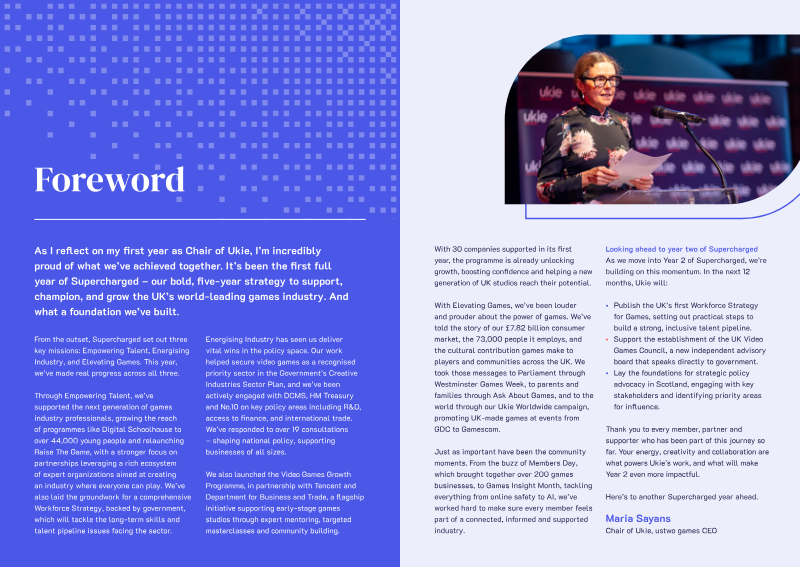
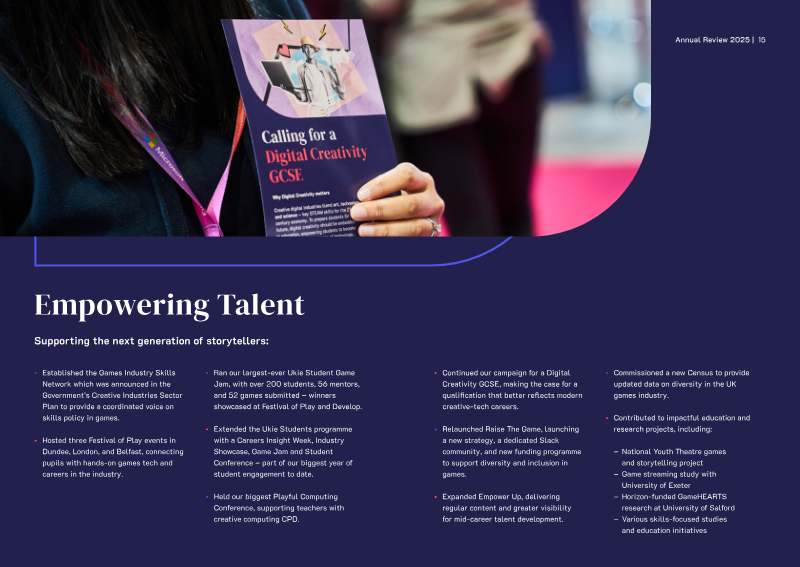
The document outlines Ukie’s first year of its five-year “Supercharged” strategy, aimed at accelerating the UK video games and interactive entertainment sector.
- UK consumer spending on video games and interactive entertainment reached a record high of £7.6 billion in 2024.
- Ukie’s advocacy efforts secured £30 million in funding for the UK Games Fund and official recognition of the sector as a key driver of economic growth.
- Global trade activities at GDC and Gamescom generated £75 million in business wins for the UK games industry.

How AI Continues to Reshape Game QA
The integration of generative AI and vision-language models is fundamentally transforming game quality assurance by shifting the industry toward black-box testing methodologies.
- Game QA is shifting from code-integrated systems to 'black-box' testing, where AI agents use computer vision to observe and interact with games without requiring deep engine-level software integration.
- Modern multimodal AI models, such as Gemini and various open-source alternatives, allow agents to perform visual reasoning by processing game images and text, enabling them to navigate and test games similarly to human players.
- The primary technical challenge in current AI QA is balancing reasoning quality with operational speed and cost, as high-latency cloud-based models often require integration with faster, locally-run models to maintain production-ready workflows.

From Space Ape to Duolingo via Supercell with Simon Hade
The evolution of modern mobile gaming studios reveals a critical shift from rapid, decentralized experimentation toward a model defined by genre mastery and operational focus.
- The mobile gaming industry has shifted from decentralized, rapid experimentation to a model of genre mastery and operational focus, as the market now demands blockbuster-level commercial performance.
- High-autonomy, broad-spectrum R&D strategies are increasingly ineffective because studios that diversify across too many genres dilute their expertise and fail to meet modern growth thresholds.
- Integrating gaming expertise into non-gaming sectors like educational technology allows companies to leverage game-like mechanics and engagement loops to drive user retention.

Meet the developer behind Bradley The Badger, The Game Awards’ most bonkers reveal
Day for Night, a game development studio founded by industry veterans Davide Soliani and Christian Cantamessa, recently debuted their upcoming title, Bradley the Badger, at The Game Awards.
- Day for Night, a studio founded by Mario + Rabbids and Red Dead Redemption veterans Davide Soliani and Christian Cantamessa, has debuted its first title, Bradley the Badger.
- The studio operates with a lean team of approximately 24 employees, prioritizing an agile, collaborative structure over the fragmented models typical of AAA development.
- The project has successfully secured funding from 1Up Ventures and Krafton, despite the current challenging global economic climate for game development investment.