Game Design reports and market data
Documents
These Games Are Winning Big In 2025!
The mobile and platform-based gaming landscape in 2025 is defined by a dichotomy between long-term sustainable titles and aggressive, hit-driven monetization models.
- The Merge 2 puzzle subgenre has experienced significant growth, with in-app purchase revenue doubling over the past 12 months.
- Financial viability in 2025 is driven by a hybrid model that pairs mass-market, accessible gameplay with deep, complex monetization systems designed to maximize revenue from high-spending users.
- Chinese development studios are currently setting the industry standard by successfully integrating casual mechanics with aggressive, hardcore monetization designs.
Subnautica 2 Publisher Implosion | Design Club
The game industry frequently operates without standardized business frameworks, leaving creative studios vulnerable to the structural instability inherent in publisher-developer relationships.
- Krafton, which acquired Unknown Worlds in October 2021, removed three key project leads—Ted Gill, Charlie Cleveland, and Max McGuire—from Subnautica 2 on July 2, 2025.
- Charlie Cleveland has filed a lawsuit against Krafton, disputing the company's claim that the game was not ready for Early Access and alleging the leadership change was a strategy to avoid paying out contractual earnouts.
- The dispute centers on conflicting assessments of development progress, with Krafton alleging the team failed to meet milestones, including the removal of a custom game mode and a reduction in narrative content from two chapters to one.

2.5 gamers x Live Game Review - Hole People by Rollic Games
Hole People, published by Rollic Games, exemplifies the current evolution of the hyper-casual market, where deterministic puzzle mechanics are leveraged primarily as vehicles for low-cost user acquisition.
- Rollic Games has shifted its business model from producing many small games to focusing on high-revenue 'hit' titles, with a single successful game like Color Block Jam potentially outperforming the combined revenue of ten smaller projects.
- The game 'Hole People' utilizes a modular development approach where core mechanics—such as the bench system, boosters, and level design—are inserted into established templates, allowing for rapid production with minimal new feature development.
- The 'Hole' theme in 'Hole People' is primarily a strategic choice for User Acquisition (UA) to achieve low CPIs, rather than a core gameplay necessity, as the game mechanics are essentially a variation of existing puzzle-genre templates.
Online Safety Act: Children's Safety Duties Factsheet
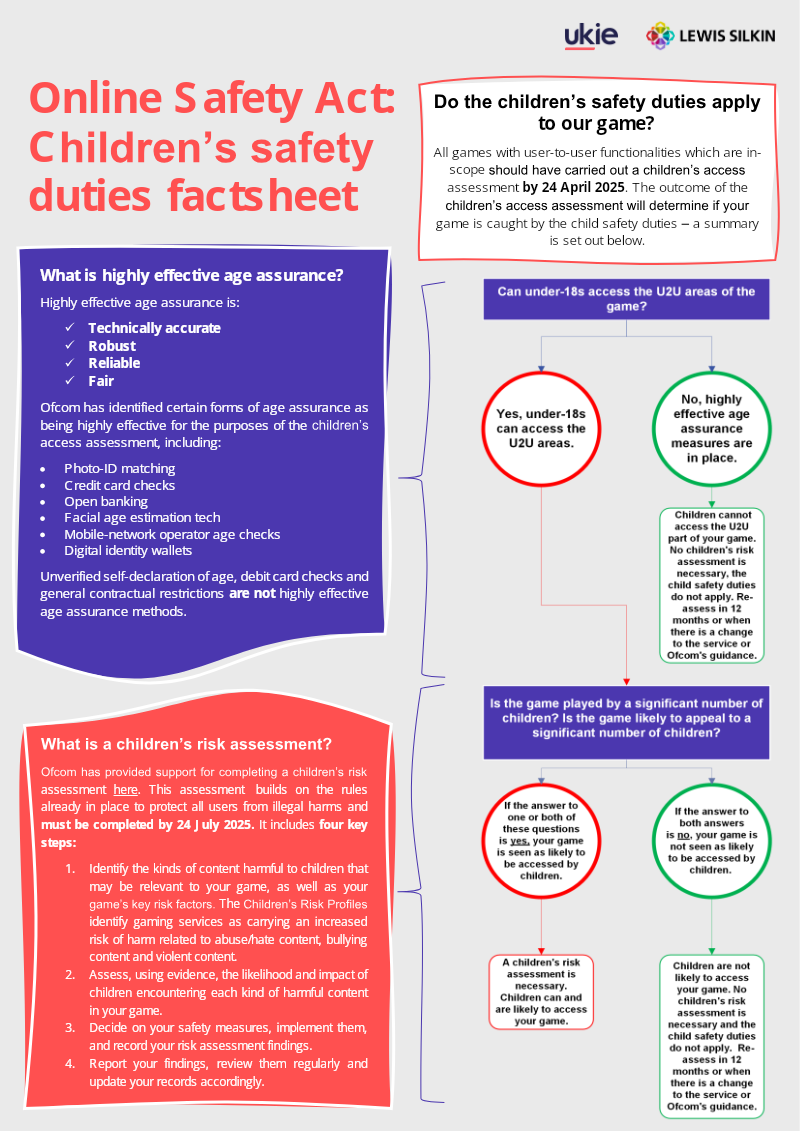
The Online Safety Act establishes a regulatory framework requiring gaming services with user-to-user (U2U) functionalities to assess and mitigate risks posed to children in the United Kingdom.
- Gaming services with user-to-user features must complete a comprehensive children’s risk assessment by July 24, 2025, if their platform is likely to be accessed by a significant number of minors.
- Ofcom requires the implementation of highly effective age assurance methods, specifically citing photo-ID matching, facial age estimation, or digital identity wallets as the standard.
- Basic age verification methods, such as unverified self-declaration or simple debit card checks, are explicitly excluded from meeting the regulatory compliance standard.

Let's Review Your Games — Ep. 021
The current landscape of independent game development reveals a critical tension between aesthetic polish and functional design.
- Market success requires balancing high-quality aesthetic polish with functional design, as seen in the contrast between the stylized engagement of 'No Way Home' and the generic, feedback-poor assets of 'Lunatics'.
- Developers must prioritize player agency by presenting challenges, such as locks, before providing the tools to overcome them to ensure progression feels rewarding rather than punishing.
- To maintain immersion during repetitive gameplay loops, developers should introduce atmospheric shifts or narrative pivots to prevent player boredom.

Let's Review Your Games — Ep. 020
Independent horror and experimental titles often succeed by prioritizing unique, surreal atmospheres over technical polish.
- A strong, eccentric creative identity can allow a game to transcend technical limitations and resonate with audiences more effectively than conventional, polished products.
- Developers must balance atmospheric choices like heavy post-processing or excessive darkness with functional accessibility to ensure players can navigate environments without frustration.
- Weak opening sequences risk losing players before they engage with core mechanics, making early narrative hooks and clear combat feedback essential for retention.

🐎 Uma Musume Pretty Derby: Best Progression System in Mobile & Why should everybody play Umamusume
Uma Musume Pretty Derby represents a significant evolution in mobile game design, successfully transitioning from a niche Japanese title to a global phenomenon with consistent daily engagement.
- Uma Musume Pretty Derby maintains long-term player retention by prioritizing deep, emergent complexity over the industry-standard model of frequent content updates.
- The core progression loop utilizes a roguelite-inspired, multi-generational breeding system where veteran characters pass stats, affinities, and skills to new trainees.
- Character optimization is driven by a three-tiered elemental system covering surface, distance, and running style, which creates a near-infinite array of strategic paths.

Top Differences Between Mobile and AAA Live Service Games (Scott Hartsman Interview)
The gaming industry is effectively bifurcated into two distinct sectors: the core PC and console market and the mobile and casual live service market.
- The gaming industry is effectively split into two distinct sectors: core PC/console games and mobile/casual live service games, each requiring fundamentally different business models.
- Mobile and casual live service games operate as a math-driven business focused on minimizing user acquisition costs while maximizing the lifetime value of each player.
- Top-performing mobile titles often utilize 'gacha' or pulse mechanics, requiring players to spend currency for random chances at items or heroes, which must then be collected in multiples to reach full power.

Let's Review Your Games — Ep. 018
Indie game development requires a rigorous focus on professional polish and intentional design to elevate projects beyond the perception of unrefined asset flips.
- Atmospheric immersion and narrative clarity are the primary drivers of player retention, requiring a shift away from generic musical scores toward reactive, thematic soundscapes.
- Effective indie storytelling should prioritize environmental cues and central mysteries over text-heavy exposition to maintain player engagement.
- Professional polish requires cohesive typography, modern lighting techniques, and directional shadows to prevent projects from being perceived as unrefined asset flips.

Keeping Live Games Good | Design Club
Maintaining a healthy, engaging live game environment requires a delicate balance between direct intervention and ecosystem management.
- Maintaining a healthy live game requires balancing direct interventions with ecosystem management to prevent dominant strategies from stifling player creativity and rendering content obsolete.
- Digital platforms should prioritize granular, surgical adjustments like stat tweaks or hitbox modifications over the blunt bans and restrictions typically required by static, physical tabletop games.
- Designers can shift the meta-game indirectly by altering environmental factors like terrain or introducing new items, which preserves the mechanical investment players have already made in their characters.

How To Start Making Games With NO EXPERIENCE
The development of successful indie games is often characterized by a transition from early personal isolation to professional collaboration, rather than innate technical mastery.
- Fredrik Prantare, creator of Core Keeper, grew the game to over 4 million copies sold, with figures currently approaching 4.5 million units.
- Prantare’s development journey began in high school by utilizing level editors in games like Heroes of Might and Magic III, which helped him build foundational design skills.
- The transition from a high-schooler with low academic attendance to a leader of a 50-person team was driven by years of iterative failure in various project 'constellations'—small, collaborative groups formed to build games.
Building Big Impact, One Brick at a Time: Marginal Gains in 'LEGO Horizon Adventures'
The philosophy of marginal gains, popularized by British cycling’s transformation into a dominant global force, serves as a powerful framework for game development.
- The principle of marginal gains suggests that if you improve a process by 1% every day, you will be 37 times better after one year due to the compounding effect of incremental improvements.
- Studio Gobo implemented a 'feedback tracker' on Confluence for each game biome to capture minor 'toe stubbers'—small friction points that were not significant enough to be classified as formal bugs.
- Small, cross-functional teams, such as the three-person 'boss pods' used in LEGO Horizon Adventures, demonstrated significantly faster iteration speeds compared to larger development teams.