Game Design reports and market data
Documents

I made Cyberpunk 2077... BUT IT'S 2D
This analysis examines the technical and creative process of adapting a complex 3D AAA title into a 2D platformer.
- The project successfully distilled a complex 3D AAA title into a 2D Metroidvania-style prototype using the Unity engine within a one-week development cycle.
- 2D development requires more intensive character animation and rigging than 3D, as the entire character model must be visible and responsive to cursor movement at all times.
- Dynamic lighting, fog, rain, and post-processing glow effects are the primary drivers for replicating a high-fidelity 'cyberpunk' atmosphere in a 2D environment.

Will Wright's 2006 Keynote: What's Next in Game Design?
Game design functions as an iterative process of discovery that prioritizes generative systems over static, pre-scripted content.
- Will Wright emphasizes that game design innovation is best achieved by assembling a small, highly specialized team of experts to solve specific technical risks rather than relying on a large, generalist workforce.
- To improve user-generated content quality, developers should focus on creating intuitive, accessible in-game editors that guide players toward higher-quality output, as most raw user content tends to be low-quality.
- Research for game concepts should be driven by deep dives into books and expert interviews, using these sources to spark iterative ideas rather than treating them as rigid blueprints.
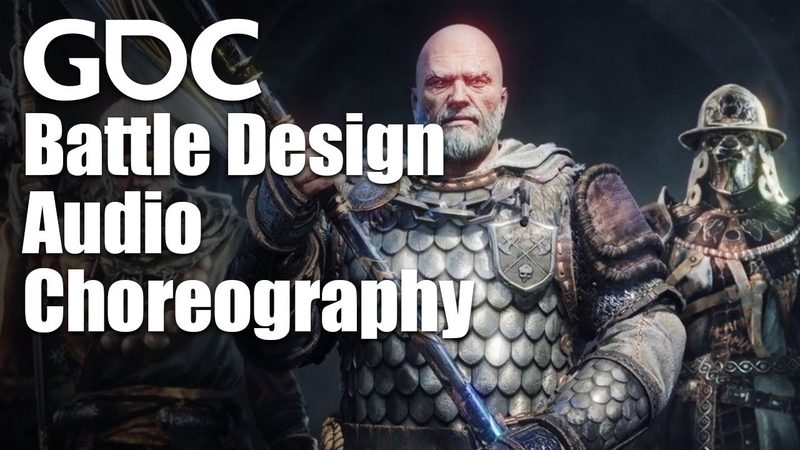
Fighting Legos: Audio Choreography for Battle Design
The primary objective of modern combat audio design is to move beyond simple, binary sound effects toward a system of bespoke, highly specific audio choreography.
- Modern AAA combat design, such as in For Honor, utilizes voiceover sound effects as a core game mechanic to provide players with immediate, consistent feedback that confirms their inputs and helps them learn the game's rules.
- Moving away from traditional 'variety packs'—where random sounds are pulled from a large bank—improves gameplay by creating a highly specific, repeatable audio-to-animation bond that reinforces player actions.
- To achieve this consistency, audio directors must coach voice actors to perform specific, repeatable sounds rather than relying on the long-standing industry practice of recording large batches of varied takes.
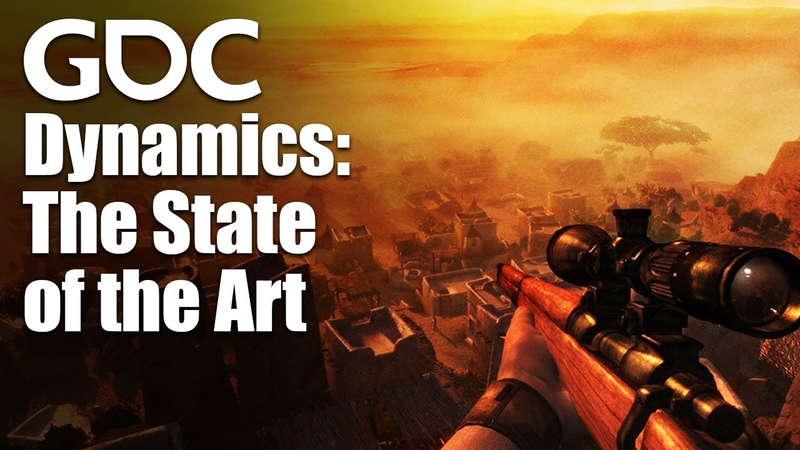
Dynamics: The State of the Art
The game industry currently lacks a unified framework for understanding how games generate meaning, a deficiency that hinders the medium’s maturation.
- Meaning in games is not inherent in static rules but emerges from the juxtaposition of player actions and systemic responses, similar to the Kuleshov Effect in cinema.
- The industry must shift focus from borrowing narrative techniques from other media to prioritizing foundational dynamics—the runtime behaviors generated by mechanics.
- Designers must balance authorial control with open systems, as seen in titles like Splinter Cell and Far Cry 2, to foster player-driven dynamics.

Designing Fall Guys with Joe Walsh | Game Dev Unchained Episode 249
The development of Fall Guys serves as a case study in balancing viral accessibility with the logistical realities of rapid scaling.
- Fall Guys achieved success eight times greater than initial 2020 launch projections by prioritizing slapstick physics and a strict three-word rule for explaining game mechanics.
- During the 2020 launch, server traffic surged to three times the capacity of the team’s most aggressive simulations, requiring methodical troubleshooting rather than reactive resource allocation.
- The development team maintained long-term production health by resisting pressure to sacrifice employee well-being for rapid content cycles during periods of intense growth.
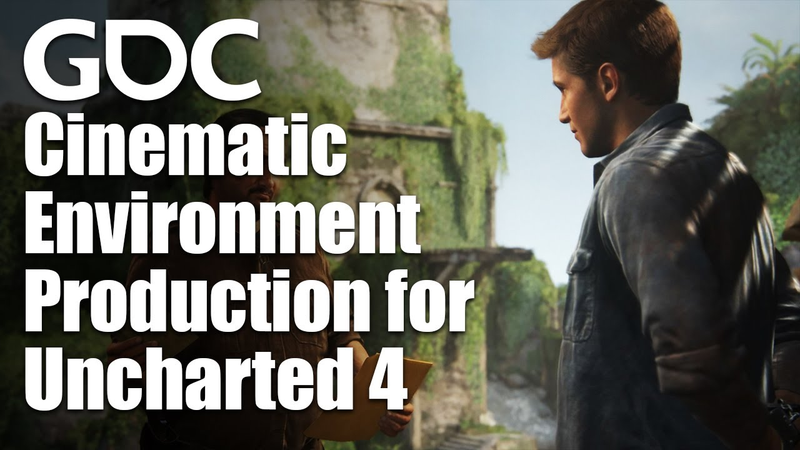
Cinematic Environment Production for Uncharted 4
The production of cinematic environments for Uncharted 4 centers on the integration of visual composition and narrative storytelling to deepen character development.
- Transitioning from pre-rendered cinematics to a real-time pipeline eliminated technical bottlenecks, enabling seamless transitions between gameplay and cutscenes.
- Cinematic spaces are scaled up by 25% compared to standard gameplay environments to accommodate specific camera angles and collision requirements.
- The production workflow utilizes an iterative process starting with rough block meshes to establish scale and composition before committing to detailed asset creation.
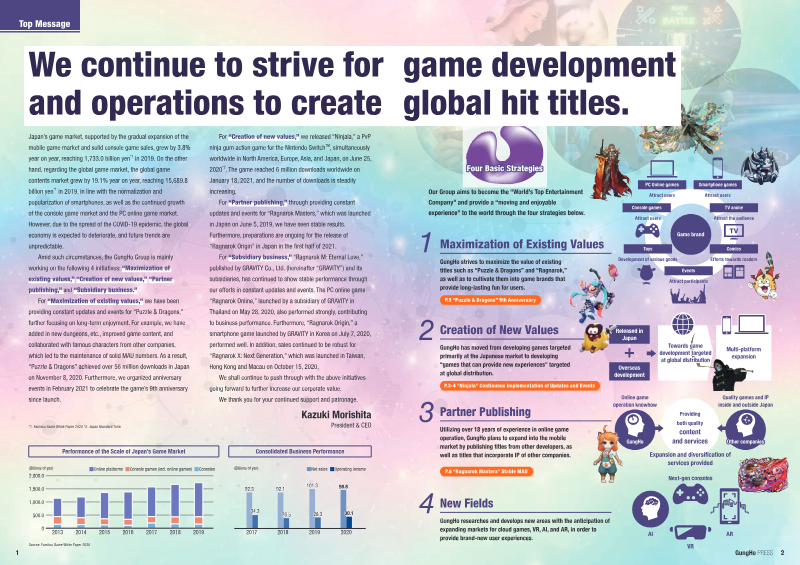
Ninjala: Battle Action Game Overview
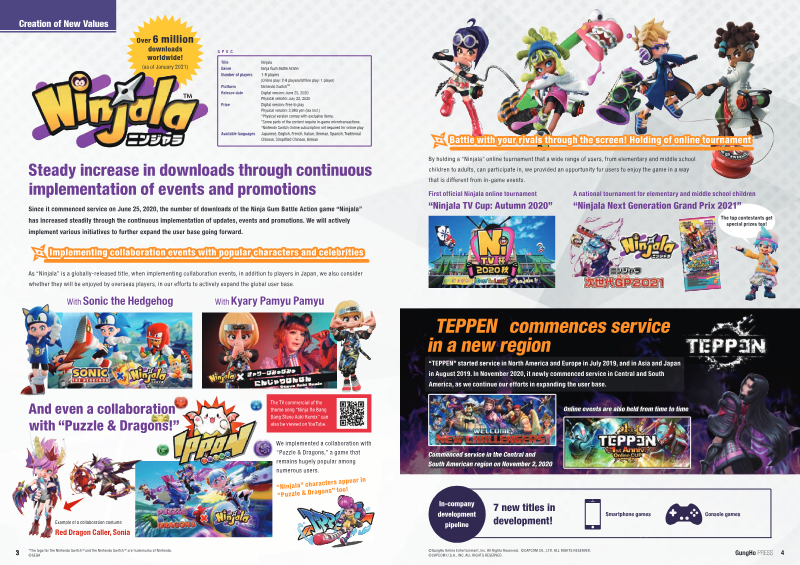
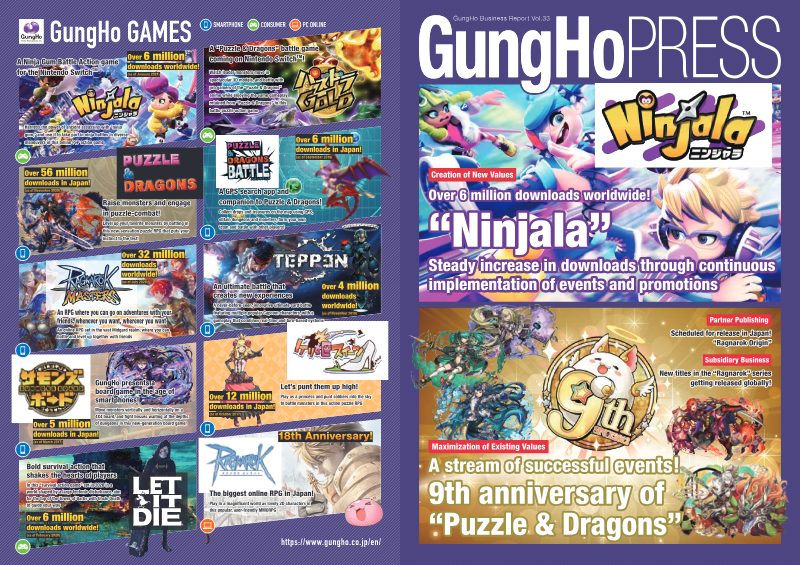
GungHo Online Entertainment pursues a multi-faceted growth strategy centered on the maximization of existing intellectual property and the creation of new, globally distributed gaming experiences.
- GungHo Online Entertainment reported 98,844 million yen in net sales and 30,157 million yen in operating income for 2020.
- The mobile title Puzzle & Dragons surpassed 56 million downloads in Japan as of November 2020 and reached its 9th anniversary in 2021.
- The Nintendo Switch PvP title Ninjala achieved over 6 million worldwide downloads by January 2021.


Market Snapshot: Q2 2021 US, China & Japan
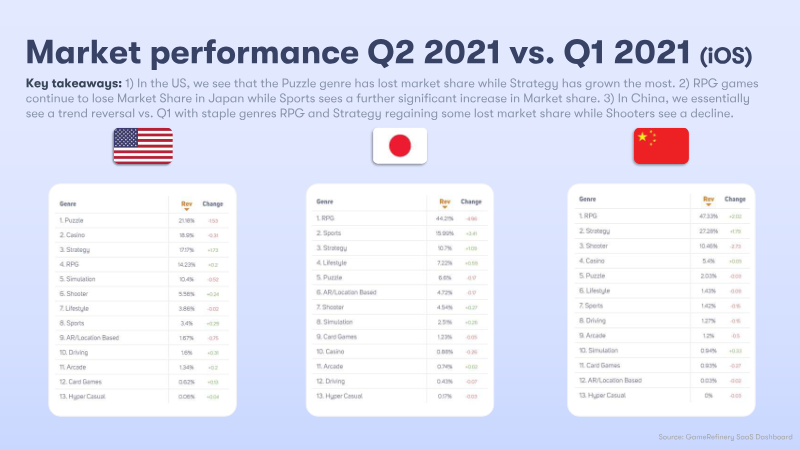
The mobile gaming market in the second quarter of 2021 experienced notable shifts in genre performance and publisher dominance across the United States, China, and Japan.
- Live-service feature updates increased by 37% year-over-year, with Strategy games leading the surge at 208% growth.
- Engagement tactics are shifting toward non-recurring live events and limited-time in-app purchase offers, which saw frequency increases of 143% and 122% respectively.
- In the US, the Strategy genre grew while the Puzzle genre declined, with Supercell emerging as a top-performing publisher.


Innovate to Win on the Next Level with Hybrid Genre Games
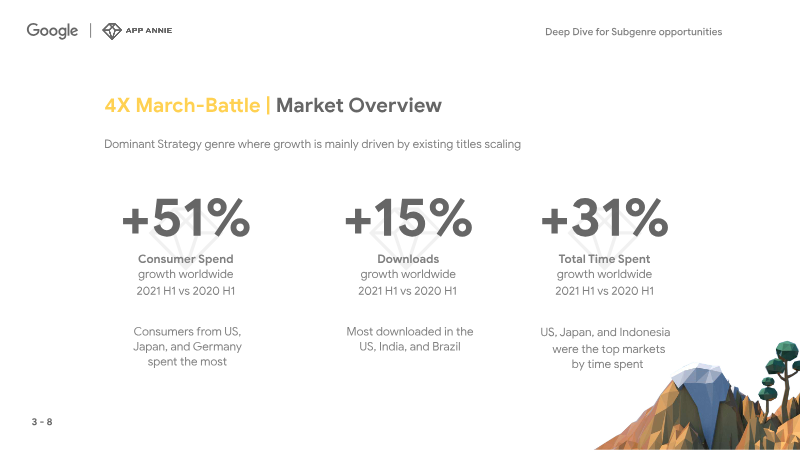
The global mobile gaming landscape has entered a period of sustained growth following the pandemic, with overseas consumer spending reaching $36 billion in the first half of 2021.
- Mobile gaming consumer spending reached $36 billion in H1 2021, marking a 73% increase since 2018, with China-based publishers now capturing 23% of the international market.
- The industry is pivoting toward hybrid game design, which integrates casual mechanics like farming or social features into hardcore frameworks to diversify monetization and broaden demographics.
- The Idol Training subgenre saw a 129% surge in consumer spending, signaling the growing global influence of Asian cultural themes and 'Nijigen' aesthetics.
Because Games Matter - Jane the Concussion Slayer - Extra Credits
The primary thesis of this account is that the psychological strengths cultivated through video games—such as resilience, optimism, and creative problem-solving—can be effectively applied to manage real-world trauma and chronic health challenges.
- The SuperBetter methodology, which gamifies recovery to manage trauma and chronic illness, has been used by over 1 million people since its inception 11 years ago.
- Peer-reviewed research from institutions like the University of Pennsylvania and Ohio State University indicates that engaging with the SuperBetter method for just 10 minutes daily can accelerate concussion recovery and reduce symptoms of anxiety and depression.
- Game designer Jane McGonigal developed the 'Jane the Concussion Slayer' framework in 2009 to treat her own Post-Concussion Syndrome, utilizing role-playing elements like secret identities, allies, and power-ups to regain agency.
The Walking Dead: Crafting a Stylized World for the Mature Franchise
Telltale Games developed a distinct, stylized visual language for the 2013 release of The Walking Dead to differentiate the title from the saturated market of gritty, realistic zombie games.
- Telltale Games achieved a unique visual identity for The Walking Dead by rejecting the industry-standard gritty, desaturated aesthetic in favor of handcrafted, comic-inspired art that utilized bold silhouettes and high-contrast lighting.
- The production team successfully maintained visual cohesion across 78 environments and 45 characters by creating 2,316 textures that featured 'crafted imperfection' to reflect the series' mature, flawed narrative themes.
- To ensure the game could run on a wide range of platforms, the team imposed strict technical constraints, including a 30,000-vertex limit per environment and the use of vertex lighting instead of per-pixel lighting.

Can You See Me Now? Building Robust AI Sensory Systems
Robust AI sensory systems function as the foundational binary check for all subsequent non-player character behaviors, requiring a collaborative development approach that integrates programming, game design, and animation.
- Align NPC sensory systems with the head bone rather than the chest to ensure perception matches visual animations, preventing immersion-breaking detection failures.
- Implement a modular library of geometric sensor shapes—such as cones, spheres, and cylinders—dynamically attached to specific character bones to provide flexible, designer-friendly tools.
- Optimize performance by utilizing local space computations and dedicated sensor bones instead of root-based positioning, while employing deferred raycast requests and stacked modifiers.