Game Culture reports and market data
Documents
An Embodied Cognition Approach for Understanding Role-playing
This paper proposes an embodied and grounded cognition framework as a unifying theory for understanding role-playing, arguing that character immersion and "bleed" (the spillover of a character's emotions into the player) emerge naturally from how cognition operates rather than from special game-specific mechanisms.
- The paper proposes embodied and grounded cognition as a unifying theory for role-playing, arguing that immersion and bleed (a character's emotions spilling into the player) arise from ordinary cognitive processes rather than game-specific mechanisms.
- Its central premise is that action, perception, and thought draw on overlapping motor and sensory systems, supported by tool-recognition neuroimaging, mirror-neuron research, and studies of facial-expression mimicry.
- Building on Barsalou's Perceptual Symbol System, the authors treat 'simulators' as multimodal knowledge structures, and argue that role-playing shares core features with pretence play, including a fictive world layered over reality and a character built on Smith's person schema.
Homo Ludicus: The Ubiquity of Play and Its Roles in Present Society
Peppino Ortoleva's essay "Homo ludicus" argues that play has moved far beyond traditional games to become a pervasive force in contemporary society, and that it constitutes a primordial human resource essential to adaptation and meaning-making.
- Play has spread far beyond traditional games into metaphor and "applied play" across domains such as war, management, science, and mourning, blurring the boundary between play and serious life that Caillois had drawn.
- Ortoleva argues that play is a primordial human resource essential to adaptation and meaning-making, and that vertigo- and imitation-based play, once confined to childhood, has been re-accepted among adults.
- Angry Birds reached over 500 million downloads in roughly five years, and Italian gambling spending exceeded €85 billion in 2011, with nearly a fifth conducted online.

First-Person Shooters: Immersion and Attention
First-person shooter immersion has been studied as a multifaceted and still-contested phenomenon, and the research discussed here frames it as a convergence of perceptual, attentional, and design factors.
- Immersion in first-person shooters lacks a single accepted definition, but scholars broadly agree it involves incorporation into the gameworld, emotional involvement, and perceived plausibility rather than strict realism.
- The research frames immersion as a sustained state of selective attention, in which players filter out their physical surroundings and focus on the gameworld, sustained by self-motivated engagement and a sense of progression rather than task difficulty alone.
- Routinized, automated control actions free cognitive resources for gameplay, and Brown and Cairns' three-level model (engagement, engrossment, total immersion) describes how attention shifts progressively toward the virtual environment.
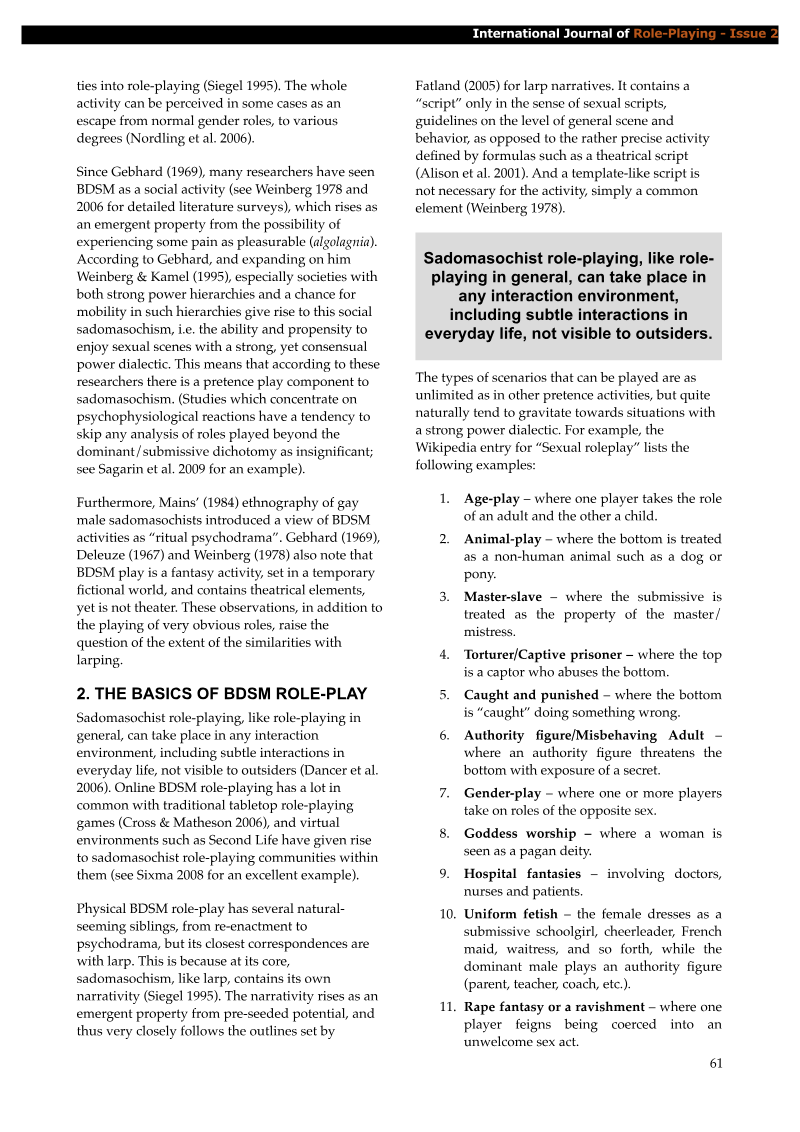
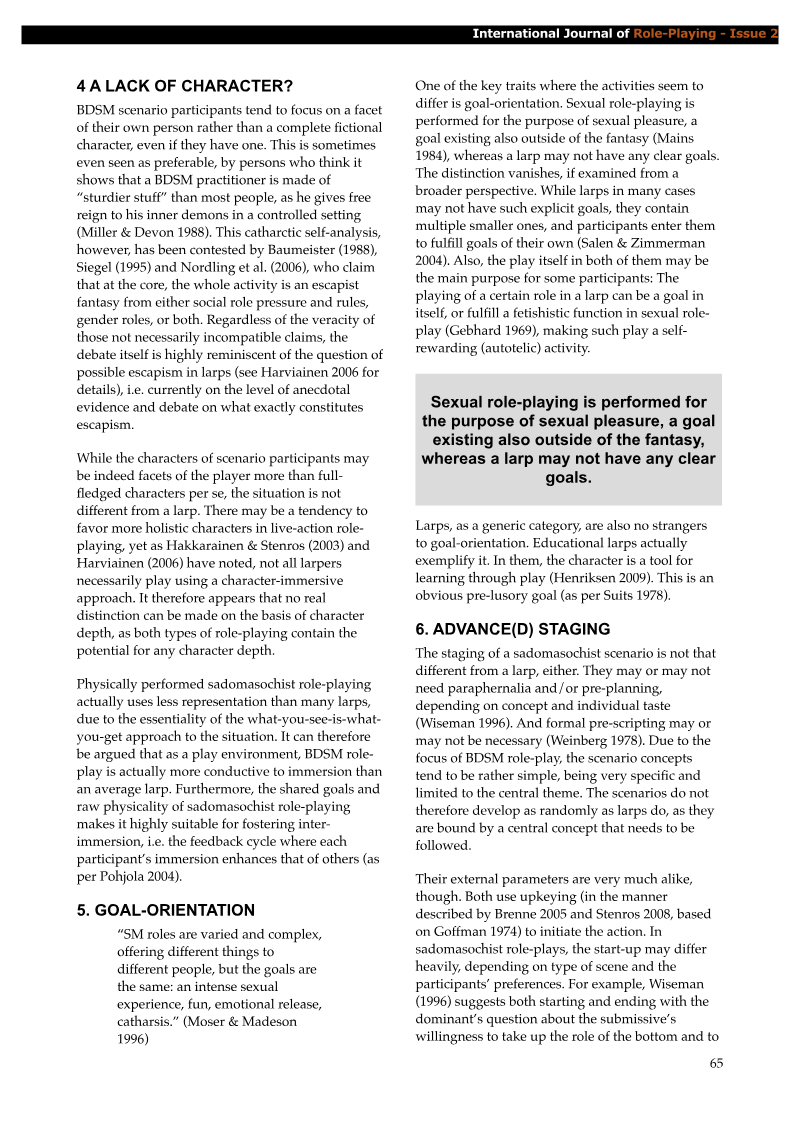
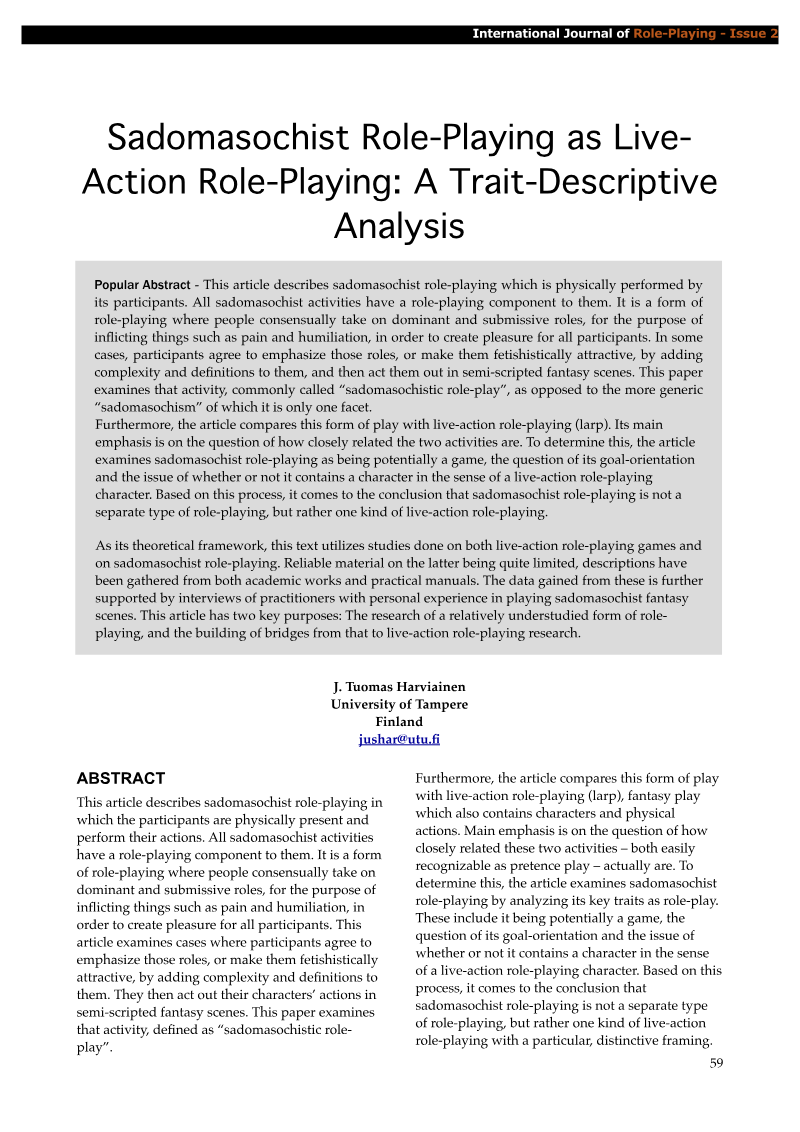
Sadomasochist Role-Playing as Live-Action Role-Playing: A Trait-Descriptive Analysis
Harviainen's paper contends that sadomasochist role-playing, or BDSM role-play, is best understood as a form of live-action role-playing (larp) rather than as a wholly separate category.
- The paper argues that consensual BDSM role-play is best understood as a form of live-action role-playing (larp), based on shared traits such as physical performance, fictional characters, and narrative structure.
- Structurally, BDSM role-play meets established definitions of games and role-playing games, sharing a magic circle, a set of rules, a dominant partner functioning much like a game master, and comparable immersion and staging mechanics.
- The main difference between the two activities lies in framing rather than structure: BDSM role-play is framed as a sexual activity and is often part of a broader sadomasochistic lifestyle, while larp is framed as a game for fun or experiential purposes.
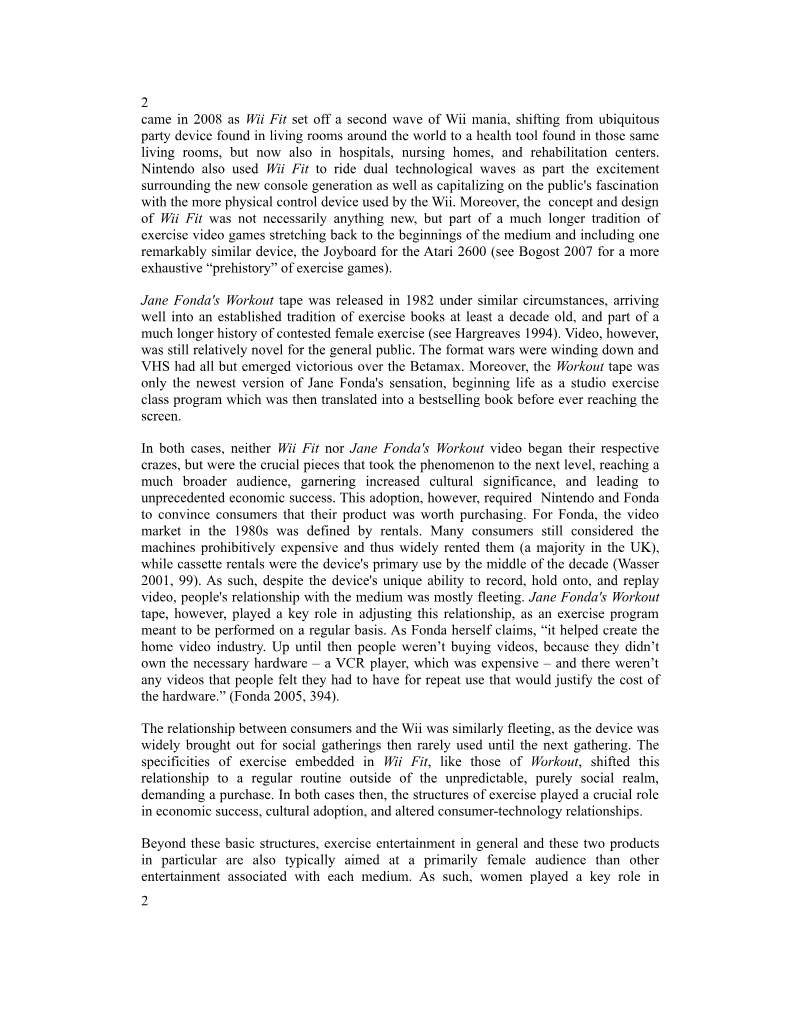
Jane Fonda's Wii Fit: Continuity, Contingency, and Concordance in Fitness Gaming
This paper examines Nintendo's Wii Fit (2007) through a historical and discursive comparison with Jane Fonda's Workout video (1982), arguing that the two products share structural parallels in how they were adopted by consumers and promoted by their producers.
- The paper argues that exercise content, rather than novelty alone, turned Wii Fit and Jane Fonda's Workout from fleeting entertainment into regular routines, and that this shift drove both products' economic and cultural success.
- Using Celeste Condit's concept of concordance, the author treats new technology adoption as a negotiated process in which producers, existing users, and wider publics contest what a device means and whether it is useful.
- Both products reached audiences broader than their predecessors and relied heavily on women for market penetration, despite the media being typically associated with men.
Danger Close: Contesting Ideologies and Contemporary Military Conflict in First-Person Shooters
Danger Close examines how the military first-person shooter Medal of Honor (2010) embeds ideological assumptions within its gameplay and presentation, despite its developers' claims of realism.
- The report argues that Medal of Honor (2010) embeds ideological assumptions despite its developers' claims of realism, driven by three interlocking forces: first-person shooter genre conventions, the military-entertainment complex, and neo-Orientalist framings of Afghans as a generic enemy Other.
- These forces strip the Afghan conflict of historical and political context, recasting the invasion of Afghanistan as a simple contest between good and evil.
- Gameplay mechanics such as the first-person gun perspective, invincible player avatars, headshot bonuses, and repetitive kill sequences (exemplified by the sniper mission "Friends from Afar") position the player as a super-human warrior and naturalize domination through destruction.
Marbles and Machiavelli: The Role of Game Play in Children’s Social Development
Lancy and Grove argue that children develop Machiavellian intelligence (MI), the social skills of alliance-building, negotiation, and strategic influence, through rule-governed, self-directed play such as marbles, hopscotch, jump rope, and make-believe.
- Lancy and Grove argue that children build "Machiavellian intelligence" (alliance-building, negotiation, and strategic influence) through rule-governed, self-directed play such as marbles, hopscotch, and jump rope, and call the resulting diplomatic competence "gamesmanship."
- The authors contend that as adult-managed activities and video games displace free play, children lose a key training ground for social intelligence.
- The argument draws on evolutionary theory, which holds that human intelligence evolved in response to the demands of group living, and on Piaget's account of children moving from motor play to seeing rules as conventional and negotiable.
Discourse Engines for Art Mods
Cindy Poremba's "Discourse Engines for Art Mods" argues that the meaning and value of art mods, modifications of commercial video games created as artistic works, depend substantially on the interpretive framework applied to them.
- Poremba argues that the meaning and value of art mods, modifications of commercial video games created as artistic works, depend substantially on the interpretive framework applied to them, and that no framework is neutral.
- Four competing discourses frame art mods: open authorship (players as co-authors), alternative media (countergaming against the industry), folk practice (vernacular modding culture), and fine-art contexts emphasizing artistic intent and appropriation.
- The open-authorship framework can obscure the distinction between artists and fan-modders, a risk Poremba identifies as a central weakness of that approach.
Stillborn Gamers? Writing a Birth Certificate for Corporeality and Locomotion in Game Research
Nørgaard's paper, presented at the Nordic DiGRA conference in 2010, argues that game research has largely neglected the corporeal and locomotive dimensions of play.
- Nørgaard's 2010 paper argues that game research has neglected the corporeal and locomotive dimensions of play, portraying gamers as detached cognitive observers when they are fundamentally embodied, movement-based agents.
- The author frames gaming as "thinking in movement," drawing on phenomenology (Drew Leder, Maxine Sheets-Johnstone, Edward Casey) on body memory and the primacy of movement.
- A survey of the thirteen articles in the WoW Reader found none addressing corporeality or movement, and a search of 99 papers in Game Studies found none focused on gamers' bodies, locomotion, or tool-use.
Fun Forever?: Toys, Games, and Play in Louisa May Alcott's Little Women
Louisa May Alcott's Little Women (1868/1869) is presented here as an unusually early and original American children's text in which play is valued for its own sake rather than merely as a vehicle for moral instruction.
- Louisa May Alcott's Little Women (1868/1869) treats play as valuable in its own right rather than merely as a vehicle for moral instruction, an unusually early stance in American children's literature, and it contrasts sharply with Martha Finley's Elsie Dinsmore (also 1868), where play is subordinated to Christian submission.
- The novel is read as a faithful record of nineteenth-century American play culture, with its improvised toys, domestic spaces such as the garret, and period games like croquet, Authors, and Rigmarole reflecting the era's leisure practices.
- Alcott's family commitment to play, especially her mother Abba's practice of hosting games, grounds the novel's emphasis on play, as shown in Alcott's childhood journals.
Conflict Management and Leadership Communication in Multiplayer Communities
Conflict in multiplayer gaming communities tends to arise less from simple misunderstandings than from deeper disagreements over motivations, cheating, and the negotiation of shared values, goals, and norms.
- Conflict in multiplayer gaming communities usually stems from deeper disagreements over motivations, cheating, and shared values or norms rather than simple misunderstandings, and because player groups are self-organized, managing it becomes a collective responsibility with leadership communication as a key mechanism.
- The study, based on interviews with 15 players and e-mail exchanges with six more, identifies a recurring tension between competitive, task-oriented "powerplayers" and casual players who prioritize enjoyment, with friction between fun and effectiveness eroding cohesion when norm interpretations stay unresolved.
- Players with serious, goal-directed motives tend to accept stronger authoritative leadership, whereas casual players are more likely to resist it.
Genre in Genre: The Role of Music in Music Games
Music games have long been shaped by the economics of music licensing, and this analysis argues that the pursuit of popular recordings drove publishers toward well-known tracks as declining CD sales and the growing commercial value of game exposure reshaped negotiations over rates.
- Music game song selection has been shaped by licensing economics: as CD sales declined and game exposure gained commercial value, publishers pursued popular recordings and rate negotiations shifted accordingly.
- Konami's Dance Dance Revolution succeeded through a deliberate balance of genres, track lists, and difficulty tiers that sustained player engagement over time.
- Ubisoft and A2M's Flow: Urban Dance Uprising, a hip hop title with a smaller licensing budget and tight development timeline, received panned reviews and weak 'meaningful play' outcomes.