Game Culture reports and market data
Documents
Player as Archivist: A Proposed Analysis of Player-centric Video Game Preservation Practice
This proposal, presented at DiGRA 2026 by researchers at Edinburgh Napier University, argues that video game preservation depends heavily on informal, player-driven labor that remains under-studied relative to institutional archiving.
- Video game preservation relies heavily on informal, player-driven labor that is under-studied compared with institutional archiving, and the paper argues this should be investigated empirically.
- The authors contend that games are complex digital objects whose authenticity depends on user practice and the lived playing experience, not only on technical layers, so purely technological preservation may lose what makes games culturally distinctive.
- The proposed research agenda examines four behavioral determinants of player-driven preservation: nostalgic motivation, preservation practice orientation (e.g., emulation, modding, walkthrough production), community engagement, and technical and resource investment.
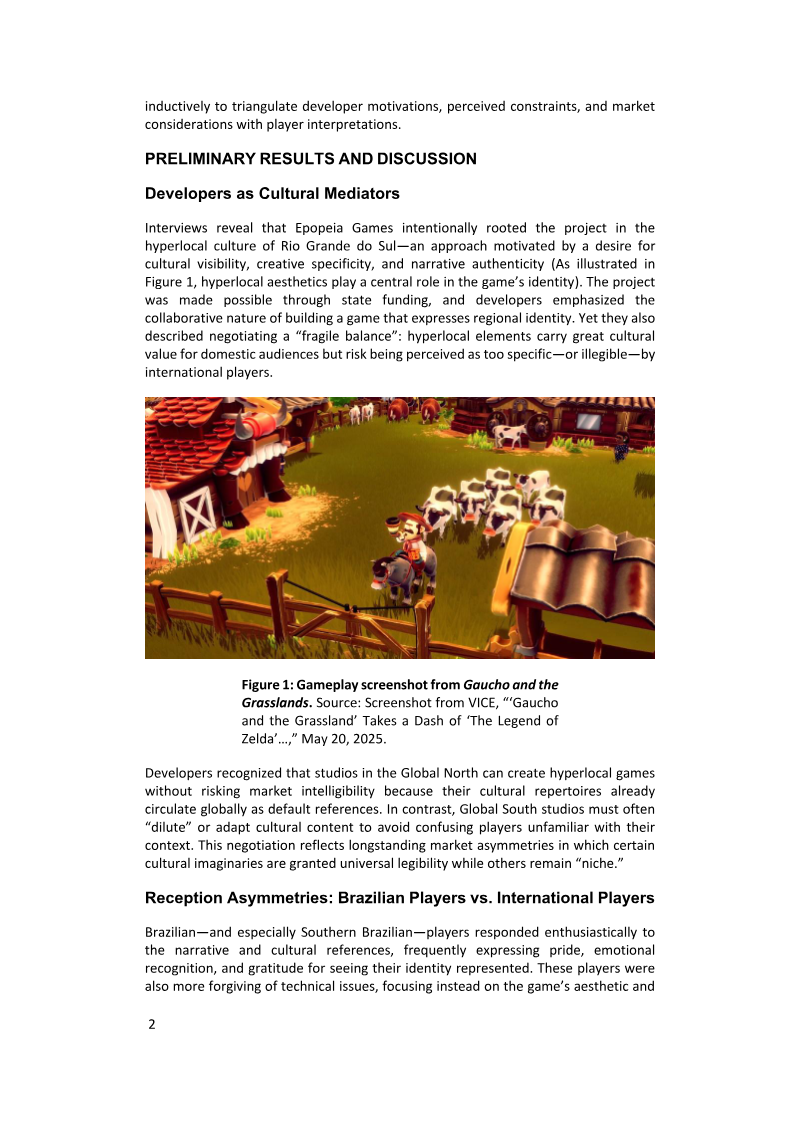
Brazilian Indie Games and Hyperlocal Identity: Analyzing Culture, Design Choices, and Steam Reception in Gaucho and the Grasslands
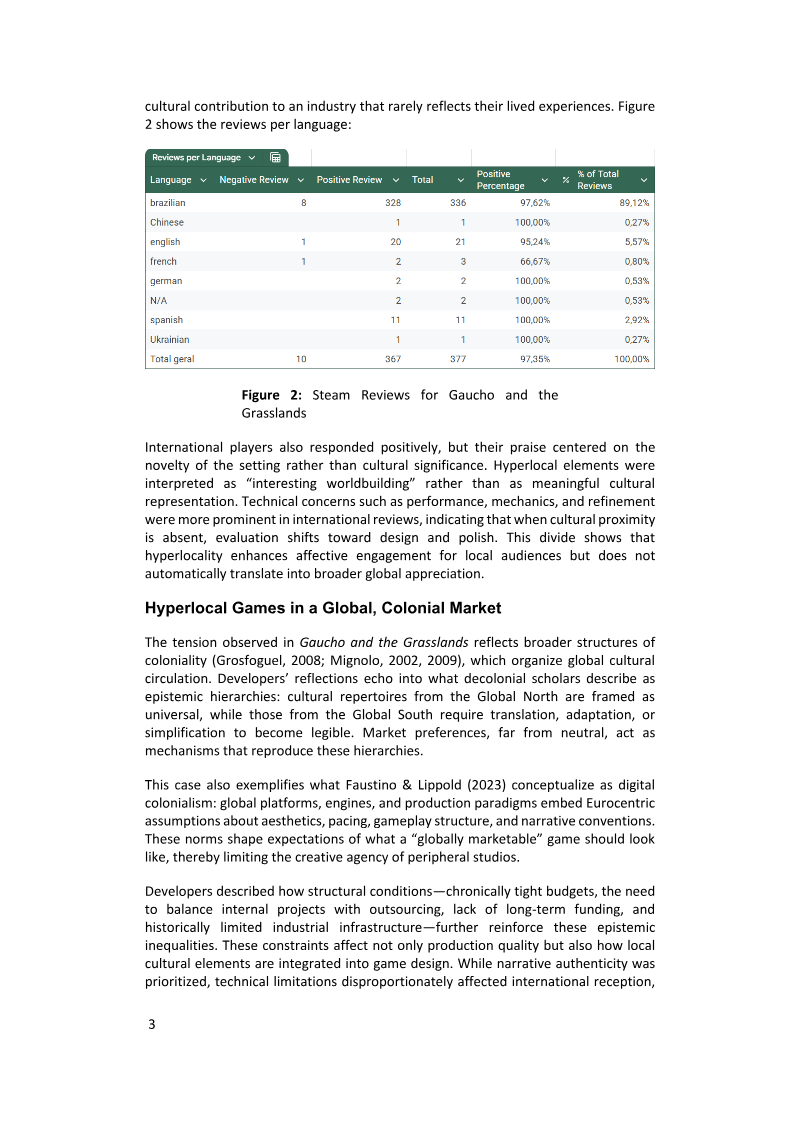
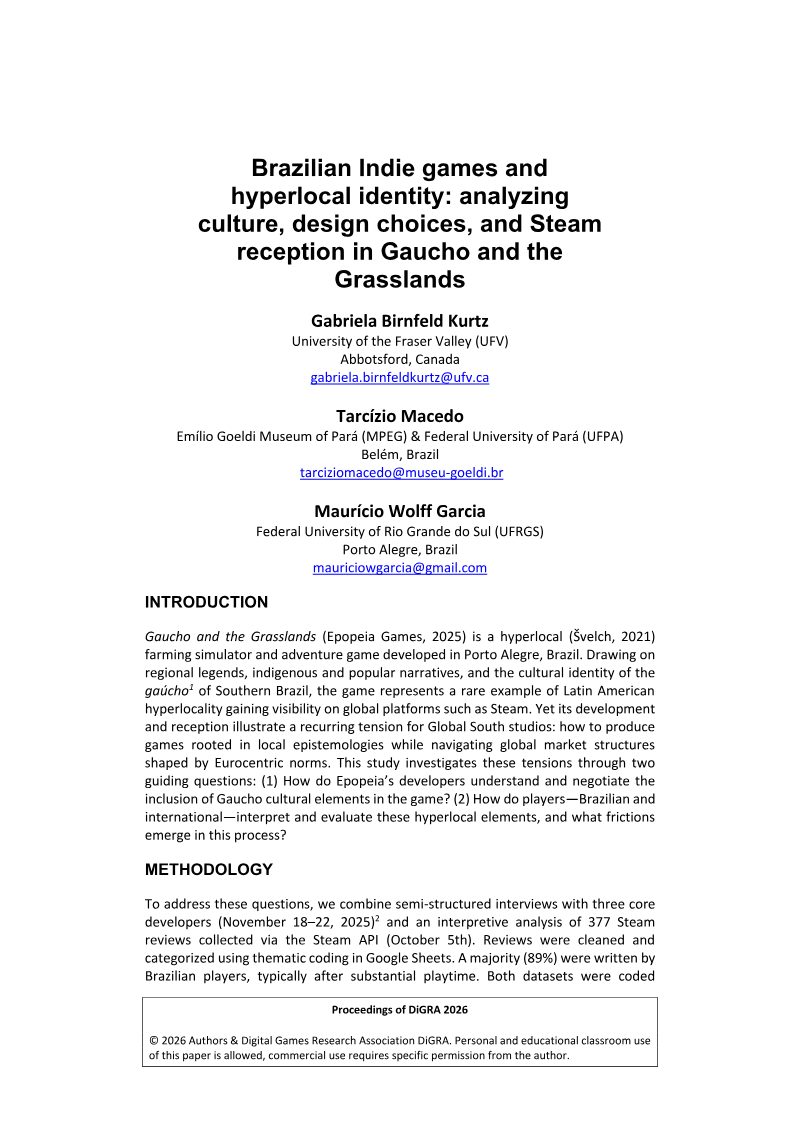
This study examines Gaucho and the Grasslands, a farming simulator and adventure game developed in Porto Alegre, Brazil, to understand how hyperlocal cultural content from Rio Grande do Sul is negotiated in production and received on the global Steam platform.
- The study analyzes Gaucho and the Grasslands, a farming simulator and adventure game developed in Porto Alegre, Brazil, to examine how hyperlocal cultural content from Rio Grande do Sul is produced and received on Steam.
- Hyperlocal cultural specificity generates strong emotional resonance with domestic players, while the same specificity creates market and legibility barriers for Global South studios seeking international audiences.
- Developers described a "fragile balance" between keeping cultural authenticity and diluting content to make it more internationally legible, a dilemma they contrast with Global North studios that can rely on globally circulating cultural defaults.



Thinking on Our Feet: Baby Steps (2025) Towards (Im)balancing the Somatic and the Stoney
This paper examines Baby Steps (2025), the Bennett Foddy, Cuzzilo, and Boch game, through a combined phenomenological, post-phenomenological, and ontological lens, arguing that the game's minimalist, extremely difficult design makes visible a reciprocal relationship between the human body and the mountain.
- The paper argues that Baby Steps (2025) makes visible a reciprocal relationship between the human body and the mountain, with the player feeling both themselves and the stony terrain as mutually constitutive agents rather than neutral backdrops.
- Its core mechanic of foot-by-foot movement (gripping, leaning, planting) is read as a source of somatic knowledge about momentum, friction, and restraint, analysed through phenomenological and new materialist scholarship including Merleau-Ponty, Straus, Marder, and Cohen.
- The awkward, unassisted protagonist (a "failson") and the plain, store-bought environment are argued to confront the assumed able-bodied, male player with the banality and uncertainty of movement.
Disclosure and the "Secret Underground Movement": Analysing Queerness in Disco Elysium
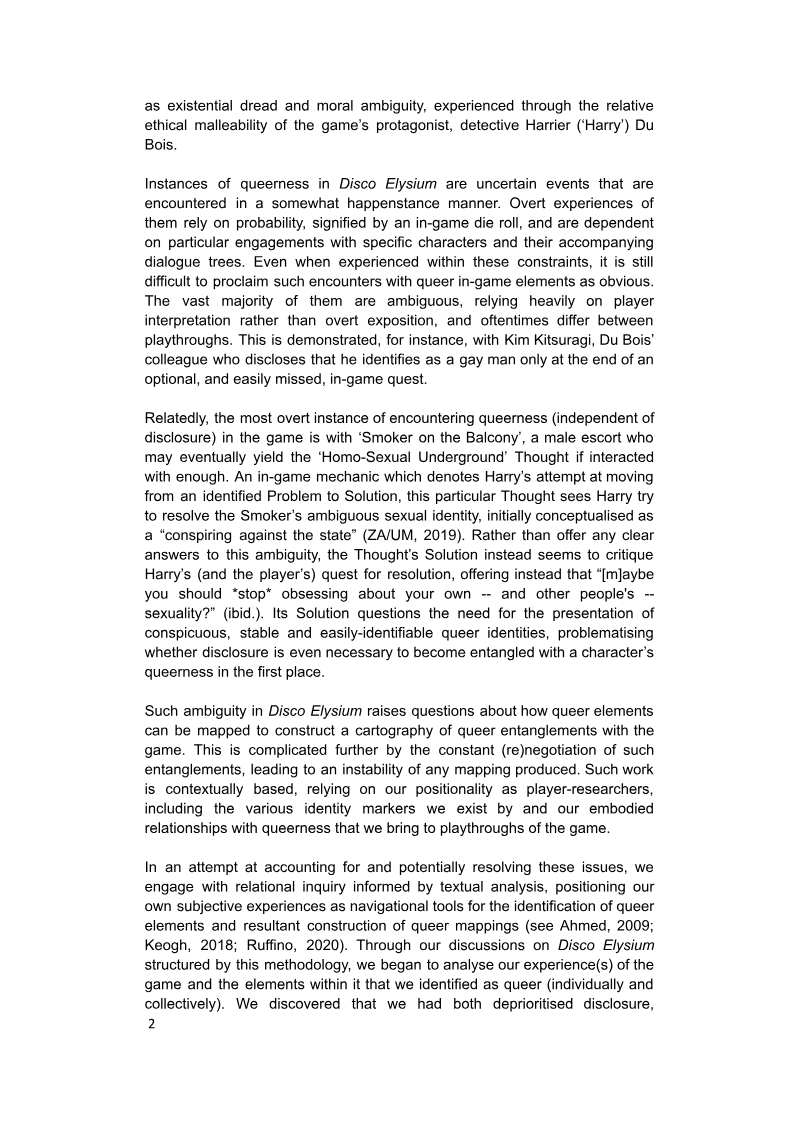
This paper examines whether disclosure is necessary for players to engage with queer elements in Disco Elysium: The Final Cut (ZA/UM, 2019), an isometric detective RPG set in the post-war city of Revachol.
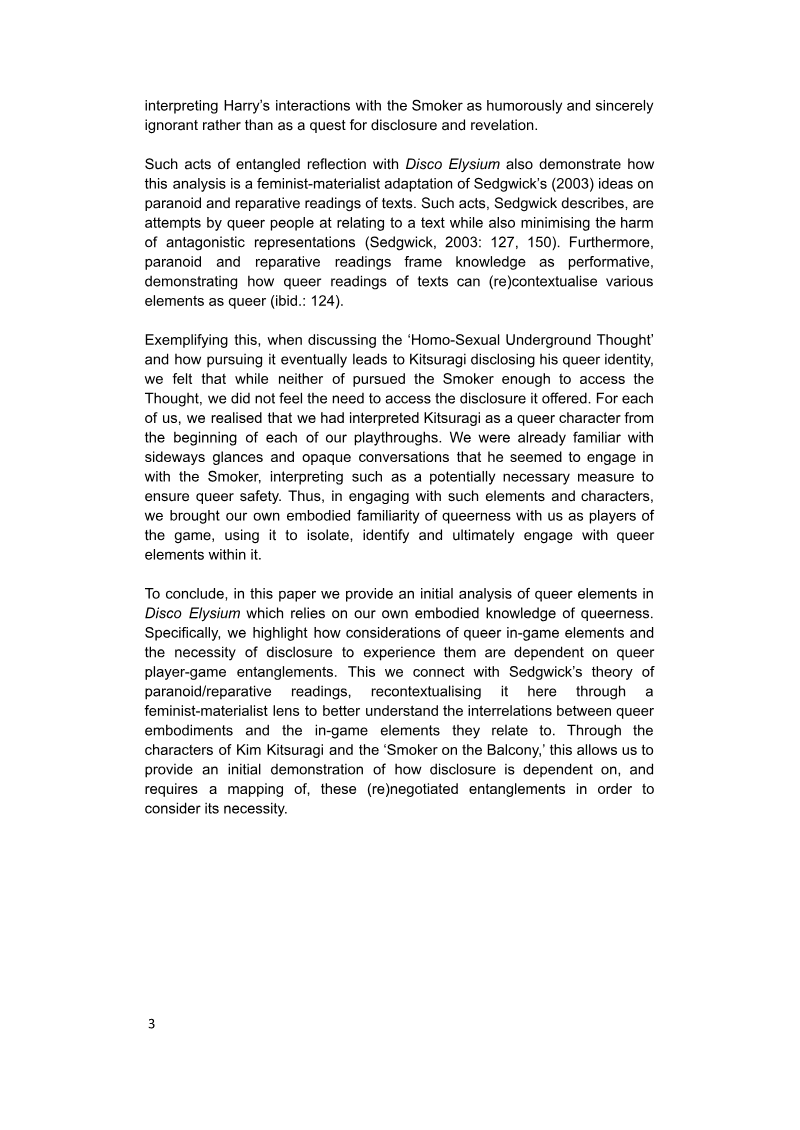
- The paper argues that queerness in Disco Elysium: The Final Cut is often ambiguous, probabilistic, and interpretively constructed rather than explicitly revealed, and that whether disclosure is necessary depends on the player's own embodied relationship to queerness.
- Its two focal cases are Kim Kitsuragi and the male escort "Smoker on the Balcony," both conditionally closeted characters whose queer elements are encountered through chance, dialogue choices, and specific character engagements.
- Kitsuragi's disclosure that he is gay occurs only at the end of an optional quest, yet the authors had already read him as queer from the start of their playthroughs, suggesting disclosure was not required for engagement.



Modernities of Authenticity in Recreated Online Digital Games: A Comparative Case Study
This paper examines how nostalgic game recreations construct authenticity, using a comparative case study of two projects that attempt to restore earlier versions of online games: World of Warcraft Classic, a recreation of the 2006 "Vanilla" version of World of Warcraft, and Team Fortress 2 Classified, a community-developed mod…
- The paper compares two nostalgic game recreations: World of Warcraft Classic, a recreation of the 2006 'Vanilla' version of World of Warcraft, and Team Fortress 2 Classified, a community-developed mod re-imagining Team Fortress 2's 2008–2009 era.
- It reframes the question from whether restorations are accurate to how different philosophies of authenticity, drawn from postmodern and post-postmodern perspectives, shape nostalgic design and play.
- World of Warcraft Classic is described as a 'genuine fake' operating through postmodern hyperreality, built on players' subjective memories and sentimental myth rather than strict fidelity, including quality-of-life updates and reimplemented historical bugs.



The Pleasure(s) of Griefing: Tracing Multimodal Toxicity in League of Legends
The paper examines multimodal toxicity in League of Legends, arguing that hostile communication in competitive online play is not confined to text chat but emerges from the combined use of pings, emotes, UI interactions, champion positioning and chat messages.
- Toxicity in League of Legends is multimodal: hostile signals emerge from combined pings, emotes, UI interactions, champion positioning and chat rather than from text chat alone, so text-only classification misses much of it.
- Toxic episodes tend to appear as clusters across channels, and understanding them requires temporally synchronized, context-aware analysis instead of surface-level classification.
- The paper's main contribution is MuMoDeTox, a prototype pipeline combining YOLOv8-based detection of pings and champion positions from video frames, minimap localization, OCR of chat and on-screen text, and external match metadata such as role and performance statistics.
Killjoy Play: Illness, Disability, and No-Fun Pleasures in Video Games
This paper examines video games that deliberately refuse conventional notions of fun in order to represent illness, disability, and care.
- The paper argues that the expectation that games be enjoyable shapes which play experiences get valued, and proposes 'no-fun' games about illness, disability, and care as a counter-model of pleasure built on frustration, slowness, non-mastery, and acceptance.
- Drawing on disability studies, crip theory, and Sara Ahmed's feminist killjoy concept, the author frames these games as 'crip killjoy' modes of play that resist cure, progress, and resolution.
- The analysis centers on three titles: you're just imagining it (npckc, 2024), That Dragon, Cancer (Numinous Games, 2016), and Before I Forget (3-Fold Games, 2020), examined through close readings of narrative, mechanics, and audiovisual design.
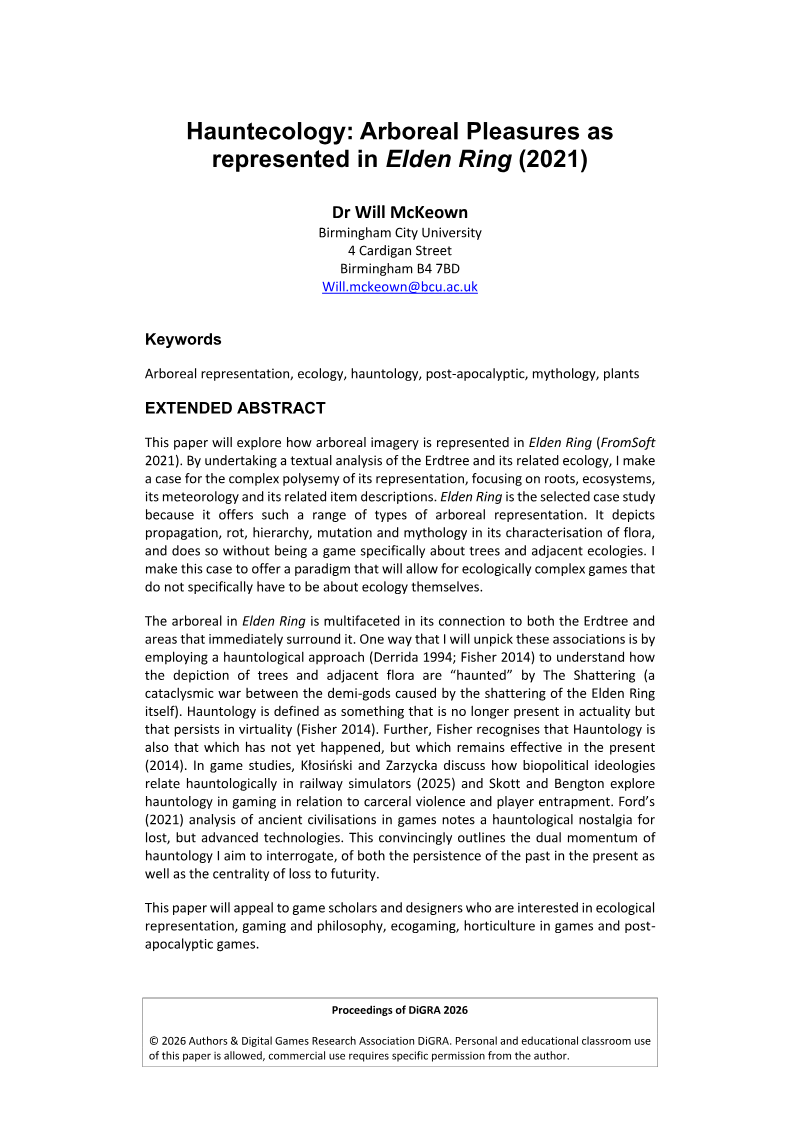
Hauntecology: Arboreal Pleasures as Represented in Elden Ring (2021)
This paper offers a textual analysis of arboreal imagery in Elden Ring (FromSoft, 2021), arguing that the game's depiction of the Erdtree and its surrounding flora carries a complex, layered set of meanings.
- The paper is a single-case textual analysis of arboreal imagery in Elden Ring (FromSoft, 2021), arguing that its depiction of the Erdtree and surrounding flora carries layered meanings despite the game not being primarily about ecology.
- It applies hauntology (following Derrida and Fisher) to read the game's botanical landscape as haunted by The Shattering, the cataclysmic war among the demigods triggered by the breaking of the Elden Ring.
- Hauntology is framed as a dual temporal force: the past persists in the present, and loss that has not yet occurred still shapes the present, giving the analysis its lens on the game's world.



My Cozy Hero: How Cozy Games Challenge Conventional Hero Dynamics
This paper examines how cozy video games reshape the traditional hero paradigm that dominates mainstream digital play.
- Cozy games shift the hero paradigm away from combat, conquest, and power accumulation toward care, gentleness, and relational support, positioning coziness as both an aesthetic and an ethical stance.
- The study draws on Project Horseshoe's definition of coziness as "the fantasy of safety, abundance, and softness" and on Miguel Sicart's concept of "player logic" as its theoretical foundation.
- The analysis is based on close readings of three titles (Spiritfarer, Wanderstop, and Sips and Sonnets) rather than large-scale player surveys or quantitative data, and is presented as among the first systematic studies of the hero's role in the genre.
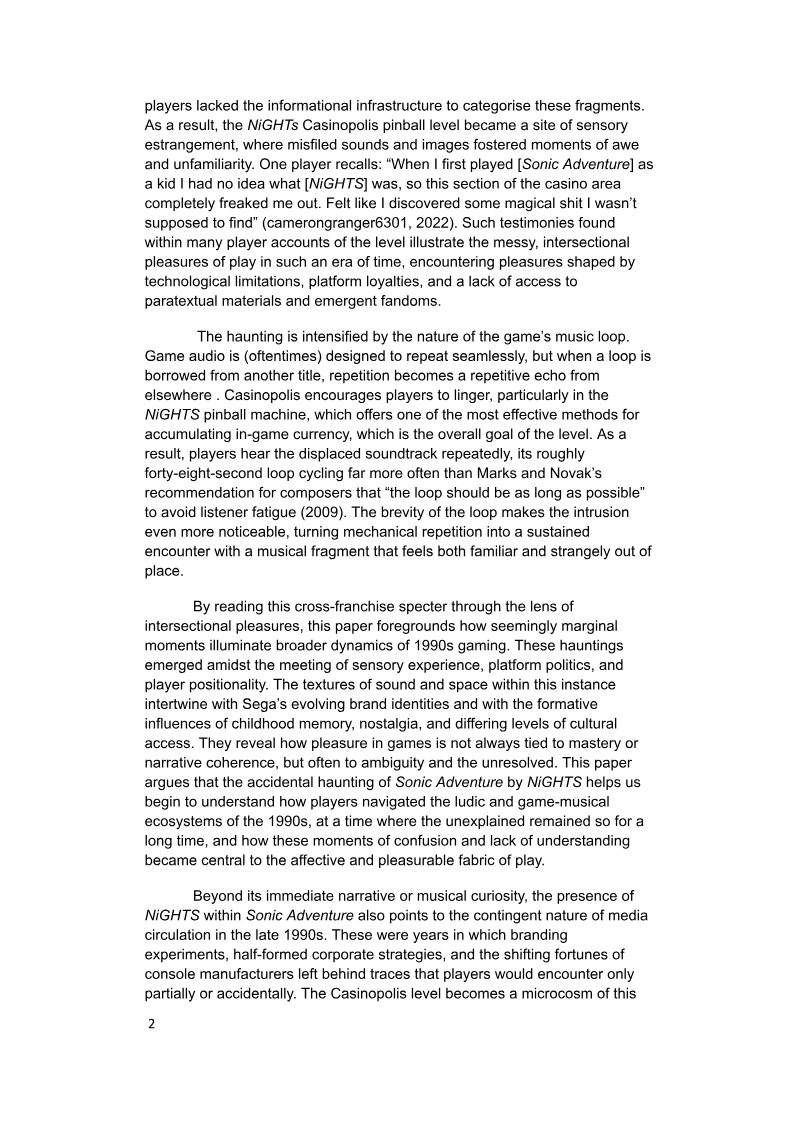
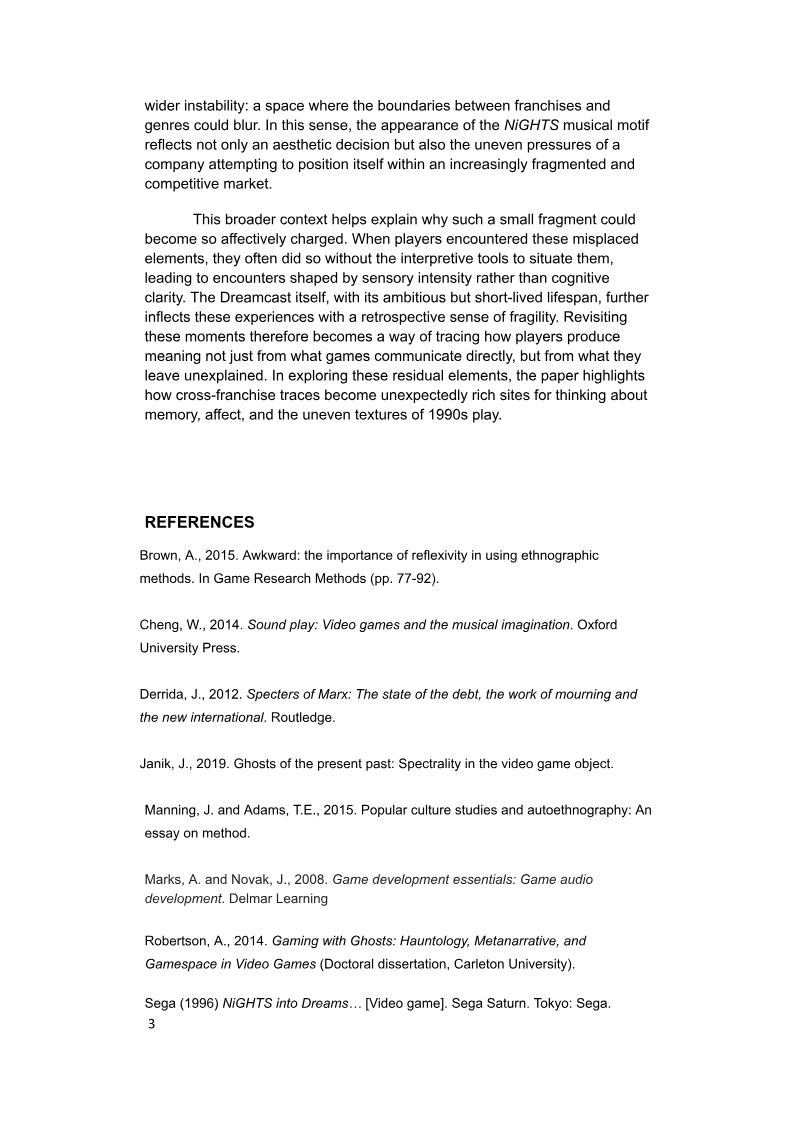
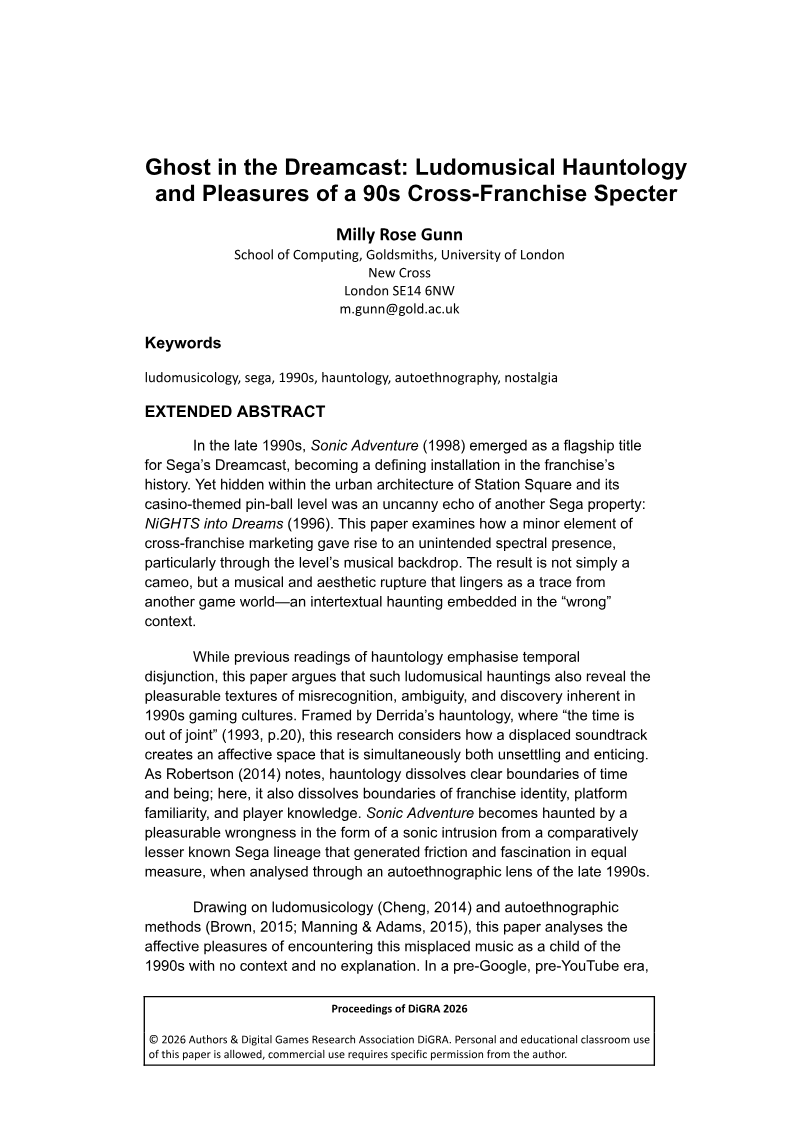
Ghost in the Dreamcast: Ludomusical Hauntology and Pleasures of a 90s Cross-Franchise Specter
This paper examines an unintended cross-franchise presence in Sonic Adventure (1998), the Dreamcast flagship, where a pinball level in the Casinopolis area carries a musical loop borrowed from Sega's NiGHTS into Dreams (1996).
- The paper analyses an unintended cross-franchise intrusion in Sonic Adventure (1998), the Dreamcast flagship, where a Casinopolis pinball level loops a musical fragment borrowed from Sega's NiGHTS into Dreams (1996).
- Using hauntology and autoethnographic method, the author argues that displaced soundtracks generate affective pleasures of misrecognition, ambiguity, and discovery characteristic of late-1990s play.
- The loop's roughly forty-eight-second duration is markedly shorter than conventional game-music recommendations, and combined with the level's incentive to prolong play at the NiGHTS pinball machine, it recurs frequently and sustains an encounter with familiar-yet-out-of-place material.
Posthuman Cuteness: Affective and Agentic Tensions
This paper examines cuteness in videogames through a textual analysis of the Turnip Boy series, namely Turnip Boy Commits Tax Evasion (2021) and its sequel Turnip Boy Robs a Bank (2024).
- The paper's central claim is that cuteness, as an instrumentalised emotive form, lets cute things resist subordination and become agentic subjects within a posthuman framework.
- Turnip Boy is framed as subordinate in three overlapping ways: as a vegetable positioned as 'less than' human, as an avatar subordinate to the player, and as a cute object apparently posing no threat.
- The games nonetheless depict Turnip Boy threatening economic structures such as capitalism, and in the sequel Turnip Boy Robs a Bank (2024) he shakes down fellow vegetables for money.
How Can an Unfinished Multiplayer Networking Scheme Produce Pleasure? XBAND as an Affective Infrastructure
This paper revisits XBAND, a short-lived 1994 third-party modem peripheral for the Super Nintendo and Sega Genesis, to argue that its appeal lay less in the games themselves than in players' relationship to an unfinished, visible, and breakable networking infrastructure.
- XBAND was a short-lived 1994 third-party modem peripheral for the Super Nintendo and Sega Genesis, and the paper argues its appeal lay less in the games than in players' relationship to its unfinished, visible, and breakable networking infrastructure.
- XBAND used a hybrid design: a central server handled authentication and matchmaking, while matches ran over direct modem-to-modem phone calls, making players co-producers of the system rather than passive endpoints.
- Marketing promoted seamless ease, but the system's technical labor was concealed; programmers reverse-engineered individual titles to enable online play, and players took pride in the system's complexity and the rare access it granted.