Game Culture reports and market data
Documents



Old Pleasures, Dying Flames: Final Fantasy XIV and the Evolution of the MMO Genre
This paper, by Benjamin Horn of the University of Hong Kong, examines how Final Fantasy XIV has evolved over more than a decade and what that evolution reveals about the enduring appeal of massively multiplayer online role-playing games.
- Naoki Yoshida, director of Final Fantasy XIV, suggested in 2025 that the MMO genre's demand for hundreds of hours of investment no longer fits contemporary play habits, a claim this paper challenges.
- A February 2026 community census estimated 934,000 active Final Fantasy XIV players, which the author cites as evidence against the idea that MMOs are declining as a genre.
- The paper, by Benjamin Horn of the University of Hong Kong, traces Final Fantasy XIV's development from its original 2010 release through the 2013 relaunch to the present, treating it as a single-title longitudinal case study.



Time vs. History in JRPGs
This paper examines how Japanese Roleplaying Games (JRPGs) that use time travel as a narrative or gameplay mechanic represent history, and what those representations imply for both players and scholars of Historical Game Studies.
- The paper argues that fantasy JRPGs with time-travel mechanics shape how players understand history, rather than merely being interpreted through modernist academic frameworks.
- It introduces the concept of chrononormativity, the conventional linear expectation about time, and asks whether departures from it lead players to see history as fractured and in need of repair.
- The analysis closely reads a selected set of titles, including Final Fantasy XIII-2, Radiant Historia, Chrono Trigger, Chrono Cross, Final Fantasy XIV: Heavensward, Tales of Phantasia, and Tales of Destiny 2.

Right Click to De-escalate: Call of Duty and Turning Propaganda into Pleasure
This paper offers a case study of the Call of Duty franchise, focusing mainly on the Modern Warfare series, to examine how the pleasurable mechanics of first-person shooters carry political messaging about armed conflict.
- The paper argues that Call of Duty's pleasurable first-person mechanics carry political messaging about war, drawing on Ian Bogost's concept of procedural rhetoric, and that fast, embodied gameplay leaves players little room for critical distance from these claims.
- Modern Warfare II is cited for a de-escalation prompt on the US-Mexico border mission that is undercut by the player aiming weapons at panicked civilians, and for an AC-130 sequence that lets players destroy schools and residential buildings without the campaign acknowledging any breach of the laws of war.
- The multiplayer Killstreak system, which includes white phosphorus alongside conventional rewards, is read as normalizing questionable weapons.



What Now?: Ecogames after Missed Climate Targets
This conference paper by Conor McKeown argues that ecogames scholarship must shift from a focus on preservation and damage limitation toward engagement with the lived realities of an already-changing climate, now that overshooting the Paris 1.5°C target is effectively acknowledged as inevitable.
- McKeown argues ecogames scholarship must shift from preservation and damage limitation toward engaging with the lived realities of an already-changing climate, since overshooting the Paris 1.5°C target is effectively acknowledged as inevitable.
- He contends that existing ecogames work remains oriented toward hopeful, forward-looking reforms of game design and industry practice and is insufficiently anchored in present climate catastrophe.
- The paper proposes that games addressing livability, citizenship, and practical adaptation should count as ecogames, with climate migration identified as the most pressing concern.
Parasocial Incidental Politics: How Twitch Users Navigate Political Content and Misinformation
This study examines how young adults aged 16 to 29 perceive political content and misinformation on Twitch, and how they attribute political roles to streamers.
- The study is based on 60 problem-centered interviews with young adults aged 16 to 29 and analyzed through grounded theory, and it introduces the framework of 'parasocial incidental politics' to describe how political meaning emerges unintentionally on Twitch.
- Political meaning on Twitch arises mainly from moral cues, solidarity, humor, and fairness judgments rather than structured political messaging, and even streamers who avoid explicit politics are often read politically by viewers.
- Political topics on Twitch surface mainly around events, and chat environments can quickly escalate them into heated, 'war-like' exchanges due to the speed and emotional intensity of live interaction.
Applied Ethics Techniques for Video Game Ethics
This paper proposes that two families of techniques from analytic applied ethics, case construction and engaging perspectives, can strengthen both the teaching of video game ethics and collaboration among researchers and practitioners.
- The paper argues that game ethics has grown rapidly as a field, but its teaching and research are complicated by the diverse assumptions and evaluative standards found across games scholarship.
- Its central proposal is that two families of techniques from analytic applied ethics, case construction and engaging perspectives, can structure debate, clarify agreement, and pinpoint the true sources of disagreement among researchers and practitioners.
- Case construction includes analogies, which test a target case against a structurally similar one, and simplifying examples, which strip away complicating features to reveal which elements actually drive moral evaluation.
Interactivity as Embodied Pleasure: A Media-Phenomenological Reframing through Interactive Short Videos
This theoretical paper challenges the dominant technical-operational definition of interactivity in game studies by examining "finger-interactive" short videos on platforms such as Douyin and TikTok.
- The paper argues that the dominant technical-operational definition of interactivity in game studies is too narrow, since 'finger-interactive' short videos on Douyin and TikTok invite touch and reward performance even though the system detects no input, adapts to no action, and changes no state.
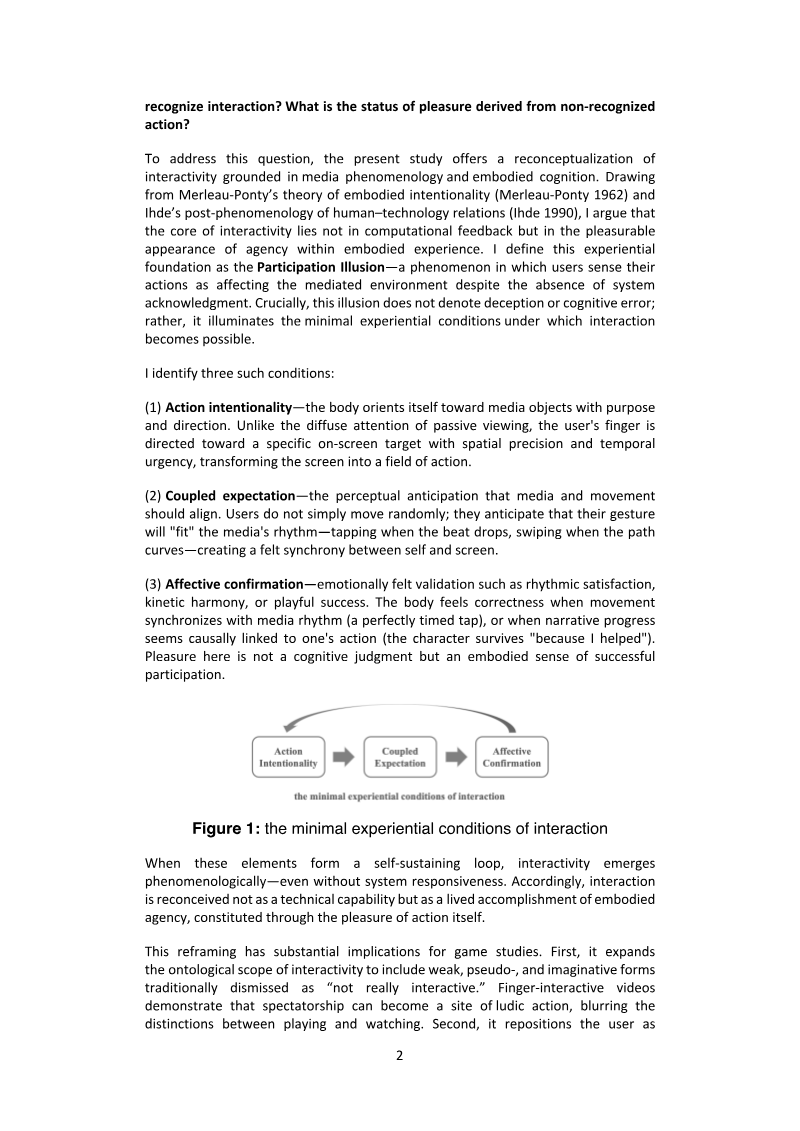
- It introduces the 'Participation Illusion', a felt sense that one's actions affect the mediated environment without any system acknowledgment, and presents it as identifying the minimal experiential conditions of interaction rather than as deception.
- The minimal conditions of interactivity are identified as action intentionality, coupled expectation between movement and media rhythm, and affective confirmation through felt correctness or success; when these form a self-sustaining loop, interactivity emerges regardless of computational responsiveness.



Monstera pocketii: The Botanical Vitality of Pokémon
This paper argues that the Pokémon franchise should be read through plant studies rather than solely as representations of animals.
- The paper argues Pokémon should be read through plant studies rather than solely as animal representations, emphasizing the botanical and 'living surface' qualities of the creatures and franchise, which exceed the category of the animal.
- Author Nikolas Matovinovic (Monash University) builds on ecocritical and critical plant studies frameworks, drawing on Sean Morey and Jason Crider's 'Hyperanimal' concept and theories of plant agency and interspecies communication, including orchid-wasp relations.
- Carnivorous-plant-inspired Pokémon such as Victreebel and Carnivine are presented as the most significant contemporary screen depiction of carnivorous plants, a category the paper says existing plant horror scholarship largely overlooks.
Artistic In-Game Photographs as Media of Care
This paper argues that many works of artistic in-game photography can be understood as media of care, drawing on feminist care ethics, game studies, and photography theory.
- The paper argues that artistic in-game photographs can be read as 'media of care,' showing care structures thematically, structurally, or materially and taking part in discourses on social and ecological responsibility.
- It proposes two care structures: existential care, arising from the obligation to keep avatars alive and sustain play (which persists even when photo mode suspends it), and relational care, adapted from Puig de la Bellacasa's 'matters of care' to describe how games embed in broader ecologies beyond play.
- The analysis is qualitative and media-aesthetic/photography-theoretical; it reports no survey sample or dataset, so its claims rest on interpretation of selected works rather than measured evidence.
Rendering Romania: A Corpus-Based Analysis of Othering in Video Games
This paper proposes a corpus-based, quantitative and typological analysis of how Romania and Romanianness are represented in video games developed by foreign studios.
- The paper is a research proposal rather than a completed study: it reports no corpus size, coding scheme, or empirical findings, so its conclusions remain provisional.
- Its central argument is that existing scholarship analyses 'othering' of Romania in games through close readings of individual titles, while the cumulative pattern across unrelated games remains understudied.
- The authors frame Romanian representation through 'hetero-images' drawn from imagology, examining historical situatedness, character individualization, handling of the Romanian language, and culturally specific references.
Playable Folklore: Digital Games and the Representation of Folklore and Cultural Heritage
This paper examines how digital games represent folklore and cultural heritage, arguing that the translation of living, variable cultural processes into codified, rule-based systems introduces structural and ethical tensions.
- Translating living, variable folklore into codified, rule-based game systems creates structural and ethical tensions, chiefly that tradition becomes stabilised as 'heritage' when it is managed or staged for external consumption.
- The paper proposes 'playable folklore' as a lens that treats games not as display cases for heritage but as cultural systems in which traditions are selected, stabilised, transformed, and contested.
- Its theoretical framework rests on four concepts: cultural presence, folk mechanics, digital folklore, and mnemonic hegemony.
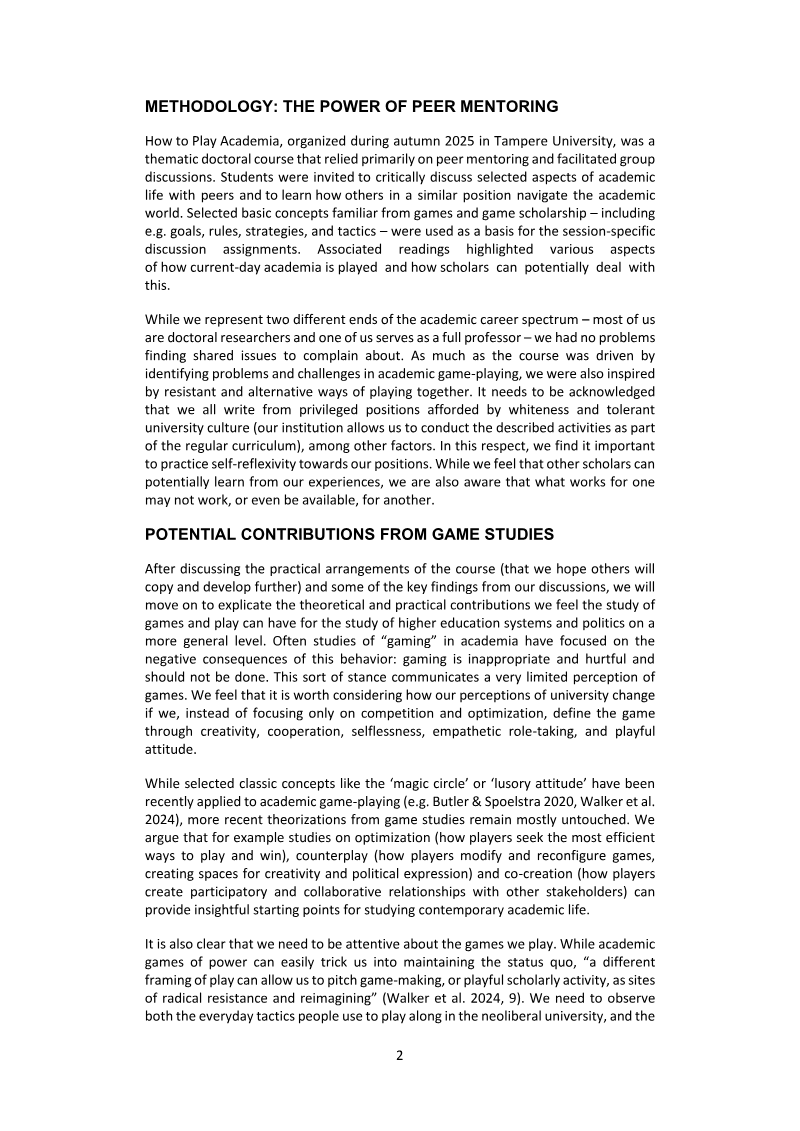
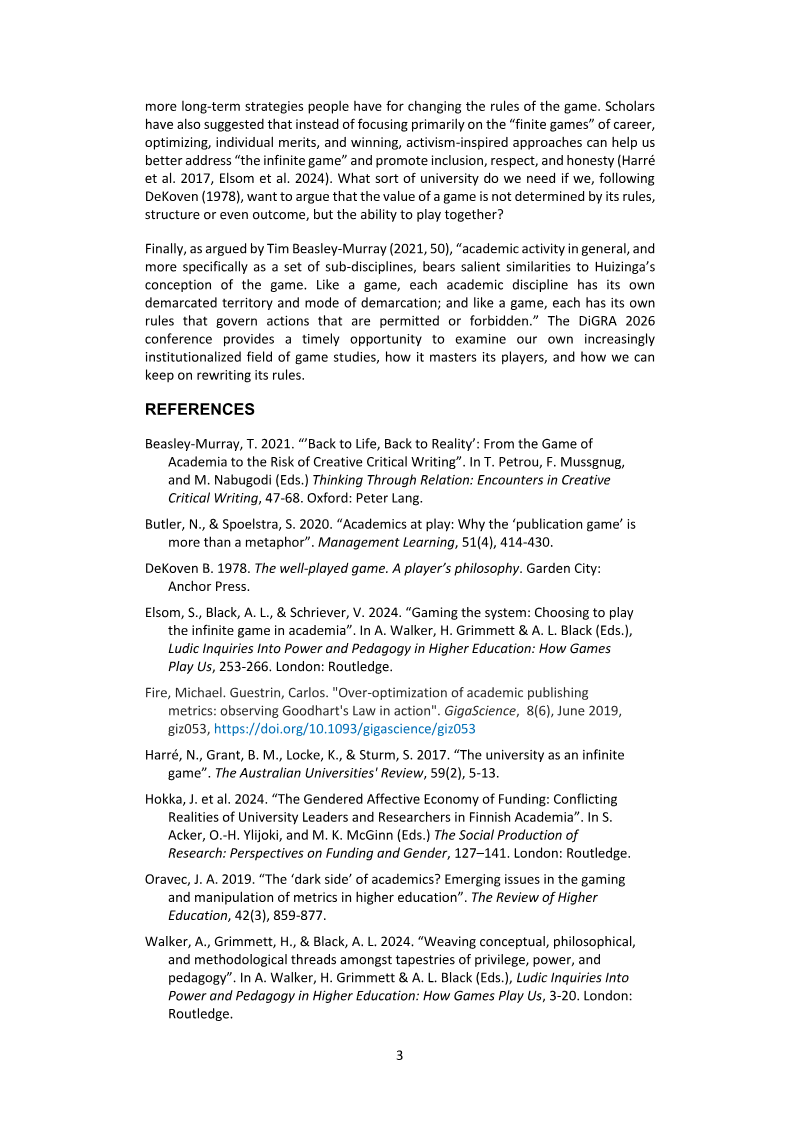
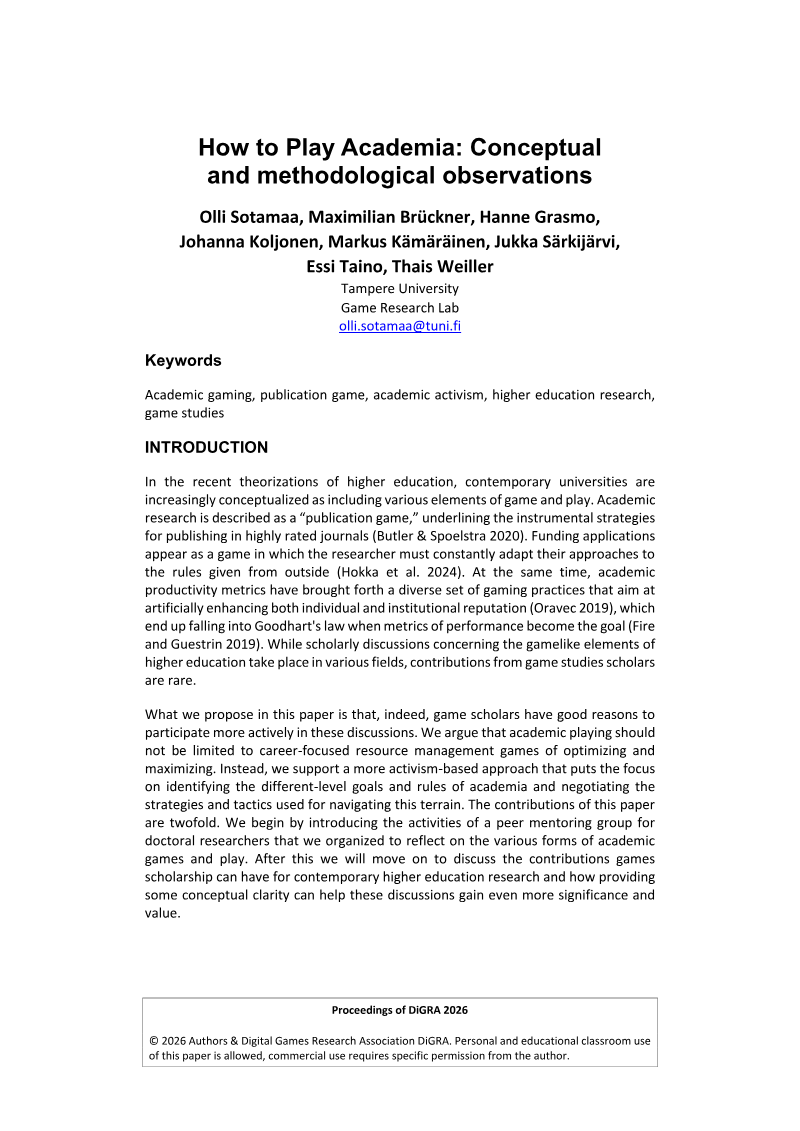
How to Play Academia: Conceptual and Methodological Observations
This paper, "How to Play Academia," argues that game studies scholars should contribute more actively to debates about the gamelike dimensions of contemporary higher education, which are often framed in terms of a "publication game," funding applications as rule-bound play, and the gaming of performance metrics that illustrates…
- The paper argues that game studies should engage more actively with the gamelike dimensions of higher education, such as the publication game, funding applications as rule-bound play, and the gaming of performance metrics illustrating Goodhart's law.
- The authors contend that existing scholarship on academic gaming focuses narrowly on negative consequences and propose an activism-oriented approach examining the goals, rules, strategies, and tactics of academic life.
- The central thesis is that game concepts such as optimization, counterplay, co-creation, the magic circle, and lusory attitude offer richer analytical resources than the dominant resource-management view of academic careers.