Game Culture reports and market data
Documents
gamevironments: Video Gaming and Death (2018)
Jordan Brady Loewen's paper, published in a 2018 special issue on video gaming and death, argues that conventional video games treat death as a mechanical reset with little existential weight, whereas virtual reality may alter how players think about mortality.
- Loewen's 2018 paper argues that conventional video games treat death as a mechanical reset with little existential weight, whereas VR may reshape players' thinking about mortality through embodiment and out-of-body experiences.
- The paper frames VR as intensifying Bergson's 'fabulation' (the tendency to attribute life and soul to images and beings), a tendency Loewen links to religious thought.
- The principal empirical anchor is a 2017 University of Barcelona study by Bourdin and colleagues, which reported a 50 percent reduction in fear of death among participants who had VR-induced out-of-body experiences compared with controls.
When to Use a First-Person Shooter as a Historical Tool: Ludic Site Preservation in Hong Kong
This paper argues that the playable space of the first-person shooter should be treated as an active medium of historical representation rather than a neutral container for 3D reconstructions, particularly when game engines are used in virtual archaeology.
- The paper argues that the first-person shooter's playable space should be treated as an active medium of historical representation, not a neutral container for 3D reconstructions in virtual archaeology.
- Its central case is Autosave: Redoubt, a CS:GO mod built on the Valve Source Engine that recreates the WWII-era British Shing Mun Redoubt in Hong Kong's Kowloon mountains.
- The author frames the FPS's 'camera-gun' perspective and 'tunnel vision' spatiality as shaping what a historical site can communicate, and warns these affordances risk the 'institutional amnesia' flagged by Gareth Beale and Paul Reilly.

Save the Park, Punish the Traitors: Games as Historical Documents
The paper argues that video games produced during periods of social and political turmoil can serve as historical documents, much as political cartoons and opinion pieces do.
- Video games made during periods of social and political turmoil can be treated as historical documents in their own right, similar to political cartoons and opinion pieces, rather than only as later depictions of past events.
- Timely games capture the perceptions, emotions, and political climate of the moment they were made, and they often disappear from circulation quickly, making them easy to lose as records.
- The study is a qualitative, illustrative case study comparing short reactive games from two Turkish episodes: the 2013 Gezi Park protests and the aftermath of the July 15, 2016 coup attempt, based on close readings rather than large samples or survey data.
Next Gen? A Critical Examination of Historical Periodization in Video Games
This extended abstract critically examines how video game history is periodized, focusing on the widely used notion of "platform generations" as a case study.
- The paper argues that periodization is a foundational act of historical sense-making, since naming a period presumes beginning and ending points along with implicit spatial, social, and cultural assumptions.
- Existing video game historiography has been shaped by linearity and US-Japan centrism, and the authors seek to open discussion of alternative periodization methods.
- The 'platform generation' model remains dominant in gaming press, encyclopedias, and game databases despite academic skepticism, and the paper treats generations more as marketing than as precise historical categories.
Star Ocean: Till the End of Time: A Nietzschian Approach to Games
Andrea Bergamini's extended abstract, presented at DiGRA 2018, argues that Star Ocean: Till the End of Time (tri-Ace, 2004) engages in a self-reflection on video game media through a Nietzschian lens.
- Andrea Bergamini's DiGRA 2018 abstract reads Star Ocean: Till the End of Time (tri-Ace, 2004) through a Nietzschian lens, centering on the game's revelation that its characters' world is a simulated MMORPG run by a programmer-God.
- The paper links the game to two themes: the overturning of Plato's Myth of the Cave in science fiction, and the atheistic, emancipatory stance tied to Nietzsche's declaration that God is dead.
- Bergamini situates the game within a wider tendency of Japanese RPGs to stage deicide and quote Nietzsche directly, citing Final Fantasy VI, Xenogears, Xenosaga, and Metal Gear Solid V.
Beyond Paratexts, Towards Paratextuality: A Case for Granular Analysis of Video Game Paratextuality
This paper argues that the concept of paratextuality, as applied in game studies, has drifted from Gérard Genette's original 1982 formulation and should be reconceived rather than simply reapplied.
- The paper argues that 'paratextuality' in game studies has drifted from Gérard Genette's 1982 formulation, where it was only one relation within a broader system of transtextual relations, and has become a catch-all label for any secondary artifact of video games.
- It contrasts a reduced framework, which limits paratext to spatially bound verbal material, with an expanded framework associated with Mia Consalvo and Jonathan Gray that includes trailers, livestreams, walkthroughs, and tie-in novels regardless of authorship, and argues the expanded version reproduces the main-text/epiphenomenon hierarchy it claims to critique.
- The author proposes treating paratextuality as a granular quality linking any text, or part of a text, to its socio-historical context, so phenomena are analyzed by degree of paratextual features rather than classified categorically as paratexts.
From ‘Training Grounds’ to Sociotechnical Actors: Do MMORPGs Presage the Futures of Work?
This conceptual paper, presented as an extended abstract at DiGRA 2018, challenges the prevailing view that massively multiplayer online role-playing games (MMORPGs) serve as "training grounds" for leadership skills that transfer to organizational settings.
- The paper reverses the common view of MMORPGs as 'training grounds' for workplace leadership, arguing instead that games like World of Warcraft are sociotechnical systems that actively shape 21st-century leadership models and forms of work.
- The authors frame their inquiry around whether MMORPGs prestage emerging cultural and organizational forms, and whether games exert agency over new modes of knowledge creation and affective labour in globalized economies.
- The paper situates its argument within a shift from command-and-control leadership toward distributed, networked, and heterarchical models emphasizing self-organizing teams, shared responsibility, and leadership exercised 'from the middle.'
If You Guild It, They Will Come: Organizational Leadership in Games
This study examines how leadership emerges and organizational structures form within online gaming groups, challenging the prior literature's reliance on anecdotal evidence and single-game case studies, particularly World of Warcraft.
- The study moves beyond prior anecdotal and single-game (largely World of Warcraft) evidence by interviewing 64 leaders of online gaming organizations across four titles: Counter-Strike (15), League of Legends (17), Guild Wars 2 (16), and RuneScape (16).
- Leaders in the sample had no formal management education or prior business work experience, yet 25 currently hold offline management positions and 14 have participated in professional esports teams as players or coaches.
- Using an inductive approach, the authors derive three ideal-typical organizational structures tied to group stage and size, ranging from groups of five to several hundred members.
Indie-viduals: Videogames' Hegemonic (Re-)Production Culture
This DiGRA 2018 extended abstract, authored by Lars de Wildt and Stef Aupers of KU Leuven, examines whether independent game development escapes the commercial conformity of the AAA industry or instead reproduces its dominant conventions, with a particular focus on how religion is represented in games.
- Independent game development often reproduces rather than escapes the conventions of the commercial AAA industry, according to a qualitative study of 27 international developers by Lars de Wildt and Stef Aupers of KU Leuven.
- Non-religious developers tend to rely on stereotyped religious imagery, such as priests who heal simply because they are priests, as narrative shortcuts, while religious developers struggle to find room for their own convictions in their work.
- The authors argue that game design has become a universal language of tropes rooted in North American and Japanese development culture, which frames religion as commodity, conspiracy, or fantasy.
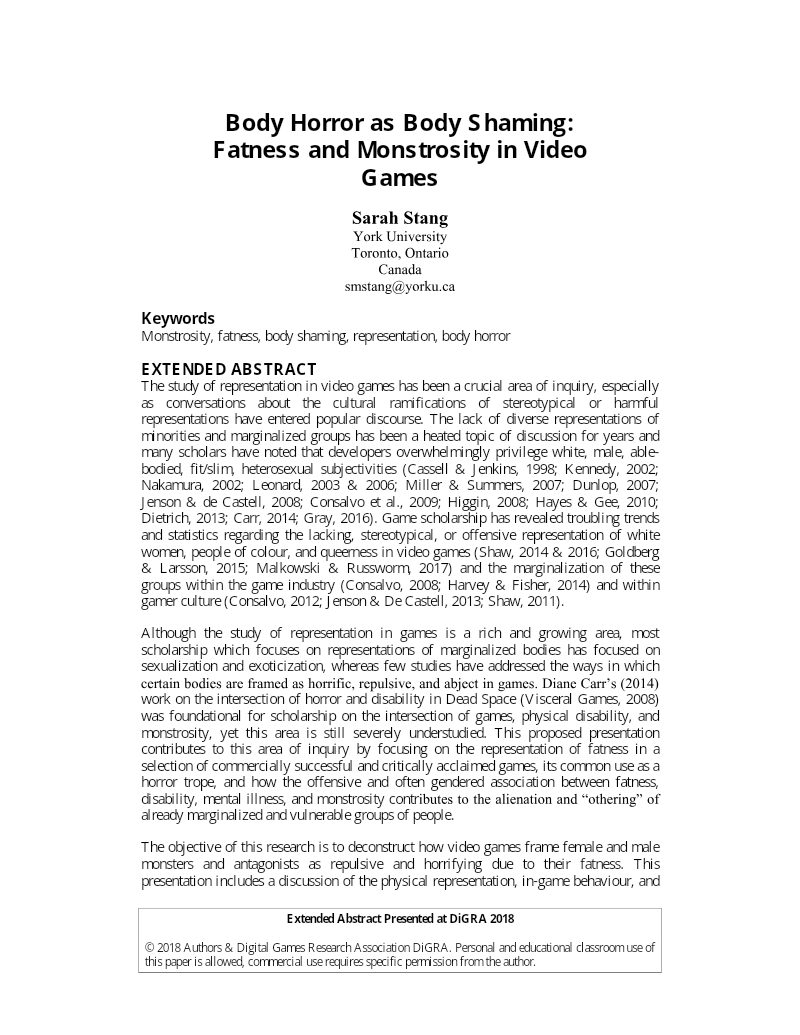
Body Horror as Body Shaming: Fatness and Monstrosity in Video Games
This extended abstract, presented at DiGRA 2018 by York University PhD candidate Sarah Stang, examines how video games depict fat bodies as horrific, repulsive, and monstrous.
- The report argues that video games frequently code fat bodies as horrific, repulsive, or monstrous, linking fatness to evil, madness, disability, disease, and body horror, which it contends reinforces the othering of already marginalized groups.
- Fatness is framed as a horror trope in games, and the author positions this framing as severely understudied compared with the widely critiqued sexualization and exoticization of marginalized bodies.
- The study is a qualitative, interpretive analysis that recorded playthroughs of 11 commercially successful and critically acclaimed games, including Dragon Age, God of War II, The Witcher 3, The Last of Us, Silent Hill, and Prey, and categorized characters thematically, narratively, and visually.
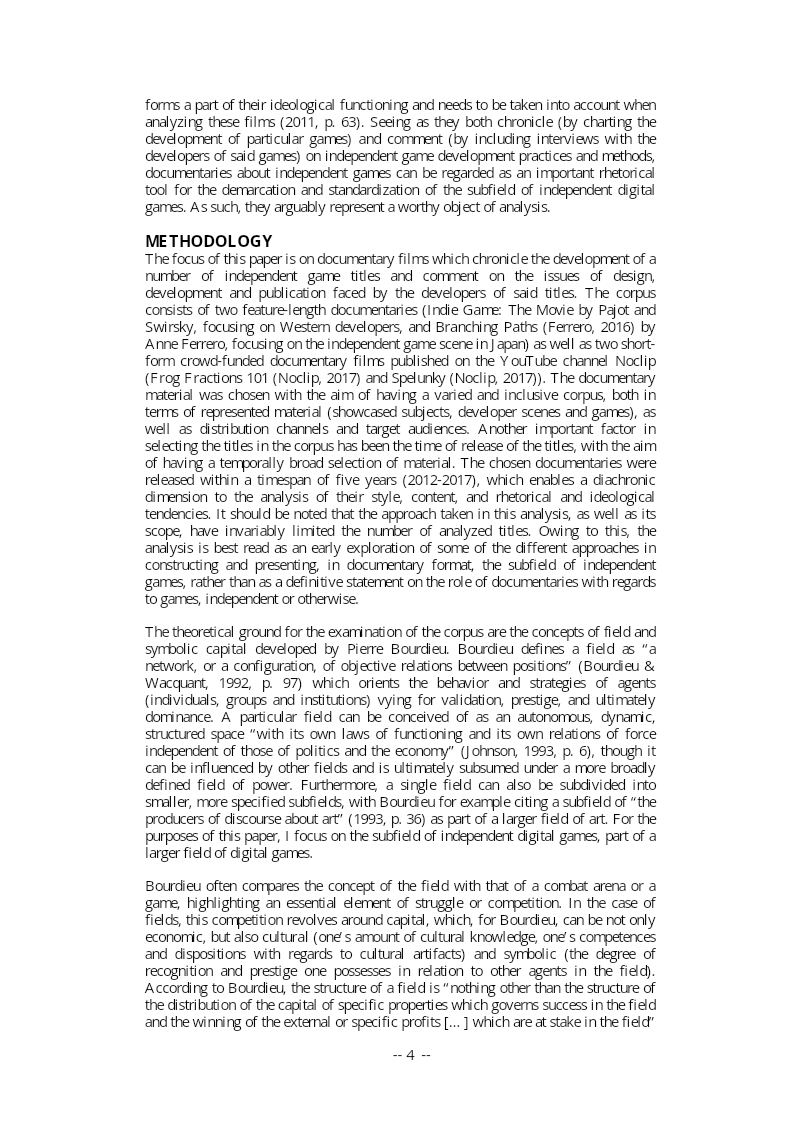
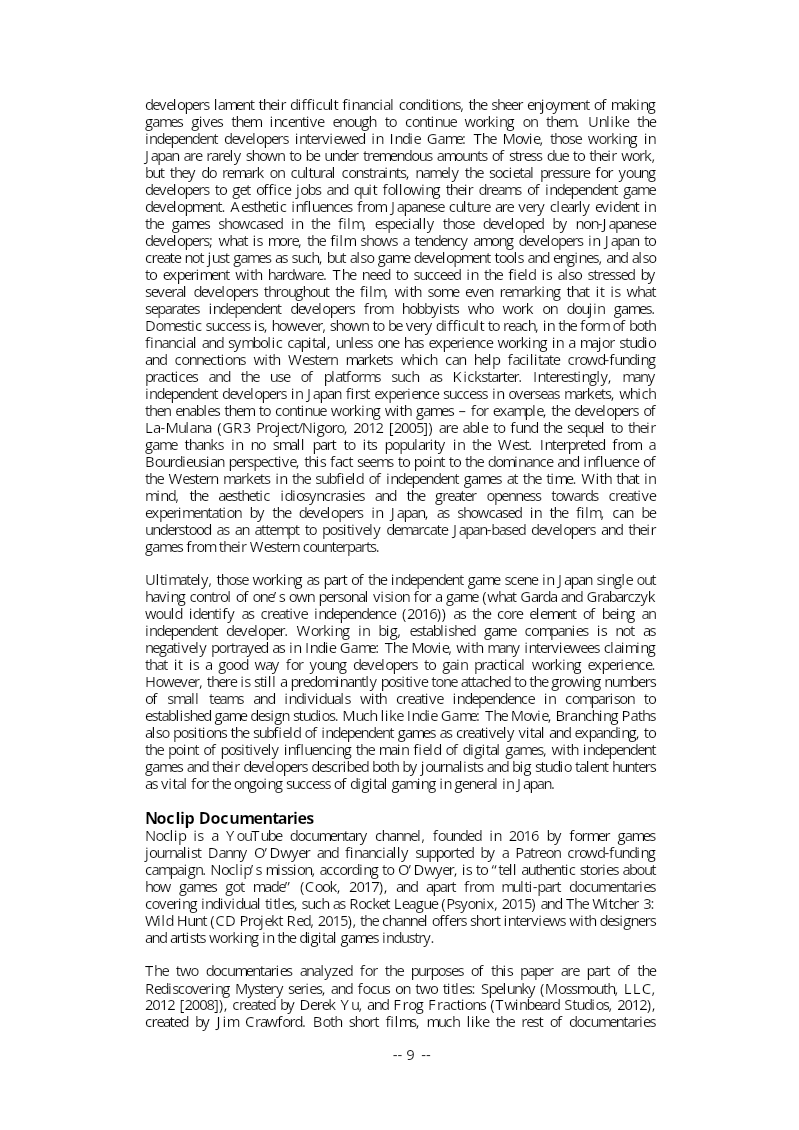
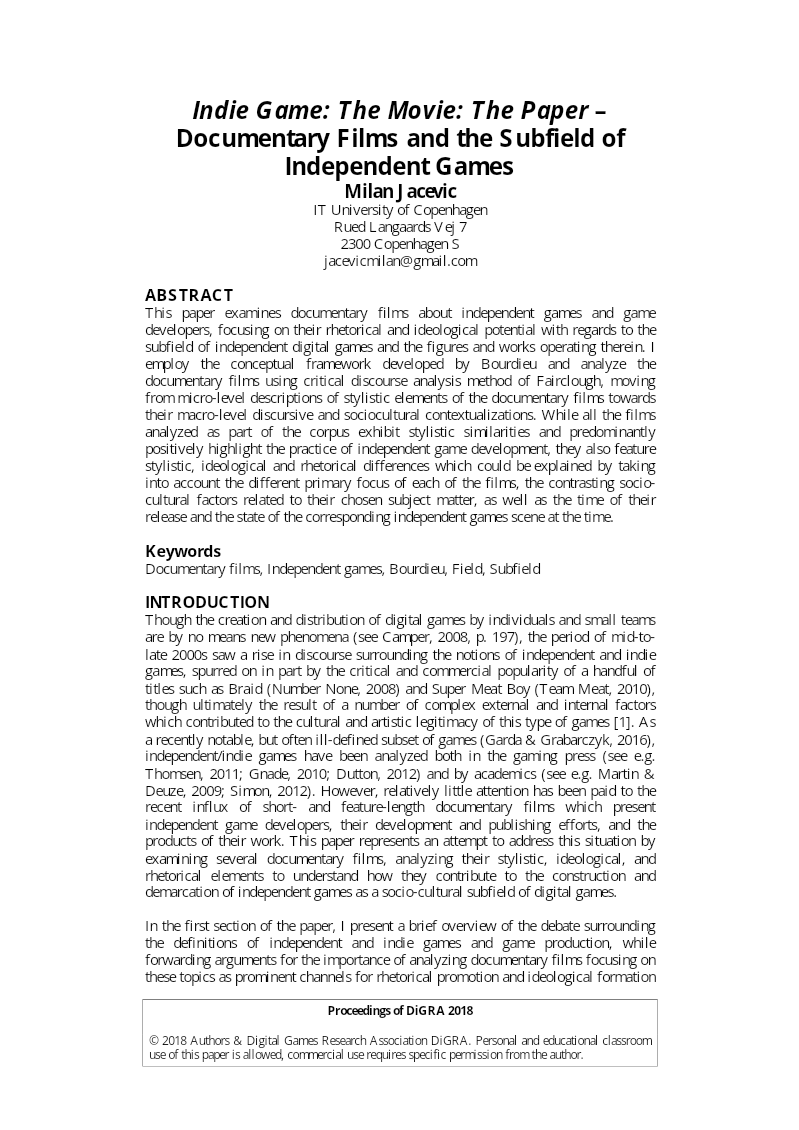
Indie Game: The Movie: The Paper - Documentary Films and the Subfield of Independent Games
This paper examines documentary films about independent game developers, arguing that such films play a significant role in constructing the cultural meaning of "indie" games, a term that remains ill-defined in both popular and academic discourse.
- The paper argues that documentary films about independent game developers play a significant role in constructing the cultural meaning of "indie" games, a term that remains ill-defined in both popular and academic discourse, drawing on Bourdieu's field theory and Fairclough's critical discourse analysis.
- The analysis rests on a corpus of four documentaries released between 2012 and 2017, selected for variety in subject matter, distribution, and release timing, and the author frames these films as contributing to the symbolic capital of independent developers and delimiting indie games as a space of heightened artistic value.
- The films consistently portray independent developers as passionate, creatively driven auteurs while casting major commercial studios in a negative light.
Markers of Subjective Perception in Larp
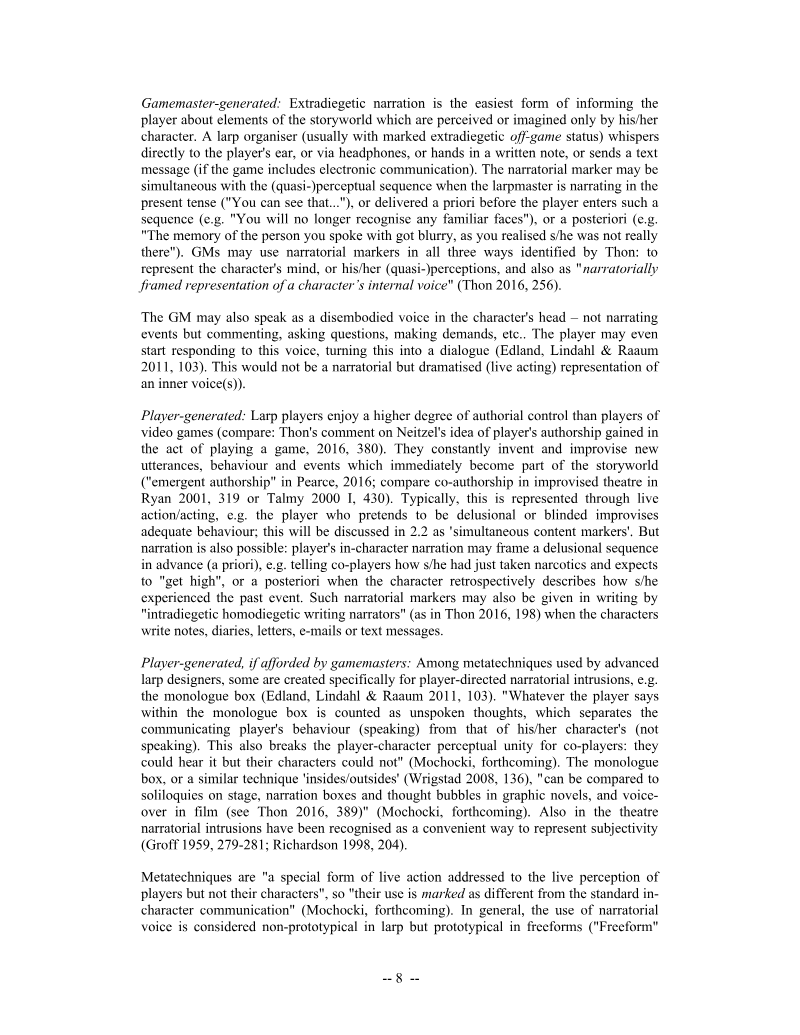
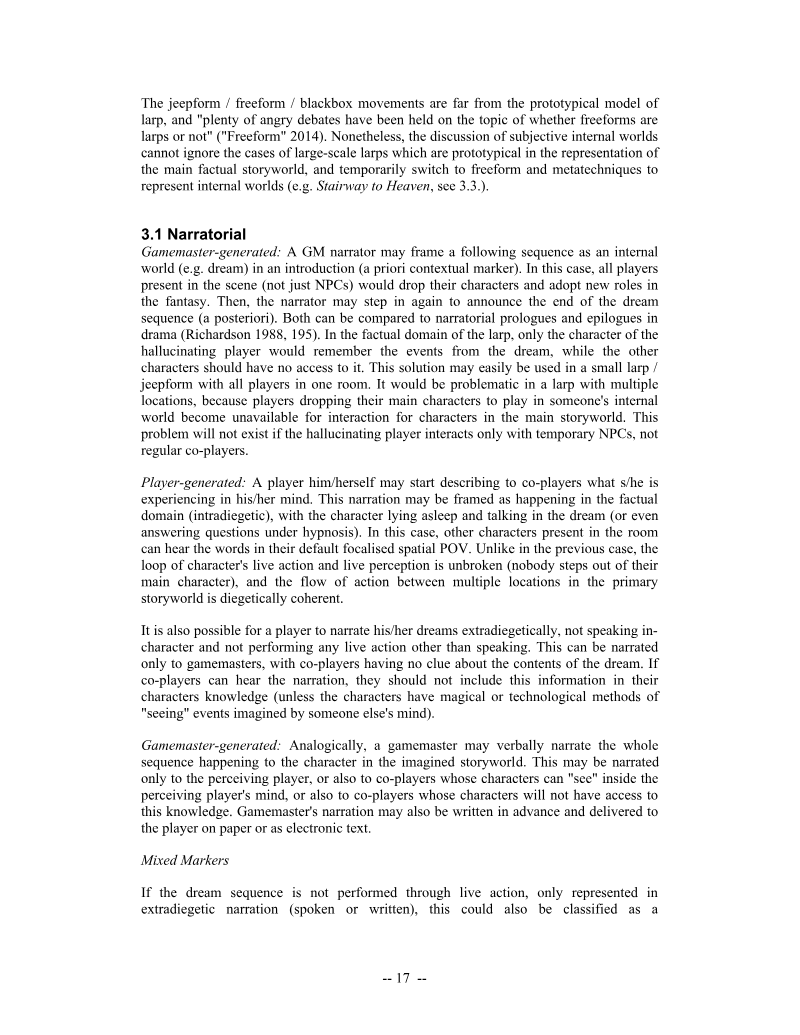
Mochocki's paper extends Jan-Noël Thon's framework of subjective representation, originally developed for film, comics, and video games, to live-action role-playing (larp).
- Mochocki argues that spatial point-of-view goes unmarked in larp because players physically inhabit their characters' perspectives, so subjectivity markers in larp signal only other forms of subjectivity, and the paper adds a fourth, "metasymbolic" marker category to cover what Thon's film/comics/video-game framework misses.
- The paper stresses player-character perceptual unity and warns that mishandled subjectivity markers cause metalepses, breaches of diegetic coherence.
- Narratorial markers (generated by gamemasters or players, including metatechniques like the monologue box) and content markers (live acting and tangible elements introduced by the gamemaster) each carry their own metaleptic risks for perceptual unity.