Game Culture reports and market data
Documents
Gaming and the 'Parergodic' Work of Seriality in Interactive Digital Environments
Shane Denson's essay argues that seriality in videogames marks a shift from a "parergonal" logic, in which serial figures such as Batman move across analog media and blur the boundary between frame and world, to a "parergodic" logic shaped by the interactive, labor-based navigation of networked digital environments.
- Shane Denson argues that videogame seriality has shifted from a 'parergonal' logic, where figures like Batman move across analog media and blur frame and world, to a 'parergodic' logic shaped by interactive, labor-based navigation of networked digital environments.
- Denson's central case study traces the Batman franchise from Miller and Moore's 1980s graphic novels through Burton's and Nolan's films to the Arkham games, Telltale's episodic adventures, and Arkham VR.
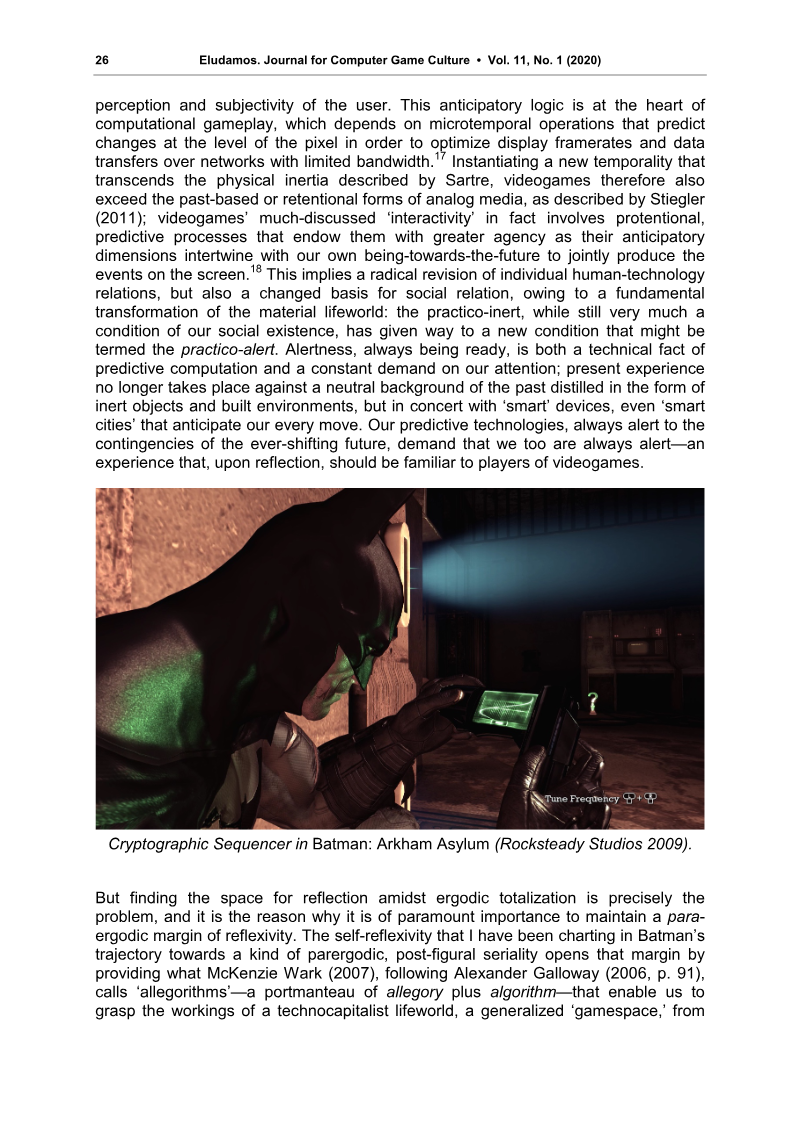
- Denson reads the simulated glitch and crash in Arkham Asylum, which many players mistook for hardware failure, as a moment that exposes the precarity of ergodic play and links it to Sartre's concept of alienated seriality.
Return to the Interactive Past
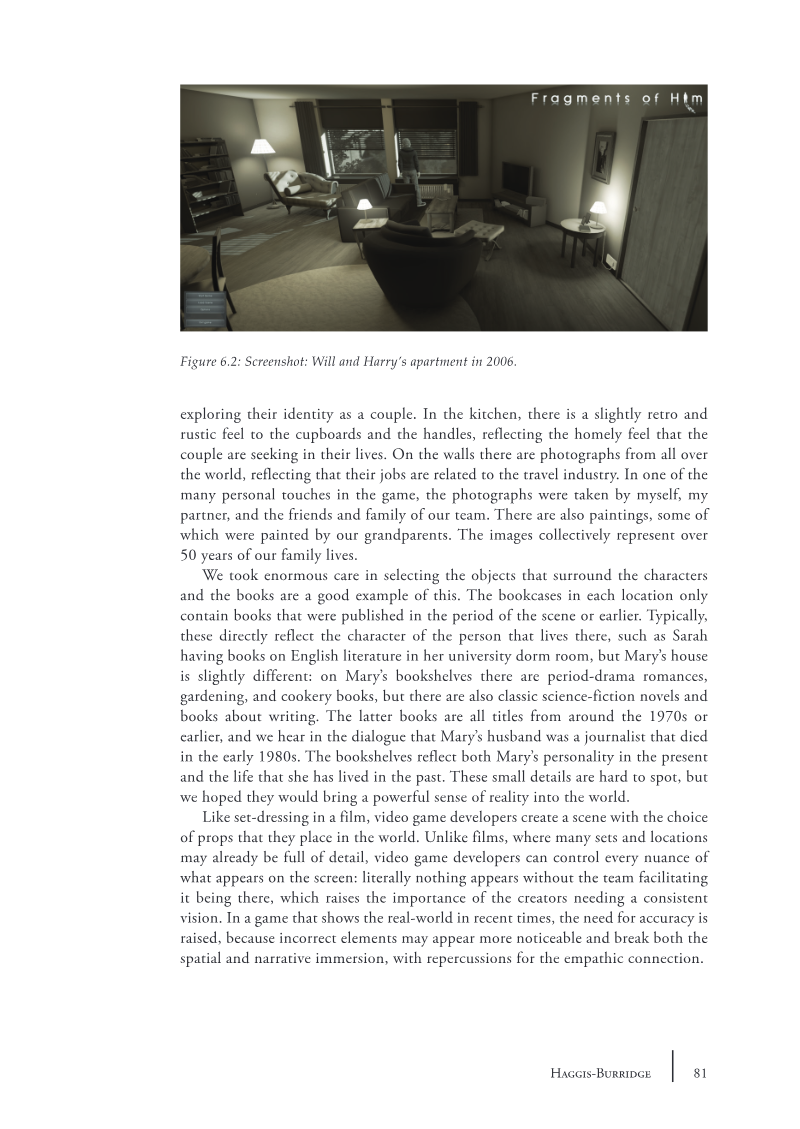
Fragments of Him is presented as a case study in how video games can be understood through emotional and narrative content rather than through their interaction mechanics alone.
- The report argues that labels like 'walking simulator' obscure what games like Fragments of Him actually do, and that the game deliberately prioritizes a story about love, grief, and recent social history over conventional notions of fun.
- The analysis proposes a four-part taxonomy of immersion, systems, spatial, empathic/social, and narrative/sequential, to give the vague concept of 'immersion' more precision.
- Fragments of Him is positioned as deliberately low in systems immersion but high in spatial, empathic/social, and narrative/sequential immersion, achieved through period-accurate objects, locations drawn from the creator's personal memories, and back-storied characters set in southern England between the 1980s and 2000s.
Public Play Space Symposium Proceedings 2021
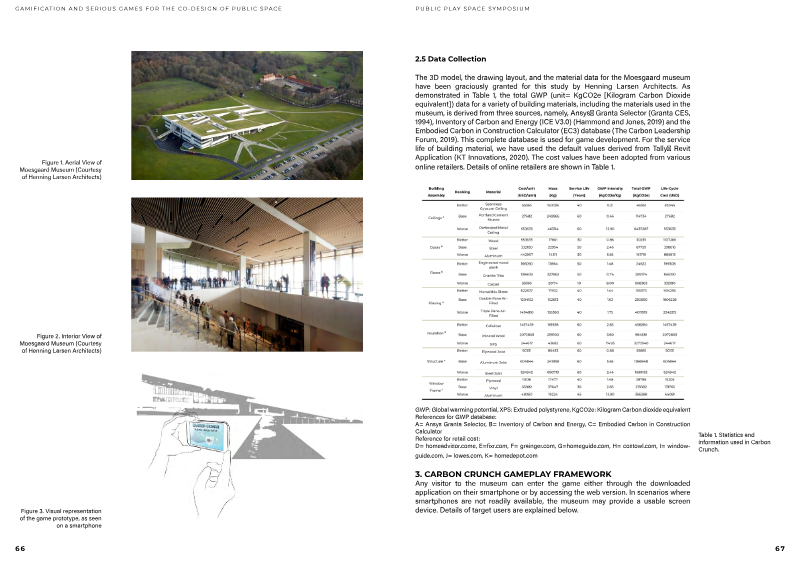
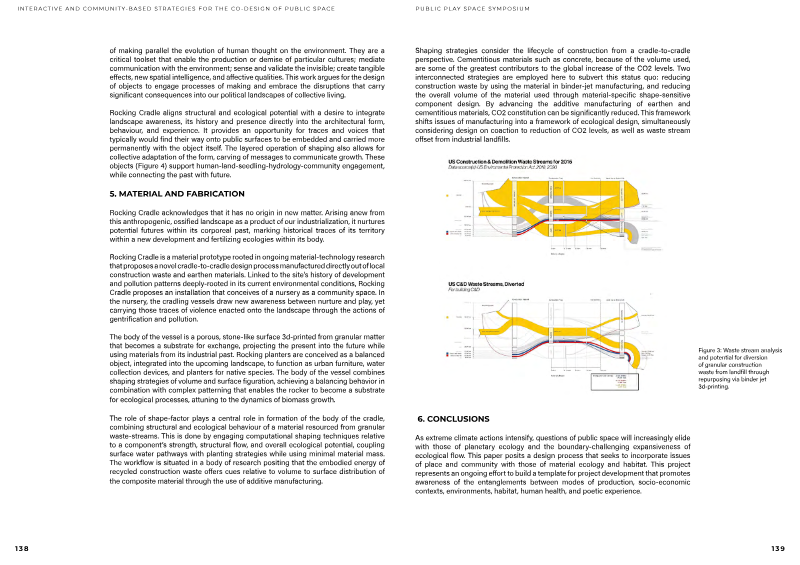
The 2021 Public Play Space Symposium Proceedings examine how gamification, responsive digital technologies, board and sandbox games, augmented reality, and playful interventions can support participatory co-design of public space.
- Serious games and gamified interfaces consistently boost engagement, collaboration, and educational value, especially with children, though individual-level data collection and facilitator dependence remain limitations.
- Play is argued to lower barriers to citizen engagement in urban planning, making participation more appealing, measurable, and sustained.
- Board-game experiments in Portugal found that collaborative groups produced more efficient transport networks.
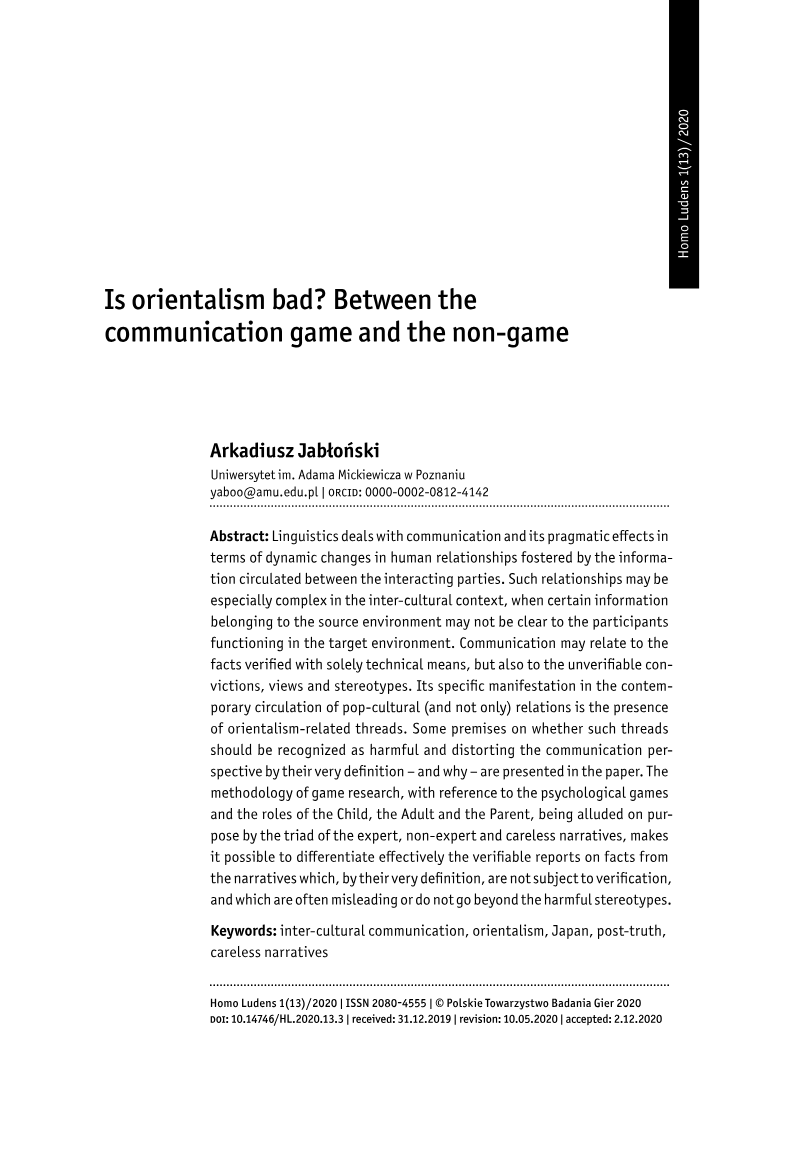
Is Orientalism Bad? Between the Communication Game and the Non-game
Jabłoński's paper examines how intercultural communication about Japan becomes distorted when verifiable facts are blended with stereotypes, and it argues that orientalist motifs in Polish popular culture and media are a central case of this problem.
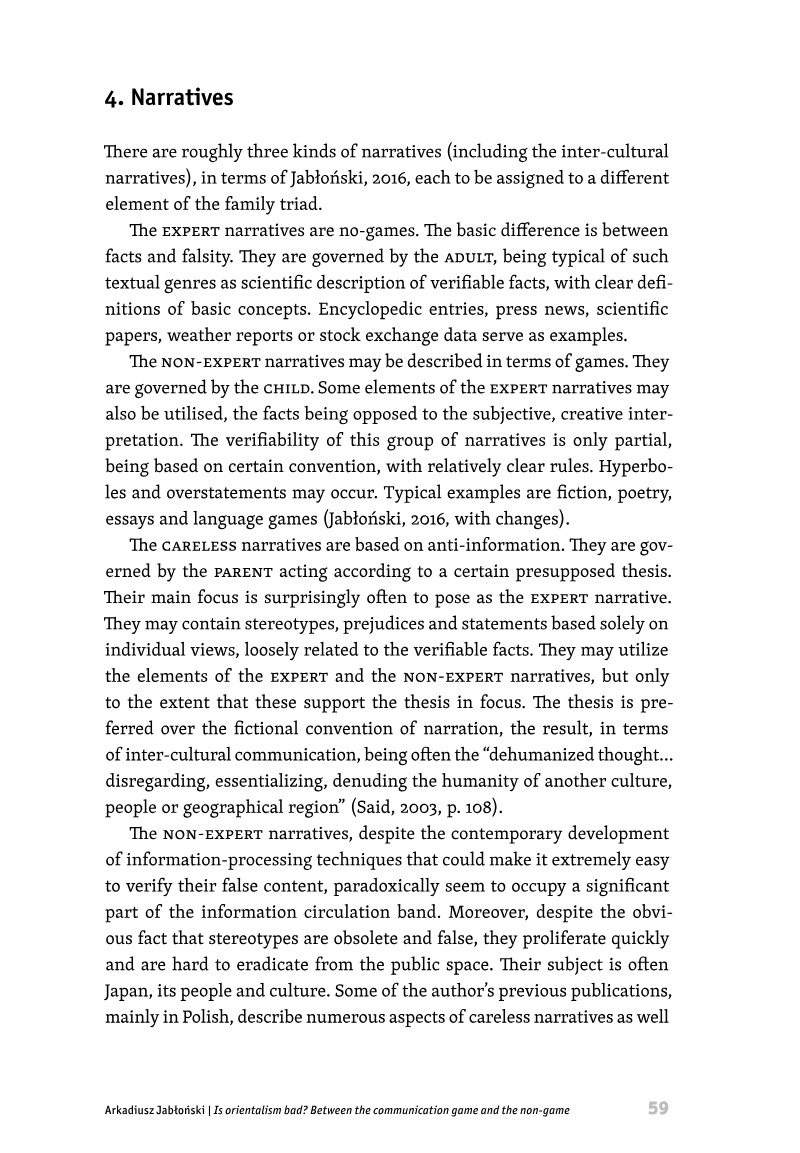
- The paper classifies narratives about Japan into three types drawn from Berne's transactional analysis: expert narratives (verifiable, governed by the Adult), non-expert narratives (partly verifiable and playful, governed by the Child), and careless narratives (presented as expert but serving a predetermined thesis, often reproducing stereotypes).
- Its central critique targets careless narratives in Polish media about Japan, which blend verifiable facts with stereotypes and selectively pick facts to reach conclusions fixed in advance.
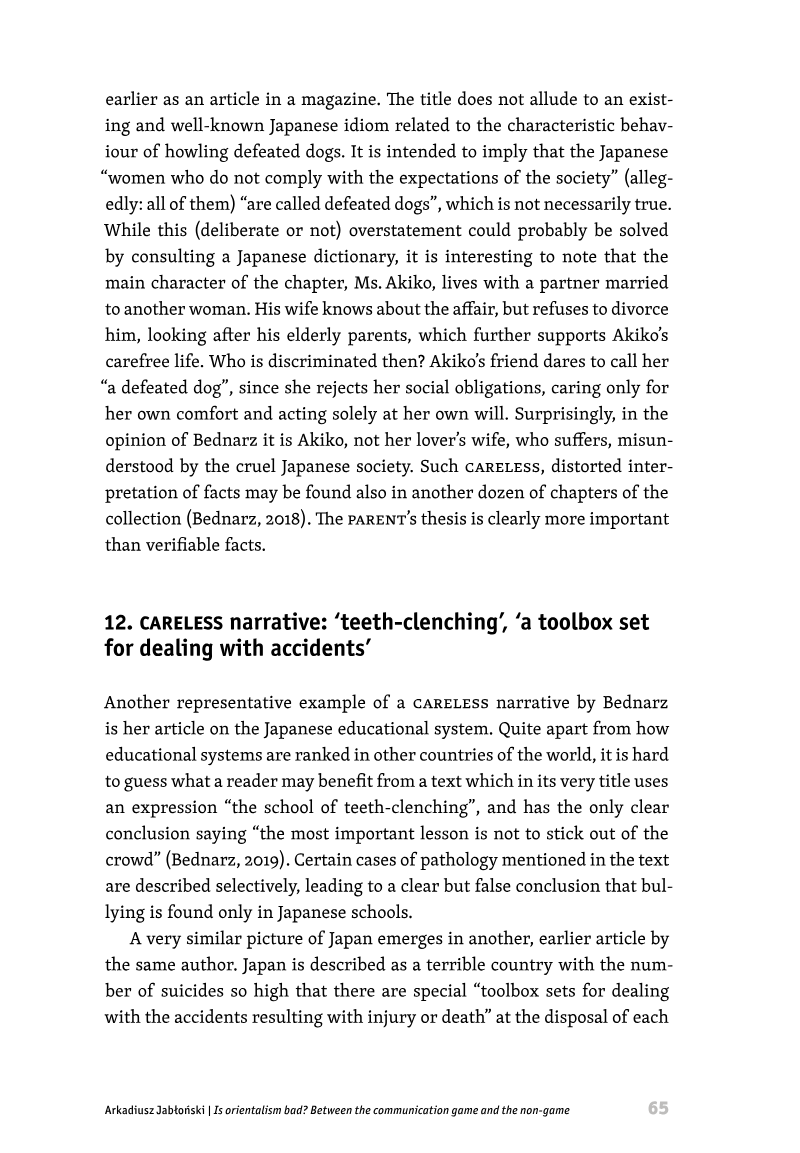
- The paper examines Joanna Bator's books and Karolina Bednarz's articles and book as examples, arguing that Bednarz's treatment of a divorced woman in "Defeated dog," and her writing on Japanese schools and railway suicides framed through "toolbox sets," exemplify this problem.
A Meta-Synthesis of Agency in Game Studies: Trends, Troubles, Trajectories
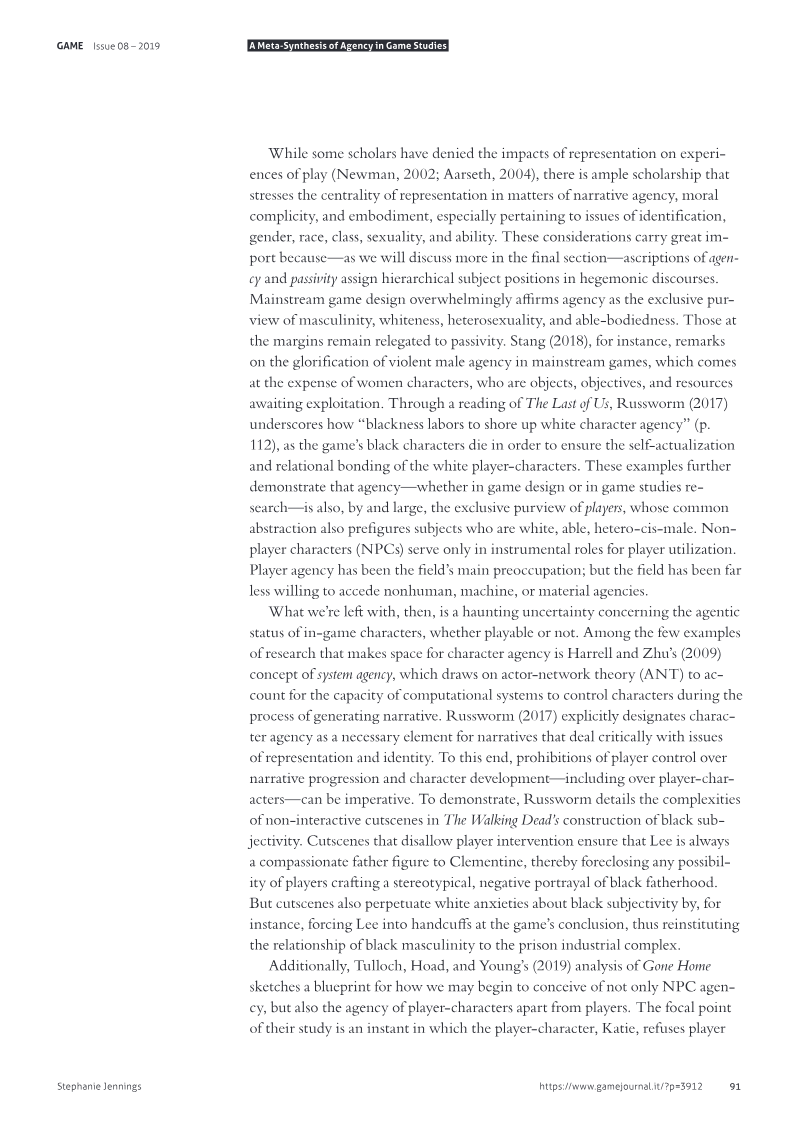
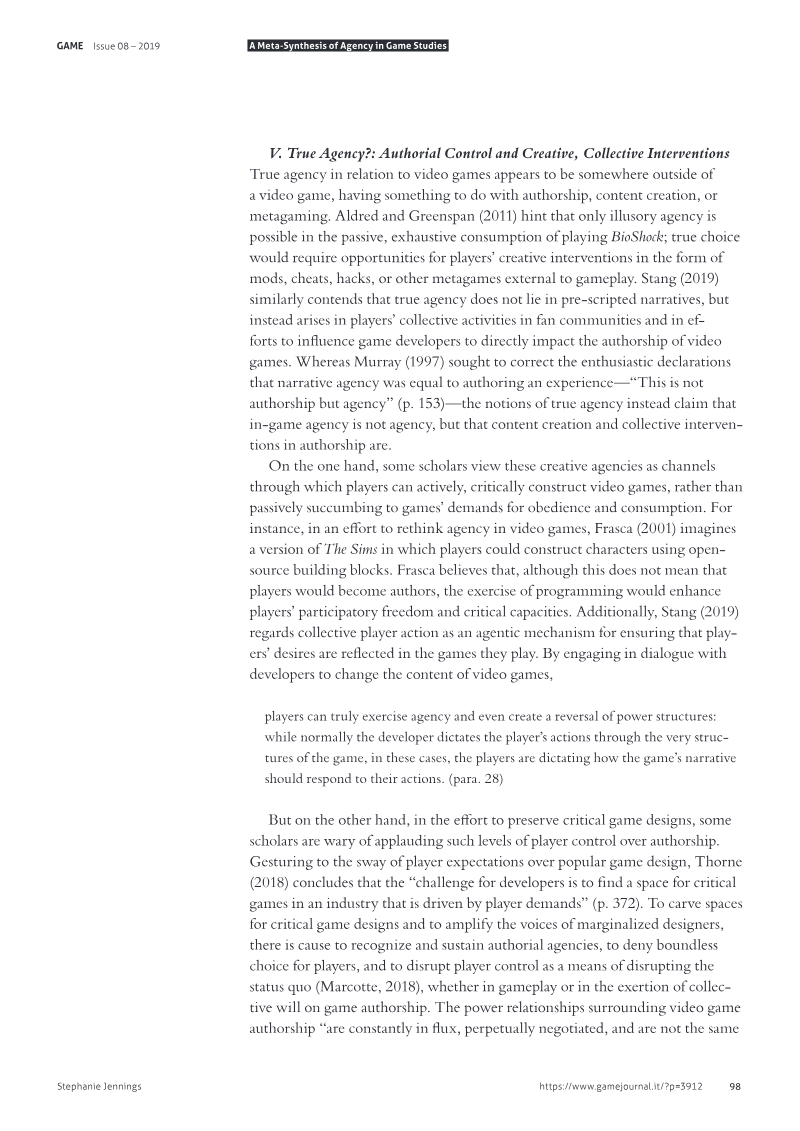
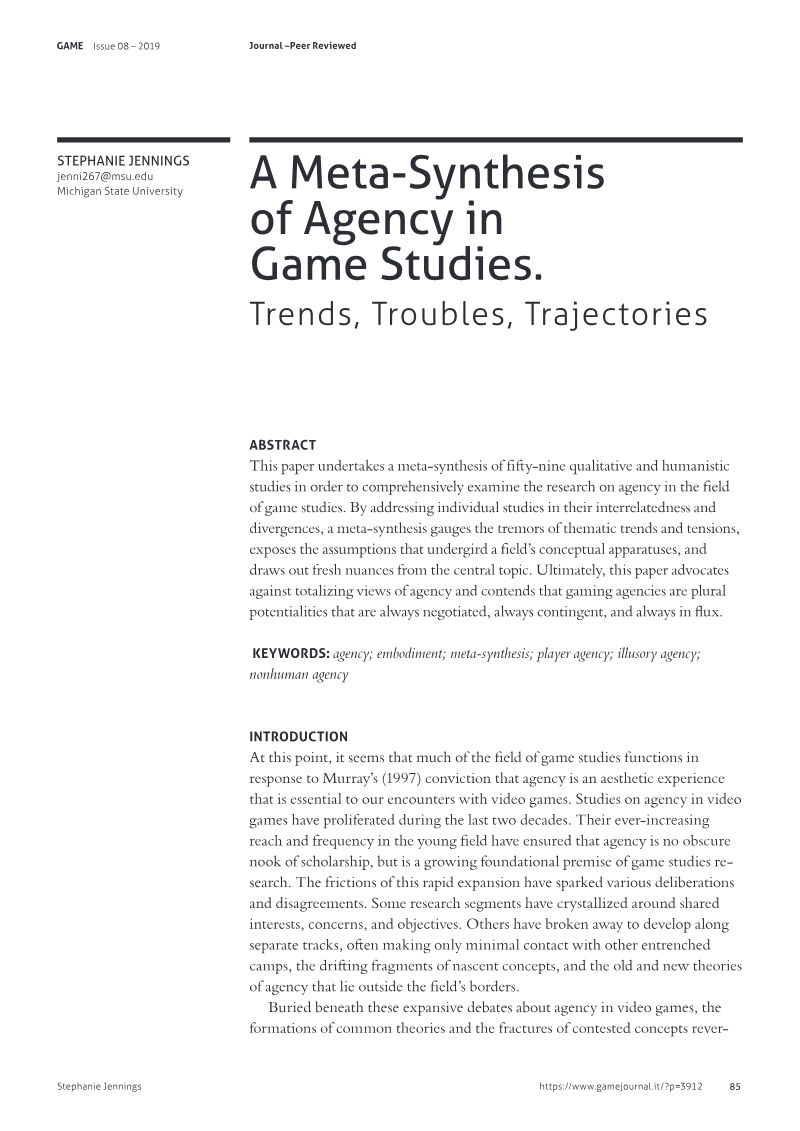
This meta-synthesis examines 59 qualitative and humanistic studies of agency in game studies, arguing that agency in games is plural, contingent, and continually in flux rather than a single, totalizing concept.
- The synthesis argues that agency in games is plural, contingent, and in flux, and that game studies has treated it as an essential aesthetic experience (following Murray, 1997) while leaving the term largely undefined and blurring it with interactivity, freedom, and control.
- The review finds that narrative and design discourses have historically tied agency to white, male, able-bodied, and heterosexual players, marginalizing characters and nonhuman forms of agency.
- Drawing on 59 studies, the synthesis highlights a recurring claim that player agency is often illusory and that such illusions may be disempowering rather than liberating, with BioShock scholarship accounting for fifteen of the fifty-nine studies.
The Discourse of Player Safety in the Forge Diaspora, 2003-2013
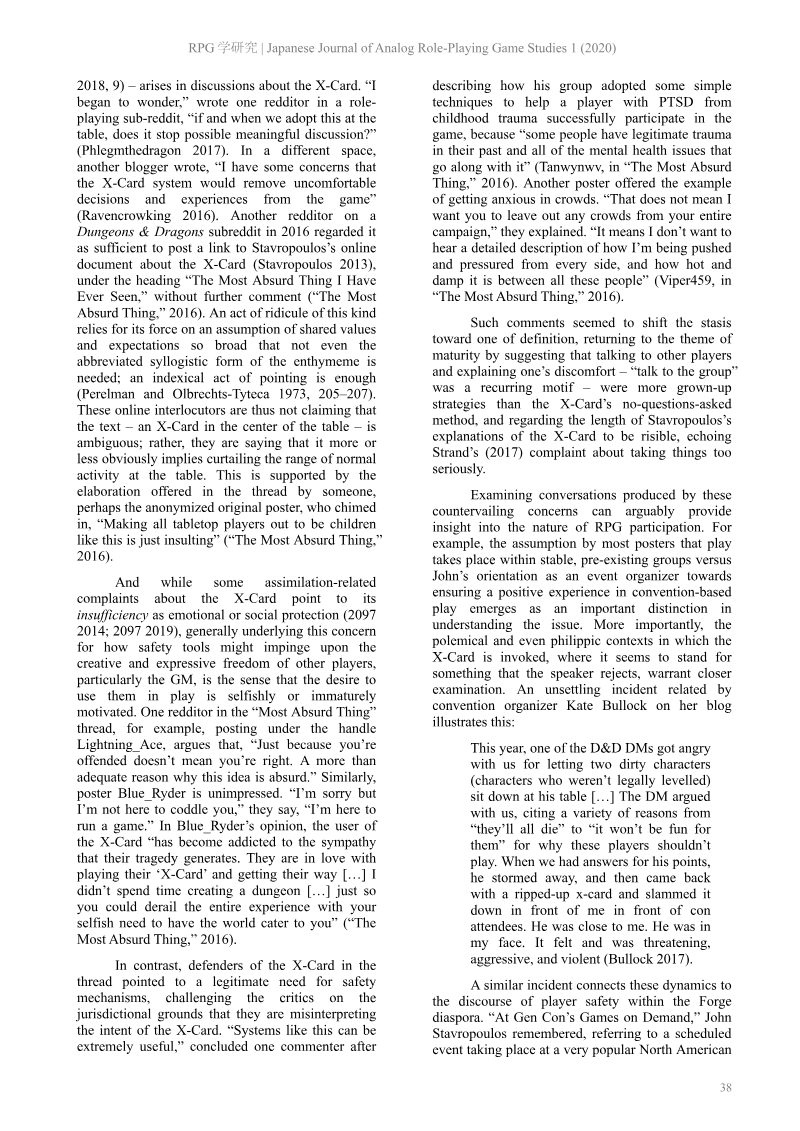
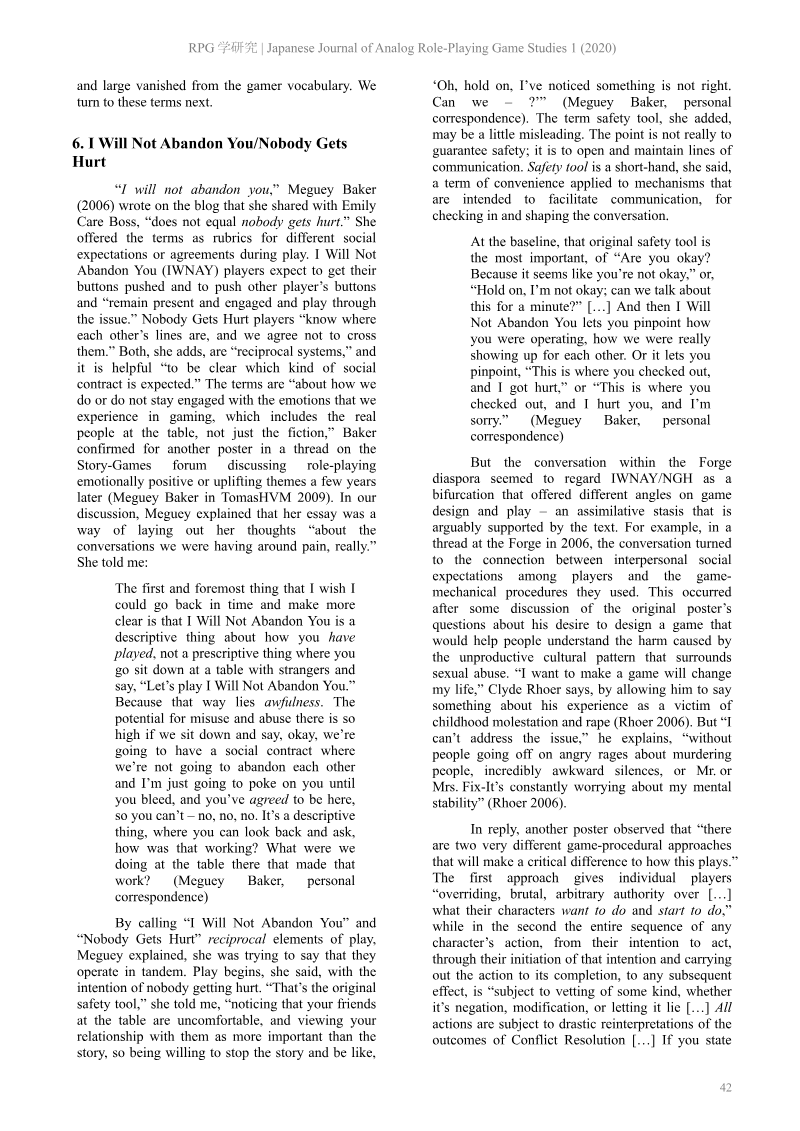
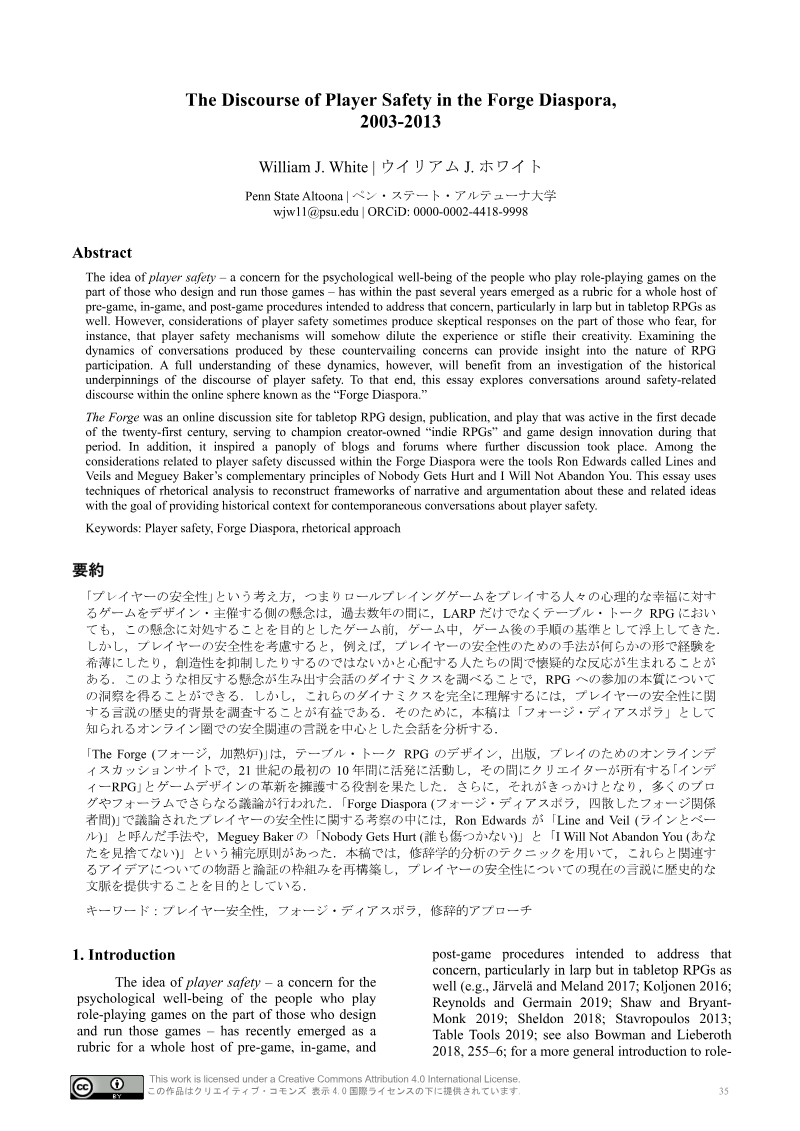
The discourse surrounding player safety within the Forge diaspora between 2003 and 2013 represents a foundational shift in how tabletop role-playing communities negotiate the intersection of creative expression and psychological well-being.
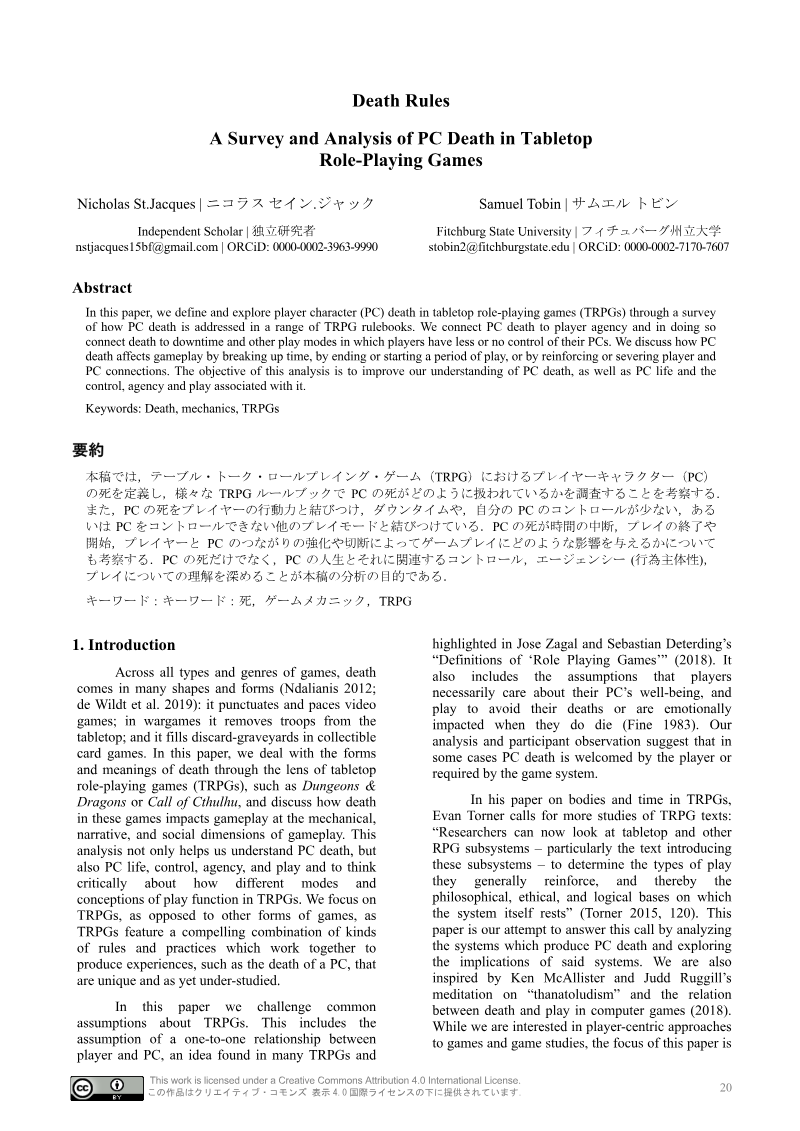
Death Rules: A Survey and Analysis of PC Death in Tabletop Role-Playing Games
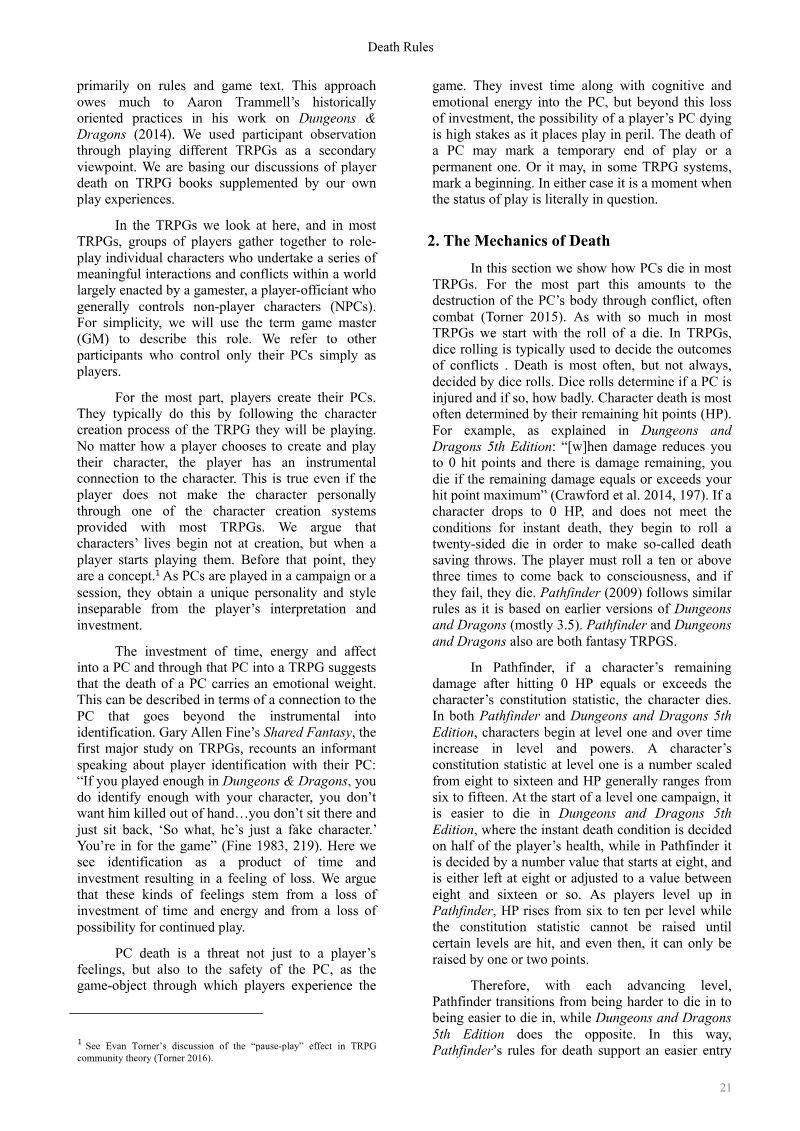
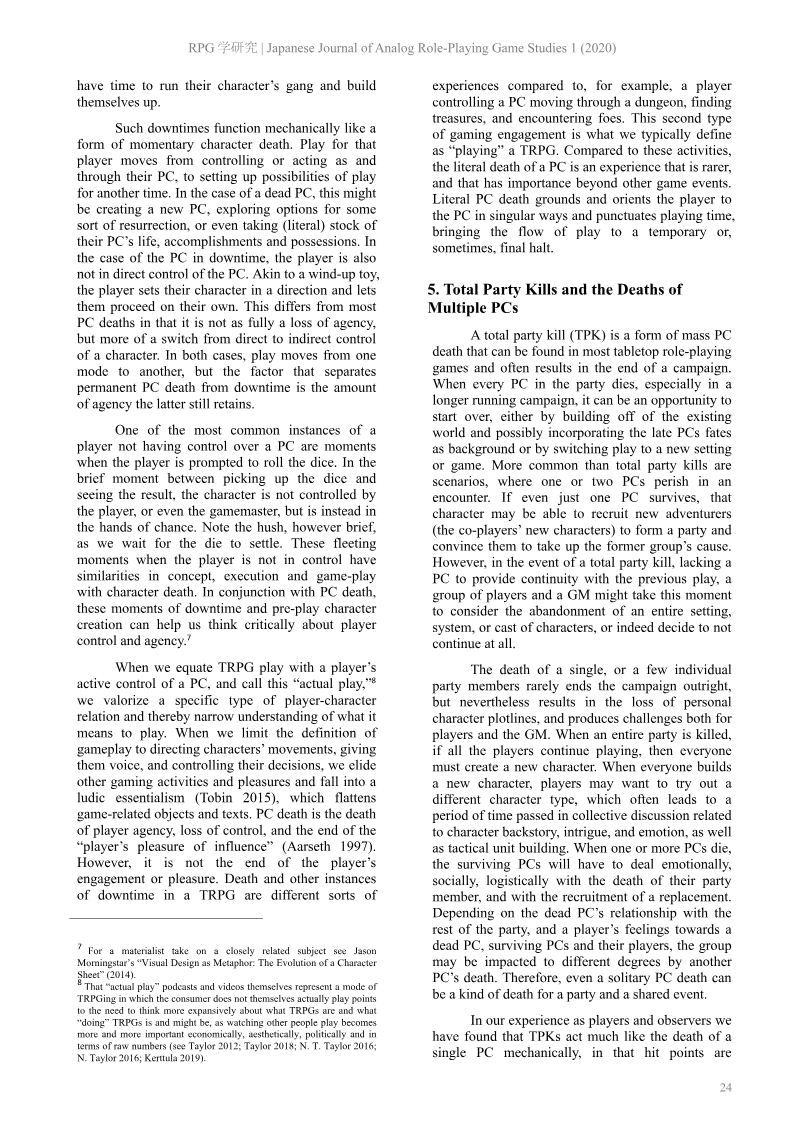
Character death in tabletop role-playing games functions as a sophisticated mechanical and narrative instrument rather than a simple failure state.
It’s About Fate, Among Other Things: Digital Games, Dialogical Teaching, and Ethics
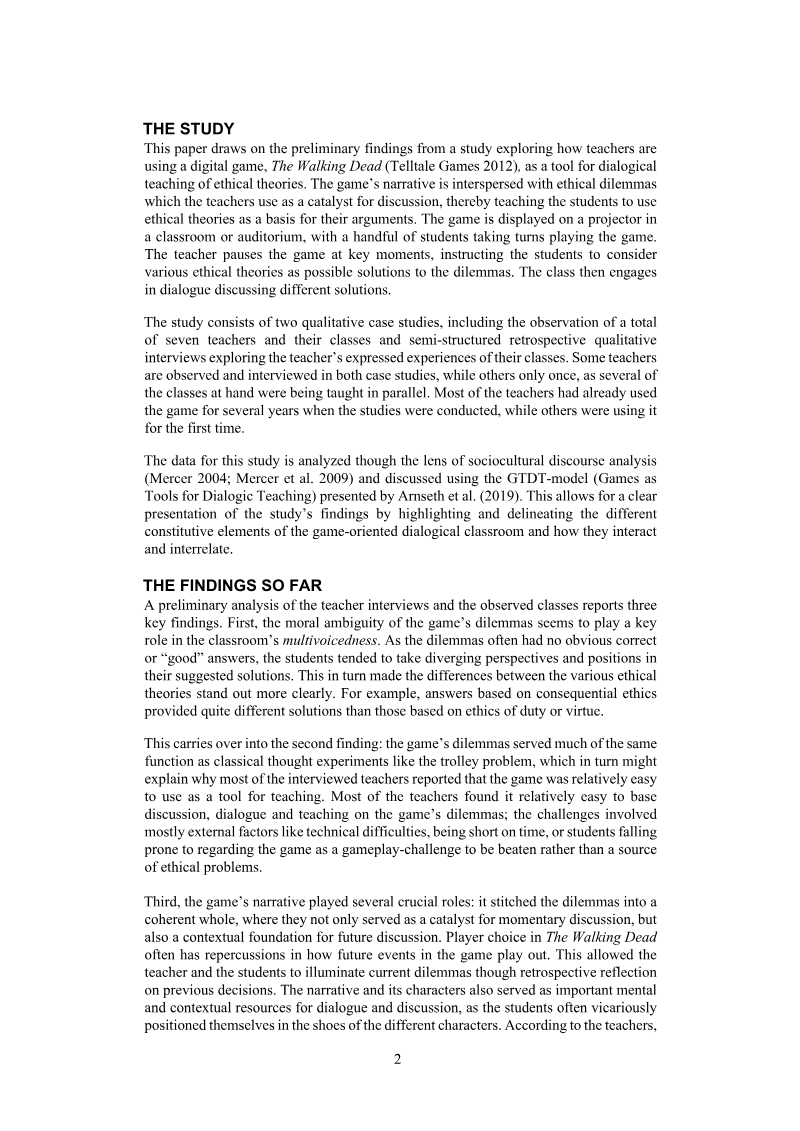
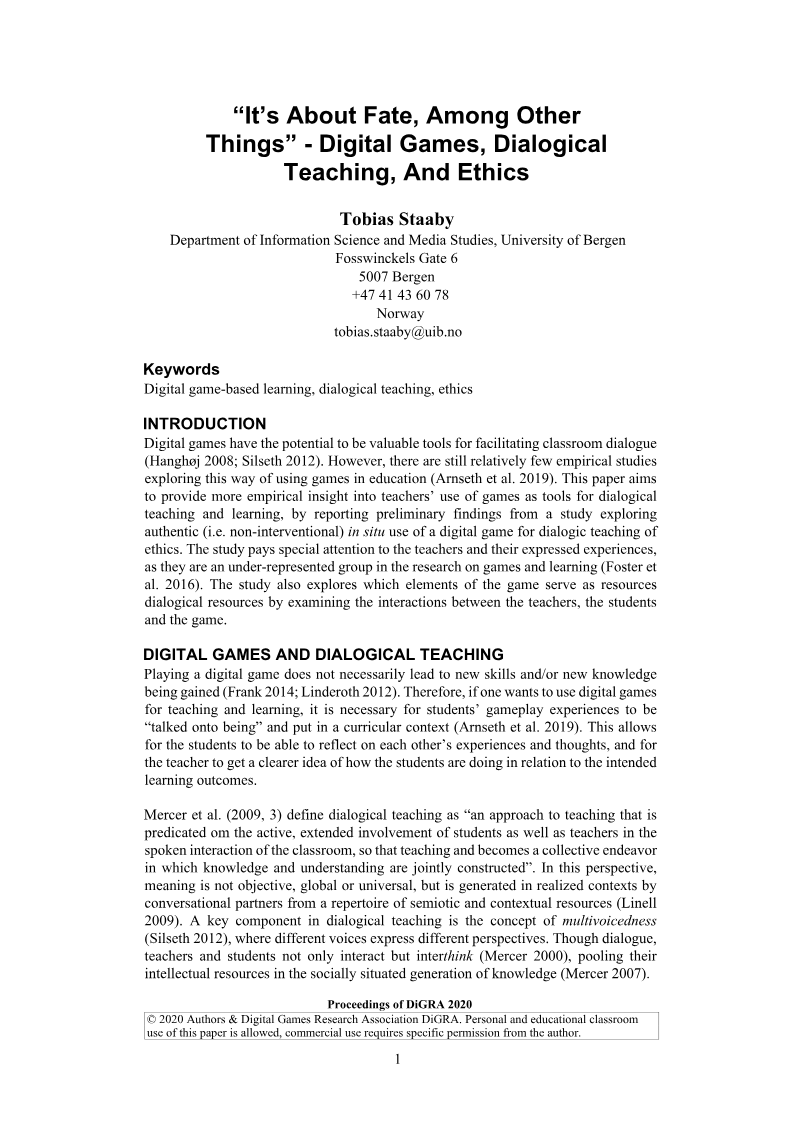
This paper presents preliminary findings from a study of how teachers use digital games as tools for dialogical teaching of ethics.
- Digital games do not automatically produce ethical learning; their educational value depends on teachers talking students' gameplay experiences into meaning and linking them to curricular goals.
- The study uses two qualitative case studies observing seven teachers and their classes, plus semi-structured retrospective interviews, focusing on teachers as an underrepresented group in game-based learning research.
- The game The Walking Dead (Telltale Games, 2012) was used in classrooms: teachers paused at moral dilemmas and had students apply consequentialist, duty-based, and virtue-based ethical theories before discussing competing solutions.
Playful Practices in Ancient Greek Philosophy
Sebastian Weichelt's "Playful Practices in Ancient Greek Philosophy" challenges the longstanding assumption, associated with Johan Huizinga, that play and rationality are opposites.
- Sebastian Weichelt argues that play and rationality are not opposites, since rationality has several distinct forms (instrumental, economic, procedural, epistemic, critical) under which play can be considered rational.
- The central thesis is that the core intellectual practices of ancient Greek philosophy were forms of play, examined through Aristotle's contemplation, sophistic debate, Socratic dialogue, and thought experiments.
- Socratic dialogue and theoretical contemplation satisfy Johan Huizinga's criteria for play and reflect Thomas Henricks' notion of joyful inquiry.

Cultural Heritage and Environmental Communication Through Digital Games
The PAC-PAC research project at the University of Cagliari investigates whether digital games can promote and communicate cultural heritage, particularly lesser-known sites, and whether such experiences can stimulate tourism and knowledge of local traditions.
- The PAC-PAC project at the University of Cagliari tests whether digital games can promote lesser-known cultural heritage sites and stimulate tourism and interest in local traditions, premised on player-driven narratives creating emotional bonds with places.
- The project uses photographs, videos, and 360-degree views rather than conventional rendered graphics to strengthen players' connection to real environments, and it built a custom authoring tool for point-and-click adventures.
- Production follows a structured pipeline: site selection and game design documentation, location scouting with local authorities, onsite filming with a specialist crew, and post-production editing.
The Tragedy of the Art Game
The paper argues that a fundamental and unresolved tension is built into computer games understood as a medium: the game artist seeks self-expression through the work, while the player seeks an instrument to play with.
- The paper argues that a fundamental, unresolved tension is built into games as a medium: the game artist seeks self-expression through the work, while the player seeks an instrument to play with, and art games' progress has depended on overlooking this conflict (the 'tragedy of the art game').
- The author concludes the two kinds of satisfaction cannot coexist, so artist and player remain in conflicting positions.
- The author suggests these two approaches may mark the ends of a continuum on which individual art games could be placed, but this continuum has not been tested through a systematic survey of art games.

Gamification Does Not Belong at a University
Gamification in higher education has drawn strong criticism from students who saw it as manipulative, and this analysis examines how such resistance played out in practice at a university setting.
- Gamification's reception depends heavily on role positioning, whether participation is voluntary, and the competing framings held by students, designers, and the institution.
- A bug that failed to apply a cooldown to experience points from clicking article links let one student reach level 9073, against an intended range of 8 to 12.
- In a Canvas-based case, students scripted thousands of automated submissions and reached levels in the thousands within days.