AI reports and market data
Documents
Games industry trends 2025 review | Week in Mobile Games podcast
The global games market is projected to reach $197 billion in 2025, with mobile gaming serving as the primary engine of growth at $108 billion, representing a 7.7% year-over-year increase.
- The mobile games market is increasingly dominated by Chinese publishers, who accounted for four of the top 10 grossing publishers in 2025, including Tencent, Century Games, and FunPlus.
- Top-performing mobile games in 2025 included Roblox, White Out Survival, and Royal Match, with all top 10 most downloaded titles exceeding 100 million downloads.
- The industry is shifting toward a more distributed revenue model, as evidenced by the fact that two of the top 10 grossing games were from outside Asia, compared to none in the previous year.

Analysis of K-Game Global Localization Strategies: Successful Market Expansion Models
The Korean gaming industry currently faces a structural crisis characterized by an over-reliance on mobile platforms and the Chinese market, coupled with mounting geopolitical and regulatory pressures.
- The global gaming market is projected to grow at an average annual rate of 3.3% through 2028, reaching an estimated 3.95 billion players, with mobile gaming currently dominating at 83% of the total player base.
- Successful global expansion requires a shift from mobile-only strategies to multi-platform development across PC and console, as console gaming is experiencing high global growth despite localized declines in markets like Japan.
- To mitigate geopolitical and regulatory risks, developers must adopt 'China-specific builds' from the planning stage, as evidenced by the necessity of rebranding PUBG to 'Game for Peace' to satisfy Chinese censorship and licensing requirements.

Creative trends November 2025: Players don’t care. Platforms don’t care. Only performance matters.
The mobile gaming industry has transitioned into a performance-first ecosystem where traditional priorities such as gameplay authenticity, creative originality, and ethical branding have been largely abandoned.
- The mobile gaming industry has shifted to a performance-first model where high-frequency ad output and data-driven trend exploitation take precedence over gameplay authenticity or thematic consistency.
- Developers are increasingly utilizing misleading or 'fake' creatives, such as puzzle-based playables that do not represent the actual in-game experience, to drive user acquisition.
- Titles such as King Shot and Whiteout Survival demonstrate the success of cultural mimicry and viral hooks, prioritizing market share capture over alignment between promotional content and the product.
Why is mobile mediation broken? Jim Payne: Here is whats next!
Mobile ad mediation currently functions as an outdated, inefficient legacy system that prioritizes the interests of ad networks over those of publishers.
- Traditional mobile ad mediation functions as a legacy system that prioritizes ad network interests over publisher revenue through opaque, network-owned ecosystems.
- Current mediation platforms often operate as 'black boxes' that utilize biased auction logic and hidden arbitrage, preventing publishers from maximizing lifetime value.
- The industry is shifting toward a supply-side infrastructure that replaces manual, biased processes with transparent, code-based automation.

H1 2025 AIGC Mobile App Marketing Analysis
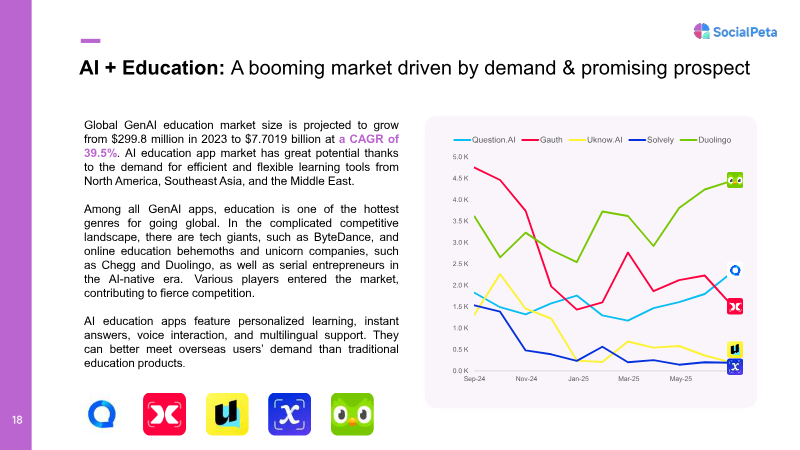
The analysis demonstrates that while the global pool of active AI-advertisers has contracted by 35–45% in H1 2025, the remaining players are compensating with a markedly higher creative output—an 84% increase to an average of 416 monthly creatives per advertiser.
- The number of active AI-advertisers in the mobile market contracted by 35–45% in H1 2025, while the remaining players increased their creative output by 84% to an average of 416 monthly creatives per advertiser.
- Meitu’s revenue grew 12.3% to RMB 1.8 billion in H1 2025, driven primarily by a 45.2% surge in AI-powered imaging and design subscriptions, which reached RMB 1.35 billion.
- Video advertising currently dominates the AI mobile landscape, accounting for 84% of all ads, with over half of inventory utilizing 15–30 second formats.

How to Create Ad Creatives With Open‑Source AI
Mobile game marketing is undergoing a fundamental transformation as the industry pivots toward AI-driven user acquisition.
- By 2026, an estimated 50% of user acquisition (UA) creatives in the mobile gaming industry will be generated using AI.
- Open-source AI models, such as those found on Civitai or utilized via ComfyUI, offer significantly more control over image and video output than 'black box' Western tools like MidJourney or ChatGPT.
- Mastering image generation is the foundational requirement for high-quality creative production, as video generation workflows rely on these initial frames for consistency and style.

How AI Continues to Reshape Game QA
The integration of generative AI and vision-language models is fundamentally transforming game quality assurance by shifting the industry toward black-box testing methodologies.
- Game QA is shifting from code-integrated systems to 'black-box' testing, where AI agents use computer vision to observe and interact with games without requiring deep engine-level software integration.
- Modern multimodal AI models, such as Gemini and various open-source alternatives, allow agents to perform visual reasoning by processing game images and text, enabling them to navigate and test games similarly to human players.
- The primary technical challenge in current AI QA is balancing reasoning quality with operational speed and cost, as high-latency cloud-based models often require integration with faster, locally-run models to maintain production-ready workflows.

Game Awards Hype, Clair Obscur's Big Win, and Disney's AI Deal | Games For Breakfast
The 2025 gaming landscape is defined by a tension between high-budget marketing spectacles and the evolving technical and ethical challenges facing the industry.
- The Game Awards functions primarily as an advertising campaign, with industry observers noting that the event's structure—specifically the rapid-fire presentation of awards and the relegation of indie titles to the pre-show—undermines its credibility as a legitimate awards ceremony.
- The industry is seeing a shift in AI discourse, with critics arguing that the knee-jerk dismissal of all AI-integrated projects as 'slop' is becoming a lazy form of criticism that fails to distinguish between creative tools and low-effort content generation.
- Disney's recent ventures into AI-driven storytelling have sparked industry skepticism, with concerns that these technologies are being used to repurpose and redistribute existing intellectual property rather than fostering genuinely new creative works.

CESA Game Industry Report 2025
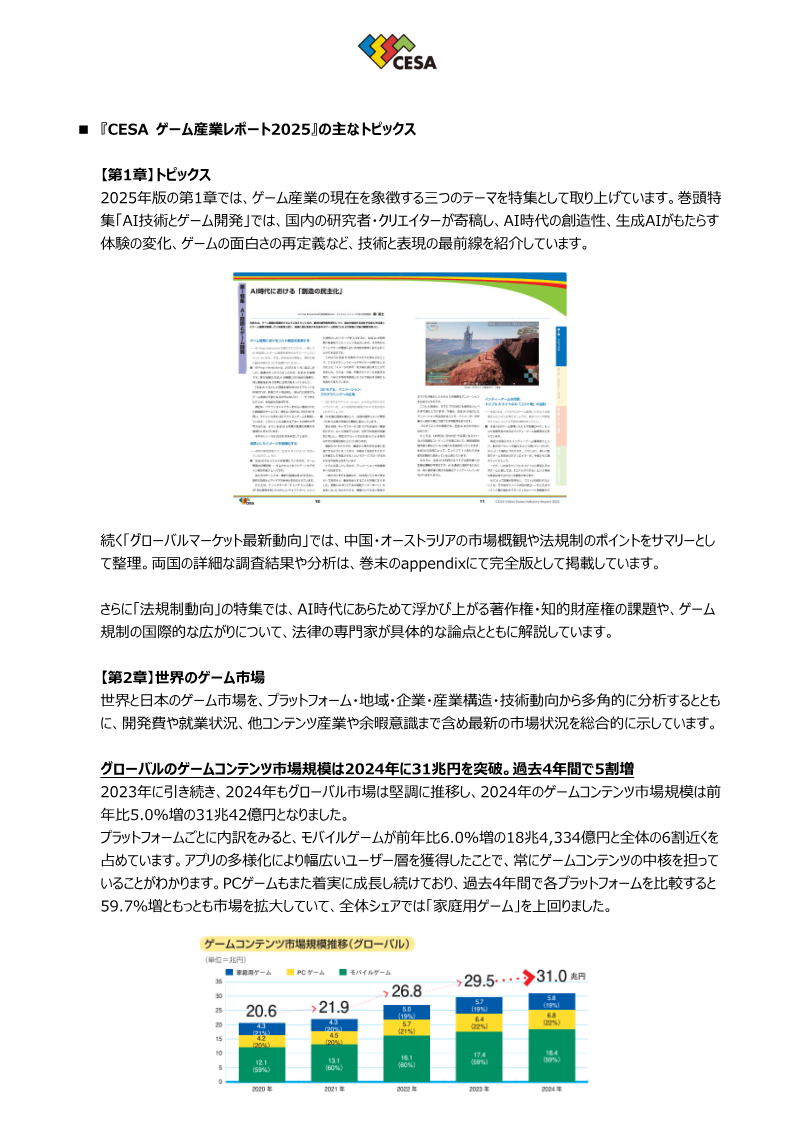
The 2025 CESA Game Industry Report presents a comprehensive assessment of the current state of the video-game sector, emphasizing three strategic themes: the impact of artificial-intelligence technologies on development, the latest dynamics of the global market, and emerging regulatory issues.
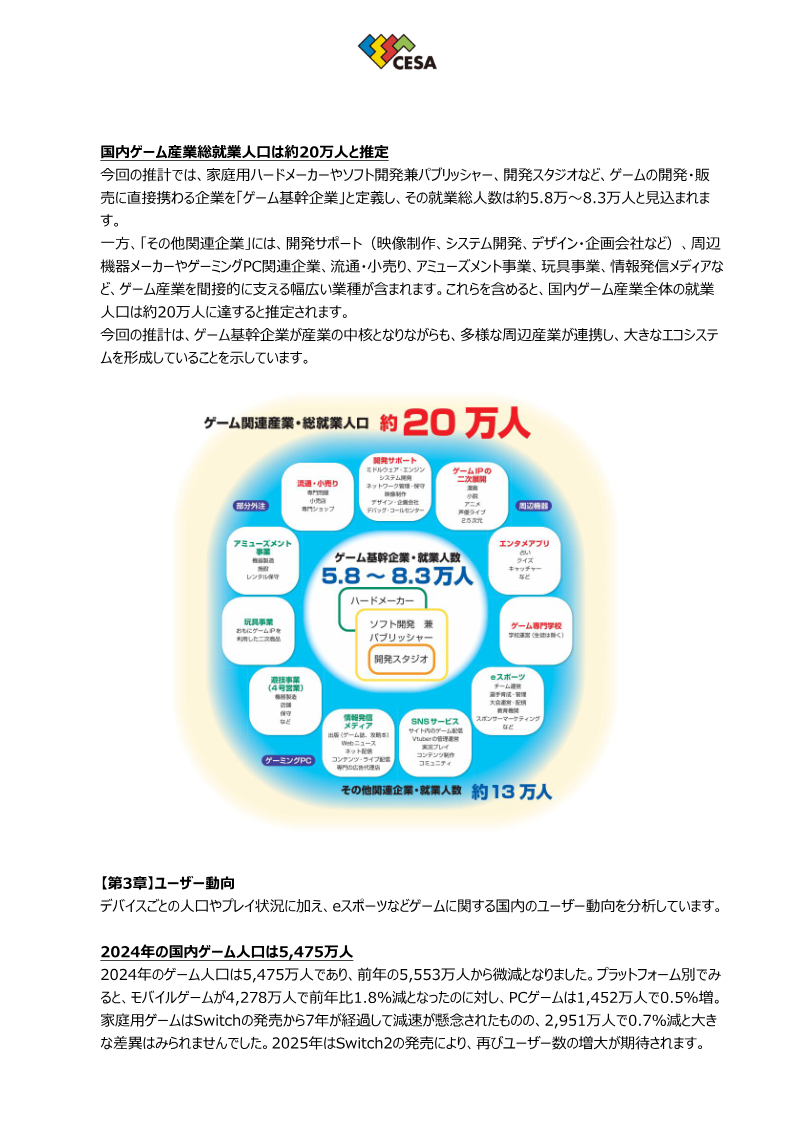
- Global game content revenue reached 31.042 trillion yen in 2024, representing a 5.0% year-on-year increase.
- Mobile gaming remains the dominant sector, generating 18.433 trillion yen—roughly 60% of total global sales—with a 6.0% annual growth rate.
- PC gaming has experienced significant momentum, expanding 59.7% over the last four years to overtake console market share.

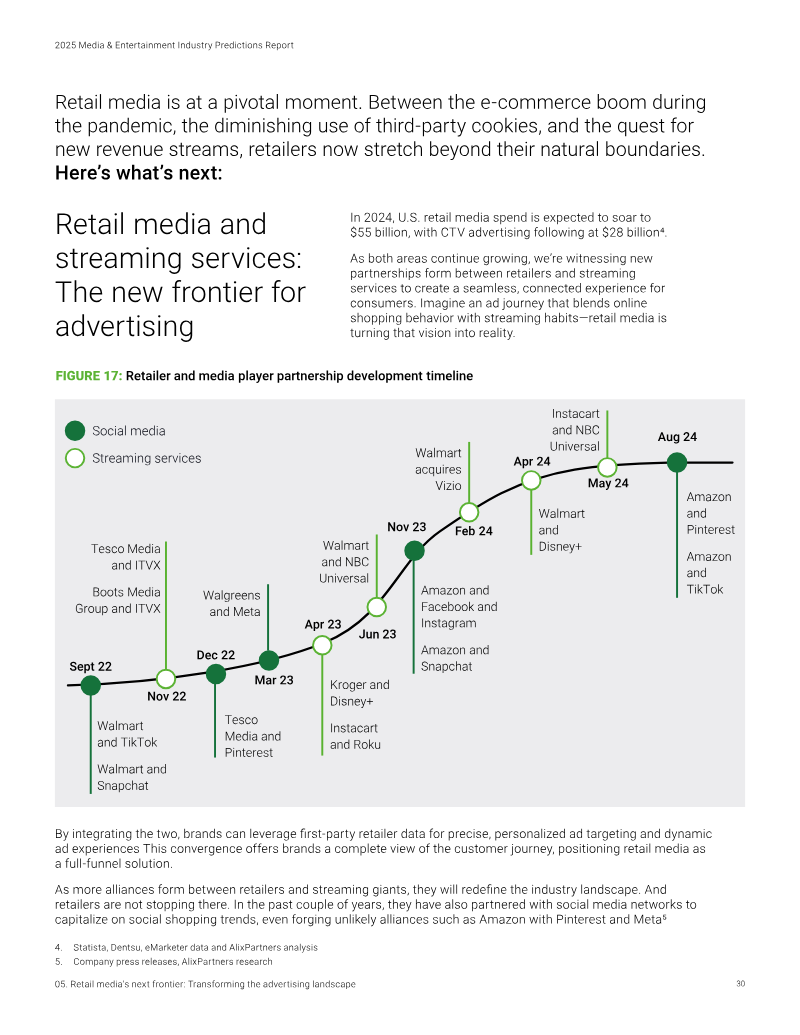

2025 Media & Entertainment Industry Predictions Report
The analysis projects that artificial intelligence will be the primary catalyst for change across the media and entertainment landscape in 2025, enhancing human talent rather than replacing it.
- Global SVOD and AVOD revenue is projected to exceed $165 billion in 2025, with 60–70% of subscriptions in mature markets expected to shift toward bundled or aggregated models to combat churn.
- Traditional U.S. pay-TV providers are forecast to lose half their subscriber base, dropping below 50 million users as the industry pivots to 'stream-hub' models that bundle broadband with multiple streaming services.
- Cloud gaming is projected to grow at a 44% CAGR through 2030, reaching a $64 billion market as subscription-based monetization increasingly replaces traditional one-time hardware purchases.

🚨📢 BREAKING NEWS: Netflix heartbroken after WB, Disney AI fun, Meta losing $70B 🤯
This analysis covers major developments in the global entertainment and gaming sectors as of early December, focusing on corporate consolidation, artificial intelligence integration, and shifting market strategies.
- Disney has secured a $1 billion equity agreement with OpenAI, granting the AI firm access to 200 iconic characters for generative content development.
- Meta is pivoting away from its Metaverse division, Reality Labs, after accumulating approximately $70 billion in losses to focus resources on AI.
- Paramount has submitted a $108 billion all-cash offer for Warner Bros., creating significant competition for Netflix, which is also pursuing the acquisition.

Netflix's $83bn Warner deal doesn't value games & why award shows hate mobile | Week in Mobile Games
Netflix’s recent $82.7 billion acquisition of Warner Bros. Discovery highlights a significant strategic ambiguity regarding the role of interactive entertainment in large-scale media mergers.
- Netflix assigned a $0 valuation to the Warner Bros. Games division despite acquiring the company in an $82.7 billion deal, signaling uncertainty regarding the strategic value of interactive entertainment in streaming-focused mergers.
- The acquisition of Warner Bros. Discovery includes major developers like Rocksteady Studios and Avalanche Software, yet their long-term operational autonomy remains in question under Netflix’s current corporate structure.
- Mobile gaming faces a persistent legitimacy gap, evidenced by its continued exclusion from major industry honors like The Game Awards and the BAFTAs, which critics argue favor console-based intellectual property.