Updated Jun 1, 2026 by AlixPartners
Report · December 14, 2025
Published by AlixPartners
One year ago, we began our first annual One year ago, we began our first annual AlixPartners Media & Entertainment Industry Predictions Report by stating that “the media and entertainment industry has always been a poster child of creative destruction.” Fast-forward to year two, and that sentence still rings true—in fact, the destruction and Fast-forward to year two, and that sentence still rings true—in fact, the destruction and competition may have only grown fiercer.
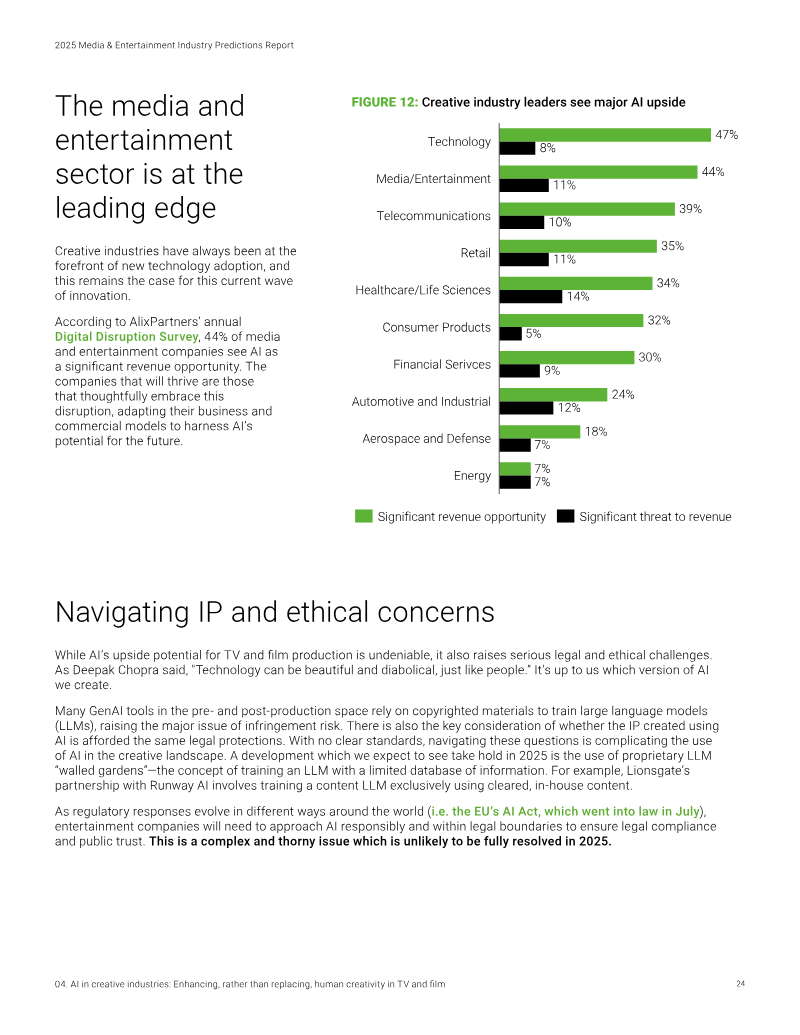
One year ago, we began our first annual One year ago, we began our first annual AlixPartners Media & Entertainment Industry Predictions Report by stating that “the media and entertainment industry has always been a poster child of creative destruction.” Fast-forward to year two, and that sentence still rings true—in fact, the destruction and Fast-forward to year two, and that sentence still rings true—in fact, the destruction and competition may have only grown fiercer. AI advances have made major inroads in the past year and will continue to serve as the major technological force disrupting business and operations across the media industry. From a creative perspective, AI has further penetrated the TV and film sectors, where practical, easy-to-implement use cases with measurable outcomes will lead the way in 2025. But we don’t expect the technology to replace human talent; it should only enhance creative output. AI is also disrupting the video gaming, casino gaming, sports betting, and search markets, shifting traditional business models to meet consumer preferences. Legacy media and advertising businesses are seeing a similar need to transform business Legacy media and advertising businesses are seeing a similar need to transform business models as subscription revenue moves from Pay TV to streaming, while advertising revenue moves from linear to digital. The continued rise of retail media will evolve where companies place their ad dollars to match consumption habits.
We lay out our second annual AlixPartners Media & Entertainment Industry Predictions Report across seven chapters. As we enter 2025, we believe our core predictions will shape the future direction of the industry: 01. STREAMING WARS: The battle over 04. AI IN CREATIVE INDUSTRIES: the next generation of TV Enhancing, rather than replacing, human 1 Streaming subscriptions purchased through wholesale creativity in TV and film distribution will rise to 60-70% in mature markets, driven AI will transform the production cycle—not by eliminating by the growing momentum of bundling and aggregation. creative jobs, but by redefining roles and sparking new Over time we expect to see three to five “central hubs” synergies between creative teams and technology. emerge as leading distributors, but in 2025, we will see In fact, we predict that in 2025 there will be a lack of several new deal partnerships as the industry experiments creatives with the expertise and skills required to use the 2 with consolidating streaming services. new AI tools available. Experimental bundling partnerships among direct-toconsumer (DTC) platforms are early indicators of broader 05. RETAIL MEDIA'S NEXT FRONTIER:
ips as the industry experiments creatives with the expertise and skills required to use the 2 with consolidating streaming services. new AI tools available. Experimental bundling partnerships among direct-toconsumer (DTC) platforms are early indicators of broader 05. RETAIL MEDIA'S NEXT FRONTIER: 3 industry consolidation coming in 2025. Transforming the advertising landscape Traditional Pay TV subscribers in the U.S. will drop below 50 million in 2025—less than half of what they were just As advertisers continue shifting budget towards digital, a decade ago. Meanwhile, virtual multichannel video the convergence of the streaming services and retail media programming distributors (vMVPDs) are approaching their trends, coupled with the global expansion of retail media peak before entering a period of decline after 2025, driven networks, will accelerate disruption within the by the rapid shift of live sports to DTC platforms, evolving media industry. consumer behavior, and rising costs. 02. SPORTS BETTING AND CASINO GAMING: Fund tech investments or face marginalization There will only be room for three to five dominant players within the online sports betting and iGaming industries to successfully invest at scale and grow. As others fight for market share, we predict at least one company will be forced out of the competitive arena. 06. THE FUTURE OF SEARCH: AI-driven disruption and diversification OpenAI, Perplexity, Amazon, and TikTok will gain further traction, signaling a new era of competition in the search industry. Google's share of the search advertising market will continue to shrink, decreasing by low single digits. 07. M&A IN MEDIA:
EARCH: AI-driven disruption and diversification OpenAI, Perplexity, Amazon, and TikTok will gain further traction, signaling a new era of competition in the search industry. Google's share of the search advertising market will continue to shrink, decreasing by low single digits. 07. M&A IN MEDIA: 03. BEYOND THE CONSOLE: An environment ripe for dealmaking Video gaming's cloud revolution 1 Reduced regulatory scrutiny and a lower cost of capital will generate a rebound in evaluation of media Both gaming console and PC hardware sales will decline, 2 consolidation deals. as consumers choose to spend instead on displays and On top of Comcast’s proposed carve-out of NBC cable streaming devices. assets, we will see at least one more cable network carve-out this year.
01. STREAMING WARS: The battle over the next generation of TV AUTHORS OF THIS CHAPTER: Jeff Goldstein, Mark Endemaño, Lexie Perrotta, and Katarina Milen 01. Streaming wars: The battle over the next generation of TV 4
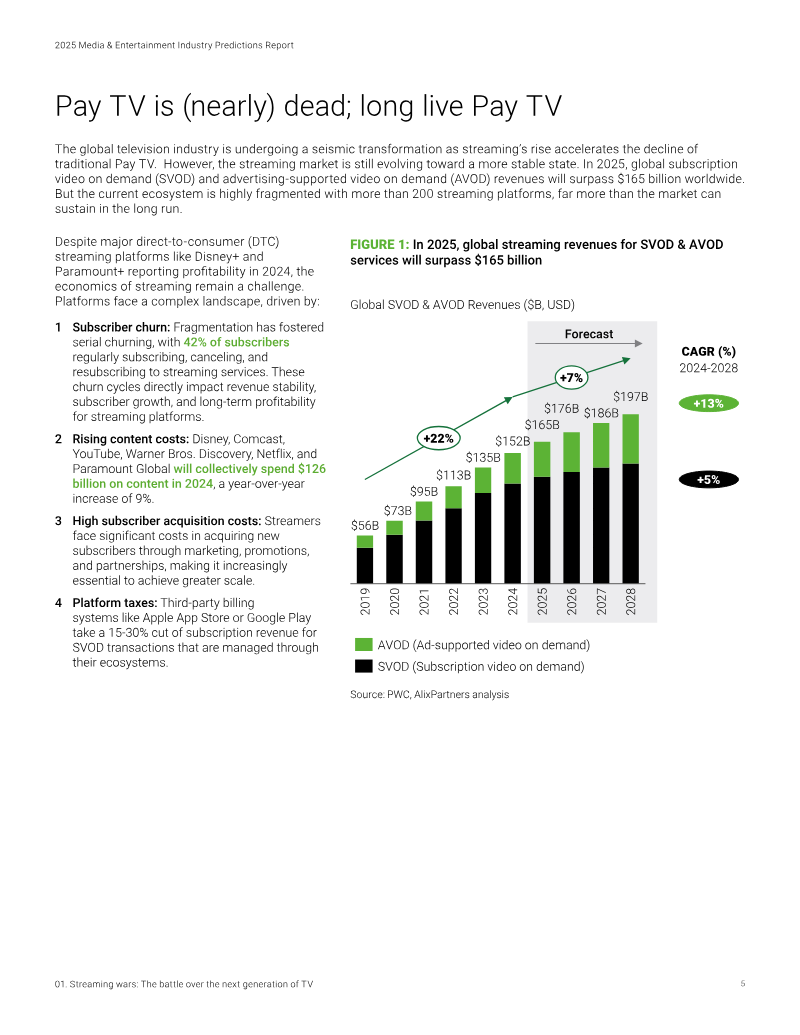
Pay TV is (nearly) dead; long live Pay TV The global television industry is undergoing a seismic transformation as streaming’s rise accelerates the decline of traditional Pay TV. However, the streaming market is still evolving toward a more stable state. In 2025, global subscription video on demand (SVOD) and advertising-supported video on demand (AVOD) revenues will surpass $165 billion worldwide. But the current ecosystem is highly fragmented with more than 200 streaming platforms, far more than the market can sustain in the long run. Despite major direct-to-consumer (DTC) FIGURE 1: In 2025, global streaming revenues for SVOD & AVOD streaming platforms like Disney+ and services will surpass $165 billion Paramount+ reporting profitability in 2024, the economics of streaming remain a challenge. Platforms face a complex landscape, driven by: Global SVOD & AVOD Revenues ($B, USD) 1 Subscriber churn: Fragmentation has fostered Forecast serial churning, with 42% of subscribers CAGR (%) regularly subscribing, canceling, and 2024-2028 resubscribing to streaming services. These +7% churn cycles directly impact revenue stability, 197B subscriber growth, and long-term profitability 176B $186B +13% 2 for streaming platforms. +22% $165B Rising content costs: Disney, Comcast, $152B YouTube, Warner Bros. Discovery, Netflix, and $135B Paramount Global will collectively spend 126 113B +5% billion on content in 2024, a year-over-year $95B
Investment committees navigating the 2026 landscape are advised to pivot toward three primary market themes: the widespread electrification of the global economy, the Federal Reserve’s interest rate easing cycle, and the depreciation of the US dollar. These trends offer a strategic framework for diversifying portfolios beyond the narrow concentration of mega-cap growth stocks, potentially enhancing resilience and capturing emerging opportunities across various asset classes. The surge in power demand, driven by artificial intelligence, data center expansion, and industrial automation, necessitates significant capital allocation toward infrastructure. Rather than focusing solely on headline technology firms, investors are encouraged to target the underlying grid modernization, energy transmission, and critical material supply chains. This thematic shift encompasses North American energy pipelines, clean energy solutions, and global natural resource producers, all of which are essential to sustaining an increasingly electrified economy. Simultaneously, the transition toward lower interest rates requires a shift in focus toward quality-oriented income strategies. As cash yields decline, active management in fixed income and the inclusion of quality-screened, dividend-paying small-cap equities can help mitigate volatility and reduce reliance on unprofitable market segments. Furthermore, the anticipated weakening of the US dollar provides a catalyst for diversifying into non-US developed markets and real assets, such as commodities and real estate investment trusts. By rebalancing toward these sectors, investors can hedge against currency risk and inflation while positioning for broader market participation across international and domestic landscapes.
Decoding the Breakout AI Across Finance, Social, and Health Apps, the 2026 Global Mobile App Marketing Trends White Paper Uncovers the Drivers In 2025, the global mobile app market experienced a fundamental shift. Traffic-driven growth approaches reached their limits, and broad, volume-oriented strategies began to lose traction. Instead, value-led operations, technology-enabled optimization, and deep localization emerged as the primary drivers of sustainable growth.
From Scale to Sustainability: How Short Drama App Marketing Will Be Redefined in 2026 Micro-dramas have moved well beyond experimentation. As the market heads into 2026, global competition is shifting from rapid expansion to a more structured phase—where success is driven less by novelty and more by scalable marketing systems, creative efficiency, and Against this backdrop, SocialPeta and AMO Pictures jointly conducted an in-...
The industry snapshot reveals a workforce that remains predominantly male and White, yet shows growing diversity in gender identity, sexual orientation, and geographic mobility. Two‑thirds of respondents are male, 24 % female, and 8 % non‑binary, with 28 % identifying as LGBTQ+. The U.S. dominates the sample (54 %), and California remains the top state of residence, while Washington has experienced the largest influx. Most workers are under 35 (64 %) and concentrated in design, programming, and visual arts roles. Layoffs continue to be a significant concern, especially within AAA studios where two‑thirds of respondents report company layoffs and nearly one in five have been personally let go. Indie studios experience fewer corporate cuts, yet a higher proportion of individuals report personal layoffs. Roughly half of all respondents anticipate no layoffs in the next year, but those with prior layoff experience express greater uncertainty. Generative AI elicits polarized views: 42 % see it as a productivity catalyst, while 38 % view it as ethically problematic and potentially job‑threatening. The debate centers on balancing efficiency gains against concerns over originality, labor displacement, and environmental impact. VR/AR/MR remains a niche segment, with only 8 % of respondents engaged in such projects. Meta Quest/Horizon dominates the market, and accessibility features are widely adopted, though advanced options lag behind. Monetization trends show premium titles favor digital downloads and physical copies, whereas free‑to‑play games rely heavily on in‑app purchases for currency and cosmetics. Crunch culture persists, with 87 % of workers clocking overtime in the past year and over half citing essential work or self‑pressure as drivers. Union support is strong in the U.S., with 82 % backing unionization and a majority expressing interest, though leadership opinions are slightly more divided.