Report52 pages
Modern Responsibility Report 2011
MTG’s 2011 corporate responsibility strategy centers on integrating ethical business practices, environmental stewardship, and social engagement across its operations in 39 countries. By aligning its governance with the Global Reporting Initiative framework and securing a position in the FTSE4Good Index, the company demonstrates a commitment to transparency and high-level sustainability standards. The primary objective is to balance commercial success with a robust social mandate, ensuring that broadcasting and production activities contribute positively to the diverse markets in which the company operates.
Operational performance in 2011 was marked by the successful achievement of 14 out of 15 short-term sustainability goals. Environmental efforts proved particularly effective, as the company exceeded its carbon reduction target by achieving a 6% decrease in emissions per employee through enhanced energy efficiency and facility management. Simultaneously, the company prioritized internal governance by updating anti-bribery and corruption policies and ensuring 100% employee participation in regulatory training. Workforce development was further bolstered by the launch of the Modern People career platform and expanded training through the MTG Academy, which aims to address gender representation in management and foster professional growth.
Social impact remains a core pillar of the company’s mission, evidenced by significant charitable contributions and community-focused programming. In 2011, the company donated 146 million SEK in airtime and raised 37 million SEK for health and welfare initiatives. Beyond financial support, the company utilized its media reach to promote social cohesion through projects like the United for Peace football tournament. Furthermore, the organization maintained a strong focus on consumer protection, particularly regarding child safety in digital and traditional media, while increasing accessibility through expanded subtitling services. These combined efforts reflect a comprehensive approach to corporate citizenship that emphasizes both internal compliance and external community development.
- MTG achieved 14 out of 15 short-term sustainability goals in 2011 while maintaining its position in the FTSE4Good Index and aligning with Global Reporting Initiative standards.
- The company exceeded its carbon reduction target by achieving a 6% decrease in emissions per employee through improved energy efficiency and facility management.
- MTG donated 146 million SEK in airtime and raised 37 million SEK for various health and welfare initiatives during the 2011 fiscal year.
- Internal governance was strengthened by updating anti-bribery and corruption policies and achieving 100% employee participation in regulatory training.
- Workforce development efforts included the launch of the Modern People career platform and expanded training via the MTG Academy to improve gender representation in management.
+1
Modern Times Group
Report24 pages
Modern Responsibility Report 2010
MTG’s 2010 Modern Responsibility initiative establishes a comprehensive framework for integrating economic, environmental, and social accountability across its global media operations. Spanning 33 countries, the company’s strategy centers on four pillars: responsible business conduct, broadcasting integrity, employee relations, and community engagement. By adopting the Global Reporting Initiative framework and conducting a formal materiality analysis, the organization has aligned its internal governance with stakeholder priorities, specifically emphasizing anti-corruption, regulatory compliance, and fair employment practices.
Operational performance in 2010 reflects a dual focus on professional development and social impact. The company invested heavily in human capital through the MTG Academy, which emphasizes leadership and sales training, while simultaneously promoting diversity and female representation in management. Beyond internal operations, the company leveraged its media influence to drive social change, donating 111 million SEK in airtime to charitable causes and launching foundations such as MTG United for Peace and Playing for Change. These efforts underscore a commitment to using broadcasting platforms to support disaster relief, cancer research, and youth development.
Environmental stewardship remains a critical, albeit challenging, area of focus. Total climate impact reached approximately 15,000 tons of CO2e in 2010, driven largely by business travel and facility energy consumption. Despite a 36 percent increase in travel-related emissions, the company has implemented rigorous mitigation strategies, including the adoption of ISO 14001 standards and a mandate to reduce CO2 emissions per employee by 5 percent by early 2012. Through the integration of green training for 59 percent of its staff and the expansion of video conferencing, the organization seeks to balance its international growth with a measurable reduction in its corporate carbon footprint.
- MTG established a 2010 corporate responsibility framework across 33 countries, utilizing the Global Reporting Initiative to prioritize anti-corruption, regulatory compliance, and fair employment.
- The company donated 111 million SEK in airtime to charitable causes in 2010, supporting initiatives like MTG United for Peace and Playing for Change.
- MTG’s total climate impact reached approximately 15,000 tons of CO2e in 2010, with business travel-related emissions increasing by 36 percent.
- To mitigate environmental impact, the company mandated a 5 percent reduction in CO2 emissions per employee by early 2012 and provided green training to 59 percent of its staff.
- Human capital investment in 2010 focused on leadership and sales training through the MTG Academy, alongside efforts to increase female representation in management.
+1
Modern Times Group
Report42 pages
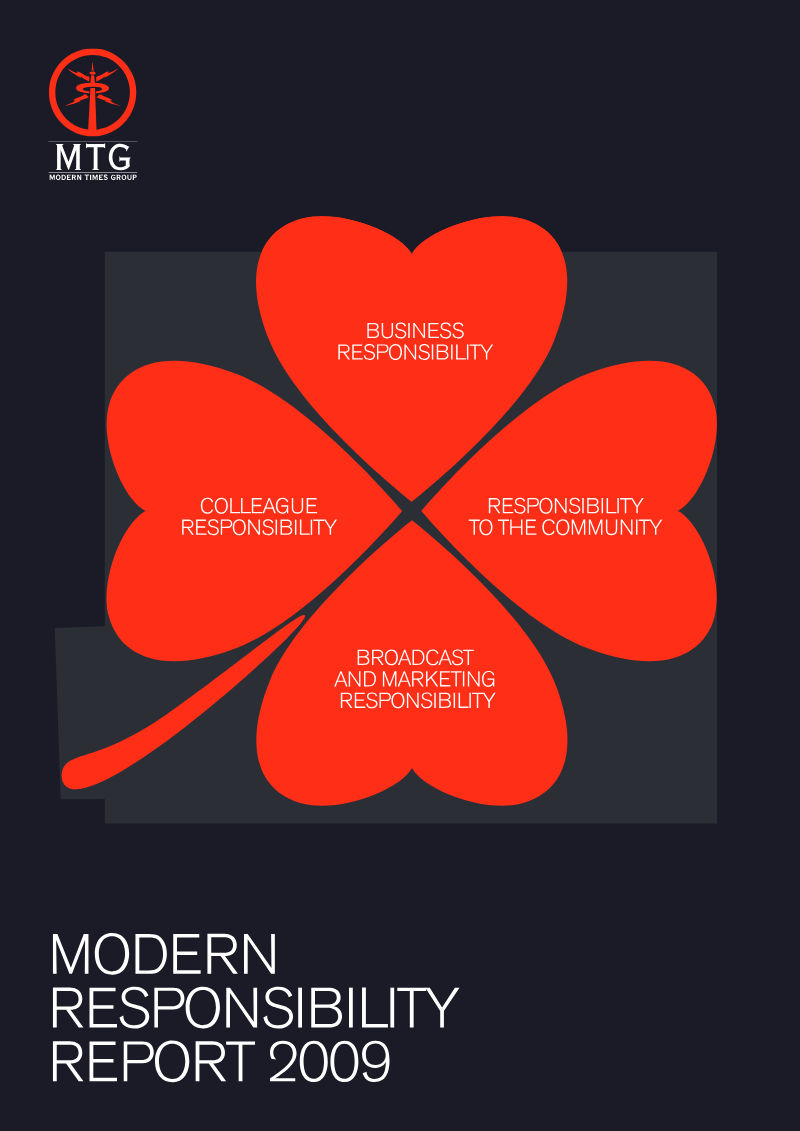
Modern Responsibility Report 2009
Modern Times Group (MTG) maintains a comprehensive commitment to integrating corporate responsibility into its broadcasting and entertainment operations across 31 countries. The primary objective of its 2009 strategic framework is to ensure sustainable business growth through rigorous governance, ethical conduct, and social accountability. By formalizing environmental policies and establishing a structured oversight committee, the company seeks to balance its commercial objectives with its impact on society and the environment, even amidst the challenging economic climate of the late 2000s.
Operational performance is anchored by a robust governance model that emphasizes transparency, fair competition, and strict adherence to a global code of conduct. Key initiatives include the implementation of a whistleblower policy, mandatory compliance training, and the protection of minors through regulated content and parental controls. The company’s focus on human capital is evidenced by the MTG Academy, which provided training to 81 percent of permanent staff, and a diverse workforce spanning 38 nationalities. These efforts are supported by internal audits and key performance indicators designed to enhance the measurability of ethical and social initiatives.
Environmental stewardship remains a central pillar of the company’s strategy, with carbon footprint audits now covering operations in 19 countries. In 2009, the organization recorded a total climate impact of approximately 13,000 tons of CO2e, prompting investments in energy-efficient infrastructure and reduced travel requirements. Beyond internal reductions, the company leverages its media platforms to drive social change, notably through the "Playing for Change" initiative and the donation of airtime to support environmental and social causes. By aligning its broadcasting reach with philanthropic goals, the company reinforces its position as a responsible stakeholder in the global media landscape.
- MTG established a formal corporate responsibility framework in 2009 to integrate governance, ethical conduct, and social accountability across its broadcasting operations in 31 countries.
- The company recorded a total climate impact of approximately 13,000 tons of CO2e in 2009, leading to the implementation of carbon footprint audits across 19 countries and investments in energy-efficient infrastructure.
- Human capital development was prioritized through the MTG Academy, which provided training to 81 percent of the company's permanent staff.
- MTG maintains a diverse workforce representing 38 nationalities, supported by a governance model that includes mandatory compliance training and a formal whistleblower policy.
- The company utilizes its media reach for philanthropic purposes, specifically through the 'Playing for Change' initiative and the donation of airtime to support social and environmental causes.
+1
Modern Times Group
Report51 pages
Modern Responsibility Report 2012
Modern Times Group (MTG) integrates sustainability and ethical governance into its core business strategy to drive long-term growth across its global entertainment operations. During the 2012 fiscal year, the company maintained a workforce of 3,012 employees and generated net sales of 13,336 MSEK. Operating across more than 30 broadcast markets, the organization utilizes a four-pillar framework—business, colleague, broadcast/marketing, and community responsibility—to ensure regulatory compliance, promote diversity, and uphold editorial integrity.
The company’s commitment to corporate responsibility is evidenced by measurable progress in environmental and social performance. In 2012, MTG achieved a 6% reduction in CO2 emissions per employee and secured a "B" rating from the Carbon Disclosure Project. Social impact initiatives were equally prominent, with the company raising 49 million SEK for charitable causes and supporting programs such as "Reach for Change" and the "School of Tolerance." Furthermore, the organization prioritized consumer safety through enhanced parental controls and expanded accessibility services, including subtitling and audio descriptions, to better serve its diverse audience.
Adhering to the Global Reporting Initiative (GRI) G3.1 guidelines at a C+ application level, the company maintains a transparent approach to its operations, supported by independent assurance from Ethos International. While the 2012 performance reflects significant advancements in anti-corruption training, internal communication, and community engagement, the organization acknowledges the necessity for future improvements in supply chain management and human resources data collection systems. By aligning its broadcasting reach with strategic sustainability goals, MTG continues to leverage its media platforms to promote social awareness and mitigate climate-related business risks.
- In 2012, Modern Times Group (MTG) generated 13,336 MSEK in net sales while employing 3,012 staff across more than 30 broadcast markets.
- The company achieved a 6% reduction in CO2 emissions per employee and earned a 'B' rating from the Carbon Disclosure Project.
- MTG raised 49 million SEK for charitable causes in 2012, supporting initiatives such as 'Reach for Change' and the 'School of Tolerance'.
- The organization reported its sustainability performance using the Global Reporting Initiative (GRI) G3.1 guidelines at a C+ application level, with independent assurance provided by Ethos International.
- MTG implemented enhanced parental controls and expanded accessibility services, including subtitling and audio descriptions, to improve consumer safety and service inclusivity.
Modern Times Group
Report43 pages
Corporate Responsibility Report 2014
MTG’s 2014 operational strategy centered on the integration of corporate responsibility into its core business model, prioritizing digital data protection, the rights of minors, and the preservation of freedom of expression. By aligning operations with UN Global Compact and OECD guidelines, the company achieved net sales of 16,746 MSEK while maintaining a rigorous ethical framework. This governance structure included the implementation of a new supplier code of conduct, mandatory anti-bribery training, and the introduction of an external whistleblower system, resulting in zero confirmed cases of corruption during the fiscal year.
The company’s commitment to social and environmental stewardship was evidenced by a 33% reduction in energy consumption per employee since 2010 and an improved CDP score of 90B. Beyond internal efficiency, MTG leveraged its media platforms to double donated airtime for social and environmental causes. HR initiatives focused on decentralizing operations to empower local markets, fostering a diverse workforce of 4,111 employees representing 44 nationalities. While the company successfully promoted initiatives like Women in Tech, it acknowledged ongoing challenges regarding gender pay parity and high turnover rates in sales-intensive roles, leading to the restructuring of certain internal development goals.
Operating across diverse geographic regions, MTG maintained strict neutrality and regulatory adherence through robust content rating systems and parental controls. Independent assurance provided by Ethos International confirmed that the company’s performance indicators met the Core level of the Global Reporting Initiative G4 guidelines. While the organization successfully met most targets regarding data protection and environmental impact, auditors recommended the adoption of advanced digital management systems to enhance the accuracy of future human resource data collection, ensuring continued transparency and operational efficiency in subsequent reporting periods.
- MTG achieved net sales of 16,746 MSEK in 2014 while maintaining zero confirmed cases of corruption through the implementation of mandatory anti-bribery training and an external whistleblower system.
- The company reduced energy consumption per employee by 33% since 2010 and achieved a CDP score of 90B, reflecting its commitment to environmental stewardship.
- MTG employed 4,111 people across 44 nationalities, though the company identified ongoing challenges regarding gender pay parity and high turnover rates in sales-intensive roles.
- Operational governance was aligned with UN Global Compact and OECD guidelines, with independent assurance from Ethos International confirming compliance with the Global Reporting Initiative G4 Core level.
- The company prioritized digital safety by implementing robust content rating systems and parental controls to protect minors and preserve freedom of expression.
+1
Modern Times Group
Report62 pages
Corporate Responsibility Report 2015
MTG’s 2015 corporate responsibility strategy centers on navigating a strategic transition into a global digital entertainment powerhouse while upholding rigorous ethical standards and sustainability commitments. The company prioritizes transparency, governance, and social impact, aligning its reporting with GRI G4 standards to ensure accountability across its diverse operations. By integrating a zero-tolerance policy toward corruption and enforcing a mandatory supplier code of conduct, the organization seeks to mitigate risks associated with its evolving digital and live-event portfolio, including cyber-resilience and intellectual property protection.
Environmental and social performance metrics reveal a complex landscape of progress and ongoing challenges. While total energy consumption and carbon emissions saw a slight uptick, the company successfully reduced emissions per employee by over 2% and improved long-term energy efficiency by 13% since 2010. Air travel remains the primary driver of the company’s carbon footprint, prompting a shift toward virtual collaboration and renewable energy reliance. Socially, the company leverages its media influence to support global causes, donating over €9 million in airtime and fostering social entrepreneurship through initiatives like Reach for Change.
Workforce development remains a critical focus, characterized by a diverse staff of nearly 4,000 employees representing 38 nationalities. Despite a 24% turnover rate and a persistent gender gap in leadership, the company has formalized a commitment to achieve gender parity in management by 2020 through targeted mentorship and internal policy adjustments. As the company expands its digital footprint, it continues to refine its risk management and compliance frameworks, ensuring that its growth is balanced by a commitment to ethical content production, child protection, and robust data privacy standards across its European and global markets.
- MTG has committed to achieving gender parity in management by 2020 through formalized mentorship programs and policy adjustments to address a persistent leadership gender gap.
- The company maintains a workforce of nearly 4,000 employees across 38 nationalities, though it currently faces a 24% annual staff turnover rate.
- MTG donated over €9 million in airtime to support global causes and social entrepreneurship initiatives such as Reach for Change.
- While total carbon emissions increased, the company achieved a 13% improvement in energy efficiency since 2010 and a 2% reduction in emissions per employee.
- Air travel is the primary contributor to MTG’s carbon footprint, leading the organization to prioritize virtual collaboration and increased reliance on renewable energy.
Modern Times Group
Report48 pages
2016 Corporate Responsibility Report
Modern Times Group (MTG) navigated a pivotal digital transformation in 2016 by embedding corporate responsibility into its core business strategy. The organization focused on four primary pillars: media responsibility, social impact, business ethics, and environmental stewardship. By aligning its operational evolution with these values, the company secured recognition in the Dow Jones Sustainability Indices and established a framework for long-term growth. This strategic shift prioritized the integration of ethical standards into digital entertainment services, ensuring that the company’s transition remained consistent with its commitment to regulatory compliance and stakeholder accountability.
Operational performance throughout 2016 reflected a dual focus on internal culture and external resilience. The company successfully reduced its total carbon emissions by 7% and increased its reliance on renewable energy to 16.6%. Simultaneously, MTG bolstered its cybersecurity and anti-corruption frameworks, achieving an 81% completion rate for mandatory information security training and maintaining a record of zero confirmed corruption incidents. Governance was further strengthened through the Corporate Responsibility Advisory Group, which oversaw the implementation of rigorous data protection measures and preparations for upcoming regulatory shifts like GDPR.
Human capital management and social engagement remained central to the company’s mission, despite a workforce reduction to 3,805 employees. MTG actively pursued gender parity in leadership through the "Women Up" initiative, aiming for a 50/50 management split by 2020. Furthermore, the company leveraged extensive consumer research and partnerships, such as "Reach for Change," to ensure content alignment with viewer preferences and broader social impact. While the company acknowledged limitations in HR data granularity, its disclosures adhered to the GRI G4 Core level guidelines, confirming a transparent and disciplined approach to corporate governance across its international operations.
- MTG integrated corporate responsibility into its core business strategy in 2016, earning recognition in the Dow Jones Sustainability Indices while preparing for GDPR compliance.
- The company reduced total carbon emissions by 7% and increased its reliance on renewable energy to 16.6% during the 2016 fiscal year.
- MTG maintained a record of zero confirmed corruption incidents and achieved an 81% completion rate for mandatory information security training.
- The 'Women Up' initiative was launched to achieve gender parity in leadership positions by 2020, despite a total workforce reduction to 3,805 employees.
- Governance was strengthened through the establishment of the Corporate Responsibility Advisory Group, which oversaw the implementation of rigorous data protection measures.
+1
Modern Times Group
Report66 pages
2019 Corporate Responsibility Report
Following its 2019 corporate spinoff, MTG established a comprehensive environmental, social, and governance framework to align its operations with the unique risks and opportunities inherent in the global gaming and esports sectors. The primary objective of this strategy is to foster long-term profitability and sustainable entertainment by prioritizing ethical conduct, the protection of minors, and the mitigation of industry-specific hazards. By implementing a revised Code of Conduct, which achieved a 94% adoption rate among employees and contractors, the company has successfully reinforced its commitment to anti-corruption, privacy compliance, and standardized governance across its international operations.
Social responsibility efforts center on improving diversity and inclusion within a historically male-dominated industry, where women currently comprise 22% of the workforce. To address these disparities and combat toxicity, MTG utilizes targeted recruitment, mentorship programs, and strategic partnerships with organizations like AnyKey and UNICEF. Furthermore, the company maintains a rigorous focus on event safety, employing standardized security protocols and risk assessments at its global tournaments and festivals. These initiatives are complemented by community-focused programs, including support for computer science education and hospital-based gaming initiatives for children.
Environmental stewardship remains a critical operational challenge, as 95% of the company’s 27,390-tonne carbon footprint is attributed to travel associated with global esports events. In response, MTG has established a new carbon emissions baseline and implemented digital tracking tools to monitor environmental impact more effectively. While the spinoff of the Nordic Entertainment Group complicates year-over-year comparisons, the company is actively transitioning toward sustainable event practices, including the use of eco-certified venues. Moving forward, MTG intends to refine its supply chain oversight and continue its commitment to transparent, GRI-compliant reporting to ensure the ongoing integrity of its corporate responsibility initiatives.
- MTG’s 2019 carbon footprint totaled 27,390 tonnes, with 95% of emissions directly attributed to travel associated with global esports events.
- The company achieved a 94% adoption rate for its revised Code of Conduct among employees and contractors to standardize anti-corruption and privacy compliance.
- Women currently represent 22% of MTG’s workforce, prompting the company to implement targeted recruitment and partnerships with organizations like AnyKey and UNICEF to address gender disparity.
- MTG has established a new carbon emissions baseline and is transitioning to eco-certified venues to mitigate the environmental impact of its international tournament operations.
- The company maintains rigorous safety protocols and risk assessments for all global tournaments and festivals as part of its core social responsibility framework.
Modern Times Group
Report3 pages
Modern Slavery Statement
Everplay, a global video game developer and publisher, maintains a firm commitment to preventing modern slavery and human trafficking across its operations and supply chains. Covering the financial year ending December 31, 2025, this statement fulfills the requirements of the Modern Slavery Act 2015. The organization operates with approximately 370 employees across the UK, Ireland, Germany, the USA, and Canada, maintaining a business model that relies primarily on intellectual property and digital services rather than physical manufacturing, which inherently limits its exposure to modern slavery risks.
The company’s supply chain is primarily composed of third-party development partners, royalty recipients, and external service providers for localization and quality assurance. While the overall risk profile is considered low, the organization identifies quality assurance and localization as areas requiring heightened vigilance. To mitigate these risks, Everplay mandates that all new and renewing contracts include specific clauses requiring supplier compliance with the Act, granting the company the right to terminate agreements in the event of a breach.
Governance of these efforts is overseen by the Audit Committee, which reports to the Board of Directors at least twice annually. The company utilizes a multi-layered approach to risk management, incorporating internal policies, annual risk register reviews, and an external third-party whistleblowing hotline to ensure transparency and accountability. To date, these measures have proven effective, with no reported incidents of modern slavery. Everplay continues to prioritize employee and stakeholder awareness through ongoing training and the integration of anti-slavery protocols into its broader corporate governance framework.
- Everplay employs approximately 370 staff across the UK, Ireland, Germany, the USA, and Canada, operating a business model focused on intellectual property and digital services.
- The company mandates that all new and renewing contracts include specific anti-slavery compliance clauses, granting Everplay the right to terminate agreements for breaches.
- While the overall risk profile is considered low, the company identifies third-party localization and quality assurance providers as the primary areas requiring heightened vigilance.
- Governance of anti-slavery efforts is managed by the Audit Committee, which reports to the Board of Directors at least twice annually.
- Risk management is supported by annual risk register reviews and an external third-party whistleblowing hotline to ensure transparency.
+1
Everplay
Report62 pages
Annual Report 2024: Savvy Games Group
Savvy Games Group has established itself as a premier global force in interactive entertainment, currently ranking eighth worldwide by net revenue. The organization serves as the primary vehicle for Saudi Arabia’s National Gaming and Esports Strategy, which seeks to generate $13.3 billion in GDP contribution and create 39,000 jobs by 2030. By integrating publishing, development, and esports community building, the group effectively navigates the challenges of a saturated global market, positioning the Kingdom as a central hub for the international gaming industry.
The company’s operational success is underpinned by a robust capital deployment strategy, with over $12 billion invested across nine major acquisitions since 2021. Under the leadership of CEO Brian Ward, the group has scaled to nearly 4,000 employees across 22 countries, supported by a governance structure that includes specialized committees for investment, risk, and executive oversight. This organizational framework ensures that the group maintains strategic alignment while pursuing aggressive growth in both domestic and international markets.
Key business units, specifically Scopely and the ESL FACEIT Group, have delivered record-breaking financial results and solidified the company’s market dominance. The ESL FACEIT Group currently commands a 40% share of the global esports market, engaging over 225 million users through high-profile events like the inaugural Esports World Cup. Simultaneously, internal development efforts through Steer Studios and strategic partnerships with firms like Niantic and Xsolla continue to diversify the portfolio. These collective efforts demonstrate a commitment to scaling interactive entertainment through high-engagement competitive platforms and localized talent development, ensuring long-term sustainability within the global gaming ecosystem.
- Savvy Games Group ranks as the eighth-largest global gaming company by net revenue and serves as the primary vehicle for Saudi Arabia’s goal to contribute $13.3 billion to GDP and create 39,000 jobs by 2030.
- The organization has deployed over $12 billion in capital across nine major acquisitions since 2021 to scale its operations to nearly 4,000 employees across 22 countries.
- The ESL FACEIT Group holds a 40% share of the global esports market and engages more than 225 million users through platforms like the Esports World Cup.
- Business units Scopely and ESL FACEIT Group are the primary drivers of the company's record-breaking financial performance and current market dominance.
- The group is diversifying its portfolio through internal development at Steer Studios and strategic partnerships with firms including Niantic and Xsolla.
+2
Savvy Games Group
Whitepaper13 pages
Gamer Motivation Profile: Empirical Research and Data Insights
The Gamer Motivation Profile provides a comprehensive empirical framework for understanding player behavior through a psychometric model that categorizes gaming preferences into twelve distinct motivational drivers. These drivers—organized into six primary clusters including Action, Social, Mastery, Achievement, Immersion, and Creativity—allow developers and marketers to quantify why specific audiences engage with particular game titles. By linking psychometric data with demographic variables and specific game franchises, the model offers a data-driven approach to audience segmentation and product positioning.
The research is built upon a robust dataset derived from over 1.75 million global participants who have completed the Gamer Motivation Profile survey. This large-scale, ongoing collection of data enables real-time analysis of player demographics, such as age, gender, and play frequency, alongside their psychological motivations. The methodology utilizes factor analysis to identify how various gaming preferences cluster together, providing a statistically sound basis for comparing individual titles against broader genre norms.
The primary utility of this research lies in its ability to generate actionable insights for game development and player acquisition. Through a dynamic dashboard, users can perform side-by-side comparisons of different franchises, identify "game neighborhoods" based on shared motivational profiles, and filter titles by specific criteria to uncover underserved market segments. By mapping how individual games deviate from genre benchmarks, the model helps stakeholders prioritize development features, refine marketing messaging, and identify potential competitors even across disparate genres. This analytical toolset is designed to assist industry professionals in making evidence-based decisions regarding portfolio management and the strategic targeting of core and mid-core gaming audiences.
- The Gamer Motivation Profile utilizes a dataset of over 1.75 million global participants to categorize player behavior into twelve distinct motivational drivers across six primary clusters.
- The psychometric model employs factor analysis to link player demographics, such as age and gender, with specific gaming preferences to enable precise audience segmentation.
- Developers can use the framework to compare individual game franchises against broader genre benchmarks to identify how specific titles deviate from industry norms.
- The research enables the identification of 'game neighborhoods' based on shared motivational profiles, allowing stakeholders to uncover underserved market segments across different genres.
- The analytical toolset supports evidence-based decision-making for portfolio management, feature prioritization, and the strategic targeting of core and mid-core gaming audiences.
+1
Quantic Foundry
Presentation18 pages
Gamer Motivation Profile: Empirical Research Methodology
The Gamer Motivation Profile provides an empirical framework for understanding player behavior by categorizing gaming preferences into twelve distinct motivational factors. Developed through psychometric techniques and factor analysis, the model identifies how specific gaming desires—such as competition, immersion, or mastery—cluster together to drive player engagement. The primary thesis posits that gaming motivations exist on a spectrum, where both high and low scores serve as critical indicators of a player’s preferences, allowing for a nuanced analysis of why individuals gravitate toward specific titles or genres.
The research is underpinned by a robust dataset of over 1.25 million unique gamers worldwide, with a demographic composition of 74% male, 22% female, and 3% non-binary, and a median age of 23. The geographic scope is global, with the largest concentrations of participants in North America (33%) and Western Europe (14%). Data collection relied on a five-minute online survey, which achieved high internal and test-retest reliability. By mapping these motivations against a 50th-percentile industry norm, the model allows analysts to visualize which factors are disproportionately important for specific game audiences, effectively linking demographic data with franchise-specific engagement.
The twelve motivations are grouped into six thematic clusters: Action-Social (Destruction, Excitement, Community, Competition), Mastery-Achievement (Challenge, Strategy, Completion, Power), and Immersion-Creativity (Fantasy, Story, Discovery, Design). Each factor is defined by its behavioral anchors, providing a clear distinction between high-intensity, goal-oriented play and more relaxed, expressive, or exploratory experiences. By utilizing this standardized methodology, the research offers an actionable tool for developers and industry analysts to decode player behavior, predict engagement patterns, and better align game design with the psychological needs of diverse gaming audiences.
- The Gamer Motivation Profile categorizes player behavior into twelve distinct factors grouped into six thematic clusters: Action-Social, Mastery-Achievement, and Immersion-Creativity.
- The model is built on a global dataset of over 1.25 million unique gamers, providing a statistically significant foundation for analyzing player engagement.
- The participant demographic is 74% male, 22% female, and 3% non-binary, with a median age of 23 and a primary geographic concentration in North America (33%) and Western Europe (14%).
- Gaming motivations exist on a spectrum where both high and low scores serve as critical indicators, allowing analysts to map specific player preferences against a 50th-percentile industry norm.
- The framework uses psychometric techniques and factor analysis to link demographic data with franchise-specific engagement, enabling developers to predict player behavior and align design with psychological needs.
+2
Quantic Foundry
Report7 pages
The Essential UA Financing Guide: 2026
The guide outlines a non‑dilutive financing model designed to fund mobile studios’ user acquisition (UA) campaigns by leveraging cohort performance data. It argues that the global UA spend reached $78 billion in 2025, rising 13% year‑on‑year, and that studios typically allocate 50–70 % of revenue to paid UA while financing through equity. The proposed solution offers capital without equity dilution, with repayment tied directly to user revenue and a lock‑step mechanism that scales cash flow alongside UA spend. The repayment schedule follows the cohort’s return on ad spend (ROAS) curve, beginning when ROAS reaches 100 %.
Eligibility criteria focus on predictability rather than speed of payback. Studios must demonstrate at least six months of clean ROAS curves, a history of trending toward transaction data, and an average monthly payback around $100 k attributable to predictable cohorts. The financing partner evaluates whether recent cohorts mirror historically profitable ones, using a benchmark tool that compares a studio’s cohort against over 5,000 mobile app cohorts. Key metrics include cohort margin of safety, tail risk, payer retention, volatility, and scalability.
The methodology involves sharing cohort data from platforms such as Appsflyer, Adjust, GCP, or Snowflake. Underwriters then size a facility, allowing studios to draw up to 80 % of their monthly UA spend per cohort. Repayment proceeds once the ROAS curve reaches breakeven, with downside shared if cohorts underperform. The guide targets mobile studios worldwide operating in 2026, offering a structured pathway to unlock growth capital while preserving equity.
- Global mobile user acquisition (UA) spend reached $78 billion in 2025, representing a 13% year-on-year increase.
- Studios can access non-dilutive financing to cover up to 80% of monthly UA spend per cohort, avoiding equity dilution while scaling growth.
- Repayment is tied directly to cohort performance, with the schedule beginning only once the return on ad spend (ROAS) reaches the 100% breakeven point.
- Eligibility requires a minimum of six months of clean ROAS data and an average monthly payback of $100,000 from predictable cohorts.
- Underwriters evaluate studio eligibility by benchmarking cohort data against a database of over 5,000 mobile app cohorts, focusing on metrics like margin of safety, volatility, and payer retention.
+3
InvestGameApr 2026
Report20 pages
Global Gaming Report Q1 2026
LOS ANGELES | SAN FRANCISCO | NEW YORK | LONDON | PARIS | MUNICH | BERLIN | DUBAI PROVEN TRACK RECORD IN GAMING M&A AND GROWTH FINANCING ADVISORY PROVEN TRACK RECORD IN GAMING M&A AND GROWTH FINANCING ADVISORY MICHAEL METZGER JULIAN RIEDLBAUER Linkedin - Free social media icons MOHIT PAREEK Linkedin - Free social media icons MICHAEL METZGER JULIAN RIEDLBAUER ...
- Q1 2026 saw 106 private placement deals totaling $785 million, a significant decrease from Q1 2025's $5.0 billion across 149 deals, indicating a cooling investment landscape.
- Project financing is now the primary funding path for studios due to headwinds in studio equity, with dedicated User Acquisition (UA) funds emerging as a new lifeline for mid-stage mobile studios.
- Key strategics to watch include PIF/Scopely, KRAFTON, NCSoft, Tencent, MTG, Take-Two, Netflix, everplay, and Keywords Studios, while Private Equity is expected to drive take-private transactions of publicly listed gaming firms.
- AI, User-Generated Content (UGC), and tech platforms remain top investment areas, with a projected surge in Augmented Reality (AR) activity, exemplified by RayNeo's eSIM-enabled AR glasses and 24% AR glasses market share in Q3 2025.
- Notable M&A activity includes NCSOFT acquiring a 70% stake in JustPlay for $202 million, Nazara Technologies acquiring a 50% controlling stake in Bluetile Games for $100.3 million, and Mattel taking full ownership of Mattel163 for $159 million.
+1
Drake Star PartnersApr 2026

Report45 pages
Video Game Market Update: Q1 2026
This report is provided for general information and discussion purposes only and is intended solely for subscribers. It does not constitute a financial promotion, investment advice, or a recommendation to engage in any investment activity. The content reflects the views of the authors at the time of publication and may be subject to change without notice.
- The console market reached a record $21.7 billion in Q1 2026, primarily driven by the Nintendo Switch 2's first holiday season, while Sony and Microsoft experienced year-over-year revenue declines.
- Mobile gaming's in-app purchase (IAP) revenue has plateaued, with Q1 2026 gross IAP revenue at $20.6 billion, while install volumes hit multi-year lows, indicating a shift towards monetization efficiency.
- Mergers and Acquisitions (M&A) activity in Q1 2026 saw a high quarterly deal value of $7.7 billion across 52 deals, with mobile studios accounting for the majority of headline acquisitions.
- Public capital offerings remained subdued in Q1 2026, totaling $1.0 billion across 11 deals, concentrated in mid-sized fixed income deals (e.g., Hasbro, Stillfront) and strategic investments.
- Private investment in Q1 2026 totaled $0.8 billion across 101 deals, with early-stage activity falling to its lowest level in recent years at just 43 deals.
+1
Aream & CoApr 2026
Report185 pages
Annual and Sustainability Report 2024
Modern Times Group (MTG) concluded the 2024 fiscal year as a focused European mobile gaming entity, reporting net sales of SEK 6,015 million, representing a 3% currency-adjusted growth. Despite achieving an adjusted EBITDA of SEK 1,666 million, the group recorded a net loss of SEK 210 million. The company maintains a strong liquidity position with SEK 3,543 million in cash and equivalents and no utilized external debt, supported by a disciplined capital allocation strategy that includes active share buybacks and a commitment to long-term, evergreen game franchises.
The company’s strategic trajectory is defined by its "Gaming Village" model, which emphasizes organic growth and accretive M&A to bolster its portfolio of studios, including InnoGames, Hutch, and Ninja Kiwi. A transformative development in this period was the acquisition of Plarium Global Ltd, finalized in early 2025, which significantly scales the group’s mid-core gaming capabilities and adds the flagship title RAID: Shadow Legends to its offerings. This expansion is supported by the "Flow Platform," a centralized infrastructure designed to share business intelligence and user acquisition tools across the group’s subsidiaries.
Sustainability and governance remain central to the company’s operational framework. In 2024, MTG transitioned its reporting to align with the Corporate Sustainability Reporting Directive (CSRD) and European Sustainability Reporting Standards (ESRS). While this methodological shift resulted in a reported 118.2% increase in location-based greenhouse gas emissions due to expanded accounting scopes, the company has committed to a 50% reduction in value chain emissions by 2032. Furthermore, the group maintains a robust governance structure, reporting no incidents of corruption or bribery, and continues to prioritize consumer safety through transparent odds disclosure and data protection measures. The board remains focused on long-term shareholder value, integrating ESG metrics into executive incentive schemes while maintaining a stable, low-leverage financial foundation.
- MTG finalized the acquisition of Plarium Global Ltd in early 2025, significantly scaling its mid-core gaming capabilities and adding the flagship title RAID: Shadow Legends to its portfolio.
- The company reported 2024 net sales of SEK 6,015 million, reflecting 3% currency-adjusted growth, alongside an adjusted EBITDA of SEK 1,666 million and a net loss of SEK 210 million.
- MTG maintains a strong financial position with SEK 3,543 million in cash and equivalents and zero utilized external debt, supporting a strategy of active share buybacks and evergreen franchise investment.
- The group utilizes a 'Gaming Village' model supported by the 'Flow Platform,' a centralized infrastructure designed to share business intelligence and user acquisition tools across studios like InnoGames, Hutch, and Ninja Kiwi.
- Following a transition to CSRD and ESRS reporting standards, MTG reported a 118.2% increase in location-based greenhouse gas emissions and has committed to a 50% reduction in value chain emissions by 2032.
+1
Modern Times Group
Whitepaper10 pages
2026 Global Mobile App Marketing Trends White Paper
The white paper argues that the 2025 mobile app market has shifted from volume‑driven traffic growth to value‑centric, technology‑enabled optimization. It identifies a “scissor gap” where the number of active advertisers fell 16.7 % YoY while creatives per advertiser rose 73.3 %, indicating higher competitive thresholds and a focus on creative quality. Market share remains strongest in business & productivity, utilities, entertainment, and finance, but creative volume is dominated by short‑drama, reading, and AI apps. iOS and Android advertising ratios stabilized at 4:6, with iOS advertisers producing more creatives due to higher monetization expectations.
User acquisition spend reached $78 billion, a 13 % YoY increase driven almost entirely by iOS, with e‑commerce, fintech, and betting leading non‑gaming verticals. Video remains the dominant ad format (≈70 % of social inventory), while static and playable ads serve testing, Android traffic, and engagement signals. AI has moved from a marketing tool to a core capability; leading AI apps scale through volume and quality, while many smaller entrants exit due to weak monetization.
Finance apps maintain steady growth focused on user quality, lifetime value, and compliance, contrasting with AI’s rapid scaling. North America remains the most selective market, demanding high content quality and long‑term trust; success here signals scalability elsewhere. The paper concludes that sustainable growth now hinges on creative capability, system efficiency, AI integration, and long‑term value creation rather than sheer traffic volume.
- The mobile app market has shifted from volume-based growth to a quality-focused model, evidenced by a 16.7% YoY decline in active advertisers alongside a 73.3% surge in creatives per advertiser.
- Global user acquisition spend grew 13% YoY to $78 billion, with the increase driven almost exclusively by iOS advertising.
- Video remains the dominant advertising format, accounting for approximately 70% of social media inventory, while static and playable ads are relegated to testing and engagement signaling.
- The iOS-to-Android advertising ratio has stabilized at 4:6, though iOS advertisers maintain higher creative output due to expectations for superior monetization.
- AI has transitioned from a marketing tool to a core operational capability, where success is defined by the ability to scale volume and quality while maintaining sustainable monetization.
+3
SocialPetaApr 2026

Report43 pages
Insight into Global Micro Drama App Marketing for 2026
SocialPeta’s analytics platform aggregates data from more than 90,000 micro‑drama advertisers and 80 million ad creatives across over 55 countries, positioning itself as a key resource for launching and scaling micro‑drama apps worldwide. The platform projects the global micro‑drama market to reach $6 billion by 2026, emphasizing its capacity to deliver actionable insights into advertising strategies, creative formulas, and regional audience preferences.
In 2025 the ecosystem expanded sharply: active advertisers rose by 63.6 % to over 700, while each advertiser produced a 144.9 % increase in creatives, largely thanks to AI‑powered production tools. Southeast Asia dominated genre preferences for “reversal of fortune” and “rebirth” dramas, whereas North America’s high‑paying users gravitated toward premium romance content. Europe remained the largest source of creative volume, underscoring a sustained upward trend in both advertiser participation and output across the globe.
A case study of “Evil Bride vs. The CEO’s Secret Mom” illustrates high‑impact marketing: 44 K creatives generated an estimated 2.7 B impressions in key markets such as the USA, UK, Canada, Australia, and Germany. AI‑driven tools—DSV restructuring and automated cover/clip generation—reduced production time, enabling rapid localization. Short, cliffhanger‑style ads with intense conflict and strong visual hooks outperformed longer formats, driving downloads and engagement in North America, Southeast Asia, Latin America, and the Middle East.
By late 2024 vertical micro‑dramas had matured into a stable ecosystem, with regional preferences—“reversal of fortune” in Southeast Asia and conflict‑driven stories in Latin America—fueling audience engagement. Production scaled to 55 vertical dramas in 2025 through standardized pipelines and AI‑enhanced marketing, allowing faster creative validation, lower volatility, and continuous data‑driven optimization. The analysis stresses that audience‑first IP development—testing concepts in short form before scaling—and multi‑platform, AI‑supported workflows are essential for reducing creative risk and converting IP into long‑term company capital.
- The global micro-drama market is projected to reach $6 billion by 2026, supported by a 63.6% increase in active advertisers to over 700 in 2025.
- AI-powered production tools drove a 144.9% increase in creative output per advertiser in 2025, enabling rapid localization and standardized production pipelines.
- High-impact marketing campaigns, such as the 44,000 creatives for 'Evil Bride vs. The CEO’s Secret Mom,' demonstrate that short, cliffhanger-style ads with intense conflict are the most effective format for driving global engagement.
- Regional audience preferences are highly segmented, with Southeast Asia favoring 'reversal of fortune' and 'rebirth' themes, while North American users gravitate toward premium romance content.
- Europe currently leads the global market in total creative volume, while Latin America and the Middle East show strong engagement with conflict-driven storytelling.
+3
SocialPetaApr 2026

Report23 pages
Gaming the Future: How to Make an Impact With Younger Generations
Gaming has become the dominant entertainment medium for younger generations, with 80 % of under‑18s actively gaming and Gen Z allocating up to 22 % of free time to play. The study, combining first‑party data from SuperAwesome and Anzu with social listening, qualitative research, quantitative surveys, syndicated data, brand lift studies and parent‑tracking panels, covers the UK, France, Germany, the United States and global markets from 2023‑24. A sample of 30 000 children, teens and young adults (ages 4‑24) plus parent responses informs the analysis.
Key findings show that gaming captures more attention than social media for Gen Z, with 55 % of under‑18s reporting a strong affinity for branded in‑game experiences. Younger gamers are highly receptive to ads, with 75 % of Gen Z players in the UK and US saying in‑game ads improve their experience, compared to 34 % of older adults. In‑game advertising drives higher brand recall (+7 pts) and purchase intent (+9 pts) for audiences under 34, and generates a “halo effect” that boosts brand affinity by up to 86 % among under‑18s. Parents report that children influence household spending, with 86 % saying their child’s opinions matter in purchases and 82 % prioritising items for children.
The report recommends a multi‑platform, contextual approach that respects emerging data‑protection regulations and Age Appropriate Design Codes. It emphasizes early engagement before brand loyalties lock at age 16, contextual targeting over behavioural profiling, and rigorous creative vetting to avoid manipulative design. The analysis underscores gaming’s strategic importance for reaching Gen Alpha and Gen Z, offering measurable lift across awareness, consideration and purchase stages.
- Gaming has become the primary entertainment medium for younger demographics, with 80% of under-18s actively gaming and Gen Z dedicating up to 22% of their free time to play.
- In-game advertising significantly outperforms traditional metrics for younger audiences, driving an 86% boost in brand affinity among under-18s and increasing brand recall by 7 points and purchase intent by 9 points for those under 34.
- Younger gamers are notably more receptive to in-game ads than older adults, with 75% of Gen Z players in the UK and US reporting that ads improve their gaming experience compared to only 34% of older adults.
- Children exert substantial influence on household economics, as 86% of parents report that their child’s opinions impact household purchases and 82% prioritize spending on items for their children.
- Gaming captures more attention than social media among Gen Z, with 55% of under-18s expressing a strong affinity for branded in-game experiences.
+4
AnzuApr 2026

Report69 pages
State of Gaming 2026
The 2026 State of Gaming analysis demonstrates a shifting landscape in which mobile gaming remains the largest driver of downloads—approximately 50 billion in 2025—but its growth rate is slowing. Revenue, however, continues to climb as monetization models mature and lifetime value deepens, especially within hybrid‑casual titles that now generate the most incremental income. In contrast, PC and console platforms experience record revenue growth, with Steam’s premium segment up 32 % and blockbuster releases such as Battlefield 6 capturing significant market share from incumbents. Shooter downloads on these platforms have plateaued, suggesting new titles are primarily cannibalizing existing audiences rather than expanding the category.
Genre‑specific dynamics reveal that strategy games are the only mobile genre to grow in downloads, driven by 4X titles from Eastern developers. Action and shooter games dominate PC/console gains, while hyper‑casual remains the largest download engine but shows a notable lift in time spent, particularly in Tier 2 markets. Casual titles face declining day‑7 retention, indicating a stickiness challenge that could erode long‑term player value.
Live‑ops and acquisition strategies have evolved toward retention‑focused events, multi‑tier season passes, and expedition‑style rewards. These mechanisms now represent the most reliable revenue drivers across competitive genres such as RPG, action, and simulation. Advertising spend remains concentrated on social channels—YouTube, Facebook/Instagram—and high‑attention formats like video, playable, and rewarded ads. Battlefield 6’s pre‑launch spend surpassed Call of Duty titles, leveraging Facebook, Reddit, and desktop display, while its post‑launch strategy pivoted to YouTube with cinematic, celebrity‑hook creatives.
Geographically, the U.S. market shows a skew toward lifestyle and puzzle categories despite lower IAP shares, whereas casino titles exhibit higher spend‑to‑revenue efficiency. Overall, the industry is moving from acquisition toward deeper monetization per user, with indie shooters and simulation titles gaining traction amid intense competition in the shooter segment.
- PC and console platforms are seeing record revenue growth, highlighted by a 32% increase in Steam’s premium segment and the strong market performance of Battlefield 6.
- Mobile gaming growth is slowing despite reaching 50 billion downloads in 2025, with hybrid-casual titles now serving as the primary drivers of incremental revenue.
- Shooter games on PC and console have reached a download plateau, indicating that new releases are cannibalizing existing player bases rather than expanding the total market.
- Retention-focused live-ops, including multi-tier season passes and expedition-style rewards, have become the most reliable revenue drivers for RPG, action, and simulation genres.
- Strategy games are the only mobile genre experiencing download growth, fueled primarily by 4X titles from Eastern developers.
+1
Sensor TowerApr 2026