Market (PC & Console)·Updated Apr 30, 2026 by Newzoo
Report · April 1, 2026
Published by Newzoo
1. Market trajectory What direction is the PC and console market heading in 2026? 8 What direction is the PC and console market heading in 2026? 2. Attention & value allocation Where do players spend time and money on PC and console? 17 3. Market concentration What happens if you are not a top-20 game? 45 4.
Introduction Table of contents 1. Market trajectory What direction is the PC and console market heading in 2026? 8 What direction is the PC and console market heading in 2026? 2. Attention & value allocation Where do players spend time and money on PC and console? 17 3. Market concentration What happens if you are not a top-20 game? 45 4. Business model viability Which monetization models perform best under current dynamics? Business model viability Which monetization models perform best under current dynamics? 59
Introduction Executive summary The PC & Console The PC and console market is not in decline, but it is no longer Drawing on Newzoo's data platform, this report provides a The PC and console market is not in decline, but it is no longer Drawing on Newzoo’s data platform, this report provides a market at an the growth engine it once was. structured analysis of the forces reshaping the market. Hardware cycles are stretching, development costs are Market trajectory examines overall market direction Hardware cycles are stretching, development costs are ü Market trajectory examines overall market direction, inflection point rising, and even proven franchises are no longer guaranteed including revenue forecasts, player growth across to succeed. The rules that shaped the industry over the past platforms, regional leadership patterns, and the evolving two decades are being rewritten. mix of premium, microtransaction, subscription, and What is emerging in their place is a more complex, downloadable content models. more demanding market. Players are not spending more ü Attention & value allocation analyzes how player time is Emmanuel Rosier time playing, but they are becoming far more selective about Director of Market Intelligence where that time goes. Subscription models and user Newzoo generated content platforms are reshaping the relationship between studios and audiences, shifting the value proposition from ownership to ongoing engagement. distributed across platforms, franchises, and genres, assessing market concentration, shifts in engagement, and the competitive share available to new releases. ü Market concentration explores the depth of each
ios and audiences, shifting the value proposition from ownership to ongoing engagement. distributed across platforms, franchises, and genres, assessing market concentration, shifts in engagement, and the competitive share available to new releases. ü Market concentration explores the depth of each In this environment, success looks different: a small, platform beyond its biggest hits, evaluating long-tail passionate team behind Clair Obscur demonstrates that expansion, lifecycle dynamics, and what determines the craftsmanship creates resonance; Schedule 1 shows that survival of titles outside the top tier. cultural timing can be as powerful as production scale. survival of titles outside the top tier. cultural timing can be as powerful as production scale. ü Business model viability assesses how monetization The implication for publishers and studios is clear: scale alone strategies perform under current structural dynamics, no longer guarantees outcomes. Understanding where comparing premium-led and microtransaction-led players are going, and why, has become a strategic ecosystems, and evaluating the performance of imperative, not a research exercise. annual and non-annual releases in a slower-growth imperative, not a research exercise. environment. environment.
Introduction Key takeaways 1 Market 2 Attention & 3 Market 4 Business model trajectory value allocation concentration viability ü PC growth remains structurally ü Global playtime has remained flat, ü Titles ranked 21+ are capturing a ü Playtime is down, but premium supported, with steady player with the top 20 titles still taking up growing share of playtime, with PC revenue is growing across major expansion underpinning sustained >50% of playtime. This share is showing the strongest shift since western markets. Premium revenue revenue growth. shrinking, most notably on PC. 2022. is growing on PC and PlayStation, ü Console growth has returned but ü AAA-driven genres (Shooter, Battle remains premium- and cycle-driven, Royale, Sports) are seeing structural as hardware momentum and major decline, with growth segments like releases lift spend despite limited Sandbox not fully absorbing lost player expansion. hours. Sandbox audiences are less likely to play AAA games, ü Regional dynamics reinforce the especially annual sports and split. Growth markets are driving story-led single-player. player scale, especially on PC, often story-led single-player. at lower ARPU, while mature markets ü Playtime share to new releases continue to generate higher console remained stable. Breakout hit spend but face slower demographic audiences are less likely to overlap expansion. with annualized sports franchises. expansion.
n PC, often story-led single-player. at lower ARPU, while mature markets ü Playtime share to new releases continue to generate higher console remained stable. Breakout hit spend but face slower demographic audiences are less likely to overlap expansion. with annualized sports franchises. expansion. with annualized sports franchises. ü PC’s long tail keeps widening, while Xbox’s more modest growth PlayStation remains more can’t offset free-to-play and Call of franchise-concentrated, and Duty declines. Xbox’s long tail benefits from Game ü PC is the only platform monetizing Pass discovery, shifting playtime F2P effectively. Revenue held share more than total hours. stable despite falling playtime in the west. On console, F2P revenue is ü Enduring winners tend to be dropping faster than engagement. premium, progression-heavytitles dropping faster than engagement. with strong back-catalog ü Premium growth is driven by sub performance (not just breakout 50 games. The 30–50 segment launches), with RPG/Adventure leads across platforms, sub-30 over-indexing. thrives on PC via breakout indies. over-indexing. thrives on PC via breakout indies.
Introduction Meet the authors of the report Emmanuel Rosier Tianyi Gu Michiel Buijsman Director of Market Intelligence Manager Market Analysis Principal Market Analyst Zoey Hunt Mehmet Mert Şahin Market Analyst Junior Market Analyst Special thanks to Ben Porter BenPorter Director of Consulting Horatiu Mitu Horatiu Mitu Director of Marketing Jelle Kooistra Jelle Kooistra Director of Data and Analytics Sam Peevey Francesco Magni Francesco Magni Lead Data Modeler Brand & Visual Designer Aleksandra Dubrovskaia Danjing Zhou Aleksandra Dubrovskaia DanjingZhou Senior Research Manager Senior Digital Marketing Manager Layla Amir-Soleymani Lynn van den Hoven Layla Amir-Soleymani Lynn van den Hoven Head of PR & Communications Product Marketing Manager
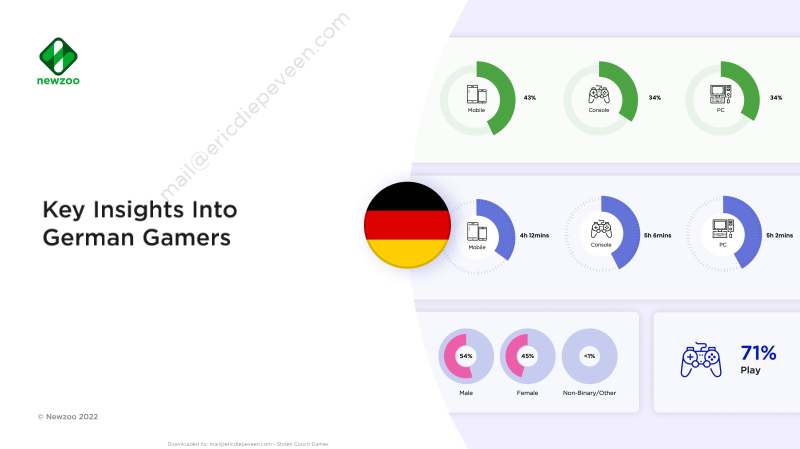
The Consumer Insights: Games and Esports 2022 report provides a comprehensive analysis of global gaming behaviors, motivations, and market engagement. The primary purpose of the research is to equip game developers, publishers, and industry stakeholders with actionable data to benchmark titles, understand player demographics, and identify growth opportunities across 36 diverse international markets. By examining over 100 key performance indicators, the analysis offers a granular view of how players interact with PC, console, and mobile platforms. The research is underpinned by a robust methodology, drawing on survey data from over 75,000 consumers worldwide. The findings highlight distinct engagement patterns, such as the prevalence of specific gaming personas—notably Time Fillers and Mainstream Gamers—and the interplay between playing and viewing habits. For instance, data from the German market indicates that while playing remains the dominant activity, a significant portion of the population also engages with gaming video content and esports. Furthermore, the report identifies key drivers for consumer spending, noting that price sensitivity, the desire for exclusive content, and social connectivity are primary motivators for financial investment in games. Covering a broad geographic scope that includes North America, Europe, Latin America, the Middle East, and the Asia-Pacific region, the report serves as a strategic tool for navigating the complex global gaming landscape. By synthesizing metrics such as monthly active users, daily active users, and lifetime player value, the analysis facilitates a deeper understanding of the motivations driving player behavior. Ultimately, the findings emphasize that a nuanced approach to audience segmentation and platform-specific engagement is essential for companies seeking to reach and retain diverse gaming populations in an increasingly competitive entertainment market.
In 2025, roughly 14.2 million Italians—about a third of the population aged six to seventy‑five—engage in video gaming, with a pronounced male bias and a concentration of players under 35. The industry’s total revenue remains steady at €2.4 billion, of which game sales account for 77 percent (€1.8 bn). Gaming time has risen to nearly eight hours per week, driven primarily by smart‑device play (22 percent reach, €929 m revenue) and console gaming (13 percent reach, €643 m). App‑based games now represent more than half of the market, dominated by freemium monetisation; only one percent of app revenue comes from upfront purchases. Revenue distribution varies by platform. Smart‑device earnings are almost entirely from in‑app purchases (ARPU €84), while console sales lean heavily on digital downloads—65 percent of new game revenue comes from full‑game downloads (€502 m) and 21 percent from DLC (ARPU €99). PC revenue is largely driven by DLC (43 percent) and full‑game downloads (98 percent of console sales). Subscription services are pivotal: console ecosystem subscriptions contribute 59 percent of total gaming‑subscription revenue (€153 m), with mobile and single‑game franchises accounting for 6 percent and 35 percent respectively. Player demographics reveal that smart devices attract a younger, male‑skewed audience (31 percent of 6–17‑year-olds), whereas console and PC gaming remain niche but heavily male‑skewed, concentrated among teens. Casual and sports titles dominate sales across all platforms, with subscription services such as PlayStation Plus and Xbox Game Pass driving a significant share of paid play. Engagement patterns show males spending the most hours on consoles (average seven hours per week), while PC gaming remains steady across age groups. Approximately one‑quarter of players follow gaming news on YouTube or vlogs, and 20 percent rely on social media or family discussions for information. The data derive from a nationally representative online survey of 3,000 respondents, weighted against an offline omnibus sample and calibrated to industry sales figures.
The global PC and console gaming market is projected to reach $92.7 billion by 2027, driven by a significant recovery in the console sector. While PC growth remains modest at a 2.6% CAGR, the console segment is expected to expand by 7.0%, fueled by the anticipated launch of the Nintendo Switch 2 and blockbuster releases such as Grand Theft Auto VI. Despite a revenue dip in 2024 due to a lighter premium release schedule, total playtime grew by 6%, signaling robust engagement even as market dynamics shift toward a "near zero-sum" competition for player attention. Player behavior is increasingly characterized by "calcification," where engagement is concentrated into a shrinking pool of established "forever games." Titles aged six years or older now command over 60% of playtime on PC and nearly half on consoles. This consolidation is most visible on PC, where just five legacy titles account for 30% of annual hours. While PlayStation has emerged as a growth leader with a 21% increase in playtime since 2021, the broader trend across all platforms shows players becoming more "unreachable," with a rising share of the audience engaging with only one to three games per year. To combat stagnation, publishers are increasingly leveraging "recursive nostalgia" by reintroducing classic maps and mechanics. While this strategy yielded massive engagement spikes for Fortnite, its effectiveness varies, often serving as a short-term boost rather than a long-term retention tool unless structured as a permanent gameplay mode. Furthermore, the discoverability crisis has intensified as annual releases on Steam approached 19,000 in 2024. With the impact of traditional seasonal sales declining fourfold since 2019, success now requires a shift toward targeted global events, external traffic generation, and product differentiation to break through a market dominated by AAA franchises and entrenched free-to-play titles.
The survey, conducted by Aream & Co., gauges executive optimism regarding consumer spending on gaming in 2025 across multiple channels and functional areas. Overall, 49 % of respondents view spending as “more optimistic,” another 49 % see it as unchanged, and only 2 % are less optimistic. When broken down by platform, mobile spending is perceived as more optimistic (49 %) while PC and console views are split between “more” (15–33 %) and “about the same.” In‑app purchases are viewed as more optimistic (80 %) versus in‑app advertising (41 %). Key challenges identified include content saturation and over‑supply, with 33 % citing these as concerns; marketing environment issues affect 49 %, and macro conditions are a worry for 17 %. Despite these, 54 % anticipate more new games in 2025, and 37 % expect higher average budgets. Marketing spend is expected to rise for 48 %, while engineering and game development are seen as more optimistic (71 % and 42 %). The survey also highlights a strong appetite for mergers and acquisitions, with 71 % expecting more M&A activity. Advanced integration across multiple functions is viewed as more optimistic (49 %) but limited implementation remains a concern. The data derive from a global sample of gaming CEOs, reflecting perspectives across mobile, PC, console, and various functional departments. The findings suggest a cautiously optimistic outlook for 2025, tempered by supply‑side pressures and marketing challenges.