1 free read left. Create a free account for unlimited reading + AI research.
Create free accountReport BITKRAFT Ventures
1 free read left. Create a free account for unlimited reading + AI research.
Create free accountReportBITKRAFT Ventures
2025 data reveal that spending on non-gaming apps has already eclipsed gaming. AI is emerging as the primary revenue catalyst.
See it on page 9The analysis establishes that consumer applications are entering a “Game-Design 2.0” era, driven by AI-native personalization, real-time feedback and progression systems that elevate engagement and monetization across education, fintech, e-commerce, health, social media and emerging verticals. 2025 data reveal that spending on non-gaming apps has already eclipsed gaming, with AI emerging as the primary revenue catalyst and consumer demand for instant, tailored experiences rising sharply. Founders are advised to secure durable competitive advantages by harvesting proprietary data from launch, embedding culturally resonant narratives, and deploying AI to deliver seamless, game-like value rather than merely branding an app as “AI-powered.”
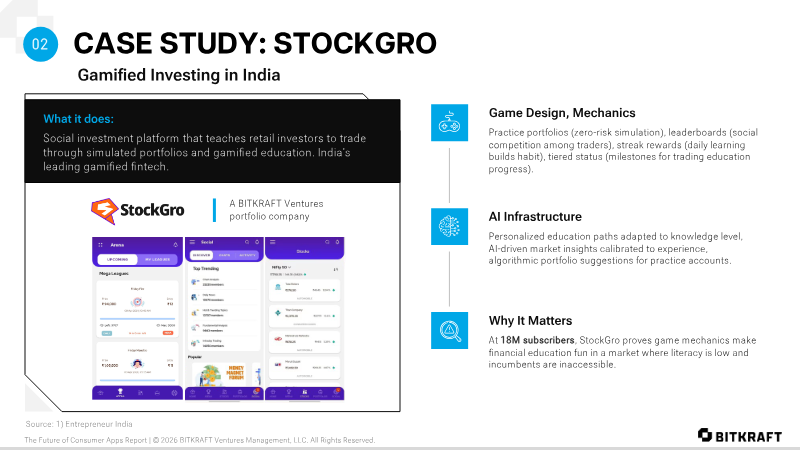
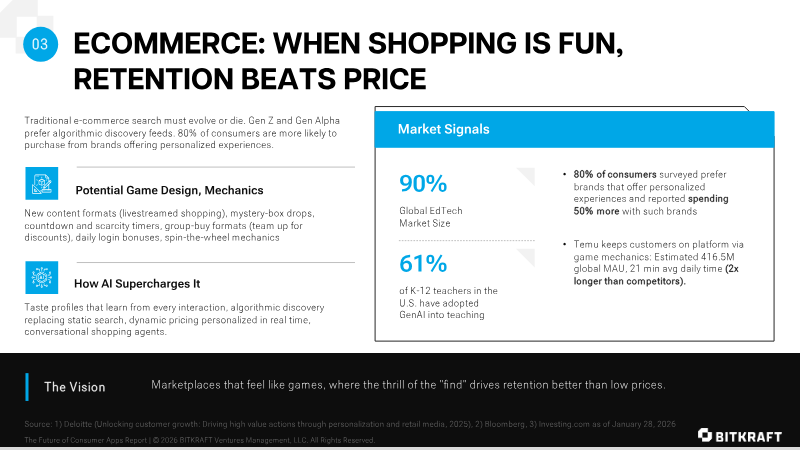
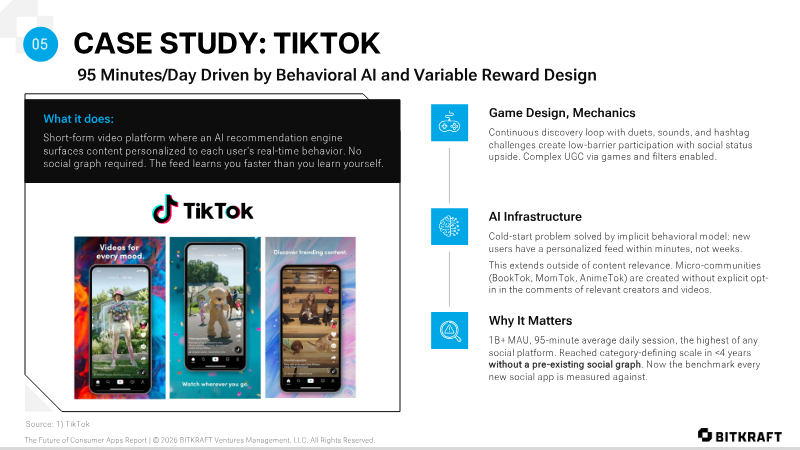
In high-friction sectors, AI-augmented game mechanics transform user behavior. Fintech platforms such as StockGro employ practice portfolios, leaderboards and AI-personalized tutorials to convert financial discipline into instant gratification. E-commerce brands like Temu and Bins use algorithmic discovery feeds, mystery boxes and streak rewards to boost retention beyond price. Health apps leverage voice-first AI coaches with progression loops, while social networks such as TikTok demonstrate that behavioral AI coupled with variable rewards can drive record-setting daily engagement. These examples underscore how immersive, AI-enhanced game design unlocks higher user engagement and monetization in traditionally low-engagement sectors.
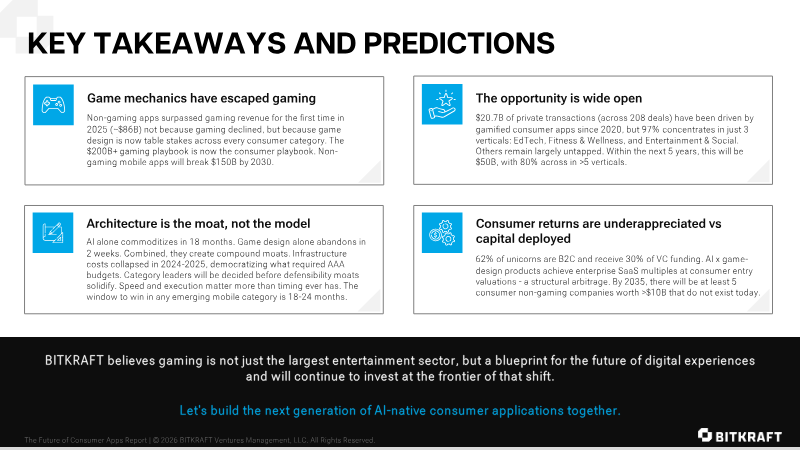
BITKRAFT Ventures positions itself as a top-decile investor in consumer apps, employing equity, crypto and non-dilutive user acquisition financing to accelerate growth. The firm projects that by 2025 non-gaming mobile apps will surpass gaming revenue, reaching $150 B by 2030, and that AI-driven gamification will create rapid, defensible moats. By 2035, BITKRAFT forecasts that at least five consumer non-gaming companies could exceed $10 B in valuation, highlighting the strategic importance of AI and game design for future digital experiences.
BITKRAFT Ventures · 2026

BITKRAFT Ventures · 2026

BITKRAFT Ventures · 2026

BITKRAFT Ventures · 2026

BITKRAFT Ventures · 2025

BITKRAFT Ventures · 2025

BITKRAFT Ventures · 2025

BITKRAFT Ventures · 2025
BITKRAFT Ventures · 2025

BITKRAFT Ventures · 2025

BITKRAFT Ventures · 2025

BITKRAFT Ventures · 2025