
Report19 pages
Mobile Gamer 2021: Gen Z Edition
The report examines Generation Z (born 1997 and later) as the newest cohort of mobile gamers, highlighting their purchasing power, digital habits, and advertising preferences. Surveying 7,103 U.S. respondents aged 18‑24 on the Tapjoy network in February 2021, it finds that 86 % of Gen Z use mobile devices for gaming, far exceeding console (42 %) and PC (38 %) usage. Nearly one‑quarter first owned a smartphone before age 10, and 49 % replace devices every two to three years. Mobile shopping dominates their retail behavior: 68 % shop on phones one to four times per week, with 60 % ordering food delivery and 57 % making retail purchases. Preferred purchase channels include branded apps, e‑commerce storefronts, rewarded offers in games, and Instagram ads.
Advertising engagement shows a strong preference for rewarded mobile game ads (61 % enjoy offerwalls) and short, creative content such as memes (50.4 %) and humor‑driven brand posts (57 % value humor). Traditional formats—banner ads, non‑skippable videos, and celebrity endorsements—are largely ineffective. Gen Z follows brands that align with their values; 52 % discover new products via social media, and 67 % follow brands for product interest. The methodology involved opt‑in participation with age verification, automatic reward distribution, and a geographically targeted U.S. sample.
Overall, the findings portray Gen Z as highly engaged mobile gamers with significant discretionary spending, a preference for value‑based advertising, and a strong inclination toward brands that reflect their social and environmental values.
- Mobile is the dominant gaming platform for Gen Z, with 86% of 18-24-year-olds playing on mobile devices compared to only 42% on consoles and 38% on PCs.
- Gen Z shows a strong preference for rewarded advertising, with 61% of respondents reporting that they enjoy offerwalls within mobile games.
- Traditional advertising formats like banner ads, non-skippable videos, and celebrity endorsements are largely ineffective with this demographic.
- Gen Z prioritizes humor and creativity in advertising, with 57% valuing humor-driven brand posts and 50.4% favoring meme-based content.
- Mobile shopping is a primary behavior for this cohort, as 68% shop on their phones one to four times per week, with 60% ordering food delivery and 57% making retail purchases.
TapjoyJan 2025
Report24 pages
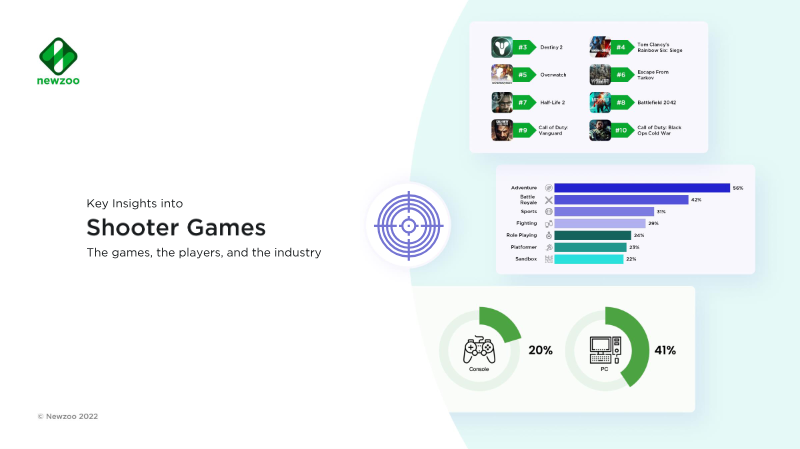
Key Insights into Shooter Games
Shooter games represent the fifth highest‑earning genre worldwide, generating approximately $2.24 billion in 2022 across all platforms. The report focuses on the genre’s popularity, player demographics, engagement patterns, and monetization strategies within a global context that excludes China and India. Data derive from Newzoo’s Global Games Market, Consumer Insights – Games & Esports 2022, and the Newzoo Expert platform, covering 37 markets with a sample of 19,544 recent shooter players and 60,020 broader gamers.
Key findings show that shooters dominate PC and console play, with 68 % of monthly active users (MAU) on these platforms also engaging in shooter titles. Player overlap with other genres is high: 56 % of shooter players also play adventure games, while strategy and simulation overlap remains low. The contemporary war theme and level‑based mechanics are the most common in shooter titles. Monetization is overwhelmingly pay‑to‑play; 97 % of shooter players experience in‑app purchases, and advertising is the least used model.
Demographically, core personas—Ultimate Gamers and All‑Round Enthusiasts—account for the largest shooter player base, yet nearly all persona groups play shooters. Motivations to spend include social interaction and access to special offers, with 13,659 of the 19,544 shooter players identified as payers. Live‑streaming data indicate that shooters rank highly on Twitch and Facebook Gaming, reinforcing the genre’s strong community presence. The report underscores shooters’ robust revenue streams, broad demographic appeal, and central role in competitive online play.
- Shooter games generated approximately $2.24 billion in 2022 across 37 global markets, excluding China and India.
- Shooters are a dominant force on PC and console platforms, capturing 68% of monthly active users.
- Monetization in the genre is heavily driven by in-app purchases, which are experienced by 97% of shooter players, while advertising remains the least utilized revenue model.
- Shooter players exhibit high cross-genre engagement, with 56% of the player base also participating in adventure games.
- The genre maintains a strong community presence and competitive profile, consistently ranking highly on streaming platforms like Twitch and Facebook Gaming.
+2
NewzooJan 2025

Report21 pages
Newzoo's Generations Report: How Different Generations Engage with Games
The report examines how gaming engagement varies across generational cohorts, drawing on a representative online sample of 72,068 respondents from 33 global markets (North America, EMEA, APAC). Data were collected via Computer Assisted Web Interviewing between January and April 2021. Findings show that younger generations devote a larger share of leisure time to gaming, with Gen Z and Millennials spending 11–12% of their free time on games versus 18% for Baby Boomers. Weekly playtime averages 7 hours and 20 minutes for Gen Z, 6 hours and 30 minutes for Millennials, dropping to just over 2 hours for Baby Boomers. Gaming remains the dominant entertainment medium across all ages, though motivations shift: younger players cite competition, socializing and achievement, while older players prioritize relaxation.
Platform preferences differ markedly; Gen Z spends 77% of gaming spend on mobile, whereas Baby Boomers allocate 73% to PC. Younger gamers also engage more with game‑related content, with 71–67% of Gen Z and Millennials both playing and watching games, compared to 44–51% for older cohorts. Persona segmentation reveals that “Ultimate Gamers” and “Community Gamers” dominate among Gen Z, whereas older groups are more likely to be “Time‑Fillers” or “Bargain Buyers.”
The report highlights the metaverse as a growing trend, with 70% of Gen Z and 63% of Millennials expecting to spend more time in virtual worlds. Overall, the study underscores a generational shift toward immersive, social gaming experiences and signals expanding opportunities for brands to reach diverse gamer audiences.
- Gen Z and Millennials spend significantly more time gaming weekly, averaging 7 hours 20 minutes and 6 hours 30 minutes respectively, compared to just over 2 hours for Baby Boomers.
- Platform spending habits are polarized by generation, with Gen Z allocating 77% of their gaming budget to mobile while Baby Boomers direct 73% of their spend toward PC.
- Engagement with game-related content is higher among younger cohorts, as 67–71% of Gen Z and Millennials both play and watch games, compared to 44–51% for older generations.
- Motivations for gaming diverge by age, with younger players prioritizing competition, socializing, and achievement, while older players primarily seek relaxation.
- The metaverse is a significant growth area, with 70% of Gen Z and 63% of Millennials anticipating increased time spent in virtual worlds.
+1
NewzooJan 2025

Report5 pages
Mobile Gaming M&A Playbook: How to Identify and Target High‑Growth Gaming Companies
The playbook outlines a systematic approach for mobile gaming publishers and investors to identify, evaluate, and acquire high‑growth developers. It argues that the mobile gaming market—projected to reach $138 billion in 2025—has become a prime arena for mergers and acquisitions, citing recent deals such as Zynga’s $2 billion purchase of Peak Games, EA’s $2.1 billion acquisition of Glu Mobile, and Embracer Group’s multi‑year funding round for future buys. The document stresses that M&A serves dual purposes: portfolio diversification and the acquisition of talent, expertise, and new IPs that can accelerate growth beyond a publisher’s core genres.
Key findings highlight the importance of data‑driven target selection. Sensor Tower’s Game Intelligence platform is promoted as a tool for tracking genre trends, revenue trajectories, and market share across regions. The playbook recommends establishing clear acquisition criteria—budget limits, company size, geographic focus—and using custom alerts and taxonomy filters to surface promising titles. It also advises building structured lead‑tracking workflows, labeling qualified versus unqualified prospects, and continuously monitoring portfolio performance to spot strategic shifts or revenue declines that may signal acquisition opportunities.
The scope covers the global mobile gaming industry, with particular emphasis on North America and Southeast Asia, over a recent five‑year period marked by accelerated M&A activity. Methodologically, the playbook relies on Sensor Tower’s proprietary analytics, supplemented by industry news feeds from outlets such as Pocket Gamer, VentureBeat, and Crunchbase. The conclusion urges publishers to leverage analytics, maintain rigorous criteria, and stay alert to market movements in order to secure advantageous acquisitions that align with long‑term growth objectives.
- The mobile gaming market is projected to reach $138 billion by 2025, driving significant M&A activity as publishers seek to diversify portfolios and acquire new talent and intellectual property.
- High-profile acquisitions demonstrate the scale of industry consolidation, including Zynga’s $2 billion purchase of Peak Games and EA’s $2.1 billion acquisition of Glu Mobile.
- Effective target identification requires a data-driven approach using platforms like Sensor Tower to track specific genre trends, revenue trajectories, and regional market share.
- Publishers should establish rigorous acquisition criteria—including defined budget limits, company size, and geographic focus—to systematically filter potential targets.
- Strategic lead-tracking workflows are essential for distinguishing qualified prospects from unqualified ones and monitoring existing targets for revenue declines or shifts that signal an acquisition opportunity.
+1
Sensor TowerJan 2025

Report29 pages
Sensor Tower India: Mobile Game Market Insights 2025
India is positioned as the world’s largest mobile‑gaming market, with 8.45 billion downloads recorded in FY 2024‑25 yet only $400 million in in‑app purchase (IAP) revenue, underscoring a pronounced monetization gap despite high engagement. Downloads have stabilized post‑pandemic while IAP spending has accelerated, largely driven by Google Play’s dominance and an expanding share of higher‑spending iOS users. Demographic analysis shows that 77 % of players are aged 18‑34, 86 % are male, and lifestyle titles uniquely attract a larger female audience.
Genre‑level insights reveal that casual, family‑oriented categories—Simulation (driving/flight), Arcade (platformer/runner), and Tabletop board games—generate the bulk of download volume. In contrast, monetization is concentrated in competitive, engagement‑heavy segments such as Shooter (Battle Royale), Casino, and Strategy (4X). Publishers are advised to pair mass‑appeal casual titles with monetization strategies that target the growing cohort of high‑value, competitive gamers.
India‑based publishers maintain robust domestic download volumes through culturally resonant titles like Ludo King and Dream11, yet monetization remains modest. To offset this challenge, publishers are expanding overseas revenue streams, with the US, Saudi Arabia, and the UK emerging as key markets. The dual strategy of leveraging local appeal for mass reach while pursuing international growth is presented as a pathway to enhance overall profitability in India’s mobile‑gaming ecosystem.
- India is the world's largest mobile-gaming market by volume, recording 8.45 billion downloads in FY 2024-25 but generating only $400 million in in-app purchase (IAP) revenue.
- Monetization is heavily concentrated in competitive, engagement-heavy genres including Shooter, Casino, and Strategy (4X), while high-volume downloads are driven by casual Simulation, Arcade, and Tabletop titles.
- The player base is predominantly male (86%) and aged 18-34 (77%), though lifestyle titles represent a unique segment for attracting female gamers.
- While domestic publishers maintain high download volumes through culturally resonant titles like Ludo King and Dream11, they are increasingly targeting the US, Saudi Arabia, and the UK to offset modest domestic monetization.
- IAP spending is showing signs of acceleration, supported by Google Play’s market dominance and an increasing share of higher-spending iOS users.
+1
Sensor TowerJan 2025

Report13 pages
China Game Industry Report 2025
The China Game Industry Report for 2025 presents a comprehensive assessment of the domestic and overseas gaming markets, highlighting sustained growth driven by youth protection initiatives, technological innovation, and cross‑sector integration. In 2025, China’s self‑developed mobile games generated US$20.455 billion in overseas revenue, a 10.23% year‑on‑year increase and the sixth consecutive year surpassing RMB 100 billion. Strategy games, including SLG, dominated overseas earnings at 49.97%, followed by shooters (9.69%) and RPGs (9.39%). The United States remains the largest market, contributing 32.31% of overseas revenue, with Japan (16.35%) and South Korea (9.15%) also significant.
Domestically, mobile games accounted for 73.29% of total sales, with MOBA leading at 19.45%, followed by shooting (18.29%) and RPG (15.10%). The domestic console market expanded sharply, reaching RMB 8.362 billion (US$1.18 billion) in 2025, a 37.38% year‑on‑year rise, driven by both software and hardware sales.
Global market projections indicate the worldwide gaming industry will reach RMB 130.17 billion in 2025, with mobile gaming contributing RMB 66.69 billion—a growth rate of 4.93%, slower than previous years but still positive.
Methodologically, the report aggregates data from CADPA’s industry surveys and market analyses, covering 2020‑2025 for domestic sales and 2019‑2025 for overseas performance. The findings underscore a resilient Chinese gaming sector, poised to maintain strong export growth while deepening domestic diversification across mobile and console platforms.
- Chinese self-developed mobile games generated US$20.455 billion in overseas revenue in 2025, marking a 10.23% year-on-year increase and the sixth consecutive year exceeding RMB 100 billion.
- The United States remains the primary overseas market for Chinese games, accounting for 32.31% of total export revenue, followed by Japan at 16.35% and South Korea at 9.15%.
- Strategy games (SLG) dominate the overseas market, capturing 49.97% of earnings, significantly outpacing shooters at 9.69% and RPGs at 9.39%.
- The domestic Chinese console market experienced a sharp 37.38% year-on-year growth in 2025, reaching a total value of RMB 8.362 billion (US$1.18 billion).
- Mobile gaming continues to lead the domestic market, representing 73.29% of total sales, with MOBA (19.45%), shooting (18.29%), and RPG (15.10%) as the top-performing genres.
+4
Meridian PlayJan 2025

Report139 pages
The Game Industry of Poland: 2025
Collective work under the direction of dr Jakub Marszałkowski dr Jakub Marszałkowski, Indie Games Poland, Poznan University of Technology (chapters 3, 5, 8, 9) Eryk Rutkowski, Polish Agency for Enterprise Development (chapters 2, 4, 6) Wojciech Trusz, Creative Industries Institute (chapters 1) Piotr Milewski, Sirius Game Studio, Gdynia Maritime University (chapters 7) Game Industry Conference team: Olga Matej, Agnieszka Wołoszyn, Kacper Żubryk, Hanna Marszałkowska, Dominik Latos Extra data minin...
- The provided report content contains only the title and author credits, lacking the body text, statistical data, or specific industry findings required to generate factual insights.
- Due to the absence of substantive data in the provided source, it is impossible to extract growth rates, company performance metrics, or industry trends for the Polish game industry in 2025.
- The source material consists exclusively of administrative metadata regarding the report's contributors and institutional affiliations.
- No concrete takeaways regarding market size, employment figures, or economic impact can be derived from the provided text.
- The input provided is insufficient to fulfill the request for a data-driven summary of the Polish game industry.
+3
Polish Agency for Enterprise DevelopmentJan 2025

Report39 pages
German Games Industry: 2025
The German games industry navigated a period of significant contraction in 2024, with total market revenue falling 6% to €9.4 billion. This downturn, driven by a decline in mobile revenue and console hardware sales, resulted in the first recorded reduction in the number of active companies and industry employees in recent years. Despite these headwinds, Germany maintains its status as the largest games market in Europe and the fifth largest globally. The domestic player base remains robust and increasingly diverse, encompassing 37.5 million individuals with an average age of 39.5 years, reflecting the deep integration of gaming into the national cultural fabric.
Strategic instability during this period stemmed largely from restrictive federal funding guidelines and project application freezes, which disproportionately impacted smaller studios. However, the outlook for 2025 is increasingly positive, anchored by a new coalition agreement that pledges to increase federal funding to €125 million annually by 2026 and introduce competitive tax incentives. These policy shifts aim to bolster Germany’s international standing, which industry leaders currently view as suboptimal despite the nation’s strong infrastructure, academic training programs, and successful startup initiatives like the "Press Start" grant.
To secure long-term growth, the industry is prioritizing a hybrid funding model, the establishment of a dedicated "Games University," and the expansion of digital cultural heritage projects, such as the AI-driven archiving of over 40,000 titles. Professionalization efforts continue through the game association, which represents over 500 members and manages critical networking platforms like gamescom. By integrating esports development, sustainability commitments, and structured career pathways, the German ecosystem is positioning itself to transition from a period of market correction toward a more resilient and internationally competitive future.
- The German games market contracted by 6% in 2024, resulting in total revenue of €9.4 billion and the first recorded decline in industry employment and active companies.
- Federal funding is set to increase to €125 million annually by 2026, supported by new competitive tax incentives designed to improve Germany's international market standing.
- Germany remains Europe's largest games market and the fifth largest globally, supported by a robust player base of 37.5 million people with an average age of 39.5.
- Market instability in 2024 was primarily driven by a downturn in mobile revenue and console hardware sales, alongside restrictive federal funding guidelines and project application freezes.
- The industry is prioritizing long-term growth through a hybrid funding model, the creation of a dedicated 'Games University,' and the AI-driven archiving of over 40,000 titles.
+1
game – Verband der deutschen Games-Branche e. V.Jan 2025
Report8 pages
Global Gaming Industry Takes Center Stage
The provided text does not contain the content of the document titled Global Gaming Industry Takes Center Stage, as the source link is restricted and inaccessible. Consequently, it is impossible to extract the main thesis, key findings, or methodological details required for an analytical summary. The available information consists solely of a server-side error message indicating a lack of authorization to view the requested file.
To provide a professional and accurate summary, the full text of the report must be made available. Once the content is accessible, the analysis will focus on identifying the primary industry trends, geographic scope, and statistical data points presented by the authors. Please provide the complete text or a functional link to the document to facilitate a comprehensive review of the gaming industry's current market position and future outlook.
- The provided report content is currently inaccessible due to a server-side authorization error.
- No factual data, market statistics, or industry trends are available for analysis from the provided source text.
- The document failed to load, preventing the extraction of any concrete insights regarding the global gaming industry.
- A comprehensive summary cannot be generated until the full text of the report is provided.
- The current input contains only an error message rather than the intended industry research.
+1
Morgan StanleyJan 2025

Report37 pages
Games 2025: The Industry Quest for Growth
The global games market reached a record $199.4 billion in 2024, cementing its status as the preeminent force in the entertainment sector. Despite this scale, the industry faces a period of moderated growth, with projections for 2025 hovering at approximately 1%. This deceleration stems from a combination of high-profile release delays, such as the postponement of major titles, and a tightening early-stage funding environment. To navigate this landscape, firms are shifting their focus from aggressive expansion toward operational efficiency, lean development cycles, and the optimization of existing intellectual property.
Strategic growth in 2025 will rely heavily on geographic diversification and demographic expansion. Emerging markets in the Middle East and Southeast Asia represent significant frontiers, while developers are increasingly targeting underserved cohorts, including older gamers and young adult females. Furthermore, the industry is leveraging user-generated content platforms like Roblox to maintain engagement among younger audiences. Hardware cycles, particularly the anticipated launch of the Nintendo Switch 2, remain a critical catalyst for consumer spending, providing a necessary boost to the broader market ecosystem.
To combat the dual pressures of escalating AAA development costs and fragmented consumer attention, publishers are adopting more conservative financial models. This includes a heavy reliance on remakes, remasters, and multi-platform porting to extract maximum value from established assets. Simultaneously, companies are pursuing margin expansion through diversified monetization strategies, such as hybrid mobile models and direct-to-consumer web shops that bypass traditional app store fees. By transitioning toward holistic franchise management that spans licensing, subscription services, and cross-media integration, the industry aims to stabilize revenue streams and ensure long-term sustainability in an increasingly competitive global environment.
- The global games market reached $199.4 billion in 2024, but growth is projected to decelerate to approximately 1% in 2025 due to release delays and reduced early-stage funding.
- Publishers are prioritizing operational efficiency and asset optimization, focusing on remakes, remasters, and multi-platform porting to mitigate the rising costs of AAA development.
- Strategic growth is shifting toward geographic expansion in the Middle East and Southeast Asia, alongside targeting underserved demographics like older gamers and young adult females.
- Companies are pursuing margin expansion by implementing hybrid mobile monetization models and direct-to-consumer web shops to bypass traditional app store fees.
- The industry is leveraging user-generated content platforms like Roblox to maintain engagement among younger audiences while managing fragmented consumer attention.
+1
Ampere AnalysisJan 2025

Report25 pages
The Big Game Engine Report of 2025
The Big Game Engine Report 2025 examines the shifting landscape of game development technology, focusing on the transition from proprietary in-house tools to third-party public engines. The analysis covers over 13,000 games released on Steam, tracking market share trends from 2012 through 2024 with projections reaching 2030. Findings are based on proprietary estimations and tagging methodologies that categorize engines into three tiers: dominant public engines (Unity and Unreal), smaller public engines (Godot, GameMaker, RPG Maker), and custom in-house engines used by major AAA studios.
The central thesis posits that the era of dominant in-house engines is ending as major studios increasingly adopt Unreal Engine 5 to reduce maintenance costs and access a broader talent pool. While custom engines powered over 70% of Steam releases in 2012, they accounted for only 13% of releases in 2024. In terms of commercial performance, custom engines still represent 42% of units sold, but this is the first time they have fallen below the 50% threshold. Unreal Engine has capitalized on this shift, particularly in the AAA space, while Unity remains the leader in sheer volume, powering 51% of all 2024 releases.
The data highlights a clear correlation between game size and engine choice. Unity dominates the "Tiny" and "Small" categories (under 100k units), whereas custom engines and Unreal Engine control the "Large" segment (over 1M units). Emerging trends show Godot as the fastest-growing smaller engine, driving over two-thirds of the growth in its tier since 2020. Looking forward, the industry expects a continued migration toward Unreal Engine 5, with Unity projected to face increasing pressure from open-source alternatives like Godot in the indie sector while struggling to gain further ground in the high-end AAA market.
- The share of Steam releases powered by custom in-house engines plummeted from over 70% in 2012 to 13% in 2024.
- Custom engines have fallen below 50% of total unit sales for the first time, currently accounting for 42% of the market.
- Unity remains the volume leader, powering 51% of all Steam releases in 2024, primarily dominating the 'Tiny' and 'Small' categories under 100k units.
- Major AAA studios are increasingly migrating to Unreal Engine 5 to reduce maintenance costs and access a larger talent pool, solidifying its control over the 'Large' segment of games exceeding 1M units.
- Godot is the fastest-growing smaller engine, accounting for over two-thirds of the growth within its tier since 2020.
Video Game InsightsJan 2025

Report34 pages
The Mobile App Growth Report: 2025 Edition
Global mobile app growth remains resilient in 2025, characterized by an 11% year-over-year increase in installs and a 10% rise in user sessions. This expansion is increasingly defined by a shift from pure volume-based acquisition toward a value-driven model that balances cost efficiency, engagement, and long-term retention. The Asia-Pacific region has emerged as the primary engine of this global momentum, achieving the highest regional growth score of 45, with India specifically leading all individual nations with a score of 49. While established markets like North America show more modest growth metrics, they remain critical hubs for high-value user monetization and sophisticated optimization strategies.
Gaming continues to be the dominant vertical worldwide, particularly within the hyper-casual and hybrid-casual subgenres. This sector is especially potent in emerging markets; India’s gaming growth score of 52.2 underscores its status as a premier expansion target, while the Latin American and Middle Eastern markets are projected to reach significant revenue milestones of $35.9 billion and $3.73 billion respectively by 2030. Beyond gaming, the publications and utilities sectors have demonstrated consistent strength across Western markets, indicating a diversified landscape where functional and content-driven apps maintain high engagement levels.
The current mobile ecosystem requires a strategic pivot toward sophisticated analytics and retention-focused operations. In regions like North America, where user acquisition costs are higher, success depends on maximizing average revenue per user and leveraging artificial intelligence to refine marketing spend. Meanwhile, specific regional opportunities, such as the rise of card and arcade games in Türkiye, highlight the importance of localized content strategies. Ultimately, the global market is transitioning into a phase where sustainable growth is achieved through the integration of high-quality user experiences and data-driven efficiency rather than simple install volume.
- Global mobile app installs grew 11% year-over-year in 2025, with user sessions increasing by 10% as the industry shifts from volume-based acquisition to value-driven retention.
- The Asia-Pacific region is the primary driver of global growth with a score of 45, led by India, which holds a national growth score of 49 and a gaming-specific growth score of 52.2.
- Gaming remains the dominant global vertical, with Latin American and Middle Eastern markets projected to reach revenue milestones of $35.9 billion and $3.73 billion respectively by 2030.
- In high-cost markets like North America, profitability now relies on maximizing average revenue per user and utilizing AI-driven analytics to optimize marketing spend.
- Hyper-casual and hybrid-casual subgenres are the most potent gaming categories, particularly within emerging markets.
+1
AdjustJan 2025

Report49 pages
Mobile App Trends 2025: Japan Edition
Japan remains the world’s third-largest mobile app market, characterized by a resilient consumer spend of $16.5 billion in 2024 and a 7% year-over-year increase in total installs. While the gaming sector remains a foundational pillar, the market is undergoing a significant diversification into finance, entertainment, and digital comics. User trust is also on an upward trajectory, evidenced by App Tracking Transparency opt-in rates rising to 21.4%, with the gaming vertical leading at 31%. This shift suggests a maturing ecosystem where users are increasingly comfortable with data sharing in exchange for personalized experiences.
The gaming sector demonstrated notable stability in the first half of 2025, with a 3% increase in installs that outperformed global trends. Card games experienced a 127% surge in sessions, while role-playing games maintained the highest engagement levels with average session lengths of 40 minutes. Simultaneously, the finance sector emerged as a high-growth vertical, with installs rising 50% driven by payment and banking apps. Although average revenue per monthly active user has seen declines in some sectors, engagement metrics remain strong, particularly in entertainment where short-form drama apps have achieved a high revenue-per-download of $4.13.
A defining trend across the Japanese landscape is the strategic shift toward paid user acquisition. This is most visible in the comic app market, which reached a record paid-to-organic ratio of 1.03. Despite a decline in new installs for comics, the vertical remains a global revenue powerhouse due to deep user loyalty and session lengths averaging over 17 minutes. Across finance, entertainment, and comics, the market is transitioning from a phase of rapid expansion to one focused on maximizing the lifetime value of a culturally invested and highly engaged user base.
- Japan’s mobile market generated $16.5 billion in consumer spend in 2024, supported by a 7% year-over-year increase in total installs.
- The finance sector is a primary growth driver, with a 50% surge in installs fueled by the adoption of payment and banking applications.
- Gaming remains a stable pillar, with card games seeing a 127% increase in sessions and role-playing games maintaining 40-minute average session lengths.
- User trust is maturing, as evidenced by App Tracking Transparency opt-in rates rising to 21.4% overall, with the gaming vertical reaching 31%.
- The comic app market has shifted to a paid-to-organic acquisition ratio of 1.03, prioritizing high lifetime value and user loyalty over raw install volume.
+1
AdjustJan 2025

Report39 pages
Playing to Win: 2025 Digital Game Advertising Report
The 2025 digital gaming market is defined by a strategic pivot toward user quality and high-velocity creative iteration, with global advertising expenditure reaching $8.7 billion. Despite a year-over-year decline in total mobile and PC downloads, the industry remains robust through the resurgence of the shooter genre and the continued dominance of 4X Strategy and Casual titles. Geographically, growth is concentrated in North American and Asian markets, fueled by high-profile releases such as Battlefield 6 and Valorant Mobile. This landscape reflects a shift where major publishers like Microsoft and Dream Games utilize aggressive spending to maintain market share in an increasingly competitive environment.
Advertising strategies have evolved to prioritize "instantly legible" gameplay and the rapid deployment of creative assets to combat audience fatigue. Static image ads remain a resilient tool due to their cost-effectiveness, while generative AI is increasingly employed to test and iterate high volumes of creative concepts. Intellectual property collaborations, featuring franchises like Naruto and Teenage Mutant Ninja Turtles, serve as a primary mechanism for lowering acquisition costs. Furthermore, platforms like YouTube have become essential for reaching PC and console audiences, while Apple Search Ads are leveraged tactically to capture competitor keywords and dominate search visibility.
The digital ecosystem also highlights the growing influence of internal discovery and content creators. Roblox maintains a massive web presence with over 187 billion visits, driven largely by organic traffic and internal discovery mechanisms rather than traditional external advertising. Meanwhile, viral indie titles and major releases like Marvel Rivals achieve commercial success by leveraging creator-led marketing. Ultimately, the industry in 2025 is characterized by a sophisticated blend of data-driven acquisition, aggressive platform-specific tactics, and a reliance on established IPs to navigate a market where engagement quality has surpassed sheer scale as the primary metric for success.
- Global digital gaming advertising expenditure reached $8.7 billion in 2025, with major publishers like Microsoft and Dream Games utilizing aggressive spending to maintain market share.
- The industry has shifted its primary success metric from sheer download scale to engagement quality, despite a year-over-year decline in total mobile and PC downloads.
- Roblox continues to bypass traditional external advertising, generating 187 billion visits through organic traffic and internal discovery mechanisms.
- Advertising strategies now prioritize 'instantly legible' gameplay and the use of generative AI to rapidly iterate high volumes of creative assets.
- Intellectual property collaborations, such as those featuring Naruto and Teenage Mutant Ninja Turtles, are being used as a primary mechanism to lower user acquisition costs.
+1
Sensor TowerJan 2025

Report72 pages
Africa Games Industry Report 2025
The African games industry is undergoing a period of rapid expansion, with total revenues projected to surpass $1 billion in 2024. This growth is primarily fueled by a mobile-first market that accounts for nearly 90% of the sector’s revenue, driven by a young, tech-savvy population and increasing smartphone penetration. While South Africa remains the most lucrative individual market, Nigeria has demonstrated the most significant momentum, with mobile revenues increasing fivefold since 2019. On a global scale, the Middle East and Africa region has emerged as a growth leader, maintaining an 8.9% year-on-year increase despite the historical dominance of North American and Asian markets.
The developer ecosystem has matured significantly, expanding from a handful of entities to approximately 250 studios by 2024. West Africa has emerged as the primary regional hub, experiencing a nearly fivefold increase in the number of active studios over the past year. Development is characterized by a youthful, male-majority demographic that favors the Unity engine to create entertainment-focused content for mobile platforms. High-profile international partnerships with brands like Microsoft Xbox, Disney, and Gameloft, alongside the success of global titles like Candy Crush and PUBG Mobile within the region, signal increasing integration into the global gaming economy.
Despite these advancements, the industry faces substantial structural and financial hurdles. Infrastructure remains a critical concern, as developers struggle with unstable power and high-speed internet access. Furthermore, a significant performance gap exists in funding and institutional support; only 3% of developers receive government funding, and over half of the continent's developers currently earn no income from their work. This has led to a trend of conservative, small-scale investment. To transition from early-stage prototyping to commercial acceleration, the sector requires a collaborative model focused on building talent pipelines, implementing rebate programs, and establishing localized payment methods to unlock the continent's full economic potential.
- The African games industry is projected to exceed $1 billion in revenue in 2024, driven by a mobile-first market that generates nearly 90% of total sector earnings.
- Nigeria has shown the most significant momentum in the region, with mobile revenues increasing fivefold since 2019, while South Africa remains the most lucrative individual market.
- The developer ecosystem has grown to approximately 250 studios by 2024, with West Africa emerging as the primary hub after a fivefold increase in active studios over the past year.
- Despite industry growth, over 50% of African developers currently earn no income from their work, and only 3% receive government funding.
- The Middle East and Africa region is a global growth leader, maintaining an 8.9% year-on-year revenue increase despite the historical dominance of North American and Asian markets.
Maliyo GamesJan 2025

Report28 pages
Mobile Game Genre Report: Comparing and Contrasting Eastern and Western Markets
This analysis explores the hypercasual mobile gaming landscape, comparing market dynamics between Western regions, such as the United States and United Kingdom, and Eastern markets, specifically Japan and South Korea. Utilizing 2021 download data and consumer insights from Newzoo and Pangle, the findings reveal that hypercasual games accounted for 36 of the top 100 most-downloaded mobile games globally. While the genre dominates Western charts—representing nearly half of the top 100 downloads in the U.S. and U.K.—it maintains a smaller footprint in Japan and South Korea, where it comprises approximately 20% of top downloads.
The sector is characterized by rapid evolution and high competition, with only eight of the top 36 hypercasual titles from 2020 remaining in the 2021 rankings. A significant shift in subgenre popularity occurred during this period, as runner and racing mechanics overtook simulation and ASMR themes. Demographically, hypercasual players across all four key markets skew male and are younger than the general mobile gaming population, with an average age below 30. These players often engage with midcore and hardcore genres, such as RPGs and strategy games, making them a valuable audience for cross-genre user acquisition.
To combat historically low retention rates—often falling below 10% by day seven—developers are increasingly adopting "hybrid-casual" strategies. This involves integrating lite meta features, progressive difficulty, and live operations to deepen engagement. Monetization remains heavily reliant on in-game advertising, with interstitial videos being the most prevalent format. However, the rise of hybrid models has introduced new revenue streams, including "remove ad" IAPs and battle passes. Success in Eastern markets specifically requires deep localization, including busier user interfaces and culturally specific live events, to effectively scale and improve lifetime value.
- Hypercasual games represent 36% of the top 100 global mobile downloads, though they command nearly 50% of top charts in the U.S. and U.K. compared to only 20% in Japan and South Korea.
- The hypercasual sector suffers from high volatility, with only eight of the top 36 titles from 2020 maintaining their positions in the 2021 rankings.
- Developers are shifting toward 'hybrid-casual' models—incorporating lite meta features and live operations—to address retention rates that typically drop below 10% by day seven.
- Runner and racing mechanics have overtaken simulation and ASMR themes as the dominant subgenres in the hypercasual market.
- Hypercasual players skew male and under 30 years old, frequently engaging with midcore and hardcore titles like RPGs and strategy games.
+3
PangleJan 2025
Report80 pages
State of Mobile 2025: TikTok Edition
The mobile industry reached a significant milestone in 2024, generating a record $150 billion in in-app purchase revenue, representing a 12.5% year-over-year increase. While global downloads experienced a marginal 1% decline to 136 billion, user engagement reached an all-time high of 4.2 trillion total hours. This growth was primarily fueled by non-gaming sectors, specifically Entertainment, Productivity, and Photo & Video, alongside a recovering mobile gaming market where eleven titles surpassed $1 billion in annual revenue. Geographically, North America and Europe remain the strongest monetization hubs, though nearly 80% of total consumer spend now occurs outside an app’s home country, signaling a highly globalized marketplace.
Artificial Intelligence has emerged as the primary catalyst for industry transformation, with AI chatbots recording a 200% revenue surge and generative AI apps reaching $1.3 billion in annual spend. This technology is being integrated across diverse verticals, from productivity tools to dating apps like Tinder and Grindr, which are utilizing AI to streamline user experiences and facilitate real-world connections. The Productivity and Utility sector specifically benefited from this trend, seeing a 35% revenue increase to $15 billion. Furthermore, niche categories such as short-form drama apps and fitness reward platforms are gaining significant traction, with the latter benefiting from a shift toward social "run clubs" and outdoor exercise.
The 2024 landscape also highlights a shift in monetization strategies and user behavior. In the dating sector, revenue grew by 14% despite a decrease in time spent, suggesting that users are prioritizing efficient, high-value interactions over passive scrolling. Meanwhile, the Health and Fitness category continues to see strong seasonal surges and global expansion in markets like Germany and Australia. Across all sectors, the industry is moving toward community-focused retention and sophisticated subscription models, leveraging AI to maintain high per-user monetization even as traditional download growth stabilizes in mature markets.
- The mobile industry generated a record $150 billion in in-app purchase revenue in 2024, marking a 12.5% year-over-year increase despite a 1% decline in global downloads.
- Artificial Intelligence is the primary industry catalyst, evidenced by a 200% revenue surge for AI chatbots and $1.3 billion in annual spend on generative AI applications.
- The Productivity and Utility sector grew 35% to reach $15 billion in revenue, driven largely by the integration of AI tools.
- The mobile gaming market is recovering, with eleven individual titles surpassing $1 billion in annual revenue during 2024.
- The marketplace is increasingly globalized, with nearly 80% of total consumer spend now occurring outside of an app’s home country.
+1
Sensor TowerJan 2025
Report29 pages
Game Developer Survey 2025
The 2025 Game Developer Survey captures the technology preferences and strategic shifts of game studios worldwide, focusing on platform targets, engine adoption, 3D creation tools, backend services, analytics, user‑acquisition solutions, and generative‑AI usage. By segmenting respondents across six studio‑size categories—from solo developers to enterprises with over 100 employees—the survey reveals how development priorities evolve as companies scale and as pricing models change.
Unity remains the most widely used engine, yet studios of all sizes report a notable decline in planned future use, driven by Unity’s revised pricing that introduced a 25 % increase for enterprise licenses and an $2,200 per‑seat fee for pro users. Open‑source alternatives such as Godot and Defold are gaining traction, while Unity’s ProBuilder and SideFX’s Houdini emerge as the fastest‑growing 3D modeling and level‑design tools, especially among studios under 100 employees focused on PC and web titles. Conversely, Adobe’s suite and Autodesk products experience the steepest drop‑offs, with declines ranging from 4 % to 10 % in anticipated usage.
Backend infrastructure shows a shift away from Photon, whose hybrid‑plus offering has sparked a modest decline, toward Edgegap, which leverages bare‑metal and cloud resources to deliver cost‑effective matchmaking. Xsolla’s recent rollout of loyalty programs, regional tiering, and cloud‑gaming integration underscores a broader move toward web‑based delivery and progressive‑web‑app capabilities, particularly in the MENA region. Analytics remain dominated by Google, but Mixpanel records a 120 % surge in interest, buoyed by a new startup‑focused pricing tier that promises over $150 k in value for qualifying studios.
User‑acquisition trends indicate a universal retreat from Apple Search Ads after its shift to a cost‑per‑tap model, while privacy‑centric platforms such as Tenjin and Branch experience rapid adoption, leveraging OpenAI‑enabled features and enhanced compliance tools. Generative AI is employed across a spectrum of development stages—from storyboarding to performance optimization—but studios report a consistent decline in its use for content creation, with smaller teams showing a 7 % drop and larger teams a 5 % reduction.
Overall, the survey highlights a diversification of technology stacks, a cautious response to pricing reforms, and an accelerating embrace of open‑source, cloud‑native, and AI‑augmented solutions as the industry navigates
- Unity remains the dominant engine, but studios are increasingly planning to move away from the platform following a 25% enterprise license price hike and the introduction of a $2,200 per-seat fee for pro users.
- Open-source engines like Godot and Defold are gaining significant traction as alternatives to traditional engines, while ProBuilder and Houdini have become the fastest-growing 3D modeling tools for studios with fewer than 100 employees.
- Mixpanel has seen a 120% surge in interest among developers, driven by a new startup-focused pricing tier that offers over $150,000 in value.
- User-acquisition strategies are shifting away from Apple Search Ads due to its move to a cost-per-tap model, favoring privacy-centric platforms like Tenjin and Branch that integrate OpenAI features.
- Studios are reporting a decline in the use of generative AI for content creation, with usage dropping by 7% among smaller teams and 5% among larger teams.
+2
KonvoyJan 2025

Report224 pages
Gaming 2025 (Epyllion)
The global video game industry has transitioned from a decade of rapid expansion into a period of contraction and market maturation. Following the 2011–2021 growth wave, the sector now faces a "zero-sum" environment characterized by stagnant player spending, plummeting stock values, and a collapse in venture capital. This downturn has triggered an unprecedented wave of studio closures and mass layoffs as publishers move away from risky new ventures to focus on aggressive multiplatform strategies for established franchises. While the industry maintains a higher net headcount than in 2022, the current climate is defined by an oversupply of content competing for limited consumer hours, with the top ten titles capturing 60% of all sales.
Market dominance is increasingly concentrated in "Black Hole" titles and User-Generated Content (UGC) platforms like Roblox and Fortnite. These ecosystems leverage deep social integration and digital entitlements to create a "lock-in" effect that makes it difficult for new live-service titles to gain traction. While the PC ecosystem is gaining momentum over traditional consoles due to its larger libraries and native social tools like Discord, the handheld market is poised for a shift with the impending launch of the "Switch 2" and Valve’s expansion of SteamOS. Furthermore, the rise of high-quality AAA titles from China and localized media in emerging markets is successfully challenging Western dominance by prioritizing domestic cultural themes and lower hardware specifications.
Future growth is expected to be driven by technological innovation and regulatory shifts rather than traditional software sales. Generative AI is being deployed to create autonomous virtual agents and lower development costs, while major publishers are aggressively pursuing programmatic in-game advertising to offset decades of price deflation. Simultaneously, the deregulation of mobile app stores is expected to improve developer margins by 10–20%, enabling new cloud-native experiences and third-party storefronts. By 2030, nearly one billion mobile devices will be capable of running high-fidelity console-spec games, positioning emerging regional markets as the primary engine for the industry’s next economic cycle.
- The industry has shifted to a zero-sum environment where the top ten titles now capture 60% of all sales, forcing publishers to prioritize established franchises over new, risky ventures.
- Market dominance is increasingly concentrated in 'Black Hole' titles and UGC platforms like Roblox and Fortnite, which utilize deep social integration to create high consumer lock-in.
- Future revenue growth is shifting toward programmatic in-game advertising and the deregulation of mobile app stores, which is projected to improve developer margins by 10–20%.
- By 2030, nearly one billion mobile devices will support console-spec gaming, positioning emerging regional markets as the primary driver for the industry's next economic cycle.
- Western market dominance is being challenged by high-quality AAA titles from China that prioritize domestic cultural themes and lower hardware requirements.
+1
EpyllionJan 2025

Report46 pages
Global State of Game Publishing & Marketing 2025 Industry Report
The global game publishing market is entering a period of significant expansion, projected to grow from $117.4 billion in 2025 to $150.7 billion by 2030. This growth is underpinned by a fundamental shift toward cross-platform development and the democratization of publishing tools, which has enabled independent titles to achieve massive commercial success alongside traditional publishers. A 40% increase in multi-platform launches reflects a strategic move to maximize player engagement, while the rise of "publishing as a service" models allows smaller studios to access professional marketing and analytical scale without traditional gatekeeping.
The industry has almost entirely transitioned to a digital-first model, with digital sales accounting for 95% of total revenue. Marketing strategies now prioritize influencer partnerships and transmedia collaborations over traditional retail channels, as 40% of enthusiasts now make purchasing decisions based on creator recommendations. This digital dominance is further reinforced by the rise of Live Service Gaming, which is expected to reach $18.7 billion by 2030. Publishers are increasingly leveraging real-time AI data analytics and community-building initiatives to sustain long-term monetization and player retention in this competitive landscape.
Revenue streams are diversifying rapidly as the market moves away from one-time purchases toward recurring models. While the premium purchase market shows only marginal growth, subscription models are forecasted to surge at a 12.2% CAGR, reaching $21.6 billion by 2030. Additionally, the esports sector remains a high-growth area, driven by sponsorships and media rights. Ultimately, sustainable growth in the modern era requires a player-centric approach that balances technological innovation with community engagement, ensuring that cross-platform strategies and AI-driven monetization can effectively offset rising development costs.
- The global game publishing market is projected to grow from $117.4 billion in 2025 to $150.7 billion by 2030, driven by cross-platform development and the democratization of publishing tools.
- Digital sales now account for 95% of total revenue, signaling a near-total transition away from traditional retail channels.
- Subscription-based revenue models are forecasted to grow at a 12.2% CAGR, reaching $21.6 billion by 2030, while the premium one-time purchase market experiences only marginal growth.
- Live Service Gaming is a critical growth pillar expected to reach $18.7 billion by 2030, supported by real-time AI data analytics to drive player retention.
- Influencer partnerships have become a primary marketing driver, with 40% of enthusiasts basing their purchasing decisions on creator recommendations.
+1
Epic GamesJan 2025