Key insights
6 slides
Market leader
Candy Crush Saga leads match-3 with 16.74% share in Q1 2021.
Candy Crush Saga remains the market leader with a 16.74% share and a revenue per download of $11.27 as of Q1 2021.

Monetization model
Match-3 monetization relies on boosters, lives, and events.
Monetization in the genre relies heavily on consumable boosters, lives, continue options, and recurring engagement events like guilds and tournaments.

Design formula
Modern match-3 uses fast loops and themed progression.
Modern match-3 success is driven by fast-paced core loops, quick animations, and progression systems integrated with home or makeover themes.

Player drivers
Match-3 players prioritize mastery and escapism over social competition.
Player motivation data indicates that match-3 users are primarily driven by mastery of milestones and escapism, while social competition remains a lower priority.

Differentiation
No-fail levels and mystery boxes distinguish match-3 titles.
Differentiating mechanics such as 'no-fail' levels, mystery boxes, and avatar customization are increasingly used to distinguish titles within the competitive subgenre.
Data scope
Analysis covers US match-3 market for Q1 2021.
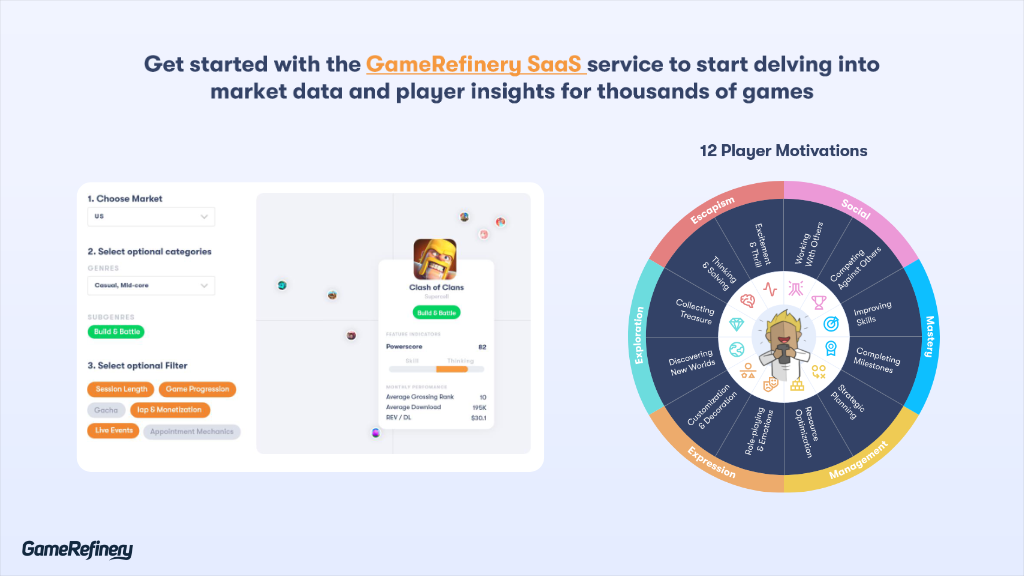
The report's methodology relies on GameRefinery's SaaS dashboard, aggregating download and revenue metrics across the US market for Q1 2021.
1 / 6
Ask AI about this report